A project can succeed technically but fail in adoption when organizational change is ignored. PMBOK® 8 puts change management responsibility directly on you.
1. Why Projects Are "Engines of Change" — and Organizations Are "Sources of Resistance"
Every project creates change — whether small (a new process) or large (an organization-wide digital transformation). PMBOK 8 states clearly:
PMBOK® 8, Section 1.3.1: "From a business perspective, a project's purpose is to move an organization from one state to another to achieve a specific objective. Before the project begins, an organization is in its current state. The desired result of the change driven by the project is described as the future state."
But people naturally resist change — especially when it affects their jobs, authority, or comfort zone. A PM who understands technology but not people will deliver outputs that nobody adopts.
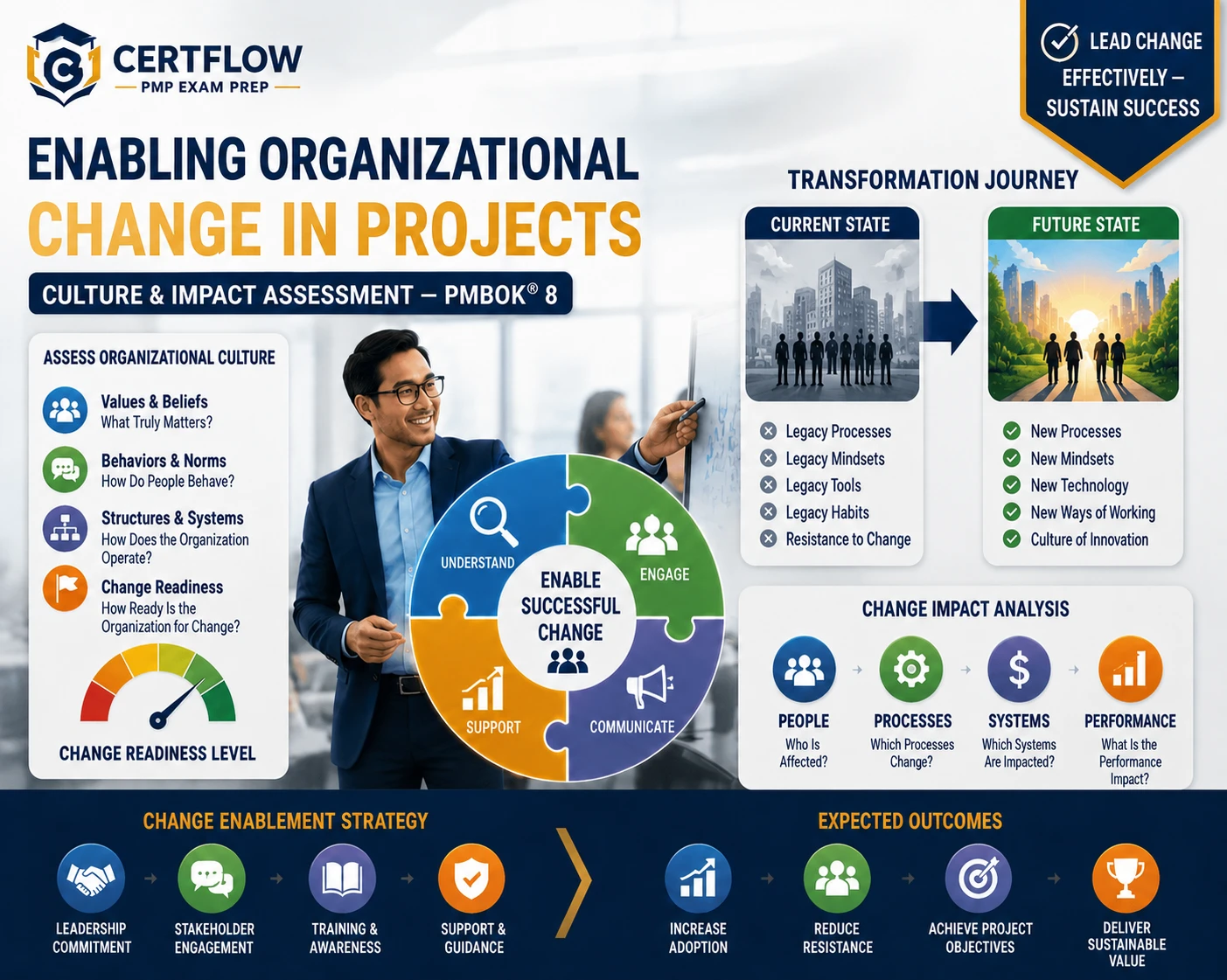
2. Current State → Transition State → Future State
PMBOK 8 describes the change process through 3 states:
State | Description | Example (ERP project) | Challenge |
|---|---|---|---|
Current State | Current organization — processes, tools, and culture in use | Excel + email + 10-year-old legacy systems | Familiar, comfortable, "works well enough" |
Transition State | Transition period — old and new coexist | Training, parallel run, new processes + old habits | Confusion, productivity dip, resistance peak |
Future State | Target organization — new processes, tools, and culture | Fully adopted ERP, new workflows, data-driven | Sustaining change, preventing regression |
PMBOK® 8: "For some projects, this shift may involve creating a transition state where several steps are taken in a structured manner to achieve the future state. The successful completion of a project results in the organization moving to the future state and achieving value."
The transition state is the most dangerous phase — productivity drops, confusion rises, and resistance peaks. PMs must plan for this phase, not just for the final deliverable.
3. The 2-Enabler Framework
Enabler | Core Question | Key activities |
|---|---|---|
Assess organizational culture | Does organizational culture support or hinder change? | Culture assessment, readiness evaluation, stakeholder analysis |
Evaluate impact and determine actions | How does change impact people? What actions are needed? | Impact analysis, change strategy, training, communication, support |
4. Assess Organizational Culture
Why Culture Matters More Than the Plan
Peter Drucker said: "Culture eats strategy for breakfast." PMBOK 8 confirms:
PMBOK® 8, Section 4.3.3: "A predictive approach may be a better fit in an organization with a culture of managing and directing. Adaptive approaches may fit better in an organizational culture that more easily embraces uncertainty while emphasizing self-managed teams, flexible thinking, and innovation."
Organizational culture influences EVERYTHING: development approach (predictive vs. adaptive), governance weight (formal vs. lightweight), communication style (hierarchical vs. flat), risk appetite (conservative vs. innovative), and change readiness (resistant vs. adaptive).
Enterprise Environmental Factors — Cultural Dimensions
PMBOK 8 lists organizational culture within EEFs: "vision, mission, values, beliefs, cultural norms, leadership styles, hierarchy and authority relationships, organizational styles, ethics, and codes of conduct."
6 Dimensions for Assessing Culture
Dimension | Assessment Questions | Impact on Change |
|---|---|---|
Risk tolerance | What level of risk does the organization accept? Innovation-focused or safety-first? | Low tolerance = more resistance to new approaches |
Decision-making | Top-down or collaborative? Fast or bureaucratic? | Top-down = easier mandate, harder buy-in |
Communication | Open or siloed? Formal or informal? | Siloed = harder to spread change message |
Power structures | Formal hierarchy or informal influence networks? | Informal influencers can make or break adoption |
Learning orientation | Growth mindset or fixed? Blame culture or learning? | Blame culture = fear of new + fear of failure |
Change history | Have past changes succeeded or failed? What is the trust level? | Failed past changes = "here we go again" cynicism |
Change Readiness Assessment
PMs should assess readiness BEFORE planning changes: stakeholders' awareness of the need for change, desire to participate, knowledge of how to change, ability to implement new behaviors, and reinforcement to sustain change.
5. Evaluate Impact of Change and Determine Actions
Impact Analysis — 6 Dimensions
Impact Area | Question | Example (ERP implementation) |
|---|---|---|
People | Who is affected? How do roles change? What about job security? | Finance team: new workflows, new skills needed. Some roles may become redundant. |
Processes | Which processes change? What training is needed? | Procurement process completely redesigned. Manual approvals → automated. |
Technology | What new tools are introduced? Data migration? Integration? | New ERP replaces 5 legacy systems. Data migration required. |
Structure | Does the org structure change? Reporting lines? | Centralized procurement replaces department-level purchasing. |
Culture | What mindset shift is required? | From "my spreadsheet" to "shared system." Transparency increases. |
Performance | Do KPIs change? Productivity dip during the transition? | Expect 20-30% productivity dip during first 3 months. |
5 Required Actions — Supporting Change
- Communication Strategy — WHY change is needed (not just WHAT is changing). PMBOK 8: "Communicating the project vision helps stakeholders understand how their work contributes to achieving that vision." People accept change when they understand why.
- Training and Capability Building — Skills gap analysis → training plan → hands-on practice. PMBOK 8: "Training plan — identify skill gaps and strategies to address them." People resist change when they lack confidence.
- Stakeholder Engagement — Identify champions (supporters) and resistors early. Engage resistors to understand concerns. PMBOK 8: "Stakeholder agreement with project objectives is achieved."
- Transition Planning — Plan for the transition state: parallel runs, phased rollout, support during the productivity dip. PMBOK 8: closure includes "validate readiness for transition to operations."
- Reinforcement — Post-go-live support, celebrate early wins, monitor adoption metrics, address regression. Change is not "done" at go-live — it takes months to become the new normal.
Resistance Management
Resistance Type | Source | Strategy |
|---|---|---|
Fear of unknown | Uncertainty about new roles, processes | Transparent communication, involve early, training |
Loss of control | Power/autonomy reduced by new system | Empower in new system, give ownership of aspects |
Competence anxiety | "I don't know how to use the new system" | Training, mentoring, safe practice environment |
Past trauma | Previous failed changes destroyed trust | Acknowledge past, demonstrate this is different, quick wins |
Political | Change threatens someone's position/influence | 1-on-1 engagement, find win-win, escalate if needed |
6. PM's Role vs. Change Manager's Role
Project Manager | Change Manager | |
|---|---|---|
Focus | Technical delivery — scope, schedule, cost, quality | People adoption — awareness, desire, knowledge, ability |
Deliverables | Products, services, results | Adoption plans, communication strategies, training, support |
Success metric | On-time, on-budget, quality met | Adoption rate, user satisfaction, behavior change sustained |
Timeline | Project lifecycle (start → close) | Beyond project — sustaining change post-close |
PMBOK 8 lists "change management specialists" as one of the roles performing facilitation and support functions. In many organizations, the PM and the Change Manager are separate people, but they must collaborate closely. The PM ensures the deliverable is ready; the Change Manager ensures the organization is ready.
When there is no dedicated Change Manager, the PM must assume BOTH roles — this is the reality in most mid-size and small projects.
7. Predictive vs. Adaptive Change Support
Aspect | Predictive | Adaptive |
|---|---|---|
Change timing | Big-bang at go-live — major transition event | Incremental — small changes each sprint |
User exposure | Users see product at UAT/go-live — late | Users see working increments each sprint — continuous |
Adoption approach | Formal training + launch + post-go-live support | Gradual adoption through demos, feedback, iterative improvement |
Resistance risk | Higher — large change all at once | Lower — small changes easier to absorb |
Feedback loop | Post-launch surveys, support tickets | Sprint reviews, continuous stakeholder feedback |
PMBOK® 8 Adaptive advantage: Incremental delivery reduces change shock. Users adapt gradually rather than facing a "big bang." Sprint reviews act as natural change management touchpoints — each demo builds familiarity and reduces fear of the unknown.
8. PMP Exam Tips
📍Tip 1 — Culture BEFORE approach: When the exam asks "which development approach for this organization?" — assess culture FIRST. Hierarchical + risk-averse = predictive. Innovative + flexible = adaptive. Culture drives approach, not the other way around.
📍Tip 2 — Resistance = symptom, not enemy: When the exam describes "a stakeholder resists the project" — the correct answer is "understand their concerns and address them," NOT "escalate" or "get the sponsor to force compliance." Resistance contains valuable information.
📍Tip 3 — Adoption ≠ Go-live: When the exam asks "what should the PM ensure for project success?" — the answer includes adoption/transition planning, NOT just technical delivery. A delivered system nobody uses = no value.
📍Tip 4 — Current → Transition → Future: When the exam describes "productivity drops after implementation" — this is a NORMAL transition dip, NOT project failure. The PM should have planned for it and communicated expectations.
9. Ten Situational Practice Questions
Question 1
You're assigned to implement a new project management methodology across a traditional, hierarchical organization that has used waterfall for 20 years. Leadership mandates agile adoption.
What should you do FIRST?
A. Start training everyone on Scrum immediately.
B. Assess the organizational culture to understand readiness for agile adoption — including risk tolerance, decision-making patterns, communication styles, and change history — then develop a tailored transition plan.
C. Implement agile in one pilot team and expand later.
D. Create a detailed agile rollout plan with milestones.
Question 2
After deploying a new CRM system, adoption is only 30% after 3 months. The system works perfectly. Training was provided. Users say: "The old system was fine. Why did we change?"
What was the PRIMARY failure?
A. The training was inadequate.
B. The WHY wasn't communicated effectively. Users don't understand the business need for change. Without understanding purpose, people default to familiar processes. The change communication focused on HOW (training) but not WHY (vision and value).
C. The system should have had more features users wanted.
D. The rollout should have been mandatory with consequences.
Question 3
A new department head joins mid-project and announces: "I'm reorganizing my team — 3 key project stakeholders will move to new roles." This impacts your project's communication plan, resource allocation, and stakeholder engagement.
What should you do?
A. Continue with the current plan — the project shouldn't change because of organizational restructuring.
B. Evaluate the impact of this organizational change on your project: assess how new roles affect stakeholder engagement, communication channels, resource availability, and decision authority — then update project plans accordingly.
C. Escalate to the sponsor to prevent the reorganization.
D. Add the organizational change to the risk register.
Question 4
During culture assessment, you discover that the organization has a strong "blame culture" — past project failures resulted in public reprimands. Your project requires innovative approaches with inherent risk of failure.
How should you address this?
A. Avoid innovative approaches and use proven methods only.
B. Acknowledge the cultural reality and create psychological safety within your project: establish team agreements that normalize experimentation, celebrate learning from failures, protect team from blame, and demonstrate that innovation requires acceptable risk-taking.
C. Escalate to leadership to change the organizational culture.
D. Include extra contingency for potential failures.
Question 5
Your automation project will eliminate 15 manual data entry positions. The affected employees are aware and actively resisting — delaying testing, providing negative feedback, and discouraging adoption.
What is the MOST effective approach?
A. Escalate to HR for disciplinary action.
B. Acknowledge their concerns empathetically, involve them in transition planning, explore reskilling opportunities, and work with HR to develop a fair transition plan — their resistance is rational given the threat to their jobs.
C. Proceed without their input — they're biased against the project.
D. Offer incentives for cooperation.
Question 6
Post-implementation, productivity dropped 25% — as expected during transition. But after 3 months, productivity hasn't recovered. Management is concerned.
What should you investigate?
A. The system has technical issues slowing users down.
B. Assess multiple factors: Is the system meeting user needs? Was training sufficient? Are new processes properly designed? Are users receiving ongoing support? Has the organizational culture reverted to old behaviors? The prolonged dip may indicate inadequate transition support, not system failure.
C. Users need more training — schedule refresher sessions.
D. The productivity target was unrealistic — adjust expectations.
Question 7
Your project sponsor wants to implement a major process change across 5 departments simultaneously ("big bang"). You know from culture assessment that 3 departments are ready but 2 are highly resistant.
What should you recommend?
A. Proceed with big bang as sponsor directs — they have authority.
B. Present the culture assessment data and recommend phased rollout — start with the 3 ready departments (building success stories and momentum), then expand to the 2 resistant departments with targeted change management. Data-driven recommendation with reduced risk.
C. Wait until all 5 departments are ready.
D. Implement in all 5 but with extra training for the resistant ones.
Question 8
The organization just completed a painful ERP implementation last year that was poorly managed — late, over budget, and users felt ignored. Now you're starting a new digital transformation project. Team members say: "Here we go again."
How should you address this change history?
A. Ignore the past — this is a different project.
B. Acknowledge the past experience openly, explain what will be different this time (early user involvement, iterative delivery, transparent communication), demonstrate quick wins early to rebuild trust, and involve skeptics in the planning process.
C. Hire a different team so there's no baggage from the previous project.
D. Get the sponsor to reassure everyone this will be better.
Question 9
You discover that the real decision-makers in the organization are not the people on the org chart. An informal network of senior engineers has significant influence over whether new tools are adopted or rejected.
How should this affect your change strategy?
A. Focus on the formal hierarchy — informal networks aren't reliable.
B. Identify and engage these informal influencers as change champions. Their endorsement can accelerate adoption far more effectively than top-down mandates. Include them in pilots, seek their input on design decisions, and leverage their influence networks.
C. Ask management to direct the engineers to cooperate.
D. This is a political issue — stay neutral.
Question 10
Your project successfully delivered a new workflow system. At closure, the sponsor asks: "How do we ensure people don't revert to old habits?"
What should you recommend for sustained change?
A. The project is closing — sustainment is an operations responsibility.
B. Recommend a post-implementation sustainment plan: monitoring adoption metrics, ongoing support resources, regular check-ins with users, refresher training schedule, recognition for champions, and escalation path for regression. Transition this plan to operations with clear ownership before project closure.
C. Make the old systems unavailable so users have no choice.
D. Schedule a follow-up project in 6 months to address any issues.
10. Answer Key
Question 1
Answer: B — ECO: "Assess organizational culture." PMBOK 8: culture assessment must precede approach selection. A 20-year waterfall organization needs understanding BEFORE action. Pilot (C) is a good tactic but culture assessment comes first to inform the entire strategy.
Question 2
Answer: B — PMBOK 8: "The vision and objectives are communicated throughout the project and are essential for understanding." People adopt change when they understand WHY. "The old system was fine" signals they don't see the value in changing. Communication of purpose failed, not training.
Question 3
Answer: B — ECO: "Evaluate the impact of organizational change on the project and determine required actions." Organizational changes outside the project directly impact it. The PM must assess and adapt — not ignore (A) or try to prevent (C). Risk register (D) is one action but not sufficient alone.
Question 4
Answer: B — PMBOK 8 Build an Empowered Culture: "Project teams have the flexibility to customize their organizational frameworks to optimally achieve the intended project goal within such new cultures." PM can't change org culture (C) but CAN create a micro-culture within the project. Avoiding innovation (A) doesn't solve the underlying issue.
Question 5
Answer: B — Resistance here is RATIONAL — their jobs are at risk. PMBOK 8: "Supporting people through change and helping to address obstacles." The PM should address the legitimate concern (job loss), not punish the response. Involving them in transition shows respect and may convert resistors into advocates for the new system.
Question 6
Answer: B — Transition dip is expected, but prolonged dip signals transition support gaps. PMBOK 8's holistic view: investigate ALL dimensions — technology, training, process, support, AND culture. A single-cause assumption (A, C, D) may miss the real issue.
Question 7
Answer: B — ECO: "Assess organizational culture" → use assessment to INFORM decisions. A phased approach leverages early adopters as champions, reduces risk, and builds evidence for the resistant departments. Extra training alone (D) doesn't address root causes of resistance.
Question 8
Answer: B — Change history is a critical cultural dimension. Past trauma creates cynicism — "here we go again." The PM must acknowledge it (not dismiss), demonstrate credibility through actions (quick wins), and involve skeptics rather than exclude them. Sponsor reassurance (D) alone is insufficient without PM follow-through.
Question 9
Answer: B — Culture assessment dimension: "Power structures — formal hierarchy vs informal influence networks." PMBOK 8's Political Awareness: "Recognition of formal and informal power relationships." Informal influencers can be the PM's most powerful allies — or most dangerous opponents. Engage them proactively.
Question 10
Answer: B — PMBOK 8 closure: "Validate readiness for transition to operations." Sustainment must be PLANNED and TRANSFERRED — not left to chance. Simply removing old systems (C) forces compliance but not genuine adoption. The PM should ensure sustainment is someone's explicit responsibility post-close.
11. Conclusion
Supporting Organizational Change connects the project to the human reality — because ultimately, a project succeeds when the ORGANIZATION changes, not just when the DELIVERABLE is handed over. Three key takeaways:
1. Culture eats strategy — assess BEFORE you plan — Organizational culture determines how a project is received. Risk tolerance, decision-making style, communication patterns, change history — all influence approach, governance, and adoption. A PM who skips culture assessment is planning in the dark.
2. The transition state is the most dangerous phase — Current → Transition → Future. A productivity DIP during transition is NORMAL — but it must be planned for, communicated, and supported. A PM who doesn't plan for the transition state leaves the organization "falling" mid-change without a safety net.
3. Adoption > Delivery — Delivered system + zero adoption = zero value. The PM must think beyond go-live: WHY communication (not just HOW training), stakeholder engagement (especially resistors), quick wins for momentum, and a sustainment plan transferred to operations. The project closes, but the change journey continues.
PMBOK® 8, Section 1.3.1: "The successful completion of a project results in the organization moving to the future state and achieving value for the organization, as defined by key stakeholders." — Value is only realized when the organization is TRULY in the future state — not just when the deliverable is handed over.
Frequently Asked Questions (FAQ)
How do Kotter's 8 Steps and the ADKAR model apply in a project context?
Kotter's 8 Steps: create urgency → build coalition → develop vision → communicate → empower → generate wins → sustain acceleration → institutionalize. Best suited for large-scale organizational change. ADKAR: Awareness → Desire → Knowledge → Ability → Reinforcement. Best suited for tracking individual change readiness. PMs can combine both: Kotter for organizational strategy, ADKAR for individual tracking.
How does a PM handle resistance to change according to PMBOK 8?
PMBOK 8 approach: (1) Understand root cause — fear of job loss? lack of skills? past bad experiences? (2) Engage resistors early — include them in planning; people resist what is done TO them, not what they help create. (3) Communicate WIIFM (What's In It For Me) clearly. (4) Provide training and support. (5) Celebrate early adopters — positive reinforcement. Avoid: dismissing resistance, using pure authority.
How does organizational culture affect project success?
Culture determines: how decisions are made, how conflict is handled, how risk is perceived, how change is accepted. A culture mismatch = project friction. PMs need to assess culture before tailoring their approach: hierarchical culture requires more formal governance; an innovative culture embraces agile more readily. Understanding culture is not a "nice to have" — it is essential project intelligence.
Now that you understand organizational change management, it's time to put it into practice with real exam questions.
Next article: Evaluating the Business Environment: PESTLE & EEFs according to PMBOK 8
Governance and the business environment domain according to PMBOK 8
Try Free PMP Practice Questions →
Official References: