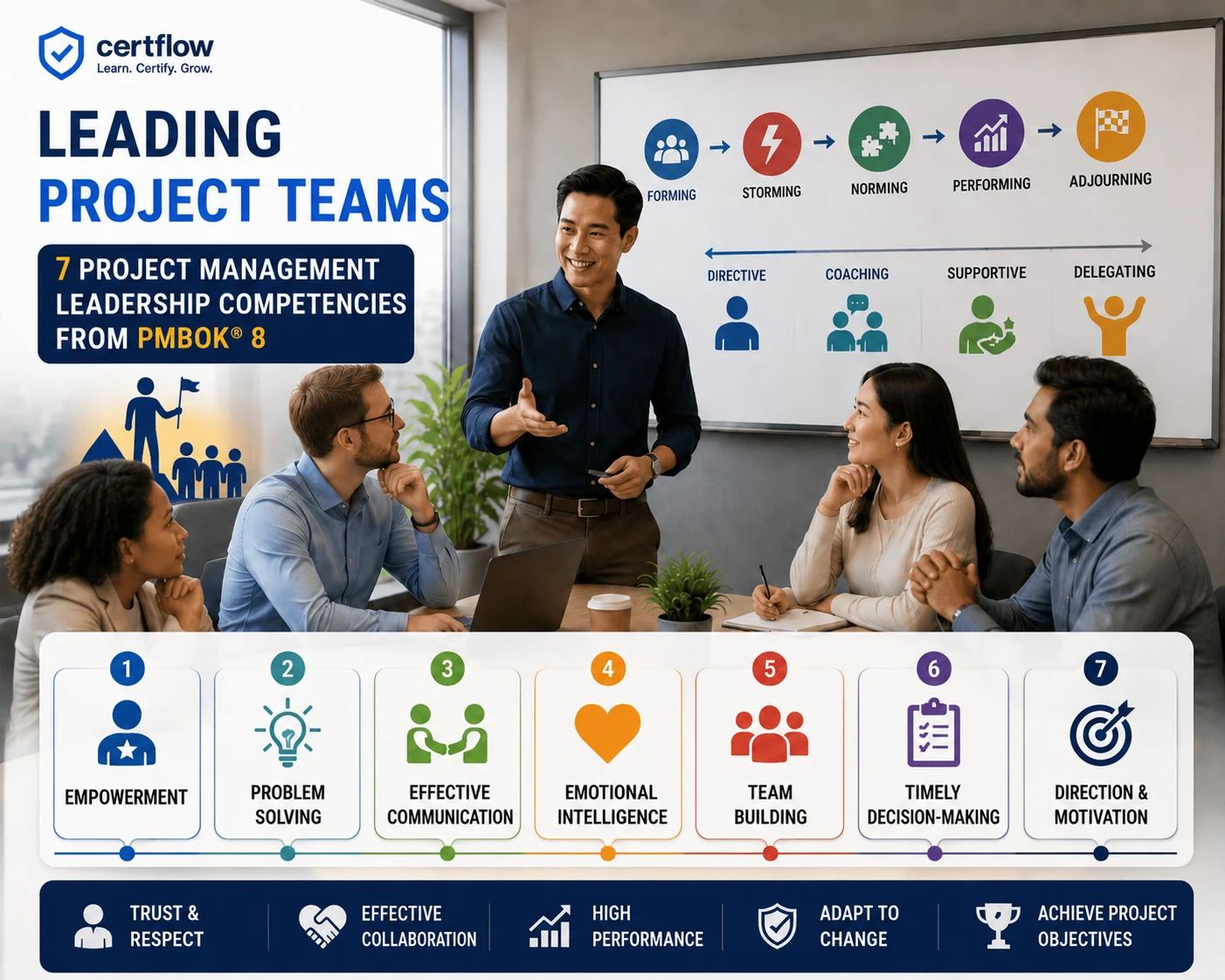
PMBOK 8 redefines the PM role from authority to servant leader. These 7 leadership competencies are the foundation for building high-performing project teams.
1. Leadership vs. Management — The PM Needs Both
Many PMs excel at managing schedule, budget, and scope — yet struggle when the team loses motivation, a senior developer considers leaving, or two groups refuse to collaborate. The problem is: they manage well but haven't yet learned to lead.
PMBOK 8 draws a clear distinction:
Management Activities | Leadership Activities | |
|---|---|---|
Focus | Processes, plans, measurement | People, inspiration, empowerment |
Question asked | "Is this task done?" | "What do you need to succeed?" |
Outcome | Efficiency — doing things right | Effectiveness — doing the right things |
PMBOK 8 | "Focus on the means of meeting objectives" | "Focus on people — influencing, motivating, listening, enabling" |
PMBOK® 8, Section 5 — Leadership: "Project management is more than just working with numbers, templates, charts, graphs, and computing systems. A common denominator in all projects is people. People can be counted, but they are not numbers."
This is why the ECO designates "Lead the Project Team" as the most comprehensive task in the People Domain — with 7 enablers, more than any other task.
2. The 7-Enabler Team Leadership Framework
Group | Enabler | Core Question |
|---|---|---|
Foundation | Establish expectations at team level | Does the team know the "rules of the game"? |
Foundation | Establish clear roles and responsibilities | Who does what, and who is accountable? |
Empowerment | Empower the team | Does the team have decision-making authority within their scope? |
Support | Solve problems | How does the PM help the team resolve issues? |
Support | Represent the voice of the team | Does the PM advocate for and represent the team? |
Diversity | Support varied experiences, skills, perspectives | Is diversity being leveraged as an advantage? |
Strategic | Determine appropriate leadership style | Does the PM adapt their leadership approach to the context? |
Let's explore each group in depth.
3. Setting Clear Expectations and Roles
Establish Expectations — Team Charter and Ground Rules
Every team needs to know the "rules of the game" from the very start. PMBOK 8 identifies the Team Charter as the primary tool, covering: team values, communication guidelines, decision-making criteria and processes, conflict resolution processes, meeting guidelines, and team agreements.
Most importantly: the team must participate in building the team charter — the PM does not impose it.
PMBOK® 8, Section 5: "Discussing areas such as codes of conduct, communication, decision-making, and meeting etiquette allows team members to discover values that are important to one another." — The process of discussing ground rules is itself a team-building activity.
Establish Clear Roles — RACI Matrix
When no one knows "who is accountable," everyone assumes it's not their job — or worse, multiple people work on the same task without knowing it.
PMBOK 8 identifies the RACI Matrix as the primary tool:
Symbol | Role | Meaning | Rule |
|---|---|---|---|
R | Responsible | The person who does the work | Can be multiple people |
A | Accountable | The person ultimately answerable for the outcome | Only ONE person |
C | Consulted | Those whose input is sought before a decision | Two-way communication |
I | Informed | Those notified after a decision is made | One-way communication |
PMBOK® 8: "A RACI matrix is a useful tool to ensure the clear assignment of roles... ensures that there is only one person accountable for any one task to avoid confusion about who is ultimately in charge."
4. Empowering the Team — Empower, Not Micromanage
This is the enabler many PMs find most difficult — because empowerment requires releasing control, which runs counter to the instincts of someone accustomed to managing.
PMBOK® 8, Section 2.6.2.4.2: "Project team members who feel empowered to make decisions about the way they work and about specific details in the deliverables being produced — even under limited range — perform better and have a higher degree of satisfaction than those who are micromanaged."
Daniel Pink — 3 Elements of Intrinsic Motivation
PMBOK 8 cites Daniel Pink's model of intrinsic motivation — the foundation of empowerment:
Element | PMBOK 8 Definition | How the PM Applies It |
|---|---|---|
Autonomy | "The desire to direct one's own life... determining how, where, and when to accomplish work" | Let the team decide how to execute, offer flexible hours and remote work options |
Mastery | "The desire to do excellent work, learn, and achieve goals" | Provide learning opportunities, mentoring, stretch assignments, career development |
Purpose | "Knowing the project vision and how work contributes to achieving that vision" | Connect daily work to the project vision, explain WHY not just WHAT |
Servant Leadership — The PM Serves the Team
PMBOK® 8, Section 5: "Servant leadership is the practice of leading the team by focusing on understanding and addressing the needs and development of team members in order to enable the highest possible team performance."
A servant leader doesn't ask "what has the team done for the project?" — they ask "what can I do to help the team succeed?" — removing impediments, providing resources, creating a safe environment, coaching, and mentoring.
5. Solving Problems and Representing the Team's Voice
Solve Problems — Tools from PMBOK 8
Six Thinking Hats® — a group brainstorming technique that analyzes a problem from 6 different perspectives:
Hat | Perspective | Question Asked |
|---|---|---|
Blue | Overview, facilitator | "What problem are we solving?" |
White | Data, facts | "What do we know? What data are we missing?" |
Red | Emotions, intuition | "What is everyone's gut feeling?" |
Black | Critique, risks | "What could go wrong? What are the risks?" |
Yellow | Optimism, benefits | "What are the opportunities and benefits?" |
Green | Creativity, alternatives | "Is there another way to approach this?" |
Additionally, PMBOK 8 emphasizes Critical Thinking: "Recognize, analyze, and resolve problems; identify bias, unstated assumptions, and values."
On decision-making, PMBOK 8 cautions: "Decisions can be made unilaterally. This has the advantage of being fast but is prone to errors. Unilateral decision-making can also demotivate people who are impacted by the decision." — The PM should involve the team in decisions whenever possible.
Represent the Voice of the Team
The PM is the bridge between the team and external stakeholders. Specifically: shield the team from unreasonable pressure from the sponsor or client. Honestly communicate the team's concerns and recommendations to management. Advocate for the resources the team needs. Ensure the team receives recognition for their achievements — not the PM taking the credit.
PMBOK® 8, Section 2.6.2.4.2: "Project team members who are recognized for the work they put in and the performance that they achieve are more likely to continue to perform well. Even the simple act of showing appreciation reinforces positive team behaviors."
6. Supporting Diversity and Choosing the Right Leadership Style
Support Diversity
PMBOK 8 emphasizes: "A diverse project team can enrich the project environment to create a more inclusive space by bringing together different perspectives." The PM needs to: create psychological safety so everyone feels confident contributing, leverage diversity as an advantage (more perspectives = better solutions), and recognize and address bias within the team.
On cultural awareness, PMBOK 8 defines it as: "Understanding of the differences among individuals, groups, and organizations and adapting the project's communication strategy in the context of these differences."
Determine Appropriate Leadership Style
PMBOK 8 makes it clear: there is no one-size-fits-all approach. The PM must flexibly adapt their style to the situation.
Leadership Style | Description | Best Suited When |
|---|---|---|
Servant Leadership | PM serves the team — removes barriers, enables performance | Agile teams, mature teams, innovation projects |
Centralized | Decision-making concentrated in the PM or a small group | Predictive projects, new teams, high-compliance environments |
Distributed | Decision-making distributed to the team, self-organizing | Adaptive/agile, experienced teams, creative projects |
Situational | Adapts to team maturity: Directive → Coaching → Supporting → Delegating | All contexts — PM adapts to the specific situation |
Transformational | Inspires performance beyond expectations, develops potential | Change initiatives, turnaround projects |
PMBOK® 8: "Leadership is not exclusive to any specific role; in different moments of the project, a team member, stakeholder, or professional may take the leadership seat. Leadership is different from authority — leadership is about inspiring and motivating others through leading by example."
7. Tuckman Ladder — Understanding Where Your Team Is to Lead Effectively
PMBOK 8 references the Tuckman Ladder as a core tool in Lead the Team. The PM needs to recognize which stage the team is in and adjust their approach accordingly:
Stage | Characteristics (PMBOK 8) | What the PM Should Do |
|---|---|---|
Forming | "Team members meet and learn about the project. Members tend to be independent and not as open." | Directive: set expectations, clarify roles, facilitate introductions |
Storming | "Team begins to address project work. If not collaborative, environment can become counterproductive." | Coaching: guide through disagreements, reinforce ground rules |
Norming | "Team begins to work together and adjust habits. Members learn to trust one another." | Supporting: step back gradually, encourage collaboration |
Performing | "Teams function as a well-organized unit." | Delegating: empower team, focus on strategic support |
Adjourning | Project complete, team disperses, celebrate achievements | Recognize, celebrate, facilitate knowledge transfer |
PMBOK® 8, Section 5: "Although it is common for these stages to occur in order, it is not uncommon for a team to get stuck in a particular stage or regress to an earlier stage. Projects with team members who worked together in the past may also skip a stage."
Pay special attention: when new members join or existing members leave, the team often regresses to an earlier stage (typically Storming or Forming). The PM must recognize these signs and adjust their approach.
8. High-Performing Teams — 9 Characteristics from PMBOK 8
PMBOK 8 (Section 2.6.2.4.2) identifies 9 characteristics of a high-performing project team — this is the ultimate goal of every Lead the Team activity:
Characteristic | Meaning |
|---|---|
Open communication | A safe environment for brainstorming, problem-solving, and trust |
Shared understanding | Shared clarity on purpose, goals, and how to achieve them |
Shared ownership | Greater ownership leads to higher performance |
Trust | Trust in one another → willingness to go the extra mile |
Collaboration | Working together rather than in isolation → diverse ideas, better outcomes |
Adaptability | Ability to adapt to changing environments and circumstances |
Resilience | Quick recovery from issues and failures |
Empowerment | Authority to make decisions → higher performance + satisfaction |
Recognition | Being recognized → continued high performance |
You can use this list as a team health check: which characteristics is your team currently missing? That's exactly where you need to invest your energy.
9. PMP Exam Tips on Leadership
📍Tip 1 — Servant Leadership is the default: PMI favors servant leadership. When a question describes a PM who "supports the team," "removes impediments," or "enables success" — that's servant leadership. Reserve directive approaches for scenarios that explicitly call for them (emergency, new team, compliance environment).
📍Tip 2 — RACI: only ONE Accountable: When a question describes "confusion about who is in charge" or "multiple people think they're accountable" — the answer usually involves reviewing or establishing the RACI matrix. Remember: multiple people can be Responsible, but only ONE person can be Accountable.
📍Tip 3 — Team composition changes = Tuckman regression: When a question describes "a key member leaves" or "new members join" and asks "what is the PM's MAIN concern?" — the answer is usually "the team may regress to an earlier Tuckman stage," NOT "find a replacement" or "update the schedule."
📍Tip 4 — Empower, don't do: When a junior team member is struggling — the best answer is "mentor/coach them," NOT "do the work yourself" or "reassign the task." PMI wants the PM to develop the team's capabilities, not bypass the team.
10. Ten Scenario-Based Practice Questions
Question 1
You've just been assigned to lead a newly formed project team. Members come from four departments and have never worked together. During the first meeting, everyone is polite but reserved — no one shares ideas or challenges anything.
What stage is the team in, and what should you do?
A. Storming — Use coaching to help them work through disagreements.
B. Forming — Use a directive approach: set clear expectations, establish ground rules, clarify roles, and facilitate introductions.
C. Norming — Step back and let the team self-organize since they seem to be getting along.
D. Performing — Delegate and let them manage their own work.
Question 2
Your team has been performing well for 3 months. You learn that 2 key members are being reassigned and 3 new members will join next week. The team is anxious.
What should you be MOST concerned about?
A. The new members may lack the right technical skills.
B. The team may regress to an earlier Tuckman stage and lose its high performance.
C. The schedule needs rebaselining for the transition.
D. The departing members must complete knowledge transfer.
Question 3
A senior developer consistently dominates sprint planning discussions, dismissing junior members' estimates as "unrealistic." Two juniors have stopped participating. The senior delivers excellent code.
What should you do?
A. Accept the situation since the senior has the most experience.
B. Have a private conversation about the impact of their behavior, then use facilitation techniques (like Planning Poker) that ensure equal participation.
C. Separate the senior from the juniors.
D. Ask the juniors to be more assertive.
Question 4
Your team proposes a new approach that could save 2 weeks but deviates from organizational standard procedures. The project has strict regulatory compliance requirements.
How should you respond?
A. Approve since the team is empowered to make decisions.
B. Reject because deviating from standards is too risky.
C. Acknowledge the initiative, then collaboratively evaluate regulatory implications before making a joint decision.
D. Escalate to the sponsor.
Question 5
The sponsor frequently contacts your team members directly, assigning tasks that conflict with the project plan. Team members are confused about priorities and velocity has dropped.
What should you do?
A. Ask team members to redirect the sponsor to you.
B. Meet with the sponsor to discuss the impact, agree on a communication protocol, and advocate for the team's capacity constraints.
C. Adjust the plan to include the sponsor's tasks.
D. Document the scope creep for the steering committee.
Question 6
A team member privately tells you they're overwhelmed and considering leaving. They've been working 60-hour weeks for a month. They are a critical resource with specialized skills.
What should you do FIRST?
A. Reassign some tasks immediately to reduce their workload.
B. Listen actively, acknowledge their contribution, and collaboratively develop a sustainable workload plan that addresses both their well-being and project needs.
C. Escalate to find a backup resource in case they leave.
D. Ask them to push through the current phase.
Question 7
You manage a distributed team across 3 time zones. The US team makes decisions in morning meetings that the India team consistently misses. India has expressed frustration that they're "always informed after the fact."
What should you do?
A. Record US meetings and share with India.
B. Move all decisions to async tools.
C. Redesign the meeting schedule and decision process to ensure equitable participation across all zones, combining synchronous overlap windows with async tools.
D. Ask India to adjust their schedule.
Question 8
The project methodology hasn't been decided. Your team has a mix of experienced agile practitioners and members who've only worked in waterfall. The project involves evolving requirements for a new customer portal.
How should you determine the approach?
A. Use agile since requirements are evolving — waterfall practitioners will adapt.
B. Use waterfall since some members aren't familiar with agile.
C. Assess project characteristics, team capabilities, and org context, then collaboratively design a hybrid approach that leverages both groups' strengths while providing training for gaps.
D. Let the team vote on methodology.
Question 9
Your project's RACI matrix shows the quality inspector as "Consulted" for design reviews. However, designs are consistently approved without consulting them. Last week, a design failed safety standards, requiring expensive rework.
What is the ROOT CAUSE?
A. The design team is incompetent.
B. The RACI matrix is clear but not being followed — reinforce adherence and implement process checks to ensure Consulted parties are engaged before decisions are finalized.
C. The quality inspector should be "Accountable" instead of "Consulted."
D. Add a formal sign-off gate.
Question 10
Your team just completed a challenging sprint delivering a key milestone ahead of schedule. During the sprint review, the sponsor acknowledges delivery but immediately starts discussing the next aggressive timeline. The team looks deflated.
What should you do?
A. Begin planning the next sprint to maintain momentum.
B. Thank the sponsor, then ensure the team receives proper recognition before transitioning to the next phase.
C. Ask the sponsor to delay the next discussion to give the team a break.
D. Let the team celebrate on their own time.
Answer Key
Question 1: Answer: B
— Politeness without engagement is classic Forming. PMBOK 8: "Team members tend to be independent and not as open in this phase." The PM should be more directive: set expectations, create the team charter, clarify roles, and build familiarity.
Question 2: Answer: B
— PMBOK 8: "It is not uncommon for a team to regress to an earlier stage." When composition changes significantly, teams often revert to Forming or Storming. While skills (A), schedule (C), and knowledge transfer (D) matter, the team dynamics regression is the most fundamental concern.
Question 3: Answer: B
— The ECO requires PMs to "support the team's varied experiences, skills, and perspectives." PMBOK 8 emphasizes that empowered teams where all members contribute perform better. Address the behavior privately; use structured techniques to equalize participation. Telling juniors to "be more assertive" (D) blames the victims.
Question 4: Answer: C
— Empowerment works "even under limited range" (PMBOK 8). In regulated environments, the PM should recognize initiative (motivation) but ensure compliance (accountability). Collaborative evaluation honors both. Flat rejection (B) kills initiative.
Question 5: Answer: B
— The ECO requires PMs to "represent the voice of the team." The PM must directly and professionally engage the sponsor — not avoid it (A), passively accommodate (C), or defer to a committee (D). Advocate for the team with data showing the impact.
Question 6: Answer: B
— Servant leadership: focus on "understanding and addressing the needs of team members." FIRST listen and understand — don't reassign without understanding (A), escalate prematurely (C), or ignore well-being (D). PMBOK 8 now explicitly addresses employee well-being and quiet quitting.
Question 7: Answer: C
— The ECO requires supporting "varied experiences, skills, and perspectives." PMBOK 8 emphasizes cultural awareness and adapting communication. Recording (A) makes India passive. Full async (B) loses real-time benefits. Asking India to adjust (D) is inequitable. A balanced approach ensures all voices are equal.
Question 8: Answer: C
— PMBOK 8: "Leaders should be versatile and able to switch between different leadership styles." The ECO requires "determine an appropriate leadership style" and "support varied experiences." A hybrid approach considers BOTH project needs AND team capabilities. Voting (D) doesn't account for project requirements.
Question 9: Answer: B
— The RACI correctly identified the role — the problem is process adherence. PMBOK 8: establishing roles isn't enough; the PM must ensure they're exercised. The ECO's "establish clear roles and responsibilities" includes making sure those roles are actually followed. A sign-off gate (D) could help but the root cause is the process gap.
Question 10: Answer: B
— PMBOK 8: "Project team members who are recognized for the work they put in are more likely to continue to perform well. Even the simple act of showing appreciation reinforces positive team behaviors." The PM should ensure recognition happens AND respect the sponsor's needs — it's not either/or. "Represent the voice of the team" includes ensuring they're acknowledged.
11. Summary
Leading the Project Team is the most comprehensive task in the People Domain — and the skill that defines a PM's career. Three key takeaways:
- Lead people, manage processes — Management keeps the project on track. Leadership keeps people wanting to stay on that track. Both are necessary, but many PMs lean too far toward management. PMBOK 8 reminds us: "A common denominator in all projects is people."
- Style must match context — Servant leadership for mature teams. Directive for new teams. Coaching during Storming. Delegating during Performing. A PM who is rigid about one style will fail across diverse situations. Situational leadership is the most important meta-skill.
- Empower > Control — Micromanagement creates compliance; empowerment creates commitment. Teams granted autonomy (Autonomy + Mastery + Purpose) perform better AND experience greater satisfaction. The PM should ask "what can I do for my team?" rather than "what has my team done for me?"
PMBOK® 8, Section 3.6: "Leadership is different from authority. Authority is the position of control given to individuals within the organization, whereas leadership is about inspiring and motivating others through leading by example."
Frequently Asked Questions (FAQ)
How is servant leadership in PMBOK 8 different from traditional leadership?
Traditional leadership: the PM holds authority, makes decisions, and the team follows. Servant leadership (PMBOK 8): the PM serves the team — removing impediments, providing resources, and shielding the team from distractions. The PM remains responsible for outcomes but empowers the team to decide HOW to achieve them. This approach is especially suited to agile teams and knowledge workers.
What role does Emotional Intelligence (EI/EQ) play in project management?
EI comprises 4 components: Self-awareness (recognizing your own emotions), Self-management (controlling your reactions), Social awareness (reading others' emotions), and Relationship management (building and maintaining relationships). A PM with high EI handles conflict more effectively, builds trust faster, and navigates stakeholder dynamics more skillfully.
What does Tuckman's team development model mean for a PM?
Tuckman describes teams progressing through 4 stages: Forming (new, still reserved), Storming (conflict and power struggles), Norming (finding a working rhythm), and Performing (high-performance, self-directed). The PM needs to recognize which stage the team is in and apply the right leadership style: directive during Forming/Storming, coaching during Norming, and delegating during Performing.
Now that you understand leading the project team, it's time to put it into practice with real exam questions.
Next article: Stakeholder Engagement: 6 Strategic Steps according to PMBOK 8
Project team management: Tuckman model and conflict resolution according to PMP
Building a shared vision and project leadership according to PMBOK 8
Try Free PMP Practice Questions →
Official References: