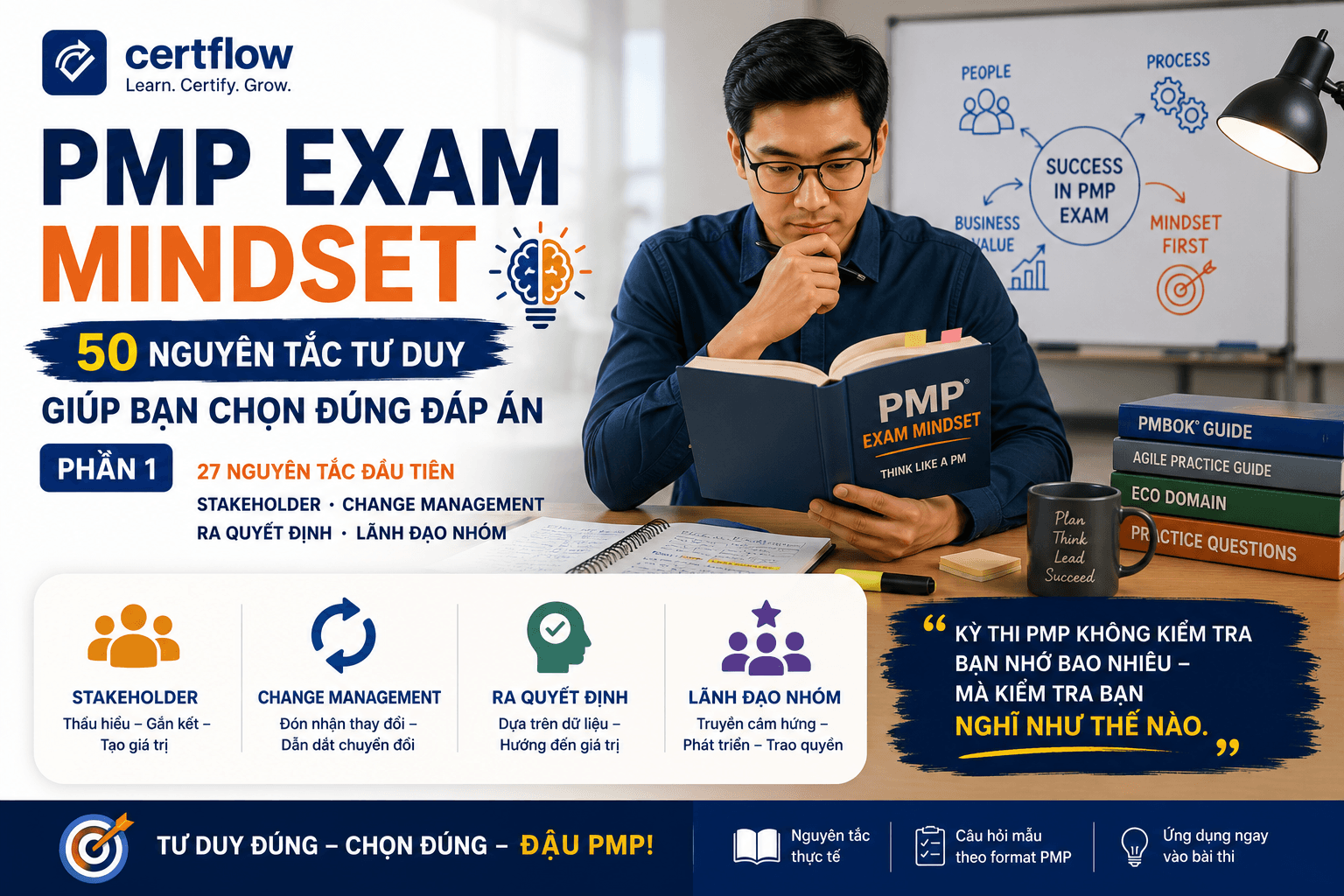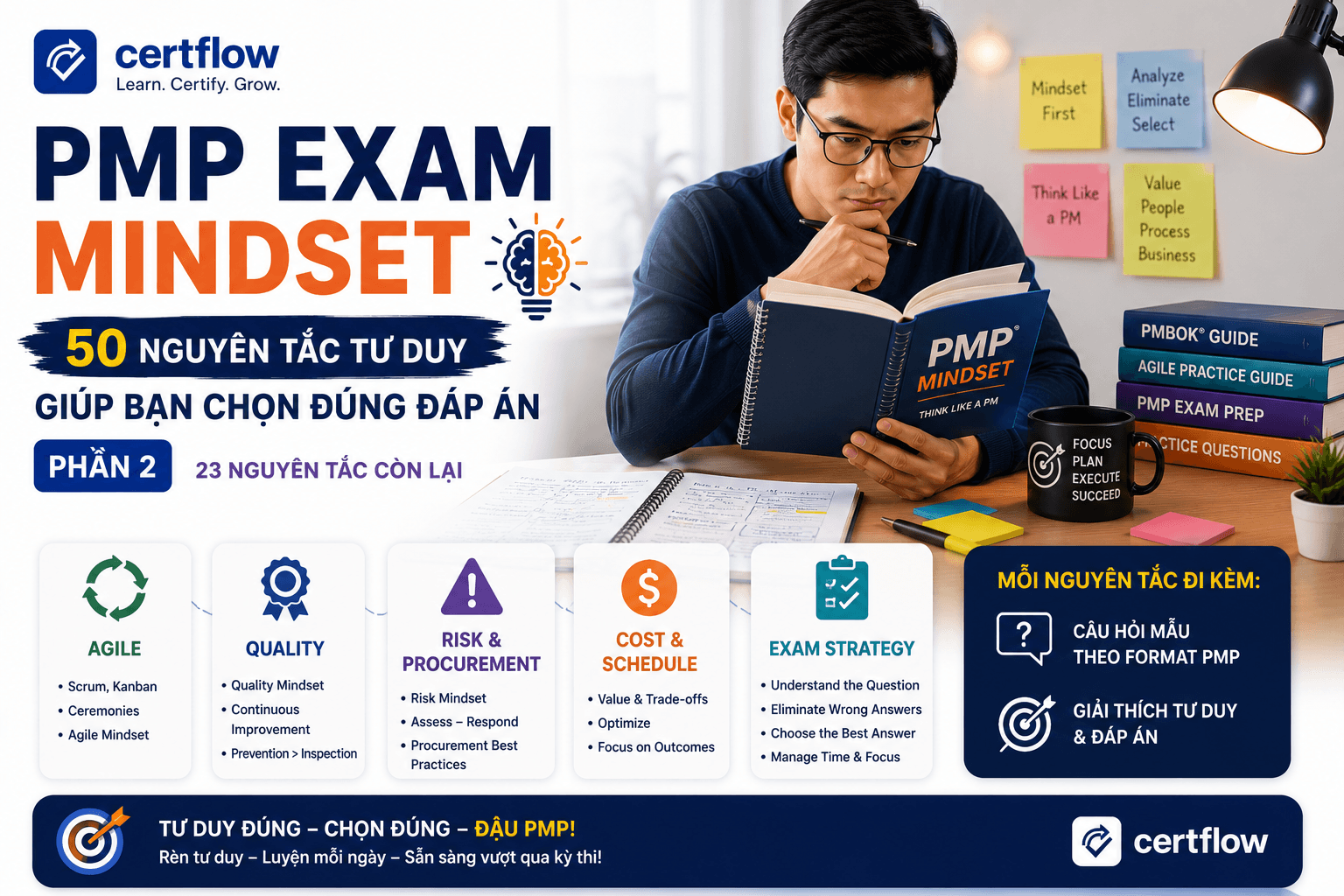
Tiếp nối phần 1, 25 nguyên tắc cuối tập trung vào agile mindset, quản lý thay đổi và tư duy cải tiến liên tục. Đây là tư duy PM thế hệ mới theo PMBOK 8.
Trong Phần 1, chúng ta đã đi qua 27 nguyên tắc đầu tiên — nền tảng tư duy về Stakeholder, Change Management, Ra quyết định và Lãnh đạo nhóm. Nếu bạn chưa đọc Phần 1, mình khuyên bạn quay lại đọc trước vì các nguyên tắc được xây dựng có hệ thống.
Phần 2 này đi vào 23 nguyên tắc còn lại, bao gồm những chủ đề mà nhiều thí sinh hay bị "vấp": Agile specifics, Quality, Risk & Procurement, Cost & Schedule, và đặc biệt — 4 chiến lược làm bài thi giúp bạn loại trừ đáp án sai khi đối mặt với câu hỏi "không biết chọn gì."
Mỗi nguyên tắc vẫn đi kèm câu hỏi mẫu theo đúng format đề thi PMP. Hãy thử trả lời trước khi đọc đáp án — đó là cách tốt nhất để rèn phản xạ.
V. Nguyên tắc Agile cụ thể (Nguyên tắc 28–31)
Với khoảng 50–60% bài thi PMP liên quan đến Agile/Hybrid, bạn cần nắm vững các nguyên tắc này. Điểm mấu chốt: trong Agile, vai trò và quyền hạn được phân chia rất rõ ràng.
Nguyên tắc 28: Chỉ Product Owner mới quản lý Product Backlog
Product Owner sở hữu và ưu tiên hóa Product Backlog. PM (hoặc Scrum Master) không được tự ý thêm, bớt hay sắp xếp lại các hạng mục trong backlog.
Exam Question:
The project manager identifies a technical debt item that could cause significant issues in future sprints. What should the project manager do?
A. Add the technical debt item directly to the top of the Product Backlog
B. Discuss the technical debt with the Product Owner and recommend it for inclusion and prioritization in the backlog
C. Create a separate backlog for technical items managed by the development team
D. Address the technical debt during the current sprint without informing the Product Owner
Answer: B — PM có thể recommend, nhưng chỉ Product Owner mới có quyền thêm và ưu tiên hóa items trong Product Backlog.
Nguyên tắc 29: Ưu tiên colocation và giao tiếp trực tiếp
Giao tiếp face-to-face là hiệu quả nhất. Các đội Agile sử dụng information radiators (bảng Kanban, burndown chart) để tăng sự minh bạch.
Exam Question:
An agile team is distributed across three time zones. The team is experiencing frequent miscommunication and delays. What should the project manager do to improve collaboration?
A. Increase the number of written status reports
B. Implement video conferencing for daily standups and use visible information radiators such as a shared digital Kanban board
C. Reduce the team size to fit within one time zone
D. Switch to a predictive methodology with detailed documentation
Answer: B — Khi face-to-face không khả thi, video call là lựa chọn gần nhất. Information radiators (Kanban board) giữ cho thông tin minh bạch cho cả team.
Nguyên tắc 30: Triển khai thay đổi methodology từ từ
Khi chuyển đổi từ Traditional sang Agile, sử dụng pilot hoặc triển khai theo giai đoạn — không bao giờ "big bang" áp dụng đồng loạt.
Exam Question:
An organization's leadership has decided to transition all projects from a predictive to an agile approach. The project manager is asked to lead this initiative. What is the BEST approach?
A. Immediately convert all ongoing projects to agile and provide training during execution
B. Start with a pilot project to test the agile approach, capture lessons learned, and gradually expand to other teams
C. Hire agile coaches for every team and mandate the switch on a fixed date
D. Allow each team to decide independently whether they want to switch
Answer: B — Thay đổi lớn cần được triển khai từ từ qua pilot. Rút bài học trước khi mở rộng giúp giảm rủi ro và tăng tỷ lệ thành công.
Nguyên tắc 31: Agile đòi hỏi phản hồi liên tục từ khách hàng
Sự tham gia của khách hàng là thiết yếu trong Agile. Feedback phải được thu thập thường xuyên — điển hình qua Sprint Review — để đảm bảo sản phẩm đúng hướng.
Exam Question:
An agile team has completed three sprints, but the Product Owner has not attended any Sprint Review meetings. The team is concerned that the product may not meet the customer's needs. What should the project manager do?
A. Continue with the sprints and present a comprehensive demo at the end of the project
B. Have the team validate the work internally using the acceptance criteria
C. Engage the Product Owner and emphasize the critical importance of attending Sprint Reviews to provide timely feedback
D. Ask a business analyst to act as a proxy for the Product Owner
Answer: C — Agile không thể hoạt động hiệu quả mà không có customer feedback. Product Owner phải tham gia Sprint Review — đây không phải optional.
VI. Chất lượng và phân phối (Nguyên tắc 32–35)
Quality không phải là kiểm tra ở cuối — mà là xây dựng từ đầu. Nhóm nguyên tắc này giúp bạn hiểu cách PMP tiếp cận quality assurance và validation.
Nguyên tắc 32: Xác định quality requirements sớm, kiểm tra thường xuyên
Trong Traditional, quality requirements được ghi nhận sớm. Trong Agile, Definition of Done (DoD) xác định tiêu chí chất lượng mà sản phẩm phải đáp ứng.
Exam Question:
An agile team is starting a new project. During the first sprint planning, the team realizes there is no clear agreement on what constitutes a "completed" user story. What should the project manager do?
A. Let each developer decide when their work is complete
B. Facilitate a discussion with the team to establish a clear Definition of Done (DoD) before the sprint begins
C. Use the quality standards from a previous project
D. Ask the Product Owner to determine the completion criteria for each story individually
Answer: B — DoD phải được thiết lập rõ ràng và đồng thuận bởi cả team trước khi bắt đầu sprint. Nó là thước đo chất lượng cho mọi user story.
Nguyên tắc 33: Khách hàng phải validate deliverables
Trong Traditional, khách hàng validate scope và quality. Trong Agile, việc này diễn ra qua Sprint Review.
Exam Question:
A project team has completed a major deliverable in a predictive project. The quality assurance team has verified that it meets all technical specifications. What should happen NEXT?
A. Archive the deliverable and move to the next phase
B. Present the deliverable to the customer or sponsor for formal acceptance and validation
C. Update the project schedule to reflect completion
D. Conduct a lessons learned session for the completed deliverable
Answer: B — QA verification (kiểm tra kỹ thuật) khác với customer validation (chấp nhận của khách hàng). Cả hai đều cần thiết, và customer validation không thể bỏ qua.
Nguyên tắc 34: Ưu tiên "low-tech, high-touch" collaboration
Sử dụng bảng trắng, giấy ghi chú — phương pháp công nghệ thấp nhưng tương tác cao — để tạo điều kiện cho sự hợp tác giữa các thành viên.
Exam Question:
A cross-functional team consisting of developers, designers, and business analysts needs to brainstorm solutions for a complex problem. What facilitation technique should the project manager use?
A. Send a survey and compile the results
B. Use a collaborative whiteboard session where all team members can visually contribute ideas in real time
C. Have each discipline submit their solutions in writing for the project manager to evaluate
D. Schedule individual meetings with each discipline to gather input separately
Answer: B — Low-tech, high-touch: whiteboard sessions tạo không gian để mọi người cùng tham gia trực quan, bất kể background kỹ thuật.
Nguyên tắc 35: Sử dụng kỹ thuật ước tính phù hợp với methodology
Traditional: Bottom-up estimation là chính xác nhất. Agile: dùng Story Points và Planning Poker — ước tính tương đối, không tuyệt đối.
Exam Question:
An agile team is estimating the effort for user stories in an upcoming sprint. A new team member suggests using detailed hour-based estimates for each task. What should the project manager recommend?
A. Adopt the hour-based estimation since it provides more precision
B. Use relative estimation techniques such as story points with Planning Poker, which are better suited for agile teams
C. Let each team member estimate using whichever method they prefer
D. Skip estimation and commit to as many stories as possible
Answer: B — Trong Agile, relative estimation (story points) hiệu quả hơn absolute estimation (giờ). Planning Poker tạo consensus và tận dụng collective intelligence.
VII. Rủi ro và mua sắm (Nguyên tắc 36–38)
Risk management là lĩnh vực được mở rộng đáng kể trong ECO 2026. Hiểu đúng tư duy về risk — bao gồm cả cơ hội — là chìa khóa.
Nguyên tắc 36: Xác định rủi ro sớm, kỹ lưỡng và liên tục
Rủi ro là sự kiện không chắc chắn — có thể tích cực (opportunity) hoặc tiêu cực (threat). Việc xác định rủi ro phải diễn ra xuyên suốt vòng đời dự án, không chỉ ở giai đoạn planning.
Exam Question:
A project is nearing the end of the execution phase. A team member suggests that risk identification is no longer necessary since most of the work is complete. What should the project manager do?
A. Agree with the team member since the project is nearly complete
B. Continue risk identification activities because new risks can emerge at any phase of the project lifecycle
C. Focus only on monitoring previously identified risks
D. Conduct a final risk review only during the closing phase
Answer: B — Risk identification là quá trình liên tục. Rủi ro mới có thể xuất hiện ở bất kỳ giai đoạn nào, kể cả khi dự án gần hoàn thành.
Nguyên tắc 37: Ghi nhận response plan cho cả threats VÀ opportunities
Risk register không chỉ chứa threats — mà còn cả opportunities. Mỗi rủi ro cần có response plan tương ứng.
Exam Question:
During a risk identification workshop, a team member identifies that a new technology could potentially reduce the project timeline by 30% if adopted. How should the project manager handle this?
A. Ignore it because risk management only deals with negative events
B. Record it in the risk register as an opportunity and develop a response strategy to exploit or enhance it
C. Implement the new technology immediately to take advantage of the benefit
D. Add it to the lessons learned for future projects
Answer: B — Opportunity cũng là risk. Ghi vào risk register và phát triển response strategy (exploit, enhance, share, accept) — giống như với threats.
Nguyên tắc 38: Hợp đồng đôi bên cùng có lợi (win-win)
Khi đàm phán với vendor, hãy hướng đến thỏa thuận cân bằng, công bằng và có lợi cho cả hai bên.
Exam Question:
A project manager is negotiating a contract with a vendor for a critical project component. The vendor proposes terms that are heavily in their favor, including limited liability and no performance guarantees. What should the project manager do?
A. Accept the terms to avoid delaying the project
B. Reject the vendor and find an alternative supplier
C. Negotiate for a balanced contract that protects both parties' interests and includes clear performance expectations
D. Escalate the negotiation to the legal department and step away
Answer: C — Win-win negotiation: hợp đồng phải bảo vệ lợi ích cả hai bên. Hợp đồng một chiều tạo rủi ro và phá vỡ mối quan hệ lâu dài.
VIII. Vòng đời và đóng dự án (Nguyên tắc 39–40)
Nhiều thí sinh bỏ qua chủ đề project closure — nhưng nó xuất hiện thường xuyên trong đề thi.
Nguyên tắc 39: Cập nhật lessons learned XUYÊN SUỐT dự án
Lessons learned không phải chỉ được ghi lại ở cuối dự án. Bất cứ khi nào rút ra bài học, hãy ghi nhận ngay lập tức.
Exam Question:
After resolving a significant scope creep issue during the execution phase, a team member suggests documenting the experience. When should the project manager update the lessons learned register?
A. At the end of the project during the closing phase
B. During the next scheduled retrospective meeting
C. Immediately, while the details and insights are still fresh
D. Only if the same issue occurs again later in the project
Answer: C — Lessons learned phải được ghi nhận ngay khi xảy ra, không đợi đến cuối dự án khi chi tiết đã phai mờ.
Nguyên tắc 40: MỌI dự án phải được đóng chính thức
Dù hoàn thành thành công hay bị terminate sớm, mọi dự án đều cần formal closure: thanh toán hóa đơn, giải phóng nguồn lực, lưu trữ tài liệu.
Exam Question:
A project has been cancelled by the sponsor due to a change in business strategy. Most deliverables are incomplete. What should the project manager do?
A. Release the team immediately and close down all project activities
B. Archive whatever documents are available and move to the next assignment
C. Perform formal project closure activities including settling contracts, releasing resources, documenting lessons learned, and archiving project records
D. Continue working on the remaining deliverables until the budget runs out
Answer: C — Dù bị cancel, quy trình formal closure vẫn phải được thực hiện đầy đủ. Đây là trách nhiệm không thể bỏ qua của PM.
IX. Cải tiến liên tục (Nguyên tắc 41–44)
Continuous improvement không phải là "nice-to-have" — trong bài thi PMP, nó là kỳ vọng chuẩn mực.
Nguyên tắc 41: Thường xuyên nhắc nhở đội ngũ về tầm nhìn dự án
PM cần lặp lại và củng cố vision để đội ngũ luôn hiểu bức tranh toàn cảnh và đi đúng hướng.
Exam Question:
Midway through a complex project, the project manager notices that team members are focused on their individual tasks but have lost sight of the overall project objectives. What should the project manager do?
A. Create more detailed task assignments to keep the team focused
B. Reinforce the project vision and objectives in team meetings to realign the team with the big picture
C. Add more milestones to the project schedule to provide better tracking
D. Escalate the concern to the project sponsor
Answer: B — Khi team "lạc hướng," PM cần nhắc lại vision — không phải tăng kiểm soát. Alignment đến từ hiểu biết, không phải micromanagement.
Nguyên tắc 42: Làm rõ definition of success và failure
Tất cả stakeholder cần hiểu biết chung, cụ thể và đo lường được về tiêu chí xác định thành công hay thất bại.
Exam Question:
At the start of a new project, the sponsor defines success as "delivering a high-quality product." What should the project manager do to ensure alignment?
A. Accept the sponsor's definition and begin planning
B. Work with the sponsor and key stakeholders to define specific, measurable success criteria that everyone agrees upon
C. Define success criteria independently based on industry standards
D. Wait until the project deliverables are complete to evaluate success
Answer: B — "High-quality" quá mơ hồ. PM phải chuyển đổi thành tiêu chí cụ thể, đo lường được và được tất cả stakeholder đồng thuận.
Nguyên tắc 43: Retrospectives là bắt buộc trong Agile
Retrospectives được tổ chức cuối mỗi Sprint: xem lại những gì tốt, những gì cần cải thiện, và lập kế hoạch hành động.
Exam Question:
An agile team consistently skips the Sprint Retrospective because they feel it is unproductive. The team lead argues that the time is better spent on development work. What should the project manager do?
A. Allow the team to skip retrospectives if they prefer
B. Replace retrospectives with written surveys to save time
C. Coach the team on the value of retrospectives, improve the facilitation approach, and ensure they are conducted regularly
D. Escalate the issue to the agile coach or PMO
Answer: C — Retrospective không phải optional. Nếu team thấy không hiệu quả, vấn đề nằm ở cách facilitate — không phải bỏ qua.
Nguyên tắc 44: Áp dụng feedback loops — hành động ngay khi nhận feedback
Khi nhận feedback, hãy hành động ngay thay vì trì hoãn. Áp dụng bài học từ task này cho task tiếp theo.
Exam Question:
During a Sprint Review, the customer provides feedback that the user interface is difficult to navigate. What should the agile team do?
A. Note the feedback and address it in a future release after all planned features are complete
B. Incorporate the feedback into the Product Backlog immediately and prioritize it with the Product Owner for the next sprint
C. Explain to the customer that the UI was built according to the original requirements
D. Create a separate project to redesign the user interface
Answer: B — Feedback loop phải nhanh: ghi nhận → đưa vào backlog → ưu tiên hóa → xử lý trong sprint gần nhất. Trì hoãn feedback là phản pattern trong Agile.
X. Quản lý chi phí và tiến độ (Nguyên tắc 45–46)
Hai nguyên tắc này giúp bạn xử lý các câu hỏi về project constraints — đặc biệt khi dự án vượt budget hoặc trễ schedule.
Nguyên tắc 45: Tránh vượt cost và time — và biết cách ưu tiên
Trong Traditional: ưu tiên giải quyết budget trước schedule. Trong Agile: scope được điều chỉnh để giữ budget và timeline cố định.
Exam Question:
An agile project has a fixed budget and a fixed deadline. After three sprints, the team realizes they cannot deliver all the planned features within these constraints. What should the project manager recommend?
A. Request additional budget to complete all features
B. Ask the team to work overtime to deliver everything
C. Work with the Product Owner to reprioritize the backlog and reduce scope to the highest-value features that fit within the constraints
D. Extend the deadline to accommodate all features
Answer: C — Trong Agile, scope là biến số linh hoạt. Khi budget và time cố định, PM cùng PO điều chỉnh scope theo value priority.
Nguyên tắc 46: Quản lý schedule theo đúng methodology
Traditional: tập trung vào critical path — rút ngắn hoạt động trên critical path sẽ rút ngắn toàn bộ dự án. Agile: quản lý qua Sprint commitments và team velocity.
Exam Question:
A predictive project is running two weeks behind schedule. The project manager analyzes the schedule and identifies that the delay is caused by activities NOT on the critical path. What should the project manager do?
A. Crash the delayed activities by adding more resources
B. Monitor the situation since activities not on the critical path have float and may not impact the project end date
C. Fast-track all remaining activities to recover the lost time
D. Immediately inform the sponsor about the schedule delay
Answer: B — Chỉ activities trên critical path mới ảnh hưởng trực tiếp đến project end date. Activities có float bị trễ chưa chắc đã là vấn đề — cần monitor, không cần panic.
XI. Chiến lược làm bài thi (Nguyên tắc 47–50)
Bốn nguyên tắc cuối cùng này không phải về kiến thức PM — mà là về kỹ năng làm bài. Chúng giúp bạn loại trừ đáp án sai khi không chắc chắn, đặc biệt trong những câu hỏi mà cả 4 đáp án đều "có vẻ đúng."
Nguyên tắc 47: Tránh đáp án mang tính tuyệt đối
Các lựa chọn chứa từ "always," "never," "must always," "can never" thường là đáp án sai. Project management đòi hỏi sự linh hoạt — hiếm khi có quy tắc tuyệt đối.
Exam Question:
Which of the following statements about change management is MOST accurate?
A. All change requests must always be approved by the project sponsor before implementation
B. Changes should never be made during the execution phase of a project
C. Change requests should be evaluated for their impact on project objectives and processed according to the established change control process
D. The project manager must always reject scope changes to protect the project baseline
Answer: C — Các đáp án A, B, D đều chứa từ tuyệt đối ("must always," "never," "must always"). Đáp án C linh hoạt và chính xác: evaluate impact → follow process.
Nguyên tắc 48: Không bao giờ "không làm gì"
Bất kỳ đáp án nào mô tả việc phớt lờ vấn đề, tiếp tục công việc mà không giải quyết, hoặc "wait and see" thường là đáp án sai. PM luôn chủ động.
Exam Question:
A project manager notices that two team members have a personal conflict that is starting to affect team morale. Neither team member has raised the issue formally. What should the project manager do?
A. Wait for the team members to resolve the conflict on their own since it hasn't been formally raised
B. Ignore the conflict as long as project deliverables are not directly impacted
C. Proactively address the situation by speaking with each team member privately to understand and help resolve the conflict
D. Document the conflict in the project status report and continue monitoring
Answer: C — "Wait," "ignore," và "continue monitoring" mà không hành động đều là phương án thụ động. PM phải chủ động — đó là tư duy cốt lõi.
Nguyên tắc 49: Chọn đáp án TỐT NHẤT, không phải đáp án hoàn hảo
Câu trả lời hoàn hảo không phải lúc nào cũng nằm trong 4 lựa chọn. Nhiệm vụ của bạn là chọn phương án "phù hợp nhất" — best available answer.
Exam Question:
A project manager is managing a high-profile project when they discover that the approved budget is insufficient to deliver the full scope. The project sponsor is unavailable for the next two weeks. What should the project manager do?
A. Pause all project work until the sponsor returns
B. Continue with the current plan and hope costs can be controlled
C. Analyze the budget shortfall, identify potential cost-saving options or scope adjustments, and prepare a detailed recommendation for when the sponsor is available
D. Use management reserves without approval to cover the gap
Answer: C — Không có đáp án nào hoàn hảo (sponsor unavailable), nhưng C là hành động tốt nhất có thể: phân tích, chuẩn bị options, sẵn sàng khi sponsor quay lại.
Nguyên tắc 50: Các nguyên tắc là hướng dẫn, không phải quy tắc cứng nhắc
Có thể có trường hợp ngoại lệ khi đáp án đi ngược lại một nguyên tắc lại là câu trả lời tốt nhất. Context là king — hãy đọc kỹ tình huống trước khi áp dụng nguyên tắc.
Exam Question:
A project manager typically involves the team in all estimation activities. However, the project sponsor has requested an immediate rough order of magnitude (ROM) estimate for a new project proposal within 24 hours. The team has not yet been assembled. What should the project manager do?
A. Decline to provide the estimate since the team is not available
B. Provide an analogous or parametric estimate based on historical data from similar past projects
C. Wait until the team is assembled to provide a bottom-up estimate
D. Provide a random estimate to meet the deadline and refine it later
Answer: B — Nguyên tắc nói "team nên estimate," nhưng context đòi hỏi ROM estimate ngay. Sử dụng analogous/parametric từ historical data là hành động phù hợp nhất — nguyên tắc là hướng dẫn, không phải luật.
Tổng kết — Framework tư duy PMP
50 nguyên tắc qua hai phần bài viết có thể tóm gọn thành một framework đơn giản mà bạn có thể áp dụng cho mọi câu hỏi thi PMP:
Bước 1 — Xác định context: Traditional hay Agile? Ai là người có thẩm quyền? Bạn đang ở giai đoạn nào của dự án?
Bước 2 — Investigate trước: Loại bỏ mọi đáp án "hành động ngay" khi chưa phân tích. Bước đầu tiên hầu như luôn là tìm hiểu, xem xét, hoặc tham vấn.
Bước 3 — Loại trừ: Loại đáp án tuyệt đối (always/never), thụ động (do nothing/wait), và thiếu empathy (fire/blame/overwork).
Bước 4 — Chọn best available: Trong số các đáp án còn lại, chọn cái phục vụ tốt nhất cho mục tiêu dự án và stakeholder.
💡Pro Tip: In framework này ra và dán lên bàn học. Mỗi khi làm practice question, áp dụng 4 bước này. Sau 200–300 câu, nó sẽ trở thành phản xạ tự nhiên — và đó chính là lúc bạn sẵn sàng cho phòng thi.
Bắt đầu luyện tập ngay với hàng trăm câu hỏi scenario-based trên CertFlow. Mỗi câu hỏi đều có giải thích chi tiết dựa trên các nguyên tắc tư duy này — giúp bạn không chỉ biết đáp án đúng mà còn hiểu tại sao nó đúng.
Câu Hỏi Thường Gặp (FAQ)
Agile mindset trong PMP exam thể hiện như thế nào?
Agile mindset trong đề thi: (1) Embrace change — không resist, tìm cách accommodate change requests trong backlog; (2) Deliver incrementally — ưu tiên deliver working increments hơn wait for perfect plan; (3) Team self-organization — cho team tự quyết HOW, PM define WHAT và WHY; (4) Customer collaboration — liên tục lấy feedback; (5) Fail fast và learn — retrospectives và adjustments.
Làm thế nào để áp dụng 50 principles này khi làm bài thi PMP?
Trước mỗi câu: đọc scenario, xác định vấn đề cốt lõi, sau đó filter đáp án qua lens của principles: 'PM nên làm gì theo mindset PMI?' Loại trừ đáp án reactive, blame-focused, hay bypass process. Ưu tiên đáp án: proactive, collaborative, process-following, value-focused. Practice với mock questions và analyze tại sao đáp án đúng là đúng theo principles.
Continuous improvement mindset ứng dụng vào thực tế PM như thế nào?
Continuous improvement không chỉ là retrospectives — đây là culture. Biểu hiện: PM chủ động thu thập feedback sau mỗi milestone (không đợi project end), update lessons learned real-time (không phải cuối dự án), apply improvements vào sprint ngay tiếp theo, và share knowledge với team và organization. Goal: mỗi project phải khởi đầu tốt hơn project trước.
Bạn đã nắm vững 50 nguyên tắc tư duy PMP phần 2 — giờ là lúc luyện tập với câu hỏi thi thật.
Nguồn tham khảo chính thức:
Bạn đã sẵn sàng luyện tập chưa?
Thử CertFlow miễn phí — 10 câu hỏi, không cần đăng ký.
Bắt Đầu Miễn Phí