Building on Part 1, these 25 principles focus on agile mindset, change management, and continuous improvement — the PMBOK 8 new-generation PM thinking.
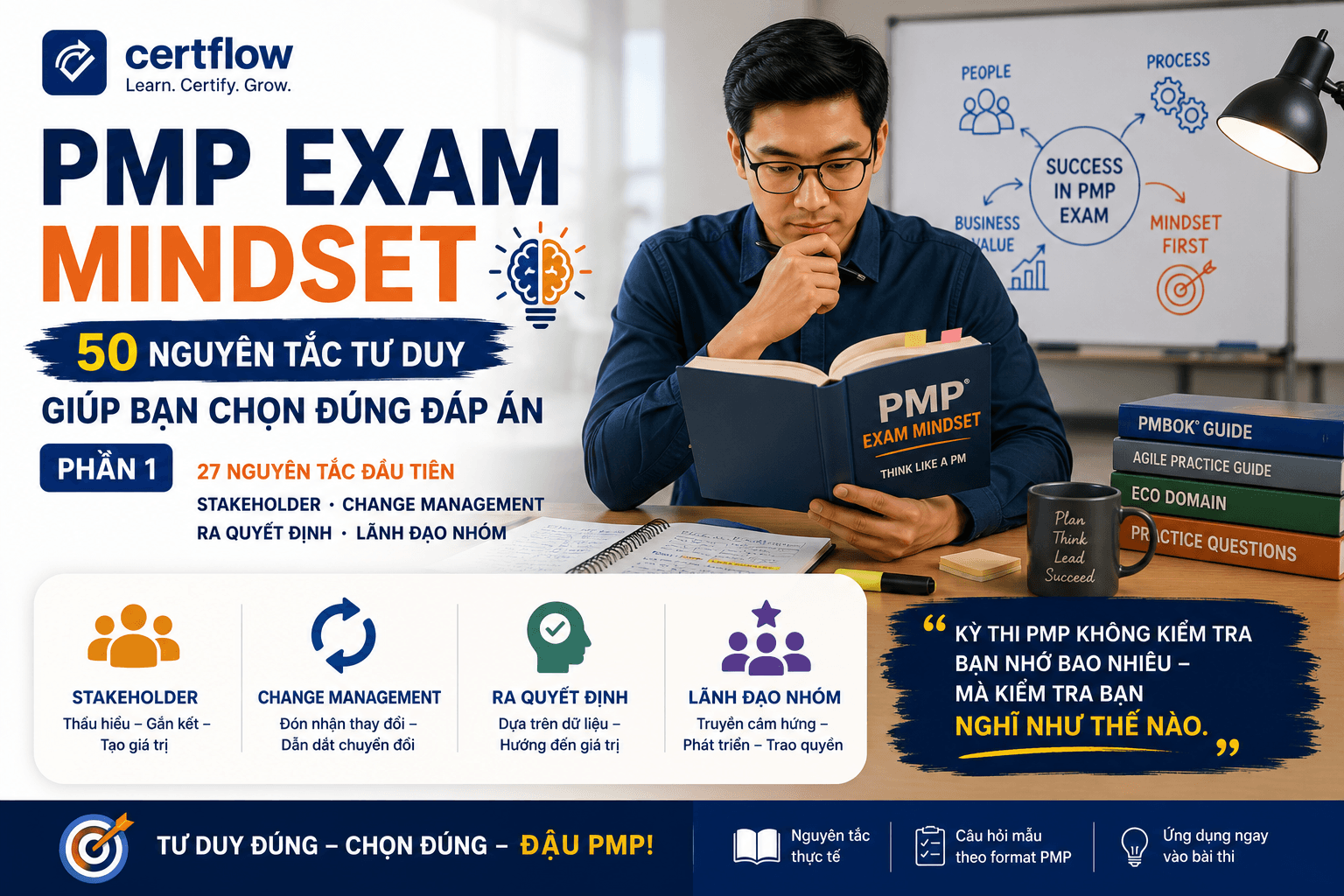
In Part 1, we covered the first 27 principles — the foundational thinking on Stakeholder Management, Change Management, Decision-Making, and Team Leadership. If you haven't read Part 1 yet, I recommend going back first, as the principles are built systematically.
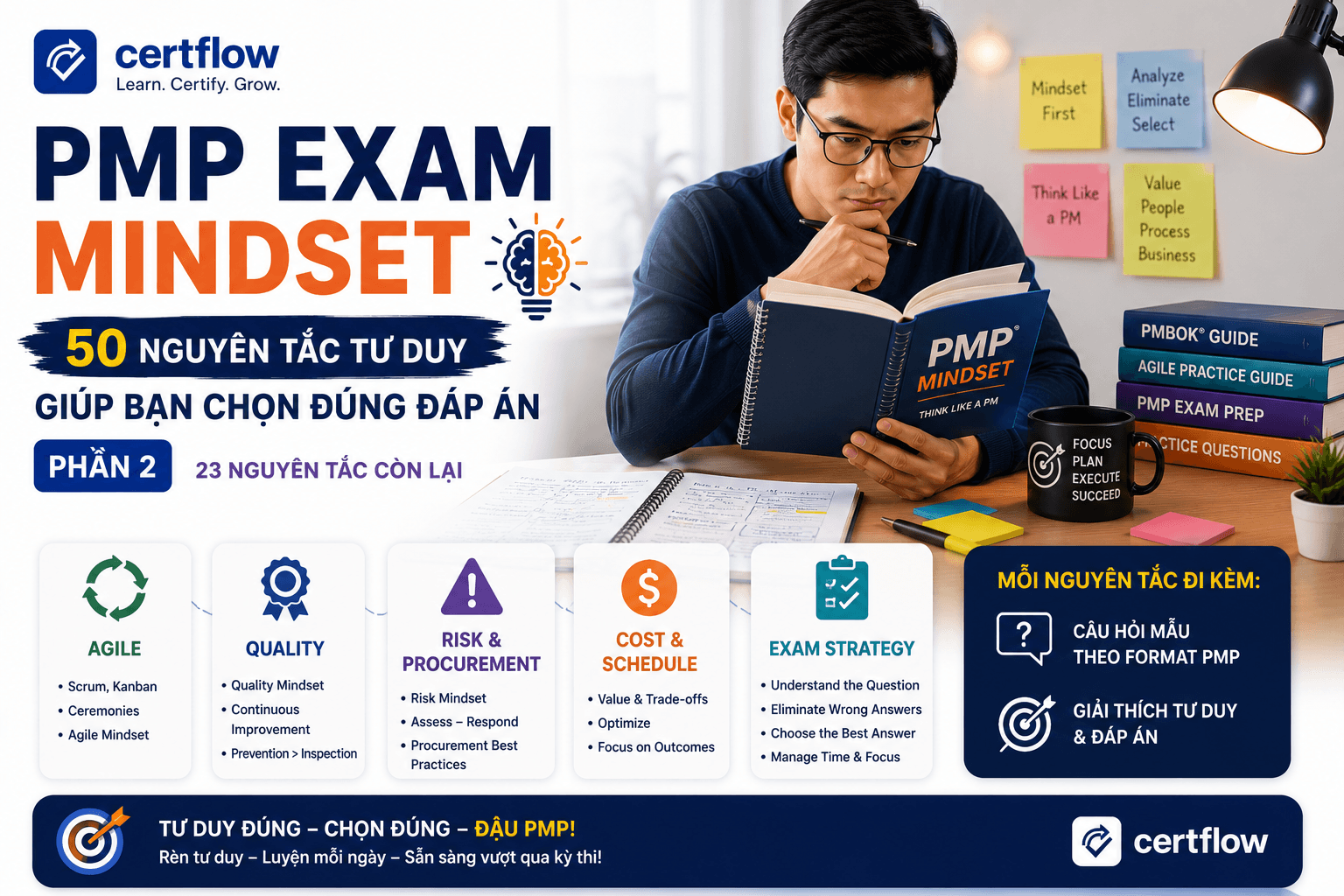
Part 2 covers the remaining 23 principles, including the topics that trip up many exam candidates: Agile specifics, Quality, Risk & Procurement, Cost & Schedule, and — most importantly — 4 exam-taking strategies to help you eliminate wrong answers when facing a question where you're not sure what to choose.
Each principle still comes with a sample question in the exact PMP exam format. Try to answer before reading the explanation — that's the best way to build your reflexes.
V. Agile-Specific Principles (Principles 28–31)
With approximately 50–60% of the PMP exam related to Agile/hybrid, you need a solid grasp of these principles. The key point: in Agile, roles and authority are clearly defined.
Principle 28: Only the Product Owner manages the Product Backlog
The Product Owner owns and prioritizes the Product Backlog. The PM (or Scrum Master) cannot unilaterally add, remove, or reorder items in the backlog.
Exam Question:
The project manager identifies a technical debt item that could cause significant issues in future sprints. What should the project manager do?
A. Add the technical debt item directly to the top of the Product Backlog
B. Discuss the technical debt with the Product Owner and recommend it for inclusion and prioritization in the backlog
C. Create a separate backlog for technical items managed by the development team
D. Address the technical debt during the current sprint without informing the Product Owner
Answer: B — The PM may recommend, but only the Product Owner has the authority to add and prioritize items in the Product Backlog.
Principle 29: Prioritize co-location and face-to-face communication
Face-to-face communication is the most effective. Agile teams use information radiators (Kanban boards, burndown charts) to increase transparency.
Exam Question:
An agile team is distributed across three time zones. The team is experiencing frequent miscommunication and delays. What should the project manager do to improve collaboration?
A. Increase the number of written status reports
B. Implement video conferencing for daily standups and use visible information radiators such as a shared digital Kanban board
C. Reduce the team size to fit within one time zone
D. Switch to a predictive methodology with detailed documentation
Answer: B — When face-to-face isn't feasible, video calls are the closest alternative. Information radiators (Kanban boards) keep information transparent for the whole team.
Principle 30: Roll out methodology changes gradually
When transitioning from Traditional to Agile, use a pilot or phased rollout — never a "big bang" implementation across the entire organization at once.
Exam Question:
An organization's leadership has decided to transition all projects from a predictive to an agile approach. The project manager is asked to lead this initiative. What is the BEST approach?
A. Immediately convert all ongoing projects to agile and provide training during execution
B. Start with a pilot project to test the agile approach, capture lessons learned, and gradually expand to other teams
C. Hire agile coaches for every team and mandate the switch on a fixed date
D. Allow each team to decide independently whether they want to switch
Answer: B — Large changes should be rolled out gradually through a pilot. Learning from the pilot before expanding reduces risk and increases the likelihood of success.
Principle 31: Agile requires continuous customer feedback
Customer involvement is essential in Agile. Feedback must be collected frequently — typically through the Sprint Review — to ensure the product is heading in the right direction.
Exam Question:
An agile team has completed three sprints, but the Product Owner has not attended any Sprint Review meetings. The team is concerned that the product may not meet the customer's needs. What should the project manager do?
A. Continue with the sprints and present a comprehensive demo at the end of the project
B. Have the team validate the work internally using the acceptance criteria
C. Engage the Product Owner and emphasize the critical importance of attending Sprint Reviews to provide timely feedback
D. Ask a business analyst to act as a proxy for the Product Owner
Answer: C — Agile cannot function effectively without customer feedback. Product Owner participation in Sprint Reviews is not optional.
VI. Quality and Delivery (Principles 32–35)
Quality is not inspected at the end — it is built in from the start. This group of principles helps you understand how PMP approaches quality assurance and validation.
Principle 32: Define quality requirements early and inspect frequently
In Traditional projects, quality requirements are captured early. In Agile, the Definition of Done (DoD) defines the quality criteria a product must meet.
Exam Question:
An agile team is starting a new project. During the first sprint planning, the team realizes there is no clear agreement on what constitutes a "completed" user story. What should the project manager do?
A. Let each developer decide when their work is complete
B. Facilitate a discussion with the team to establish a clear Definition of Done (DoD) before the sprint begins
C. Use the quality standards from a previous project
D. Ask the Product Owner to determine the completion criteria for each story individually
Answer: B — The DoD must be clearly established and agreed upon by the entire team before the sprint begins. It is the quality benchmark for every user story.
Principle 33: The customer must validate deliverables
In Traditional projects, the customer validates scope and quality. In Agile, this happens through the Sprint Review.
Exam Question:
A project team has completed a major deliverable in a predictive project. The quality assurance team has verified that it meets all technical specifications. What should happen NEXT?
A. Archive the deliverable and move to the next phase
B. Present the deliverable to the customer or sponsor for formal acceptance and validation
C. Update the project schedule to reflect completion
D. Conduct a lessons learned session for the completed deliverable
Answer: B — QA verification (technical checking) is different from customer validation (customer acceptance). Both are necessary, and customer validation cannot be skipped.
Principle 34: Prioritize "low-tech, high-touch" collaboration
Use whiteboards and sticky notes — low-technology but highly interactive methods — to enable genuine collaboration among team members.
Exam Question:
A cross-functional team consisting of developers, designers, and business analysts needs to brainstorm solutions for a complex problem. What facilitation technique should the project manager use?
A. Send a survey and compile the results
B. Use a collaborative whiteboard session where all team members can visually contribute ideas in real time
C. Have each discipline submit their solutions in writing for the project manager to evaluate
D. Schedule individual meetings with each discipline to gather input separately
Answer: B — Low-tech, high-touch: whiteboard sessions create space for everyone to participate visually and in real time, regardless of technical background.
Principle 35: Use estimation techniques suited to the methodology
Traditional projects: bottom-up estimation is the most accurate. Agile: use story points and Planning Poker — relative, not absolute, estimation.
Exam Question:
An agile team is estimating the effort for user stories in an upcoming sprint. A new team member suggests using detailed hour-based estimates for each task. What should the project manager recommend?
A. Adopt the hour-based estimation since it provides more precision
B. Use relative estimation techniques such as story points with Planning Poker, which are better suited for agile teams
C. Let each team member estimate using whichever method they prefer
D. Skip estimation and commit to as many stories as possible
Answer: B — In Agile, relative estimation (story points) is more effective than absolute estimation (hours). Planning Poker builds consensus and leverages collective intelligence.
VII. Risk and Procurement (Principles 36–38)
Risk management has been significantly expanded in the ECO 2026. Understanding the right mindset around risk — including opportunities — is the key.
Principle 36: Identify risks early, thoroughly, and continuously
A risk is an uncertain event — it can be positive (opportunity) or negative (threat). Risk identification must occur throughout the entire project lifecycle, not only during planning.
Exam Question:
A project is nearing the end of the execution phase. A team member suggests that risk identification is no longer necessary since most of the work is complete. What should the project manager do?
A. Agree with the team member since the project is nearly complete
B. Continue risk identification activities because new risks can emerge at any phase of the project lifecycle
C. Focus only on monitoring previously identified risks
D. Conduct a final risk review only during the closing phase
Answer: B — Risk identification is a continuous process. New risks can emerge at any stage, even when the project is nearly complete.
Principle 37: Document response plans for both threats AND opportunities
The risk register doesn't only contain threats — it also contains opportunities. Every risk needs a corresponding response plan.
Exam Question:
During a risk identification workshop, a team member identifies that a new technology could potentially reduce the project timeline by 30% if adopted. How should the project manager handle this?
A. Ignore it because risk management only deals with negative events
B. Record it in the risk register as an opportunity and develop a response strategy to exploit or enhance it
C. Implement the new technology immediately to take advantage of the benefit
D. Add it to the lessons learned for future projects
Answer: B — An opportunity is also a risk. Log it in the risk register and develop a response strategy (exploit, enhance, share, accept) — just as you would for a threat.
Principle 38: Negotiate contracts for mutual benefit (win-win)
When negotiating with a vendor, aim for an agreement that is balanced, fair, and beneficial to both parties.
Exam Question:
A project manager is negotiating a contract with a vendor for a critical project component. The vendor proposes terms that are heavily in their favor, including limited liability and no performance guarantees. What should the project manager do?
A. Accept the terms to avoid delaying the project
B. Reject the vendor and find an alternative supplier
C. Negotiate for a balanced contract that protects both parties' interests and includes clear performance expectations
D. Escalate the negotiation to the legal department and step away
Answer: C — Win-win negotiation: a contract must protect the interests of both parties. A one-sided contract creates risk and damages the long-term relationship.
VIII. Project Lifecycle and Closure (Principles 39–40)
Many candidates overlook the project closure topic — but it appears regularly on the exam.
Principle 39: Update lessons learned THROUGHOUT the project
Lessons learned are not only recorded at the end of a project. Whenever a lesson is gained, document it immediately.
Exam Question:
After resolving a significant scope creep issue during the execution phase, a team member suggests documenting the experience. When should the project manager update the lessons learned register?
A. At the end of the project during the closing phase
B. During the next scheduled retrospective meeting
C. Immediately, while the details and insights are still fresh
D. Only if the same issue occurs again later in the project
Answer: C — Lessons learned must be recorded as soon as they occur, not at the end of the project when the details have faded.
Principle 40: EVERY project must be formally closed
Whether completed successfully or terminated early, every project requires formal closure: settling invoices, releasing resources, and archiving documentation.
Exam Question:
A project has been cancelled by the sponsor due to a change in business strategy. Most deliverables are incomplete. What should the project manager do?
A. Release the team immediately and close down all project activities
B. Archive whatever documents are available and move to the next assignment
C. Perform formal project closure activities including settling contracts, releasing resources, documenting lessons learned, and archiving project records
D. Continue working on the remaining deliverables until the budget runs out
Answer: C — Even if cancelled, the formal closure process must be completed in full. This is a non-negotiable PM responsibility.
IX. Continuous Improvement (Principles 41–44)
Continuous improvement isn't a "nice-to-have" — in the PMP exam, it is the expected standard.
Principle 41: Regularly remind the team of the project vision
The PM must repeatedly reinforce the project vision so the team always understands the big picture and stays aligned.
Exam Question:
Midway through a complex project, the project manager notices that team members are focused on their individual tasks but have lost sight of the overall project objectives. What should the project manager do?
A. Create more detailed task assignments to keep the team focused
B. Reinforce the project vision and objectives in team meetings to realign the team with the big picture
C. Add more milestones to the project schedule to provide better tracking
D. Escalate the concern to the project sponsor
Answer: B — When a team loses its direction, the PM must revisit the vision — not increase control. Alignment comes from shared understanding, not micromanagement.
Principle 42: Clarify the definition of success and failure
All stakeholders need a shared, specific, and measurable understanding of what constitutes project success or failure.
Exam Question:
At the start of a new project, the sponsor defines success as "delivering a high-quality product." What should the project manager do to ensure alignment?
A. Accept the sponsor's definition and begin planning
B. Work with the sponsor and key stakeholders to define specific, measurable success criteria that everyone agrees upon
C. Define success criteria independently based on industry standards
D. Wait until the project deliverables are complete to evaluate success
Answer: B — "High-quality" is too vague. The PM must translate it into specific, measurable criteria agreed upon by all stakeholders.
Principle 43: Retrospectives are mandatory in Agile
Retrospectives are held at the end of each sprint: review what went well, what needs improvement, and create an action plan.
Exam Question:
An agile team consistently skips the Sprint Retrospective because they feel it is unproductive. The team lead argues that the time is better spent on development work. What should the project manager do?
A. Allow the team to skip retrospectives if they prefer
B. Replace retrospectives with written surveys to save time
C. Coach the team on the value of retrospectives, improve the facilitation approach, and ensure they are conducted regularly
D. Escalate the issue to the agile coach or PMO
Answer: C — Retrospectives are not optional. If the team finds them unproductive, the problem lies in how they're facilitated — not in whether to hold them at all.
Principle 44: Apply feedback loops — act immediately when feedback is received
When you receive feedback, act on it right away rather than deferring. Apply lessons from this task to the very next one.
Exam Question:
During a Sprint Review, the customer provides feedback that the user interface is difficult to navigate. What should the agile team do?
A. Note the feedback and address it in a future release after all planned features are complete
B. Incorporate the feedback into the Product Backlog immediately and prioritize it with the Product Owner for the next sprint
C. Explain to the customer that the UI was built according to the original requirements
D. Create a separate project to redesign the user interface
Answer: B — The feedback loop must be fast: capture it → add to backlog → prioritize → address in the nearest sprint. Delaying feedback is an anti-pattern in Agile.
X. Cost and Schedule Management (Principles 45–46)
These two principles help you handle questions about project constraints — especially when a project is over budget or behind schedule.
Principle 45: Avoid cost and schedule overruns — and know how to prioritize
In Traditional projects: prioritize resolving budget issues before schedule issues. In Agile: scope is adjusted to keep budget and timeline fixed.
Exam Question:
An agile project has a fixed budget and a fixed deadline. After three sprints, the team realizes they cannot deliver all the planned features within these constraints. What should the project manager recommend?
A. Request additional budget to complete all features
B. Ask the team to work overtime to deliver everything
C. Work with the Product Owner to reprioritize the backlog and reduce scope to the highest-value features that fit within the constraints
D. Extend the deadline to accommodate all features
Answer: C — In Agile, scope is the flexible variable. When budget and time are fixed, the PM and Product Owner adjust scope based on value priority.
Principle 46: Manage schedule according to the correct methodology
Traditional: focus on the critical path — shortening activities on the critical path shortens the overall project. Agile: manage via sprint commitments and team velocity.
Exam Question:
A predictive project is running two weeks behind schedule. The project manager analyzes the schedule and identifies that the delay is caused by activities NOT on the critical path. What should the project manager do?
A. Crash the delayed activities by adding more resources
B. Monitor the situation since activities not on the critical path have float and may not impact the project end date
C. Fast-track all remaining activities to recover the lost time
D. Immediately inform the sponsor about the schedule delay
Answer: B — Only activities on the critical path directly affect the project end date. Activities with float that are delayed don't necessarily create a problem — monitor, don't panic.
XI. Exam-Taking Strategies (Principles 47–50)
These final four principles are not about PM knowledge — they are about test-taking skills. They help you eliminate wrong answer choices when you're unsure, especially when all four options seem plausible.
Principle 47: Avoid absolute answer choices
Choices containing words like "always," "never," "must always," or "can never" are usually wrong. Project management requires flexibility — absolute rules are rare.
Exam Question:
Which of the following statements about change management is MOST accurate?
A. All change requests must always be approved by the project sponsor before implementation
B. Changes should never be made during the execution phase of a project
C. Change requests should be evaluated for their impact on project objectives and processed according to the established change control process
D. The project manager must always reject scope changes to protect the project baseline
Answer: C — Choices A, B, and D all contain absolute language ("must always," "never," "must always"). Choice C is flexible and accurate: evaluate impact → follow the process.
Principle 48: Never "do nothing"
Any answer choice that describes ignoring a problem, continuing without addressing it, or taking a "wait and see" approach is usually wrong. The PM is always proactive.
Exam Question:
A project manager notices that two team members have a personal conflict that is starting to affect team morale. Neither team member has raised the issue formally. What should the project manager do?
A. Wait for the team members to resolve the conflict on their own since it hasn't been formally raised
B. Ignore the conflict as long as project deliverables are not directly impacted
C. Proactively address the situation by speaking with each team member privately to understand and help resolve the conflict
D. Document the conflict in the project status report and continue monitoring
Answer: C — "Wait," "ignore," and "continue monitoring" without action are all passive approaches. The PM must be proactive — that is the core mindset.
Principle 49: Choose the BEST answer, not a perfect one
The perfect answer isn't always among the four choices. Your job is to select the "most appropriate" option — the best available answer.
Exam Question:
A project manager is managing a high-profile project when they discover that the approved budget is insufficient to deliver the full scope. The project sponsor is unavailable for the next two weeks. What should the project manager do?
A. Pause all project work until the sponsor returns
B. Continue with the current plan and hope costs can be controlled
C. Analyze the budget shortfall, identify potential cost-saving options or scope adjustments, and prepare a detailed recommendation for when the sponsor is available
D. Use management reserves without approval to cover the gap
Answer: C — No answer is perfect here (the sponsor is unavailable), but C is the best available action: analyze, prepare options, be ready when the sponsor returns.
Principle 50: Principles are guidelines, not rigid rules
There may be exceptions where the answer that goes against a principle is actually the best choice. Context is king — read the situation carefully before applying a principle.
Exam Question:
A project manager typically involves the team in all estimation activities. However, the project sponsor has requested an immediate rough order of magnitude (ROM) estimate for a new project proposal within 24 hours. The team has not yet been assembled. What should the project manager do?
A. Decline to provide the estimate since the team is not available
B. Provide an analogous or parametric estimate based on historical data from similar past projects
C. Wait until the team is assembled to provide a bottom-up estimate
D. Provide a random estimate to meet the deadline and refine it later
Answer: B — The principle says "the team should estimate," but the context requires a ROM estimate right now. Using analogous/parametric estimation from historical data is the most appropriate action — principles are guidelines, not laws.
Summary — The PMP Thinking Framework
The 50 principles across both parts of this article can be summarized into one simple framework you can apply to every PMP exam question:
Step 1 — Identify the context: Traditional or Agile? Who has authority? What phase of the project are you in?
Step 2 — Investigate first: Eliminate any answer choice that says "act immediately" before analyzing. The first step is almost always to find out, review, or consult.
Step 3 — Eliminate: Rule out absolute answers (always/never), passive answers (do nothing/wait), and answers that lack empathy (fire/blame/overwork).
Step 4 — Choose the best available: Among the remaining choices, select the one that best serves the project objective and the stakeholders.
Pro Tip: Print this framework and put it on your study desk. Every time you do a practice question, apply these 4 steps. After 200–300 questions, it will become a natural reflex — and that's when you're truly ready for the exam room.
Start practicing right now with hundreds of scenario-based questions on CertFlow. Every question includes a detailed explanation based on these mindset principles — so you don't just know the right answer, you understand why it's right.
Frequently Asked Questions (FAQ)
How does the Agile mindset show up in the PMP exam?
The Agile mindset in the exam: (1) Embrace change — don't resist; find ways to accommodate change requests through the backlog; (2) Deliver incrementally — prioritize delivering working increments over waiting for a perfect plan; (3) Team self-organization — let the team decide HOW, while the PM defines WHAT and WHY; (4) Customer collaboration — collect feedback continuously; (5) Fail fast and learn — retrospectives and adjustments.
How do I apply these 50 principles when taking the PMP exam?
Before each question: read the scenario, identify the core issue, then filter the answer choices through the lens of these principles: "What should a PM do according to PMI's mindset?" Eliminate answers that are reactive, blame-focused, or bypass the process. Prioritize answers that are: proactive, collaborative, process-following, and value-focused. Practice with mock questions and analyze why the correct answer is correct according to the principles.
How does the continuous improvement mindset apply in real-world project management?
Continuous improvement isn't just retrospectives — it's a culture. Signs of it in practice: the PM proactively collects feedback after each milestone (not at project end), updates lessons learned in real time (not at the end of the project), applies improvements starting in the very next sprint, and shares knowledge with the team and the organization. The goal: every project should start better than the one before it.
Now that you understand 50 PMP mindset principles — Part 2, it's time to put it into practice with real exam questions.
Try Free PMP Practice Questions →
Official References: