Hesitant to escalate project issues? Learn 4 signs it's time to escalate, how to structure an effective escalation message, and a ready-to-use email template.
How to escalate project issues effectively as a project manager starts with one skill: knowing when a problem exceeds your authority and acting before the window to respond closes. It was week three when the PM realized the payment module team was running behind — enough to push the launch date. After two direct conversations with their team lead, the answer was still "we're working on it." By week six, the PM finally escalated to the sponsor. First question: "Why are you only telling me now?" There was no longer enough runway to course-correct.
That wasn't a technical failure. The PM knew about the problem. The gap was in timing. Escalating at the right moment means bringing the issue to the right level with context, impact, and options — not just a problem report.
This guide covers four clear signals that it's time to escalate, how escalation differs from complaint, a five-part message structure that works, and a ready-to-use email template.
Key takeaways
Delaying escalation doesn't protect the team — it turns small problems into crises.
Four clear signals tell you when to escalate without second-guessing.
Escalation ≠ complaint: bring context, impact, and options — not just a problem report.
A five-part message structure reduces defensive reactions and speeds up decisions.
Choosing the wrong channel (Slack for a high-risk issue) undercuts the escalation's effectiveness.
Why PMs escalate too late — and what it costs
Three psychological patterns explain the delay — and none of them are about being unaware of the severity.
First, fear of appearing incapable. Many PMs treat escalation as an admission of failure — a signal that they can't handle things independently. PMI® views this differently: a skilled PM knows which problems belong to them and which require higher-level intervention. Escalating at the right time is a marker of management maturity, not weakness.
Second, hoping the problem resolves itself. In IT projects, some blockers genuinely disappear after a few days. This builds a dangerous habit: wait and see. But every day of waiting is a day of lost response capacity.
Third, no clear threshold for "serious enough." Without predefined risk thresholds in the communication management plan, PMs default to judgment calls — and usually err toward waiting.
Early escalation | Late escalation |
|---|---|
Sponsor has time to mobilize resources | Sponsor has no options left |
Issue handled at the right level | Issue escalates into a crisis |
PM is seen as proactive | PM gets asked "why are you only telling me now?" |
Trust with sponsor is built | Trust is damaged |
4 signals that tell you it's time to escalate
Four concrete indicators remove the guesswork from this decision.
Signal 1: The issue exceeds your authority. You can't unilaterally allocate resources from another team, don't have the budget to hire, or can't change a client-committed deadline. When a resolution requires decisions outside your authority, escalate. Example: the other module's lead reports they're being pulled onto a higher-priority project — that's a department head decision, not yours.
Signal 2: You've tried to resolve it at least twice, without success. Keep a brief record: what you tried, who was involved, what resulted. Two failed attempts at the team level indicate the problem needs higher-level intervention.
Signal 3: The impact exceeds your agreed risk threshold. If the communication management plan specifies "any delay over five business days requires escalation," follow it without further debate. If no threshold exists, establishing one is itself a priority action.
Signal 4: There's a conflict between stakeholders that you can't mediate. Two stakeholders of equal authority disagree on a decision affecting the project — and both have valid positions. This isn't a problem a PM resolves through negotiation skills alone.
Escalation vs. complaint — why the distinction matters
Both involve bringing a problem to someone above you. The difference lies in what you bring with you.
A complaint dumps a problem on someone without full context, impact analysis, or proposed solutions. The result: the recipient feels ambushed, doesn't have enough information to act, and the PM appears to be venting rather than solving.
An escalation brings a problem with the context needed to understand the situation, a clear articulation of consequences if unresolved, the solutions already attempted, and a specific ask. PMI® expects PMs to treat escalation as a problem-solving instrument, not a blame mechanism.
Complaint | Escalation | |
|---|---|---|
Content | "Team A isn't cooperating" | "Team A cannot deliver module X by Nov 25 due to two missing developers. Without resolution, go-live shifts by 3 weeks." |
Options | None | Three options with trade-offs |
Ask | Unclear | "Need a decision by Wednesday" |
Outcome | Recipient confused, defensive | Recipient can make an informed decision |
Structure of an effective escalation message
Five components, in sequence, make the difference between a message that gets acted on and one that gets forwarded without a decision. The order matters: a busy sponsor needs the big picture before the details.
1. Context (1–2 sentences): Where is the project, what phase, who is involved.
2. Issue (2–3 sentences): What specifically happened, when it started, how long it's been unresolved. No blame, no judgment — describe events.
3. Impact (2–3 sentences): What happens if this isn't resolved by [date]? Be specific: scope, schedule, budget, client relationship.
4. Attempted solutions: What you've tried, who was involved, what resulted.
5. Ask: What do you need from the recipient — a specific decision, additional resources, intervention in a conflict. The more specific the ask, the faster the response.
Subject: [Escalation] [Project Name] — [Issue in 5 words] — Decision needed by [Date]
Hi [Name],
Context: [Project X] is in sprint 4/6, targeting go-live on [Date].
Issue: Since [Date], [specific problem]. Despite two attempts to resolve at the team level on [Date 1] and [Date 2], the issue remains unresolved.
Impact: If not addressed by [Date], [specific consequence — e.g., go-live date shifts by 3 weeks, estimated cost impact: $X].
What we've tried: [Option 1 — outcome]; [Option 2 — outcome].
Options going forward:
A. [Option A] — Pros: ... / Cons: ...
B. [Option B] — Pros: ... / Cons: ...
C. [Option C] — Pros: ... / Cons: ...
Ask: I need a decision on which option to proceed with by [Date] to keep the schedule impact minimal.
Happy to jump on a 15-minute call if that's easier.
[Name]
Choosing the right channel and tone
Channel choice directly affects response speed and decision formality. Escalating a high-stakes issue via Slack chat significantly reduces its likelihood of being treated with appropriate urgency.
Informal escalation (chat or quick call): Works for small blockers that can be resolved with a quick decision and don't require a paper trail.
Formal escalation (email with appropriate CCs): Required when the issue affects scope, schedule, or budget; when documentation is needed; or when multiple stakeholders are involved.
Emergency escalation (call first, email to follow): When inaction within 24–48 hours leads to irreversible consequences — compliance risk, security breach, client relationship at breaking point. Call to alert, then email to confirm and document.
Two versions of the same message, different tones:
Defensive-triggering: "Team A still hasn't finished what they committed to two weeks ago despite multiple reminders."
Solution-inviting: "Module A is currently 10 business days behind baseline. I've engaged with Team A directly on two occasions but haven't been able to find a resolution within current resource constraints."
The second describes facts, acknowledges the PM's own limitations, and frames the issue as a shared problem — not an accusation.
PMP exam tip: escalation questions test proactiveness, not passivity
In PMP® exam questions involving escalation, the correct answer is almost always the most proactive option that stays within the PM's authority. Answers that involve "continue to monitor," "wait and see," or "hope the issue resolves" are nearly always wrong when the problem has already exceeded a threshold.
PMI® expects PMs to function as problem solvers, not problem reporters. When a question describes a situation where "the PM discovers an issue that will delay the schedule by two weeks," the correct answer typically includes "assess the impact, update the issue log, and escalate with options" — not "continue to monitor."
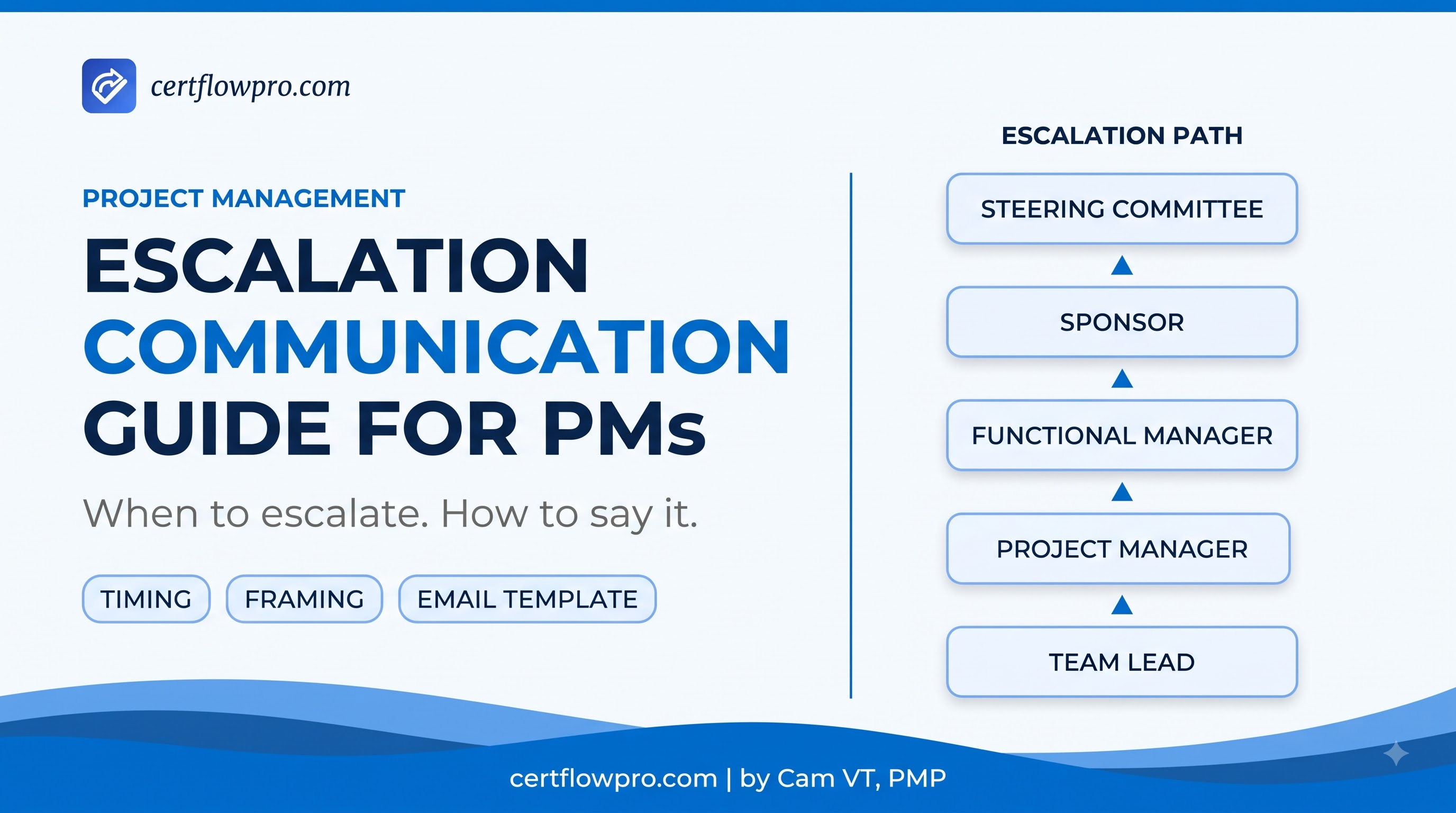
Per PMBOK® Guide 8's governance framework, the escalation path must be established before a project begins. The communication management plan should specify: who receives escalations, for which types of issues, and within what timeframe. When exam questions ask "what should the PM do when they identify an issue?", one correct element is always "follow the escalation path established in the communication management plan."
3 Scenario questions
Question 1. (Predictive) You are the PM of a software project with a fixed go-live date in 6 weeks. A critical dependency on an external vendor is now 3 weeks behind schedule. You have contacted the vendor's project lead twice, but no concrete resolution has been provided. The delay will push the go-live date by at least 4 weeks. What should you do next?
A. Continue to follow up with the vendor's project lead daily until the issue is resolved.
B. Update the issue log and escalate to your sponsor with a summary of impact and three options for proceeding.
C. Revise the project schedule to reflect the new go-live date and inform the client.
D. Negotiate directly with the vendor's management to request additional resources.Answer: B. Two failed resolution attempts plus schedule impact exceeding threshold are both clear escalation signals. Escalation must include impact analysis and options. A is wrong — continuing to monitor without escalating when the threshold is exceeded is reactive. C is wrong — the PM doesn't have the authority to change the go-live date without sponsor approval. D is wrong — approaching vendor management without informing your own sponsor creates authority conflicts.
Question 2. (Agile) During a sprint, a senior developer repeatedly introduces changes that break the agreed sprint goal without informing the team. The Scrum Master has spoken with the developer directly twice, but the behavior continues. The team is frustrated, and sprint velocity is dropping. What is the most appropriate next step?
A. Remove the developer from the sprint team immediately to protect velocity.
B. Raise the impediment at the next sprint retrospective so the full team can address it.
C. Escalate the pattern to the developer's functional manager and the project sponsor, with specific examples and impact on sprint goals.
D. Assign a team member to review all of the developer's commits before they are merged.Answer: C. Two direct conversations without behavior change, with ongoing impact on sprint goals and team morale — clear escalation signals. A is wrong — personnel decisions are outside the Scrum Master's authority. B is wrong — retrospectives are lagging; the damage accumulates until then. D is wrong — this is a temporary workaround that creates overhead without addressing root cause.
Question 3. (Hybrid) The sponsor verbally requests a significant scope addition in an informal conversation with the PM. The sponsor says "just add it, it won't take long." The PM estimates the addition would require 3 weeks of effort and $15,000 in additional cost. What should the PM do?
A. Add the scope to the backlog immediately since the sponsor has the highest authority.
B. Document the conversation, assess the full impact, and present a formal change request to the change control board with the sponsor's awareness.
C. Decline the request politely since it was not part of the original scope baseline.
D. Add a 20% buffer to the estimate and ask the sponsor to confirm in writing before proceeding.Answer: B. Even when requested by the sponsor, scope changes in predictive/hybrid projects must go through integrated change control. The PM's job is to document, assess, and submit the change request — this is proper escalation: bringing the issue to the right process with full information. A bypasses change control. C refuses without initiating the proper process. D addresses only the estimate, not the required change control process.
Want more scenario practice under timed conditions? Try 10 free PMP questions at CertFlow PRO — no registration required.
Summary
Escalation isn't an admission of failure. It's knowing the limits of your authority and acting before the problem becomes unmanageable. Effective PMs don't absorb everything — they know which problems are theirs to solve and which need the right person in the room.
The four escalation signals: issue exceeds your authority, two failed resolution attempts, impact exceeds risk threshold, and unresolvable conflict between stakeholders. When you escalate, bring context, impact, options, and a specific ask — not a complaint.
For deeper reading on escalation path design, see project governance in PMBOK 8. For conflict management within the team, see 5 conflict management techniques.
Frequently asked questions
When is it too early to escalate a project issue?
Escalating too early typically means you haven't yet tried to resolve the issue within the team, don't have a clear impact analysis, or the issue is still within the agreed risk threshold. Attempt at least one direct resolution first — unless the issue carries immediate irreversible consequences within 24–48 hours.
How do I escalate without damaging the relationship?
Keep the tone matter-of-fact, avoid personal blame, and frame the issue as a shared problem. Where possible, give advance notice: "I'll need to escalate to the sponsor if we can't find a solution by Wednesday." This isn't a threat — it's transparency about the process.
Should I always document an escalation in writing?
For informal escalations via call, a brief follow-up email confirming the decision is sufficient. For formal escalations affecting scope, schedule, or budget, written documentation is mandatory — not only for audit purposes, but because writing forces a clear articulation of impact and options before presenting them.
References
Project Management Institute. (2026). PMP® Examination Content Outline – July 2026. PMI.
Project Management Institute. (2025). A Guide to the Project Management Body of Knowledge (PMBOK® Guide) – Eighth Edition. PMI.