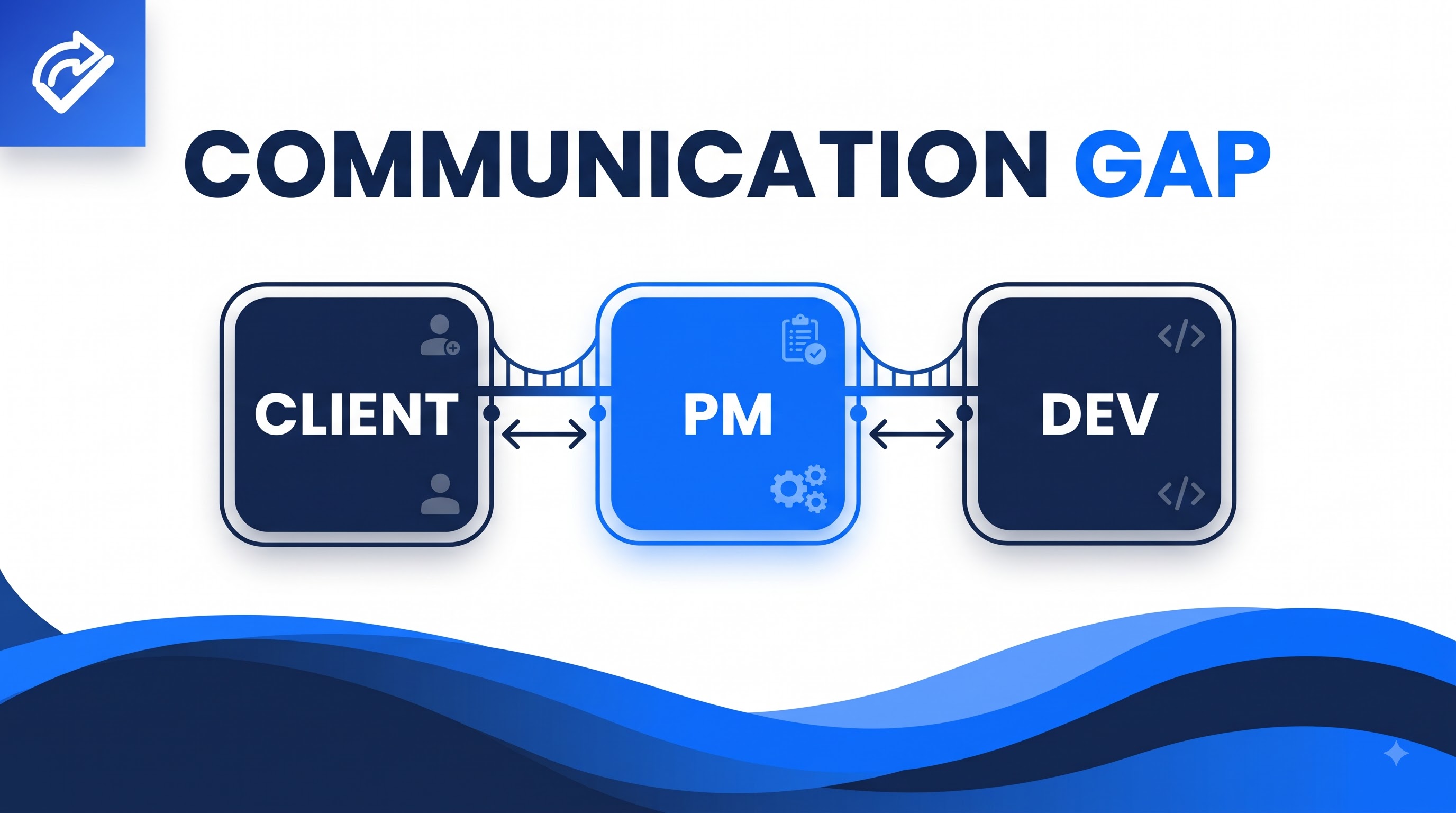
Dev built exactly to spec but the client is still unhappy? Learn how PMs can bridge the communication gap between clients and dev teams.
End-of-sprint demo. The dev team presents the advanced search feature — built exactly to the ticket, within the signed-off spec, running smoothly. The client stares at the screen and says: "This isn't what I asked for." The room goes quiet. The PM sits in the middle, knowing both sides are right in their own way — and that's precisely the problem. How to avoid communication gap between client and dev team is what separates reactive PMs from proactive ones.
Bridging the communication gap between client and dev team is one of the most practical skills a PMP® holder needs: ensuring the client's business intent is accurately translated into technical spec, and vice versa, so neither side gets lost in the translation. This guide covers root causes, prevention techniques, and what to do when the gap has already opened.
Key takeaways
Communication gaps don't come from bad intent — they come from two sides using the same words to mean different things.
A PM is not a message relay; a PM is a translator between business language and technical language.
Prototypes and jointly written acceptance criteria are the most effective tools to align before coding starts.
Regular demos throughout the project matter more than a perfect final demo.
In PMP® exams, the right answer is almost always to clarify and document — not escalate.
5 Root Causes of Communication Gaps in IT Projects
Gaps don't appear without warning. There are five common trigger points that a PM can identify and address early:
1. Business language vs. technical language. The client says "real-time dashboard" — they picture live numbers refreshing like a TV broadcast. The developer hears "real-time" and thinks WebSocket, 500ms polling intervals, infrastructure costs. Same words, completely different pictures.
2. Unspoken assumptions. Both sides assume but neither articulates. The client assumes the system supports 10,000 concurrent users — no one asks, no one writes it down. The dev assumes the existing database schema is sufficient — no one confirms. When assumptions prove wrong, they surface at the worst possible moment.
3. Requirements that exist only in the client's head. "Like the old one but better" is not a requirement — it's a feeling. The PM's job is to help the client externalize: sketch it, describe the workflow, point to the existing screen and say "keep this, change that."
4. Changes communicated verbally, never in writing. Friday's call: the client asks to change the button color from blue to orange. The PM nods, forgets to write it down. The dev team never hears about it. Two weeks later the client asks why the button is still blue. No one is wrong — but there's no record.
5. Feedback loops that are too long. The client doesn't see the product until end of sprint or end of project. Each day the gap quietly widens with no opportunity to correct course.
What the client says | What the dev hears | What the PM needs to do |
|---|---|---|
"Make it faster" | Optimize queries, caching layer | Ask: "Faster in which scenario? What's the target load time?" |
"Like Facebook" | Social graph, news feed algorithm | Ask: "Which Facebook feature specifically? News feed or notifications?" |
"Keep it simple" | Fewer features, minimal design | Ask: "Simple for the user, or simple to build? Can you show an example?" |
"We need real-time" | WebSocket, pub/sub infrastructure | Ask: "Is updating every few seconds enough, or does it need to be instant?" |
The PM Is a Translator, Not a Message Relay
PMBOK® Guide 8 positions communication as a direct responsibility of the PM, not a task to delegate. But many PMs interpret communication as forwarding — passing the client's email to the dev team, passing the dev team's questions up to the client. That's relay, not translation.
Translation means: receiving business intent from the client and converting it into technical spec the dev team can act on; receiving technical constraints from developers and converting them into business impact the client can understand and decide on.
Common mistake: the client sends an email saying "we need a report export feature." The PM forwards it verbatim to the dev team. The developers have no idea: what format (Excel, PDF, CSV), what data, who will use it, in what context. Each developer assumes differently — and three developers produce three interpretations.
The PM must intercept: before forwarding, ask the client "Export for what purpose? Who uses that file? What data needs to be in it?" Then write a proper user story: "As a finance manager, I want to export the monthly report as Excel so I can process it in our existing accounting tool." Then hand it to the dev team.
4 Techniques to Reduce the Gap at the Requirements Stage
Prevention is cheaper than rework. These four techniques target the requirements phase — before coding begins:
Technique 1: User stories + acceptance criteria. Write from the end user's perspective, not the technical perspective. Standard format: "As a [role], I want [feature] so that [benefit]." But a user story alone isn't enough — it needs testable acceptance criteria: "Given [context], when [action], then [expected result]." The client can read it, the developer can implement it, QA can test it.
Technique 2: Prototype or wireframe before coding. The client confirms on a prototype — not on a text description. Figma, Balsamiq, or even paper and pen work fine. The cost of changing a prototype is zero; the cost of changing finished code is weeks.
Technique 3: Definition of Done (DoD) written with the client. DoD isn't just "code complete and tests passing." It should include: responsive on mobile, loads in under 3 seconds, error messages are clear, test data matches production data format. When the client helps write the DoD, they're not surprised during verification.
Technique 4: Requirements confirmation email. Every requirements meeting needs a summary email within 24 hours, with "Unless I hear otherwise by [date], I'll proceed on this basis." The client has a chance to correct before development starts. See the full process in how to confirm requirements after meetings.
Keeping the Gap From Widening During Execution
The gap doesn't only appear at project start. It widens throughout execution without a continuous checking mechanism.
Regular sprint demos with the client present. Demos every two weeks aren't about showing off — they're the earliest gap-detection mechanism available. The client sees the actual product, not a description. If there's a mismatch, correction at sprint 3 costs far less than correction at sprint 10.
Backlog refinement with client participation. The PM shouldn't refine the backlog alone and present the results. The client explains priorities; the PM and developers ask clarifying questions; acceptance criteria get written in the session. One hour every two weeks saves many hours of miscommunication.
Clear escalation path when ambiguity arises. Developers need to know: when a requirement is unclear, escalate to the PM — don't assume and build. The PM must create a psychologically safe environment where developers can say "I don't understand this requirement" instead of silently interpreting it.
Predictive | Agile | |
|---|---|---|
Gap detection mechanism | UAT at phase end | Sprint review every 2 weeks |
Correction cost | High if discovered late | Lower — fix in next sprint |
Client involvement | Upfront requirements + UAT | Ongoing via PO and sprint reviews |
Change control | Formal change request | Backlog refinement + sprint planning |
When the Gap Has Already Opened — What Does the PM Do?
Signs that a gap is widening typically appear before it breaks open: the client starts asking "basic" questions that seemed settled; developers push back on requirements with technical objections; meetings run long without producing decisions; both sides use the same words but talk past each other.
When you recognize these signs, three steps:
Step 1 — Pause and acknowledge. Stop the conversation. Say directly: "It seems we're understanding [X] differently. I want to make sure we're aligned before moving forward." No blame, no drama. Just acknowledge the reality.
Step 2 — Verify: who understands what, who needs what. Ask each side to describe the feature in their own words: "In your view, how would this work?" The gap usually becomes visible immediately. A prototype, whiteboard sketch, or quick wireframe helps externalize the mental model.
Step 3 — Document the alignment in writing before continuing. Once aligned, write it down immediately: what was decided, who agreed, what impact this has on scope or timeline. Send a confirmation email the same day. See also how to write effective meeting minutes.
PMP Exam Tip: Communication Gap Questions Test PMI Mindset
The PMP® 2026 exam — 180 questions, 240 minutes — frequently presents scenarios where the client and the dev team understand a requirement differently, then asks what the project manager should do. The PMI-aligned answer is typically:
Clarify the requirements and document the alignment in writing
Organize a session to get both parties on the same page
Update the communication plan if needed
The PMI answer is usually not: immediately escalate to the sponsor, assign blame, or continue without taking action.
PMI's view: the PM is proactive, not reactive. The communication plan must address channel, frequency, and format for each stakeholder from the project start — not after problems surface. The stakeholder register must capture the client's communication preferences, including preferred language and level of detail.
Want to practice more scenario questions? Try 10 PMP questions free and test your PMI mindset.
3 Scenario Questions
Answer explanations below cover why the correct choice is right and why each other option falls short under PMI logic.
Question 1. Predictive scenario
A project team has built a reporting module exactly as specified in the requirements document. During user acceptance testing, the client states the output format is wrong and doesn't match what they envisioned. No prototype was created before development. What should the project manager do FIRST?
A. File a formal change request and add the rework to the project schedule.
B. Escalate to the project sponsor since the requirements were signed off.
C. Organize a session with the client to clarify the actual expectations and document the alignment in writing.
D. Inform the client that any changes are out of scope and require additional budget.
Answer: C. PMI mindset: the PM proactively resolves miscommunication by organizing an alignment session and documenting it. Only after understanding the gap can you determine whether this is a change or a correction. A assumes it's a change — insufficient basis. B escalates too early without resolving the root cause. D is inappropriate when the problem may stem from unclear requirements.
Question 2. Agile scenario
During a sprint review, it becomes clear that the development team and the product owner interpreted a user story differently, resulting in a feature that doesn't meet user needs. There are no documented acceptance criteria. The sprint ends in two days. What should the project manager do?
A. Cancel the sprint and restart with clearer requirements.
B. Hold an emergency session with the product owner and dev team to agree on acceptance criteria, document them, and decide what can be fixed within the sprint.
C. Mark the user story as done and add a new story to the next sprint backlog.
D. Assign the blame to the product owner for incomplete requirements.
Answer: B. The PM facilitates alignment and documents it immediately. It's better to understand the gap and decide on action within the remaining sprint than to defer the problem. A is too extreme and costly. C doesn't address the root cause — the same problem repeats in the next story. D assigns blame without solving anything.
Question 3. Hybrid scenario
During a weekly call, a client verbally requests a change to the data export format. No formal change request is submitted. Three days later, the project manager discovers that two developers have already started implementing the change. What should the project manager do?
A. Allow the developers to continue since the client already approved it verbally.
B. Stop the work immediately, have the client submit a formal change request, and assess the impact before continuing.
C. Ignore the situation since the developers are already working on it.
D. Revert the work done and inform the client that verbal approvals are not accepted.
Answer: B. Integrated change control requires all changes — no matter how small — to go through the formal process before implementation. Verbal approval creates no accountability. The PM must stop, document, and assess impact. A bypasses change control. C allows the problem to escalate. D may be unnecessary — reverting might not be needed if the change is valid, as long as it goes through the proper process.
Summary
The communication gap between client and dev team isn't anyone's fault — it's the natural result of two worlds trying to understand each other through imprecise language. The PM is the only person with enough context on both sides to bridge that gap.
Prevent it with clear user stories, prototypes before coding, jointly written DoDs, and confirmation emails. Maintain short feedback loops with regular sprint demos. And when the gap appears: pause, verify, document — no blame, no pretending it isn't there.
Further reading:
Frequently Asked Questions
Why do clients reject work built exactly to spec?
Because the spec describes what but doesn't capture how it should feel or behave. The client's mental model differs from what the text describes. Prototypes and clear acceptance criteria externalize that mental model before coding starts — which is why a prototype beats a long spec document every time.
Is a user story enough to prevent communication gaps?
A user story is a good starting point, but not sufficient without specific, testable acceptance criteria. "As a user, I want to search products" — ten people could implement ten different versions. Add "Given no keyword entered, when I press Search, then all products are displayed" — now there's no room for ambiguity.
How often should PMs run demos with the client?
In agile: every sprint (every 1–2 weeks). In predictive: at minimum every milestone or phase gate. The core principle: the shorter the feedback loop, the lower the correction cost. If the client only sees the product at UAT, the PM has let the gap widen for months.
References
Project Management Institute. (2026). PMP® Examination Content Outline – July 2026. PMI.
Project Management Institute. (2025). A Guide to the Project Management Body of Knowledge (PMBOK® Guide) – Eighth Edition. PMI.
Schwaber, K., & Sutherland, J. (2020). The Scrum Guide. Scrum.org.