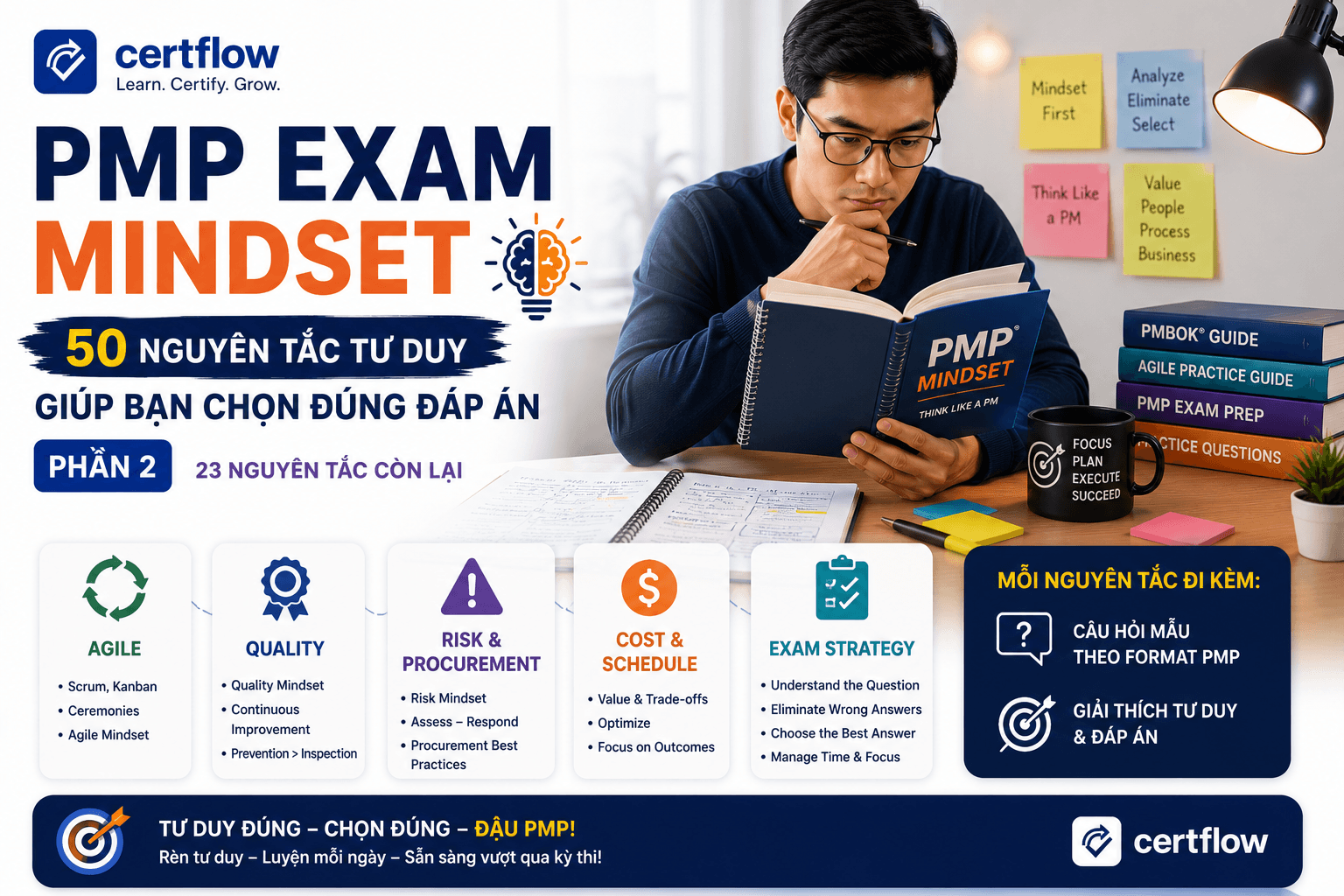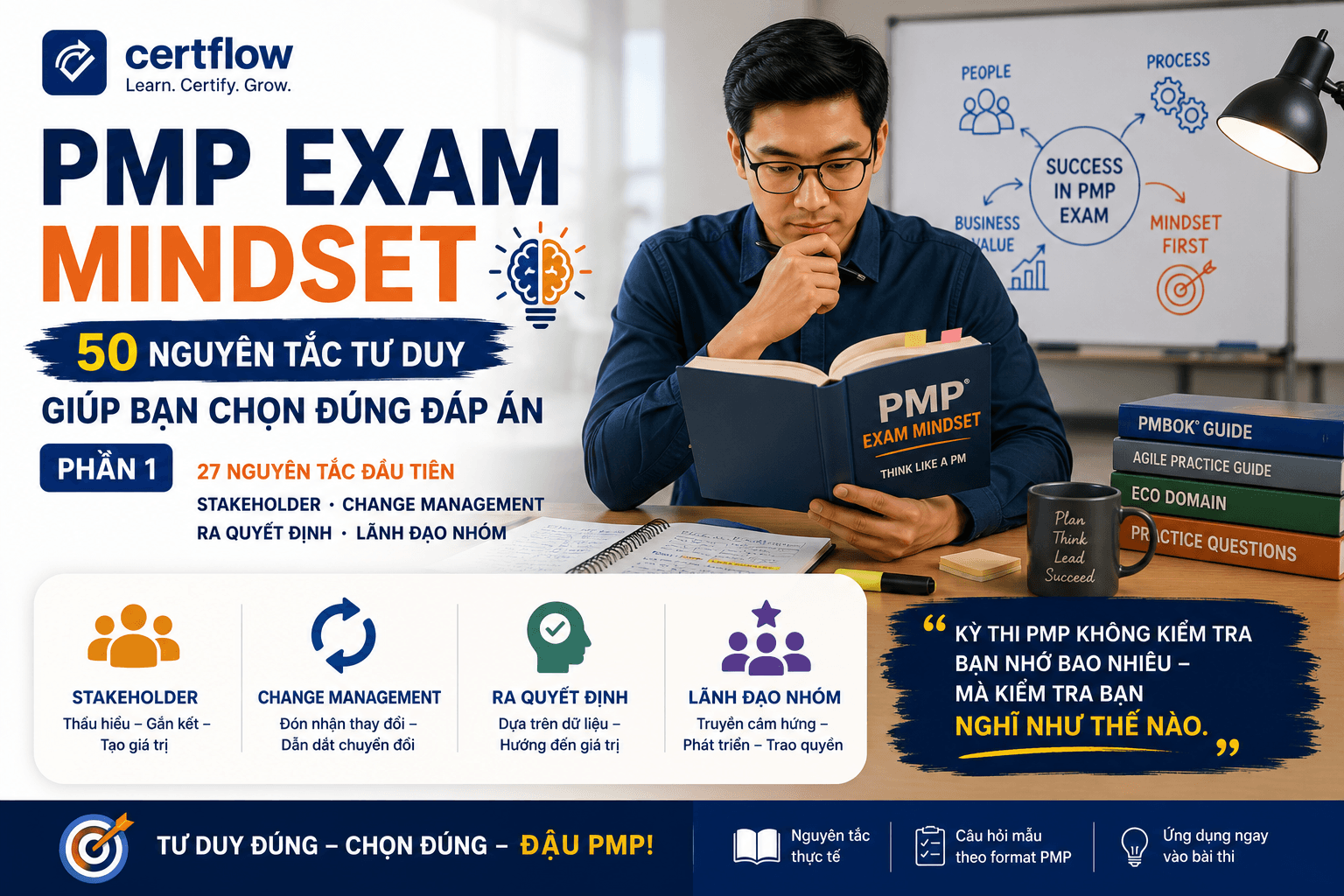
The PMP exam doesn't test what you know — it tests how you think as a skilled PM. These 25 foundational principles build the right mindset before test day.
There's a truth many PMP candidates only discover after months of studying: you can memorize the entire PMBOK Guide and still fail. Why? The PMP exam doesn't test your memory — it tests your thinking.
Every question on the exam is a real-world scenario, and all four answer choices seem "correct" to some degree. What separates those who pass from those who don't is the ability to apply the right mindset principles to eliminate wrong options and select the best answer.
This article compiles 50 core mindset principles for the PMP exam, divided into two parts. Part 1 covers the first 27 principles on Stakeholder Management, Change Management, Decision-Making, and Team Leadership. Each principle is paired with a sample question in the exact PMP exam format so you can see how it applies in practice.
I. Stakeholder Management — The Foundation of Every Project (Principles 1–5)
Stakeholder management is not a phase — it is a continuous process that runs throughout the entire project lifecycle. In the PMP exam, many questions revolve around how you identify, communicate with, and respond to the expectations of your stakeholders.
Principle 1: Continuously identify and analyze stakeholders
Stakeholders can join or leave a project at any time. The stakeholder register is a living document that must be updated regularly. When a new stakeholder appears, the first step is to meet with them to understand their concerns and impact.
Exam Question:
A project is in the execution phase when a new department director is appointed. This director's department will be significantly impacted by the project deliverables. What should the project manager do FIRST?
A. Add the director to the communication distribution list
B. Meet with the director to understand their concerns and expectations
C. Send the director a copy of the project charter
D. Continue with the current stakeholder engagement plan
Answer: B — When a new stakeholder appears, the first step is to meet with them to understand their concerns, then update the stakeholder register and adjust the engagement plan.
Principle 2: Engage stakeholders regularly through multiple channels
A skilled PM keeps stakeholders actively involved in the project. The communication method and level of engagement must be tailored to each individual — a weekly email is not always the right solution for everyone.
Exam Question:
A project manager notices that a key stakeholder has stopped attending status meetings and is not responding to weekly email updates. The project is approaching a critical milestone. What should the project manager do?
A. Document the stakeholder's lack of engagement in the issue log
B. Escalate the concern to the project sponsor
C. Meet with the stakeholder to understand their preferred communication method and re-engage them
D. Remove the stakeholder from the communication plan since they are unresponsive
Answer: C — Each stakeholder has their own preferred communication style. Before escalating or logging the issue, proactively find out what works for them and adjust your approach.
Principle 3: Use emotional intelligence (EI) to read situations and respond appropriately
EI is the ability to understand your own emotions, recognize the emotions of others, and adjust your responses accordingly. When an issue arises with an individual, address it privately — never confront someone in front of the group.
Exam Question:
During a team meeting, a developer openly criticizes the project plan and appears frustrated. Other team members become visibly uncomfortable. What should the project manager do?
A. Ask the developer to stop and follow up after the meeting in private
B. Address the developer's concerns immediately in front of the team to maintain transparency
C. Ignore the behavior and continue the meeting to stay on schedule
D. Ask other team members to vote on whether the criticism is valid
Answer: A — Emotional intelligence requires recognizing the situation and handling it appropriately. Individual issues must be resolved in private, not in front of the group.
Principle 4: Anyone affected by the project is a stakeholder
Any individual or group positively or negatively impacted — whether directly or indirectly — is a stakeholder and must be included in the stakeholder register.
Exam Question:
A project to implement a new automated inventory system will eliminate several manual data entry positions in the warehouse. The warehouse staff have not been included in any project communications. What should the project manager do?
A. Inform the warehouse manager about the project timeline
B. Identify the affected warehouse staff as stakeholders and include them in the stakeholder register
C. Wait until the implementation phase to communicate with the warehouse staff
D. Ask HR to handle communication with the affected employees
Answer: B — Anyone affected by the project is a stakeholder, including those impacted negatively. They must be identified, analyzed, and managed.
Principle 5: Never be quick to dismiss a client's request
Always evaluate every request carefully. A skilled PM is proactive and never chooses the "do nothing" option. Meet with the client to understand the business value before making a decision.
Exam Question:
A client requests a new feature that appears to be outside the original project scope. The project is already behind schedule. What should the project manager do FIRST?
A. Reject the request because the project is behind schedule
B. Accept the request to maintain a good relationship with the client
C. Meet with the client to understand the business value and urgency of the request
D. Submit a change request immediately to the change control board
Answer: C — Don't rush to reject or accept. The first step is always to understand the business value and urgency, then decide on the next course of action.
II. Change Management — Traditional vs. Agile (Principles 6–8)
How you handle change is one of the clearest distinctions between the two approaches. In the PMP exam, you must correctly identify the context (Traditional or Agile) before selecting your answer.
Principle 6: Track and manage changes according to the correct methodology
In Traditional projects: strictly follow the project management plan. All changes must go through a formal change request. In Agile projects: change is welcomed and managed by reprioritizing the Product Backlog.
Exam Question:
During a predictive project, a senior stakeholder asks the project manager to add a new deliverable. The stakeholder insists it is urgent and should be started immediately. What should the project manager do?
A. Begin working on the new deliverable to satisfy the stakeholder
B. Ask the stakeholder to submit a formal change request for evaluation
C. Add the deliverable to the project scope and update the WBS
D. Inform the stakeholder that no changes are allowed during execution
Answer: B — In a predictive project, all changes must go through the formal change request process, regardless of who is requesting it or how urgent it seems.
Principle 7: Formal change request (Traditional) or direct collaboration (Agile)
In Traditional projects, any stakeholder wanting a change must submit a change request. In Agile, changes are handled through direct collaboration with the Product Owner.
Exam Question:
An agile team receives a request from a stakeholder to add a new user story to the current sprint. What should the Scrum Master do?
A. Add the user story to the current sprint backlog
B. Submit a formal change request to the change control board
C. Direct the stakeholder to discuss the request with the Product Owner for backlog prioritization
D. Reject the request because the sprint is already in progress
Answer: C — In Agile, changes are managed through the Product Owner. The Scrum Master directs the stakeholder to the right person with authority over the Product Backlog.
Principle 8: Every change must be evaluated holistically (Traditional)
A scope change must be assessed for its impact across all knowledge areas: schedule, budget, quality, risk, resources, and stakeholders.
Exam Question:
A change request to add new functionality has been approved in a predictive project. The project manager updates the scope baseline. What should the project manager do NEXT?
A. Begin implementing the approved change immediately
B. Assess the impact of the change on schedule, cost, quality, risk, and resources
C. Notify the project sponsor that the change has been approved
D. Update the project charter to reflect the new scope
Answer: B — After a change request is approved, the PM must assess the comprehensive impact across all aspects before implementing. This is the "integrator" mindset in action.
III. Decision-Making and Problem-Solving (Principles 9–17)
This is the most critical group of principles in the PMP exam. Nearly every scenario question revolves around how you analyze the situation, consult others, and take action.
Principle 9: Never act without a plan
In Traditional projects, the project management plan provides guidance. In Agile, planning happens just-in-time for each sprint. Before taking action, always review the existing plan.
Exam Question:
A project manager discovers that a key deliverable is at risk of being delayed. What should the project manager do FIRST?
A. Assign additional resources to the deliverable to speed up progress
B. Inform the project sponsor about the potential delay
C. Review the project management plan to understand the planned response for schedule risks
D. Ask the team to work overtime to meet the deadline
Answer: C — Before acting, always check the existing plan. The project management plan may already contain a response for this exact situation.
Principle 10: Consult the team before making decisions
The project team are the subject-matter experts. The PM should serve as a facilitator for decision-making, not the sole decision-maker on everything.
Exam Question:
A project manager needs to decide on the best technical approach to resolve a complex integration issue. The project manager has limited technical expertise in this area. What should the project manager do?
A. Research the issue independently and select the best approach
B. Consult with the technical team members to gather their input before making a decision
C. Escalate the decision to the project sponsor
D. Hire an external consultant to make the decision
Answer: B — The PM is a facilitator, not an expert in everything. Leverage the team's knowledge before deciding.
Principle 11: Choose the action that best serves the project objectives
Every decision must prioritize the highest value for stakeholders and the overall goal, even when that isn't the easiest choice.
Exam Question:
A project team proposes using a familiar but outdated technology that would save development time. However, this technology will not meet the long-term scalability requirements outlined by the client. What should the project manager do?
A. Approve the team's proposal to save time and stay on schedule
B. Evaluate alternative technologies that meet the client's scalability requirements, even if they take more time
C. Let the team decide since they are the technical experts
D. Escalate the technology decision to the project sponsor
Answer: B — Decisions must serve the project objective (the client's scalability requirement), not the team's short-term convenience.
Principle 12: Understand the root cause of conflict before resolving it
The first step in conflict resolution is always to understand each party's perspective, not to impose a solution.
Exam Question:
Two team members are in a heated disagreement about the design approach for a critical module. The argument is disrupting team productivity. What should the project manager do FIRST?
A. Make the design decision to end the disagreement quickly
B. Separate the two team members and assign them to different tasks
C. Meet with each team member individually to understand their perspectives and the root cause of the conflict
D. Ask the team to vote on the best design approach
Answer: C — Before resolving anything, you need to understand the cause. Meeting individually with each person to understand their point of view is the right first step.
Principle 13: Log the issue and check the risk register
An issue is a negative event that has already occurred — it must be recorded in the issue log. Potential responses may have already been identified in the risk register as part of risk response planning.
Exam Question:
A critical vendor has just informed the project manager that they will be unable to deliver a key component on time. What should the project manager do FIRST?
A. Find an alternative vendor immediately
B. Document the issue in the issue log and review the risk register for a pre-planned response
C. Inform the project sponsor about the delay
D. Extend the project schedule to accommodate the vendor delay
Answer: B — When an issue arises, log it in the issue log and check the risk register — a response plan may already be in place.
Principle 14: Consult SMEs and organizational process assets (OPA)
The PM is not an expert in everything. When facing complex problems, seek subject-matter experts, review lessons learned, or reference organizational processes.
Exam Question:
A project manager is managing a construction project for the first time and is unsure about the regulatory requirements for environmental compliance. What should the project manager do?
A. Research the requirements online and document them in the project plan
B. Consult with subject matter experts and review organizational process assets from similar past projects
C. Ask the project sponsor to clarify the regulatory requirements
D. Hire a compliance officer to manage this aspect of the project
Answer: B — When lacking expertise, consulting SMEs and OPAs (lessons learned, organizational processes) is the logical first step.
Principle 15: Always investigate and consult BEFORE acting
The first step is never to "fix" — it is to "analyze" or "review." Gather information before responding.
Exam Question:
A project manager receives a report showing that actual costs are 20% over budget. What should the project manager do FIRST?
A. Request additional funding from the sponsor
B. Reduce the project scope to cut costs
C. Investigate the root cause of the cost overrun by analyzing the cost variance data
D. Implement corrective actions to bring costs back in line
Answer: C — Before fixing anything, analyze the cause. "Investigate first, act second" is the golden rule.
Principle 16: Demonstrate progress through tangible deliverables (MVP, prototype)
The best way to receive feedback is to give the client something they can actually use or experience.
Exam Question:
A project team is developing a new mobile application. After several sprints, the client expresses concern that the final product may not meet their expectations. What should the project manager recommend?
A. Increase the frequency of status reports to the client
B. Present a working prototype or MVP to the client for hands-on feedback
C. Share the detailed project plan with the client to build confidence
D. Schedule a meeting to review the requirements document with the client
Answer: B — A prototype or MVP lets the client experience the product firsthand, generating more valuable feedback than any document.
Principle 17: Resolve problems at your own level of authority
Don't escalate issues that fall within your authority (managing the team, internal conflicts). Only escalate when you need approval or when the issue exceeds your authority.
Exam Question:
Two team members are in disagreement about task priorities for the upcoming week. What should the project manager do?
A. Escalate the issue to the project sponsor for resolution
B. Ask the PMO to mediate the conflict
C. Facilitate a discussion between the two team members to resolve the conflict and align on priorities
D. Assign the tasks unilaterally to end the disagreement
Answer: C — An internal conflict about task priority falls within the PM's authority. Facilitate resolution rather than escalating upward.
IV. Team Leadership and Collaboration (Principles 18–27)
This group of principles shapes how you build and lead your team. In the PMP exam, questions about team dynamics and leadership style appear frequently — and the correct answer always points toward servant leadership.
Principle 18: Be a Servant Leader
Rather than giving orders, a servant leader supports, empowers, and removes impediments for the team. They listen, coach, and encourage autonomy.
Exam Question:
A team member reports that they are blocked by a dependency on another department that has not delivered the required data. What should the project manager do?
A. Tell the team member to follow up directly with the other department
B. Work to remove the impediment by coordinating with the other department on behalf of the team
C. Escalate the issue to senior management
D. Adjust the project schedule to accommodate the delay
Answer: B — A servant leader removes impediments for the team. The PM must proactively resolve the blocker rather than pushing responsibility back to the team member.
Principle 19: The PM is an Integrator
A project is a collection of interdependent parts. The PM must integrate all elements — scope, time, cost, quality — rather than optimizing just one dimension.
Exam Question:
The project sponsor asks the project manager to accelerate the schedule by two weeks without increasing the budget. What should the project manager do FIRST?
A. Agree to the request and push the team to work faster
B. Analyze the impact of schedule compression on scope, quality, risk, and resources before responding
C. Reject the request because the budget cannot be increased
D. Crash the critical path activities immediately
Answer: B — The PM is an integrator — when one constraint changes, you must analyze the comprehensive impact on all other constraints.
Principles 20 & 21: The team decomposes work and estimates time
Because the team are the experts, they are best positioned to break down the work (WBS) and estimate the time required to complete it.
Exam Question:
A project manager is developing the work breakdown structure (WBS) for a complex IT project. What is the BEST approach?
A. Create the WBS independently using templates from previous projects
B. Ask the project sponsor to define the work packages
C. Involve the project team in decomposing the work because they have the technical expertise
D. Outsource the WBS creation to a planning consultant
Answer: C — The team has the best technical knowledge for decomposing work. The PM facilitates the process rather than doing it alone.
Principle 22: Understand what motivates the team to inspire them
A disengaged team will negatively affect the entire project. Find out what drives each individual team member.
Exam Question:
A project manager notices that the team's velocity has been declining over the last three sprints. Team members appear disengaged during daily standups. What should the project manager do?
A. Set stricter performance targets for the next sprint
B. Report the declining velocity to the project sponsor
C. Have individual conversations with team members to understand what is affecting their motivation
D. Replace underperforming team members with new resources
Answer: C — Before increasing pressure or replacing people, understand the root cause. Motivation is a human issue that requires a human approach.
Principle 23: Always act with integrity
Ethics and the law always come first. Never lie, falsify information, or violate the law — even when compliance may be inconvenient for the project.
Exam Question:
A project manager discovers that the team has been reporting inflated progress metrics to make the project appear on track. The project is actually behind schedule. What should the project manager do?
A. Continue with the current reporting since correcting it would alarm stakeholders
B. Correct the progress reports immediately and communicate the accurate status to stakeholders
C. Wait until the next status meeting to provide updated figures
D. Ask the team to gradually correct the numbers over the next few reporting periods
Answer: B — Ethics are non-negotiable. When inaccurate information is discovered, correct it and report honestly, immediately.
Principle 24: Create a safe environment for disagreement
Conflict can be constructive. The PM must create space for team members to express disagreement respectfully, without fear of reprisal.
Exam Question:
During a retrospective, the team appears reluctant to share honest feedback about what went wrong in the last sprint. What should the project manager do?
A. Move on to the next agenda item since the team has no feedback
B. Ask each team member to submit anonymous feedback after the meeting
C. Create a psychologically safe environment by establishing ground rules and encouraging open dialogue without blame
D. Share the project manager's own observations about what went wrong and ask the team to agree
Answer: C — Psychological safety is foundational. Teams only share honestly when they feel their input won't lead to negative consequences.
Principle 25: Never choose overtime as a first resort
Overtime and overwork are unsustainable and lead to poor quality. In the PMP exam, answer choices requiring the team to work overtime are almost always wrong.
Exam Question:
A project is behind schedule by two weeks. The project sponsor suggests having the team work weekends until the project gets back on track. What should the project manager do?
A. Implement the sponsor's suggestion to demonstrate commitment
B. Evaluate options such as fast-tracking, re-prioritizing scope, or adjusting the schedule before resorting to overtime
C. Ask for volunteers to work weekends
D. Hire temporary contractors to make up the lost time
Answer: B — Overtime is a last resort, not a first response. Always explore sustainable solutions before sacrificing the team's wellbeing.
Principle 26: Use pair programming and cross-training
Encourage team members to learn from and teach each other, reducing the risk of dependency on a single individual.
Exam Question:
A project manager realizes that only one developer has expertise in a critical system component. If this person becomes unavailable, the project will be at significant risk. What should the project manager do?
A. Document the developer's knowledge in a technical manual
B. Implement pair programming or cross-training so that another team member can learn the critical skills
C. Hire a backup developer with the same expertise
D. Accept the risk and continue since the developer is currently available
Answer: B — Pair programming and cross-training reduce single points of failure and develop team capability at the same time.
Principle 27: "Be Nice" — The Elimination Principle
This principle helps you quickly rule out wrong answers: don't fire anyone, don't force overtime, don't criticize in public, and always speak privately before taking action.
Exam Question:
A team member has consistently missed deadlines and the quality of their work has declined. Other team members are starting to complain. What should the project manager do FIRST?
A. Issue a formal written warning to the team member
B. Reassign the team member to less critical tasks
C. Have a private, empathetic conversation with the team member to understand if there are underlying issues affecting their performance
D. Discuss the team member's performance issues during the next team meeting
Answer: C — "Be Nice" in practice: speak privately, show empathy, understand the root cause before taking any disciplinary action.
Part 1 Complete — But the Journey Continues
These first 27 principles build your thinking foundation: always be proactive, always investigate before acting, always place project objectives above personal convenience, and always treat people with respect.
If you take away just one thing from Part 1, let it be this: in the PMP exam, the first step is always to "find out" rather than to "act." Investigate → Consult → Plan → Act. Nearly every difficult question can be solved with this framework.
In Part 2, we'll cover the remaining 23 principles: Agile specifics, Quality & Delivery, Risk & Procurement, Cost & Schedule management, and — most importantly — exam-taking strategies that help you choose the right answer when you're not sure what to pick.
Start practicing with scenario-based questions on CertFlow to build this thinking reflex until it becomes instinct.
Frequently Asked Questions (FAQ)
How does the PMP mindset differ from a traditional manager's mindset?
A traditional manager: gives orders, controls, focuses on tasks. A PM according to PMI: serves the team (servant leader), empowers rather than controls, focuses on outcomes and value. In the PMP exam: answer choices that say "work WITH the team," "collaborate," or "communicate proactively" are usually correct over choices that say "tell," "force," or "escalate immediately."
How important is the proactive PM principle on the PMP exam?
Extremely important — the ideal PM according to PMI is always proactive, never reactive. This means: identifying risks before they occur, communicating issues to stakeholders early, creating contingency plans, and updating plans when changes arise — not waiting for problems to escalate before acting. In scenario questions: always choose the answer where the PM acts proactively.
What mindset does the ECO 2026 emphasize most in the PMP exam?
The ECO 2026 emphasizes: (1) Value delivery — focus on business value, not just deliverables; (2) Agile mindset — embrace change, iterate, deliver incrementally; (3) Servant leadership — empower the team, remove impediments; (4) Stakeholder engagement — proactive, transparent communication; (5) Tailoring — do not apply a one-size-fits-all approach. Understanding these mindsets helps you answer situational questions more accurately.
Now that you understand 50 PMP mindset principles — Part 1, it's time to put it into practice with real exam questions.
Next article: 50 PMP Mindset Principles (Part 2): Principles 26–50
5 common PMP exam preparation mistakes — why studying hard still isn't enough
The secret to PMP practice questions that mirror the real exam 99% on CertflowPro
Try Free PMP Practice Questions →
Official References: