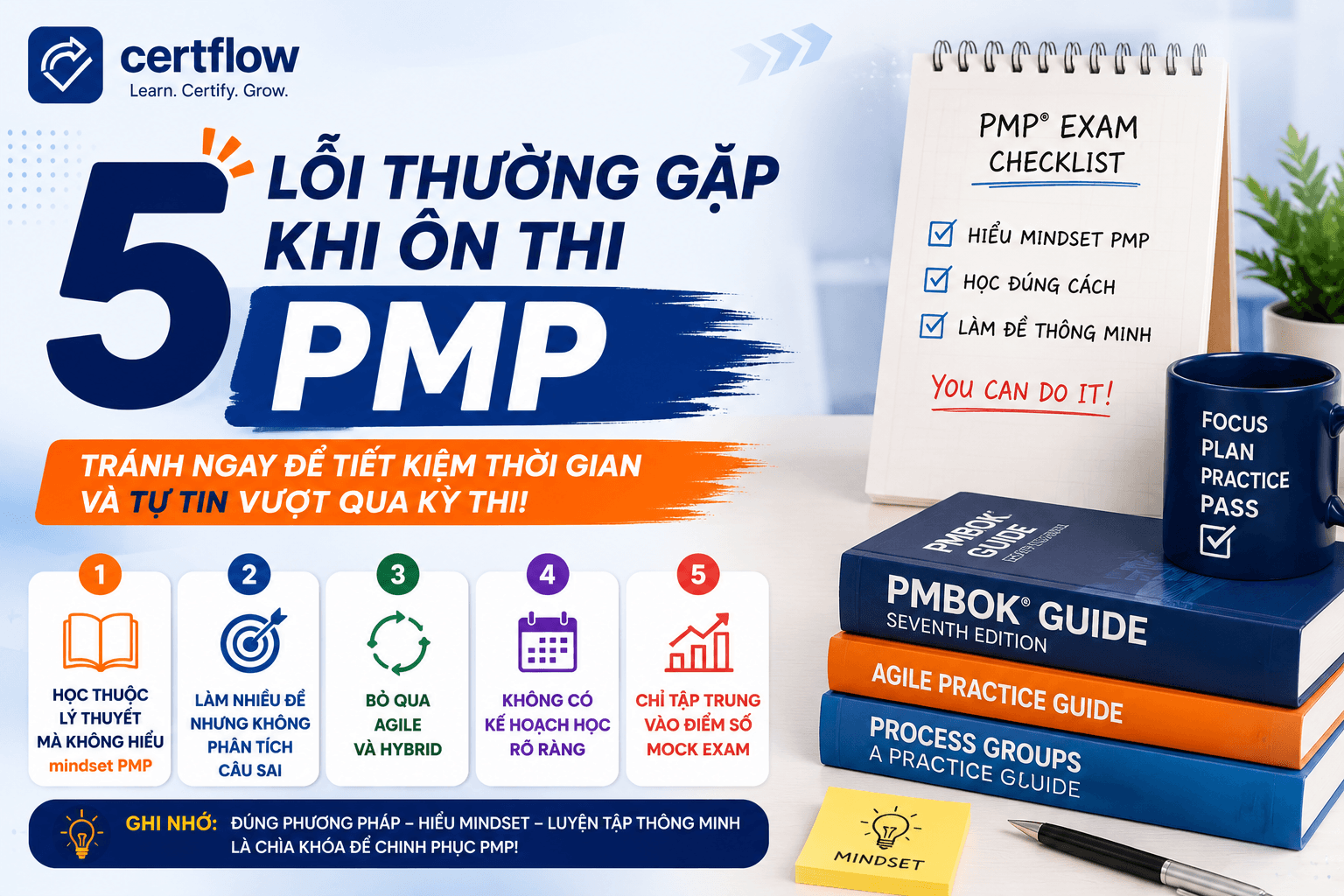
Many PMP candidates study for months and still fail — not from lack of knowledge, but from studying wrong. Discover which 5 mistakes could cost you the exam.
Studying for the PMP exam isn't simply about reading materials, learning theory, and doing as many practice questions as possible. Many people spend months preparing for the PMP and still feel uncertain, score inconsistently, or repeatedly miss scenario-based questions.
The reason usually isn't that PMP is too hard — it's that you're studying the wrong way.
In this article, we'll explore the 5 most common mistakes when studying for the PMP exam and how to fix them so you can study more effectively, develop the right PMP mindset, and increase your chances of passing.
1. Memorizing Theory Without Understanding the PMP Mindset
One of the biggest mistakes in PMP exam preparation is studying by memorizing definitions, terms, and processes.
Many candidates try to memorize:
What a risk is
What an issue is
What a change request is
What a stakeholder is
What Agile is
What scope, schedule, and cost are
Understanding the concepts is necessary — but it's not enough to pass the PMP exam.
The PMP exam is heavily scenario-based. Questions rarely ask directly "what is the definition of X?" Instead, they place you in the role of a Project Manager and ask:
In this situation, what should you do next?
If you've only memorized content, you'll find yourself confused when all four answer choices seem correct.
How to Fix It
When studying for PMP, focus on developing the Project Manager mindset:
Always analyze the situation before taking action
Don't escalate prematurely if it isn't necessary
Don't blame the team
Prioritize communication and collaboration
Respect the change management process
Support the team rather than over-controlling them
Stay focused on the project's value
PMP doesn't just test what you know — it tests whether you make decisions like a professional Project Manager.
2. Doing Too Many Practice Questions Without Analyzing Wrong Answers
Many people believe that the more questions they do, the more likely they are to pass the PMP. So they push through 1,000, 2,000, or even 3,000 practice questions.
However, if you're only doing questions, checking your score, and moving on to the next set, your learning won't improve much.
The mistake here is: doing a lot without learning from your errors.
For example, you get a stakeholder question wrong but don't analyze why. The next time you encounter a similar situation, you'll likely choose the wrong answer again.
How to Fix It
After every wrong answer, record the following:
Did I get it wrong because I didn't understand the concept?
Did I miss a keyword in the question?
Did I confuse Agile with predictive?
Did I choose an action that was too hasty?
Did I not fully understand the PMP mindset?
You can create an error log using this format:
Question topic:
Reason I chose the wrong answer:
The correct answer is based on which mindset:
Key lesson learned:
Doing 500 questions with thorough analysis can be more effective than doing 2,000 questions and only checking the score.
3. Ignoring Agile and Hybrid
A very common mistake is studying only traditional project management from a Waterfall or predictive perspective, while today's PMP exam includes a large volume of content related to Agile and hybrid approaches.
If you work in a traditional environment, you may find Agile confusing. Conversely, if you work in IT or on a Scrum team, you may be overconfident because you think you already know Agile.
Both situations lead to mistakes.
In PMP, Agile isn't just knowing what a sprint, backlog, or daily standup is. You need to understand the thinking behind Agile:
Empowering the team
- Continuous feedback from the customer
- Prioritizing value
- Adapting to change
- Servant leadership
- Continuous improvement
How to Fix It
When studying for PMP, learn all three approaches in parallel:
Approach | Meaning |
|---|---|
Predictive | Clear upfront planning, suitable for low-change projects |
Agile | Flexible, fast-adapting, suited to changing environments |
Hybrid | A combination of predictive and Agile |
When answering questions, ask yourself:
Is this a predictive, Agile, or hybrid situation?
Misidentifying the context alone is enough to choose the wrong answer.
4. Not Having a Clear Study Plan
PMP covers a wide body of knowledge. Without a clear study plan, it's very easy to fall into unfocused, scattered learning.
One day you're reading the PMBOK Guide, the next you're watching Agile videos, the day after you're doing mock questions, and then a few days later you're back to reviewing definitions. This approach makes you feel like you're studying a lot but not making clear progress.
Signs you're studying without a plan:
You don't know which areas you're weakest in
- You're studying from too many resources at once
- Your practice scores aren't improving
- You frequently stop and restart
- PMP feels too broad and unmanageable
How to Fix It
Break your exam preparation into clear phases:
Phase | Goal |
|---|---|
Phase 1 | Understand PMP at a high level and the exam eligibility requirements |
Phase 2 | Build a foundation in project management |
Phase 3 | Study Agile, hybrid, and the PMP mindset |
Phase 4 | Practice questions by topic |
Phase 5 | Take full mock exams |
Phase 6 | Review wrong answers and finalize exam preparation |
For first-time candidates, a reasonable study period is typically around 8–12 weeks, depending on experience and daily study hours.
What matters isn't studying fast — it's studying consistently and methodically.
5. Focusing Only on Mock Exam Scores and Ignoring the Quality of Your Thinking
Mock exams are essential when preparing for the PMP. However, many candidates become too focused on the score.
For example:
- A 65% mock score triggers anxiety
- A 75% mock score breeds overconfidence
- Re-doing the same mock and scoring high makes you think you're ready
- Only tracking right/wrong without evaluating your reasoning process
Your mock exam score is a useful reference signal — but it's not the whole picture.
If you're getting questions right by guessing or because you remember them from previous attempts, a high score doesn't necessarily reflect your true capability. Conversely, if you're getting questions wrong but analyzing them carefully and improving steadily, that's a genuine sign of learning.
How to Fix It
When taking a mock exam, focus on 3 things:
1. Your speed in reading and comprehending the question
2. Your ability to eliminate wrong answer choices
3. Your ability to select the answer that best fits the PMP mindset
After each mock exam, classify your errors by category:
Wrong due to knowledge gap
- Wrong due to missing key information in the question
- Wrong due to not fully understanding Agile
- Wrong due to not understanding the change/risk/issue process
- Wrong due to choosing an action inconsistent with the PM role
When you clearly understand why you're getting questions wrong, your score will improve in a sustainable way.
How to Study for PMP More Effectively
To avoid the mistakes above, apply the following approach:
1. Build your foundation first — don't start doing practice questions too early
2. Understand the PMP mindset rather than just memorizing content
3. Study all three approaches: predictive, Agile, and hybrid
4. Practice questions by topic before attempting full mock exams
5. Record your errors after every practice session
6. Review common scenario types: stakeholder, risk, change, team conflict
7. Maintain a consistent daily study schedule
A good study plan doesn't have to be complicated. What matters is knowing what you're studying, where you're weak, and what needs to improve.
Conclusion
PMP is a challenging exam if you study the wrong way — but it's absolutely achievable with the right method.
The 5 most common mistakes when studying for the PMP exam are:
1. Memorizing theory without understanding the PMP mindset
2. Doing many practice questions without analyzing wrong answers
3. Ignoring Agile and hybrid
4. Not having a clear study plan
5. Focusing only on mock exam scores while neglecting the quality of your thinking
If you avoid these mistakes, your PMP study journey will be clearer, more effective, and less stressful. Remember: PMP doesn't just test your knowledge — it tests how you think and act as a real-world Project Manager.
Frequently Asked Questions (FAQ)
Why do so many people study PMP extensively but still fail?
The most common reasons: (1) Studying facts and definitions instead of understanding the reasoning behind processes; (2) Neglecting agile/hybrid questions — which make up about 50% of the exam; (3) Doing too few practice questions — not building familiarity with the scenario-based format; (4) Not analyzing WHY an answer is correct after each mock; (5) Bringing a "that's how my boss does it" mindset instead of asking "what would the PMI ideal PM do?"
How many mock exams should I do before the real PMP?
Recommended: a minimum of 500–700 practice questions, including at least 2 full mock exams (180 questions each). Target score: consistently 75%+ before scheduling the real exam. More important than question count is the quality of your review — read the explanation for EVERY wrong answer (and even correct ones you guessed). If your score is below 70%, you're not ready to book your exam date.
How do I study Agile for PMP if I have no real-world Agile experience?
Approach: (1) Read the Agile Practice Guide (free on PMI.org for members); (2) Study the Scrum framework — the 2020 Scrum Guide (16 pages, free at scrumguides.org); (3) Understand the 4 Agile Manifesto values and 12 principles; (4) Practice agile situational questions separately. You don't need real-world experience — you need to understand WHEN and WHY agile is applied, from PMI's perspective.
Now that you understand the most common PMP exam preparation mistakes, it's time to put it into practice with real exam questions.
Try Free PMP Practice Questions →
Official References: