Change isn't your project's enemy — poor change management is. Discover how PMBOK 8 integrates change control throughout your entire project lifecycle.
1. Why change control is the project's "safety valve"
Imagine: an ERP project for a retail chain. In week 3, the VP of Marketing requests "adding a loyalty module." In week 6, the CFO wants "additional integration with the legacy accounting system." In week 9, store managers request "a mobile app for inventory checks." Each request sounds reasonable. The team accommodates all of them without a formal process. By month 6, the project has ballooned to 200% of its original scope, the budget is exhausted, and the deadline has evaporated.
The cause? Not that the requests were wrong — but that there was no process to evaluate impact before accepting.
PMBOK® 8, Section 2.1.6.8: "Integrated change control helps ensure that changes to the project are managed in a coordinated and controlled manner. By evaluating change requests, conducting impact analyses, making informed decisions, and documenting and communicating changes, the project can maintain alignment with its objectives."
2. Four types of changes — Not just scope changes
PMBOK 8 identifies that change requests can include:
Change Type | Definition | Example | Trigger |
|---|---|---|---|
Corrective Action | Action that brings performance BACK to plan | Adding resources because schedule is behind | Variance analysis (SPI < 1.0) |
Preventive Action | Action that PREVENTS a future problem | Adding buffer to risky activities | Risk analysis, trend analysis |
Defect Repair | Fixing a defect in a deliverable | Fixing a bug, correcting an erroneous document | QC inspection, testing |
Update | Changing content, features, or scope | Adding a module, modifying a requirement | Stakeholder request, new regulation |
🌟 PMP Tip: The exam clearly distinguishes these 4 types. Corrective = fixes a CURRENT deviation. Preventive = prevents a FUTURE deviation. Defect repair = fixes the PRODUCT. Update = changes the BASELINE. When a question describes "a project behind schedule and the PM adding overtime" → corrective action. "The PM identifies a risk and adds buffer" → preventive action.
3. The 4-enabler framework for change management
Enabler | Core question | Key activities |
|---|---|---|
Execute change control process | What process applies to change requests? | Submit CR, impact analysis, CCB review, decision |
Communicate status of proposed changes | Who needs to know what, and when? | CR tracking, status updates, decision communication |
Implement approved changes | Are changes being implemented correctly? | Execute per plan, verify implementation, update baselines |
Update documentation | Do documents reflect the changes? | Update plan, baselines, change log, project documents |
4. Integrated Change Control — The core process
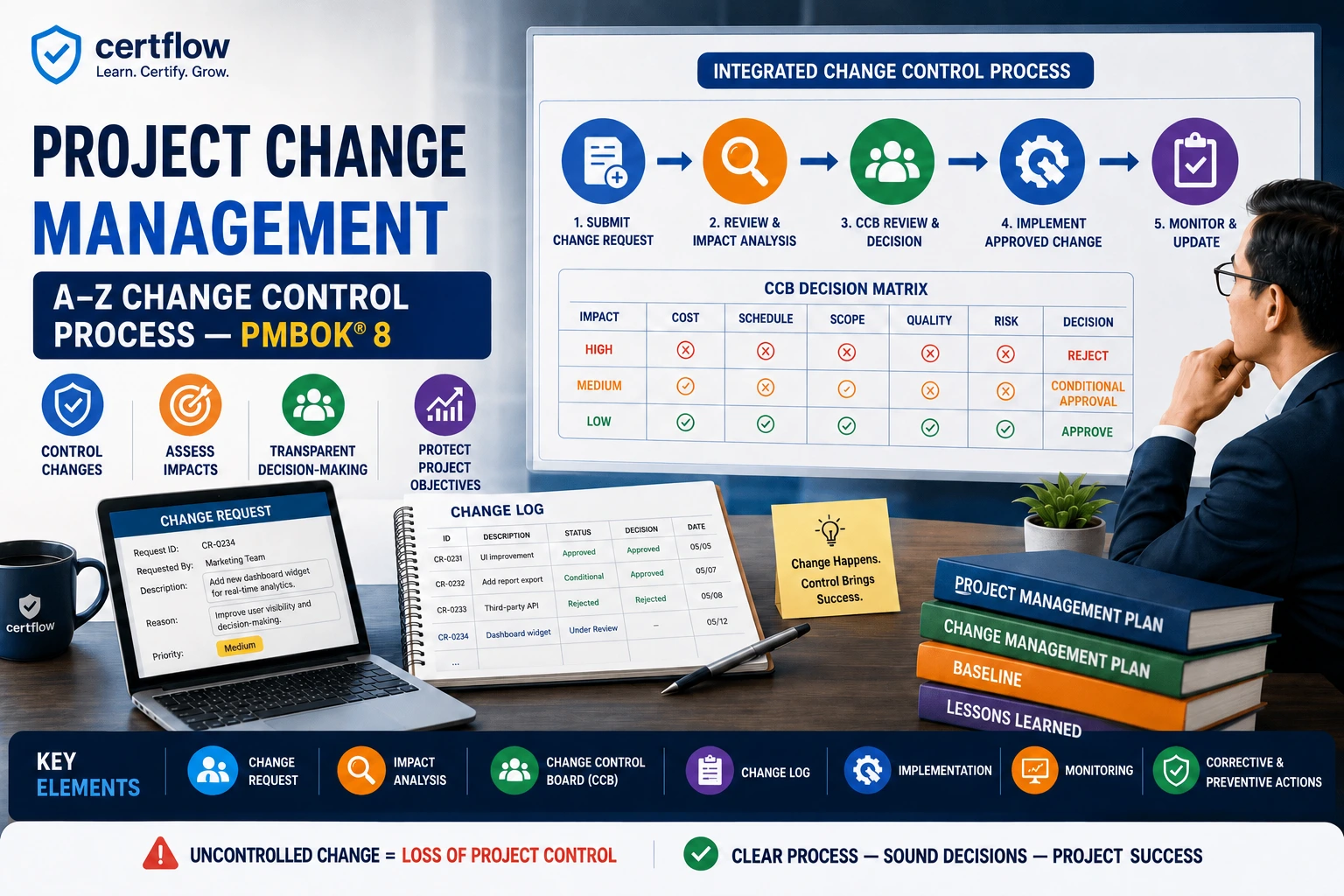
PMBOK 8 describes the Assess and Implement Changes process with a clear flow diagram:
7-Step Change Control Process
Identify the change — Any stakeholder can submit a request. Verbal requests MUST be documented in writing.
Document the change request — Log it in the change management system. Include: description, rationale, requester, urgency, and initial impact estimate.
Conduct impact analysis — Evaluate impact across ALL dimensions: scope, schedule, cost, quality, risk, resources, and stakeholders.
Submit to the decision authority — PM, CCB, or sponsor depending on the governance framework.
Decision — Approved, Rejected, or Deferred.
Implement (if approved) — Execute through Manage Project Execution. Update baselines if required.
Verify and document — Confirm implementation is correct. Update change log and project documents.
PMBOK® 8, Section 2.1.6.8.1: "Although changes can be initiated verbally, they should be documented in writing and entered into the change or configuration management system. Change requests should typically include information on the estimated schedule and cost impacts before they can be approved."
Change Control Flow — PMBOK 8
PMBOK 8 Figure 2-11 describes the flow: Change Request → Impact Analysis (Scope, Schedule, Finance, Resources, Risk, Stakeholders) → Decision (Approved / Rejected / Deferred / More Information Needed) → If Approved: Corrective Action, Preventive Action, Defect Repair, or Update. Each branch then impacts all project domains in turn.
5. Change Control Board (CCB) — Who decides?
PMBOK® 8: "A change control board (CCB) is a formally established group responsible for reviewing, evaluating, approving, deferring, or rejecting changes — and for documenting and communicating these decisions."
Role | Authority | Typical decisions |
|---|---|---|
PM | Minor changes within delegated authority, CR submission | Corrective actions within contingency, minor schedule adjustments |
CCB | Baseline changes, significant CRs | Scope changes, schedule baseline changes, cost baseline changes |
Sponsor | Strategic decisions, major budget changes | Major scope additions, project continuation, budget increases |
Customer | Customer-specific changes (if CCB member) | Customer requirement changes, acceptance criteria changes |
PMBOK 8 notes: "While awaiting the decision of the CCB, project managers should continually execute planned tasks while also analyzing the impact and risks related to accepting or rejecting the proposed changes to minimize negative impacts." — The project does not stop to wait for a CCB decision.
Configuration Management
PMBOK 8: The configuration management plan identifies "which project artifacts are subject to configuration control." This is the system that tracks: which version is current, who changed what, when, and why. Without configuration management = "I found 3 versions of the requirements document — which one is correct?"
6. Impact Analysis — Evaluate before deciding
Every change request must be evaluated across ALL dimensions — not just the one directly affected:
Dimension | Impact question | Example |
|---|---|---|
Scope | How does the WBS change? Which deliverables are affected? | Adding a module → additional work packages |
Schedule | Is the critical path affected? Does duration increase? | Add 3 weeks of development + 2 weeks of testing |
Cost | What is the budget impact? Are additional reserves needed? | $50K additional development + $10K testing |
Quality | Do quality standards change? Does the testing plan need updating? | New module requires integration testing |
Risk | Do new risks emerge? Do existing risks change? | Integration risk increases, new vendor dependency |
Resources | Are more people needed? New skills? Conflicts? | Need 2 more developers, a database specialist |
Stakeholders | Who is affected? Does the communication plan need updating? | Training plan for end users changes |
PMBOK® 8: "Approved change requests may require new or updated cost estimates, schedule adjustments, resource requirements, and risk assessments. These changes may also require updates to the project management plan and other project documents."
7. Communicate and implement changes
Communicate Status of Proposed Changes
The change log must track: CR number, description, date submitted, requester, status (pending/approved/rejected/deferred), impact summary, decision date, and decision rationale. PMBOK 8: "The disposition of all change requests is recorded in the change log as a project document update."
Communication must reach: the requester (CR accepted/rejected/deferred with rationale), affected team members (what changes for them), stakeholders (updated timeline, scope, cost), and governance (CCB decisions documented).
Implement Approved Changes
PMBOK 8: "Approved change requests are implemented via the Manage Project Execution process." Implementation includes: executing the change per plan, verifying the change is implemented correctly, updating baselines (scope/schedule/cost as needed), updating project documents (risk register, stakeholder register, communications plan), and confirming results meet expectations.
Update Documentation
After each approved change: update affected project management plan components, scope baseline / schedule baseline / cost baseline (if changed), the change log (update status), the lessons learned register (if applicable), and the risk register (new or modified risks).
8. Predictive vs. Adaptive change management
Aspect | Predictive | Adaptive |
|---|---|---|
Process | Formal change control with CCB | Backlog management — PO adds/reprioritizes items |
When changes are controlled | After baselines are established | Continuously throughout iterations |
Decision-maker | CCB, PM, Sponsor | Product Owner (with team input) |
Impact analysis | Formal, documented, multi-dimensional | Conducted but less formal — evaluated by priority vs. capacity |
"Approved" | CCB formally approves/rejects/defers | PO adds to backlog (= accepted). Low priority item (= deferred). Removed from backlog (= rejected). |
Documentation | Change log, updated baselines, plan updates | Backlog updates, sprint records, Definition of Done revisions |
Baseline | Updated through formal CCB approval | Iteration baseline changes per sprint planning |
PMBOK® 8, Section 2.1.6.8.2: "In adaptive approaches, managing project changes typically involves backlog management rather than a formal change request process. Although these are not formally termed as change requests, an impact analysis is conducted to evaluate the change's effect and set its priority."
Key point: even in adaptive environments, some changes still need formal control — budget increases, contract changes, regulatory changes, and major architecture decisions. Hybrid approach: formal CCB for "big" changes, backlog management for "small" changes.
9. PMP Exam Tips
💡Tip 1 — ALL changes go through change control: In predictive, AFTER baselines are established, ALL changes must go through formal change control. "Just a small change" is not a reason to skip the process. When a question describes "a stakeholder requesting a minor addition" → still submit a change request.
💡Tip 2 — Assess impact BEFORE deciding: When a question asks "what should the PM do FIRST when receiving a change request?" → assess impact (impact analysis) FIRST — NOT approve, reject, or implement. Impact analysis comes before the decision.
💡Tip 3 — 4 types of changes: Corrective (fix a deviation), Preventive (prevent a future issue), Defect Repair (fix the product), Update (change scope/baseline). When a question describes a situation → identify WHICH type applies.
💡Tip 4 — Don't stop work waiting for CCB: PMBOK 8 is explicit: "while awaiting CCB decision, the PM should continue executing planned tasks." The project does not freeze while waiting for the CCB.
10. Ten scenario-based practice questions
Question 1
The sponsor verbally requests adding a new feature during a hallway conversation. The feature aligns with the project vision.
What should you do?
A. Add the feature since the sponsor has authority and it aligns with the vision.
B. Document the request as a formal change request, conduct impact analysis on scope/schedule/cost/risk, and submit to the appropriate decision authority per the change management plan.
C. Add it to the backlog and prioritize later.
D. Ask the sponsor to submit a formal written request.
Question 2
Your project receives a change request to add a security feature. Impact analysis shows: +$30K cost, +2 weeks schedule, but it significantly reduces the risk of a data breach (estimated $2M exposure).
What should you recommend to the CCB?
A. Reject — it increases cost and schedule.
B. Approve — the $30K investment to mitigate a $2M risk exposure is a strong positive ROI. Present the impact analysis with a risk-value comparison to support an informed decision.
C. Defer until the next phase.
D. Approve but find savings elsewhere to offset the $30K.
Question 3
Your team discovers a defect in a delivered module. The defect causes incorrect calculations in 5% of transactions.
What type of change request should be submitted?
A. Corrective action — to bring performance back to plan.
B. Preventive action — to prevent future defects.
C. Defect repair — to fix the product defect.
D. Update — to modify the deliverable.
Question 4
The SPI is 0.85, indicating the project is behind schedule. The PM decides to add overtime for the team to recover.
What type of change is this?
A. Defect repair
B. Preventive action
C. Corrective action — the PM is taking action to bring schedule performance BACK to plan.
D. Update
Question 5
A stakeholder submits a change request. While waiting for the CCB review (scheduled in 5 days), the PM stops all related work "to avoid rework if the change is approved."
Is this the right approach?
A. Yes — it prevents potential rework.
B. No — PMBOK 8 states the PM should "continue executing planned tasks while awaiting CCB decision." Stopping work creates unnecessary delay. The PM should analyze impacts while continuing planned execution.
C. It depends on the size of the change.
D. The PM should escalate for a faster CCB review.
Question 6
Your agile team's Product Owner adds 10 new user stories to the backlog based on customer feedback. A team member complains: "This is scope creep — we need a change request."
How should you respond?
A. The team member is right — submit formal CRs for each story.
B. In adaptive environments, backlog management IS the change process. The PO has authority to add items. Adding to the backlog with appropriate prioritization is the correct approach — not every addition requires a formal CR.
C. Remove the stories until the CCB approves them.
D. Accept the stories but flag them as "unplanned scope."
Question 7
The CCB approves a scope change that adds 3 new requirements. The PM implements the change but forgets to update the WBS, schedule baseline, and risk register.
What problem will this create?
A. No problem — the change was approved and implemented.
B. The project documents no longer reflect reality. Future decisions will be based on outdated baselines — variance analysis will be meaningless, risk exposure is unknown, and the team may not know the full scope. ALL affected documents must be updated after approved changes.
C. The PM should update documents at the next milestone.
D. The PMO will catch the documentation gap in their audit.
Question 8
A critical production outage occurs. The fix requires an immediate code change and deployment. There's no time for the normal CCB review process.
What should you do?
A. Implement the fix and skip the change process — it's an emergency.
B. Implement the emergency fix following the emergency change procedures defined in the change management plan — then retroactively document the change, conduct impact analysis, and submit to the CCB for formal approval at the next meeting.
C. Wait for CCB approval — even emergencies must follow process.
D. Have the sponsor approve verbally and document later.
Question 9
Over the past 3 months, 15 change requests were approved, adding 25% to scope. Each was properly evaluated and approved by the CCB. The sponsor now says: "The project feels completely different from what we started."
What went wrong?
A. Nothing — every change was properly approved.
B. While individual changes were properly governed, nobody assessed the CUMULATIVE impact on the project's value proposition. The PM should have flagged the trend when scope growth exceeded a threshold, presenting a holistic view of how the project evolved versus the original business case.
C. The CCB should have been more restrictive.
D. The sponsor should have attended CCB meetings.
Question 10
A team member implements a "small improvement" to the codebase without submitting a change request. The improvement works well and other team members praise it.
How should you handle this?
A. Praise the initiative — the improvement is beneficial.
B. Acknowledge the good intent, but explain that ALL changes to baselined deliverables must go through the change process — even beneficial ones. Retroactively document the change, assess any impacts, and reinforce the importance of process compliance to prevent uncontrolled changes.
C. Add the improvement to the change log retroactively.
D. This is gold plating — it should be reversed.
Answer Key
Question 1: Answer: B
— PMBOK 8: "Although changes can be initiated verbally, they should be documented in writing and entered into the change management system." Even from the sponsor, even if aligned with the vision — the process must be followed. Impact must be assessed before implementation.
Question 2: Answer: B
— Change decisions should be based on value, not just cost/schedule impact. PMBOK 8: evaluate changes against the project's value proposition. $30K + 2 weeks to avoid $2M exposure = a highly favorable trade-off. The PM should RECOMMEND with data, and the CCB DECIDES.
Question 3: Answer: C
— A defect in a deliverable = defect repair. Corrective action (A) addresses process deviation, not a product defect. Preventive action (B) prevents FUTURE issues. Update (D) modifies scope, not fixes existing functionality.
Question 4: Answer: C
— SPI < 1.0 = behind schedule = deviation from plan. Adding overtime to recover = corrective action. Corrective action = "intentional activity that realigns the performance of the project work with the project management plan."
Question 5: Answer: B
— PMBOK 8 explicitly states: "While awaiting the decision of the CCB, project managers should continually execute planned tasks while also analyzing the impact." Stopping work = a self-imposed delay. If the change IS approved, rework may occur — but that's a managed risk, not a reason to halt progress.
Question 6: Answer: B
— PMBOK 8: "In adaptive approaches, changes involve backlog management rather than a formal change request process. Any proposed change can be added to the backlog." The PO adding prioritized stories based on customer feedback is exactly how agile is supposed to work. It's not scope creep if it's managed through backlog prioritization.
Question 7: Answer: B
— PMBOK 8: "Approved changes may require updates to the project management plan and other project documents." Implementing without updating documentation means baselines diverge from reality. EVM becomes meaningless (comparing actuals against the wrong baseline), risks aren't tracked, and the team doesn't have accurate scope information.
Question 8: Answer: B
— Most change management plans include emergency procedures for exactly this type of situation. The key: act quickly but FOLLOW the emergency process, then retroactively formalize. Skipping entirely (A) sets a dangerous precedent. Waiting (C) causes ongoing damage. The change management plan should define what constitutes an "emergency" and the expedited approval path.
Question 9: Answer: B
— Individual compliance does not equal strategic alignment. PMBOK 8's Adopt a Holistic View: "candidate baseline changes are evaluated for which one might yield the highest return on investment." The PM should monitor cumulative change impact and flag when the project has drifted significantly from its original value proposition.
Question 10: Answer: B
— Even beneficial changes must be controlled. PMBOK 8: "Once the project has a baseline, all changes should go through a formal process." Uncontrolled "improvements" set a precedent where anyone can modify deliverables without oversight. The PM should acknowledge the intent (positive), enforce the process (non-negotiable), and document retroactively.
11. Conclusion
Change control is the project's "safety valve" — allowing necessary changes while preventing chaos when left uncontrolled. Three key takeaways:
Process BEFORE decision — Every change must go through the process: document → impact analysis → decision → implement → update. "Just a small change" is not a reason to skip the process. Impact analysis across ALL dimensions (scope, schedule, cost, quality, risk, resources, stakeholders) comes BEFORE approval.
Predictive ≠ Adaptive, but both need control — Predictive uses a formal CCB. Adaptive uses backlog management. But both MANAGE changes — just through different mechanisms. And in hybrid environments, "big" changes still require a formal CCB even when daily work follows the agile backlog.
Document everything, assess cumulative impact — The change log must be current. Baselines must be updated. Project documents must reflect reality. And the PM must monitor CUMULATIVE change impact — 15 approved change requests adding 25% to scope is still a red flag, even if each CR was individually approved.
PMBOK® 8: "Changes are made to create improvements to the original plan and baseline, often based on changing conditions. The results of the changes should be monitored to ensure they yield the desired results."
Frequently Asked Questions (FAQ)
How does the Integrated Change Control process work according to PMBOK?
Integrated Change Control (ICC) is the process of evaluating all change requests and approving or rejecting them. Steps: (1) Submit a change request (CR) in writing; (2) PM assesses impact on scope, schedule, cost, quality, and risks; (3) CCB reviews and decides (approve/reject/defer); (4) If approved: update plans, baselines, and notify stakeholders; (5) Implement the change. All changes must go through ICC.
Who is on the Change Control Board (CCB) and what is their authority?
The CCB typically includes: the PM, the Sponsor or their representative, key stakeholders, and relevant domain experts. Authority: approve changes within the scope of delegated authority; escalate to Sponsor/Executive for major changes that exceed the threshold. Composition varies by project size and complexity — a small project may have only the PM and Sponsor; a large project may have formal CCB meetings.
How do agile projects manage change differently from predictive projects?
Agile: change is expected and welcomed through Product Backlog grooming — adding, removing, and reprioritizing stories based on feedback. No formal CCB is needed for sprint-level changes. Predictive: change control is more formalized, baselines are protected, and all changes go through ICC. Hybrid: applies a formal CCB for major scope/budget changes, but agile flexibility for sprint-level adjustments.
Now that you understand project change management — it's time to practice with real exam questions.
Next article: Removing Impediments & Managing Issues per PMBOK 8
Try Free PMP Practice Questions →
Official References: