Unclear scope kills projects before they begin. Discover how PMBOK 8 defines scope, builds stakeholder consensus, and structures your WBS correctly.
1. Why scope is the "heart" of every project
Imagine: you're managing a food delivery app project. The development team finishes all features per the requirements. The go-live is successful. But two weeks later, users complain: "The app is too slow — it takes 8 seconds to load the menu." The dev team responds: "Nobody specified a performance requirement. We delivered exactly what was in scope."
Who's right? Under the traditional interpretation — the team is right. But PMBOK 8 says otherwise:
PMBOK® 8, Section 2.2: "Scope carries a unique and central place in project management, as the value of a project derives from the outcome delivered in alignment with its scope." And: "Quality is an integral attribute of scope and can include both functional and nonfunctional requirements."
Performance (8-second load time) is a nonfunctional requirement — and it belongs to scope. If the app is slow, scope is not complete — even if every feature is present. Quality IS scope, not something separate.
This is the most important mindset shift PMBOK 8 brings to scope management.
2. Project Scope vs. Product Scope — A clear distinction
Project Scope | Product Scope
| |
|---|---|---|
Definition | The work required to deliver the product | The features, functions, and characteristics of the product |
Answers | "What do we need to DO?" | "What does the product LOOK LIKE?" |
Measured by | Comparing against the project management plan | Comparing against product requirements |
Example | Design → develop → test → deploy → train | App supports iOS/Android, real-time tracking, payment integration |
Both must be managed — but product scope is usually what stakeholders care about most, while project scope is what the PM manages day to day.
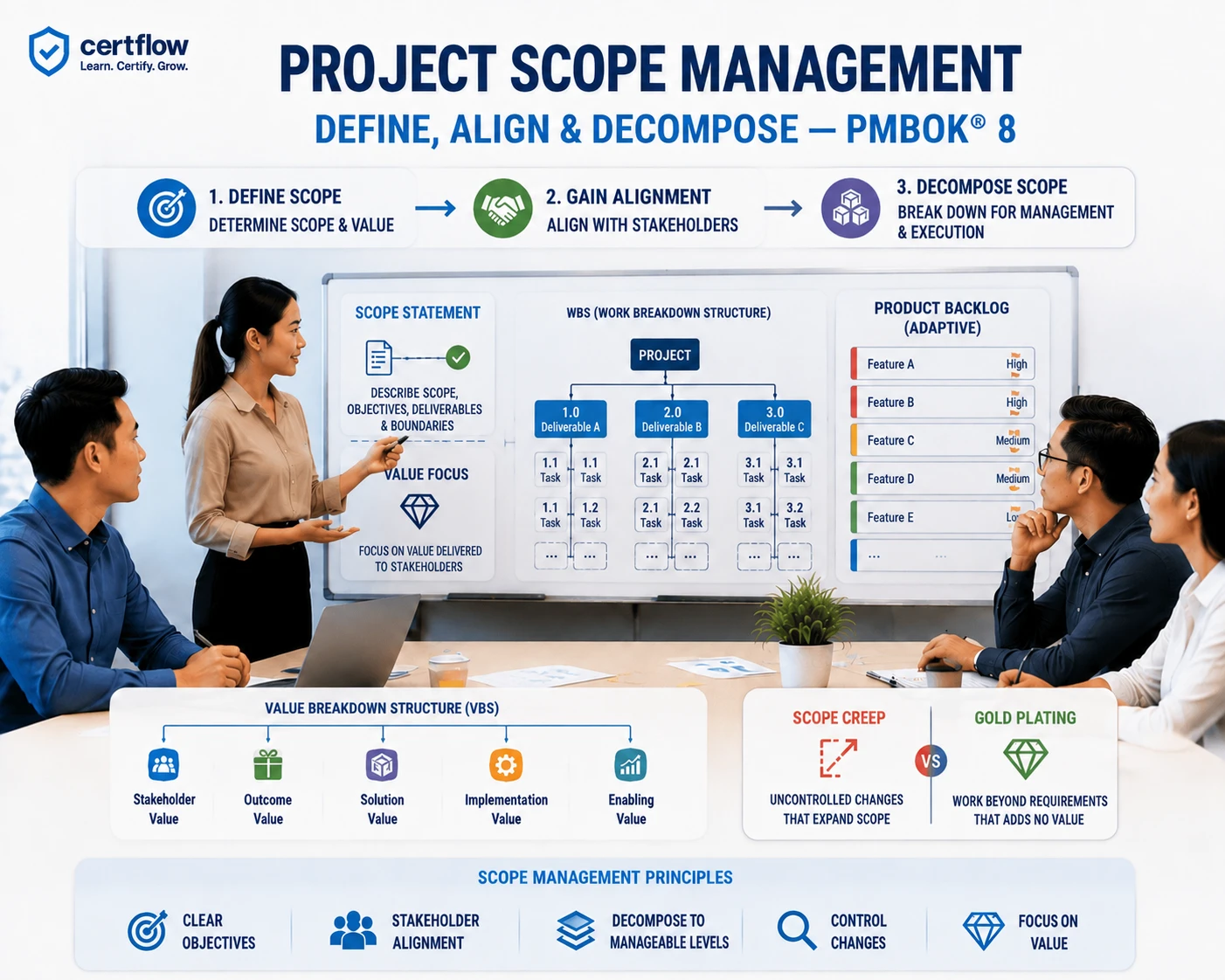
3. The 3-enabler framework for scope management
Step | Enabler | Core question | Key output
|
|---|---|---|---|
1 | Define scope | What does the project include — and what does it NOT include? | Scope statement / Product backlog |
2 | Obtain agreement | Do stakeholders agree on scope? | Approved baseline / PO acceptance |
3 | Break down scope | Is scope decomposed into manageable components? | WBS / Epics → Stories → Tasks |
4. Enabler 1: Define Scope — From requirements to scope statement
First step: Elicit and Analyze Requirements
Before defining scope, you must understand what stakeholders need. PMBOK 8 (Section 2.2.2.2): "Define and document stakeholders' needs associated with the features and functions required in the product to assure quality and value."
Elicitation tools from PMBOK 8:
Tool | Description | When to use
|
|---|---|---|
Interviews | One-on-one or small group, formal or informal | Extracting deep insights, confidential information |
Focus Groups | Prequalified stakeholders + SMEs in discussion | Assessing collective reactions, expectations |
Brainstorming | Generate ideas in a group, no judgment | Creativity, innovation, generating multiple options |
Questionnaires | Written questions for large audiences | Geographically dispersed groups, rapid data collection |
Benchmarking | Comparing against best practices or competitors | Establishing standards, performance targets |
Document analysis | Review existing documents, contracts, regulations | Understanding constraints, legacy requirements |
Design Thinking | New in PMBOK 8: Empathize → Define → Ideate → Prototype → Test | Vague requirements, innovation needed, user-centered design |
Nominal Group Technique | "Structured method to equalize participation" | When preventing dominant voices, ensuring equal input |
🌟 New in PMBOK 8 — Design Thinking: This user-centered approach is especially valuable when stakeholders say "I don't know exactly what I want." Instead of trying to extract requirements through interviews alone, the PM creates prototypes for stakeholders to react to — requirements crystallize through real-world experience.
Define Scope Statement
PMBOK 8 (Section 2.2.2.3): "Develop a detailed or high-level description of the project, product, and value expected to be delivered."
The Project Scope Statement includes:
Product scope description — features, functions, characteristics
Acceptance criteria — conditions that deliverables must meet
Deliverables — including PM deliverables (reports, plans)
Project exclusions — explicitly stating what is NOT in scope
Constraints and assumptions
In Adaptive environments: PMBOK 8: "In agile projects, the scope is typically considered at a high level, often represented by the product roadmap with its releases." Requirements are collected as user stories, prioritized in the product backlog. Scope is progressively refined through each iteration.
5. Enabler 2: Obtain Stakeholder Agreement
Scope only has value when stakeholders agree — not just "are informed."
Predictive: Formal Approval
The scope baseline (scope statement + WBS + WBS dictionary) must be formally approved by the sponsor and key stakeholders. After approval, all changes must go through formal change control (CCB).
PMBOK® 8: "The scope baseline is the approved version of formal scope documents that can be changed using formal change control procedures and is used as the basis for comparison to actual results."
Adaptive: Collaborative Agreement
The Product Owner is responsible for scope (backlog). Stakeholders agree through: sprint planning (agree on sprint goals), sprint reviews (accept or reject the increment), and backlog refinement (prioritize upcoming work). PMBOK 8: "In adaptive environments, it is usually a product owner who dynamically approves changes without a formal change control procedure."
"Agreement" is more than a signature
Sign-off | True Agreement
| |
|---|---|---|
Behavior | Signing a document that may not have been read carefully | Clearly understanding scope, trade-offs, and commitment |
Understanding | "I know this document exists" | "I understand what we will and will NOT deliver" |
When changes arise | "But I signed off on something different!" | "I understand the trade-offs — let's discuss options" |
Outcome | Formal compliance, potential surprises | Shared understanding, informed decisions |
PMs should test agreement by asking stakeholders to paraphrase the scope: "Can you summarize what the project will and will not deliver?" If the answer diverges from the scope statement — true agreement has not been reached.
6. Enabler 3: Break Down Scope — WBS, Backlog, and VBS
PMBOK 8 calls this process Develop Scope Structure (Section 2.2.2.4). The purpose: decompose scope into "smaller, more manageable components" that can be assigned, tracked, and measured.
Predictive: Work Breakdown Structure (WBS)
PMBOK 8: "A hierarchical decomposition of the total scope of work into smaller, manageable work packages."
The WBS comes with a WBS Dictionary: "scope descriptions, milestones, responsible parties, resource needs, and acceptance criteria" for each WBS element. Scope Baseline = Scope Statement + WBS + WBS Dictionary.
Decomposition rule: work packages should follow the 8/80 rule — each work package should require between 8 hours (1 day) and 80 hours (2 weeks) of effort. Under 8 hours = too granular, creates management overhead. Over 80 hours = too large, hard to track and measure.
Adaptive: Product Backlog Breakdown
PMBOK 8: "In agile projects, the WBS corresponds to the product backlog, where work items can be broken down into epics, features, and user stories."
Level | Description | Size | Example
|
|---|---|---|---|
Epic | Large body of work representing a business outcome | Multiple sprints | "Payment system" |
Feature | Functionality that delivers value | 1–2 sprints | "Credit card processing" |
User Story | "As a [user], I want [goal] so that [benefit]" | Fits in 1 sprint | "As a buyer, I want to save my card for faster checkout" |
Task | Technical work required to complete a story | Hours | "Implement card tokenization API" |
PMBOK 8: "The product backlog is a dynamic, prioritized list providing teams with a framework for managing scope by focusing on value-driven outcomes, enabling continuous prioritization, and maintaining alignment with stakeholder expectations."
Value Breakdown Structure (VBS) — New tool in PMBOK 8
PMBOK® 8: "A VBS is a hierarchical structure that connects project scope and its intended value to the product scope that will generate that value. The value that each deliverable is expected to add should be an input — either a value-based number (e.g., dollars of revenue, students taught to read, or lives saved) or a percentage of the expected total value (100% if mandatory). These value-added estimates can then be used to prioritize deliverables and estimate the drag cost of each critical path item."
The VBS answers the question: "How much is this deliverable worth?" — helping PMs decide when scope must be cut: remove the lowest-value item, retain the highest-value item.
7. Scope Creep vs. Gold Plating — Two silent enemies
Scope Creep | Gold Plating
| |
|---|---|---|
Definition | Uncontrolled scope expansion without formal approval | Team adds features no one requested |
Source | EXTERNAL — stakeholder requests, "just a small addition" | INTERNAL — team being "helpful," adding extras |
Example | Client requests additional reports without going through change control | Developer adds dark mode "because users will like it" |
Harm | Schedule delay, cost overrun, quality compromise | Wasted effort, potential bugs, uncontrolled scope |
Prevention | Formal change control process (CCB) | Clear Definition of Done, team discipline, PM monitoring |
PMBOK® 8: "Meeting or exceeding value in project management does not mean to endorse or accept gold plating or scope creep, but to emphasize a value-driven decision-making process."
Both are dangerous — scope creep because it erodes baselines from the outside, gold plating because it erodes them from within and the PM may not even know.
8. Predictive vs. Adaptive Comparison
Aspect | Predictive | Adaptive
|
|---|---|---|
Scope definition | Detailed upfront, scope statement | High-level vision + product backlog |
Requirements | Requirements documentation, traceability matrix | User stories in backlog, prioritized by value |
Breakdown | WBS + WBS Dictionary | Epics → Features → User Stories → Tasks |
Baseline | Scope baseline (frozen, formal approval) | Iteration baseline (per sprint, flexible) |
Agreement | Formal sign-off by sponsor/key stakeholders | PO approves, sprint review acceptance |
Change control | Formal CCB process with impact analysis | Backlog reprioritization by PO |
Verification | Validate Scope — formal inspection | Sprint review demos, Definition of Done checks |
Quality integration | Quality management plan, audits, inspections | Definition of Done, continuous testing, CI/CD |
Creep prevention | Formal change requests required | PO gatekeeps backlog additions |
Check Results — Effectiveness metrics (PMBOK 8 Table 2-6)
Scope Definition Accuracy (%) = Planned Scope Items Correctly Delivered / Total Planned × 100. Scope Creep (%) = Unplanned Deliverables / Total Deliverables × 100. Requirements Stability (%) = Unchanged Requirements / Total Requirements × 100.
Additionally: effective change management, clear understanding of requirements, alignment with business objectives, stakeholder satisfaction, sustainability considered in scope.
🌟 New in PMBOK 8 — Sustainability in Scope: "The WBS or backlog should include activities to manage sustainability (e.g., assess and manage CO2 emissions, manage impact on local biodiversity)." — Sustainability is not an add-on; it IS PART OF scope.
9. PMP Exam Tips
📍Tip 1 — Quality IS scope: When a question describes "a deliverable that meets all functional specs but doesn't meet performance expectations" — the correct answer relates to a scope gap (nonfunctional requirements missing), NOT a standalone quality plan failure.
📍Tip 2 — Scope creep vs. Gold plating: Scope creep = uncontrolled changes from OUTSIDE (stakeholders). Gold plating = extra features from INSIDE (the team). Both are wrong. When a question says "developer adds an unrequested feature" — that is gold plating.
📍Tip 3 — WBS lowest level = work packages: The WBS does NOT decompose down to activities — activities belong to the schedule. Work packages = lowest level of the WBS. The 8/80 rule: 8–80 hours of effort per work package.
📍Tip 4 — Scope changes in adaptive: In agile, scope changes are NORMAL — but they must go through the Product Owner. "Anyone can add items to the backlog" is WRONG — the PO owns the backlog. "The team decides what to build" is WRONG — the PO decides WHAT, the team decides HOW.
10. Ten scenario-based practice questions
Question 1
During design, the client requests adding a rooftop garden to a construction project. This wasn't in the original scope. The client says: "It will increase property value significantly."
What should you do?
A. Add it since it clearly adds value.
B. Explain scope is frozen and no changes can be made.
C. Evaluate through formal change control — assess impact on scope, schedule, cost, risk — then present analysis with trade-offs to the CCB.
D. Ask the architect to include a basic design that won't impact budget.
Question 2
Your agile team is in sprint 5. The product owner wants to add 15 new user stories from recent market research. The backlog already has 80 items. Velocity is 20 points/sprint.
What is the MOST important action?
A. Accept all — PO has authority over scope in agile.
B. Reject — adding scope mid-project is creep, even in agile.
C. Work with PO to prioritize all 95 items by value, determine if existing stories should be removed or deprioritized, keeping scope aligned with vision.
D. Estimate the 15 new stories and extend the timeline.
Question 3
During requirements workshops for an e-commerce platform, marketing requests "an AI recommendation engine" but can't articulate specific behaviors or acceptance criteria. They just know competitors have it.
What approach should you take?
A. Exclude it until marketing provides clear requirements.
B. Include "AI engine" as scope and let developers decide details.
C. Use Design Thinking — empathize with end users, ideate solutions, create prototypes for feedback, progressively elaborate into testable user stories.
D. Benchmark competitor engines and replicate features.
Question 4
The sponsor asks: "Which deliverables are most critical to business value? If we had to cut scope, which items should we keep?"
What PMBOK 8 tool is MOST appropriate?
A. WBS Dictionary — detailed descriptions of each deliverable.
B. Requirements Traceability Matrix — links requirements to objectives.
C. Value Breakdown Structure (VBS) — assigns value estimates to each deliverable for data-driven prioritization.
D. Cost-Benefit Analysis — compare cost vs. benefit of each.
Question 5
A hybrid project: predictive building renovation + adaptive patient management software. A new regulation requires changes to BOTH the building layout AND the software interface.
How should you handle scope changes across both streams?
A. Submit one change request to CCB for both.
B. Use formal change control for building (predictive baseline) and add software changes to backlog for PO prioritization — but ensure both are coordinated and combined impact assessed holistically.
C. Handle both through backlog since they're driven by the same regulation.
D. Escalate to sponsor since regulatory changes need highest approval.
Question 6
After sprint review, the development team demonstrates a feature that works perfectly per acceptance criteria. But the end user says: "It works as described, but it's not what I actually need. The workflow doesn't match how we work."
What does this reveal?
A. Acceptance criteria were wrong — rewrite them.
B. This is a scope change — user requesting new functionality.
C. Requirements elicitation failed to capture actual workflow needs. The user story captured WHAT they asked for but not HOW they work. Conduct observation and process mapping to understand real-world workflows.
D. Development team should have tested with users before review.
Question 7
Since scope approval 3 months ago, 12 change requests were submitted, 8 approved. Scope has grown 30%. Schedule and budget were updated. The sponsor says: "The project feels out of control."
What is the CORE issue?
A. Change control is working correctly — all changes formally approved.
B. Original scope was poorly defined — invest more in requirements.
C. While each change was properly governed, the CUMULATIVE impact has shifted the project significantly. Present a holistic analysis of how scope/schedule/cost/value evolved vs. original baseline — help sponsor decide whether to continue, adjust, or reset.
D. Implement a scope freeze.
Question 8
Your Scrum PO writes very detailed user stories with extensive acceptance criteria — each taking 3 days to write. By the time stories are ready, requirements have already changed. The team is frustrated.
What adjustment should you recommend?
A. Keep detailed stories — quality requirements prevent rework.
B. Switch to predictive since PO prefers detailed documentation.
C. Write stories at appropriate detail for their backlog position — detailed for the next 1–2 sprints, progressively less detailed further out. Progressive elaboration.
D. Have the development team write stories instead.
Question 9
Your WBS doesn't include any testing activities. The PM who created it says: "Testing is implied — it's part of each development work package."
What is wrong?
A. Nothing — testing is part of each work package.
B. Testing should be in a separate phase.
C. The WBS is incomplete. PMBOK 8: quality is "an integral attribute of scope." Testing must be explicitly included to be planned, resourced, and tracked. Implicit assumptions lead to underfunding.
D. Add a single "Testing" line item at the end of the WBS.
Question 10
A senior developer adds a sophisticated caching layer to the application "because users will appreciate faster performance." This wasn't in the requirements or sprint backlog. It took 3 days of sprint capacity.
What is this, and what should you do?
A. This is initiative and should be praised — the developer improved the product.
B. This is gold plating — the developer added unrequested features using sprint capacity. Address privately: acknowledge the intent, but explain that all scope additions must go through the PO for prioritization. 3 days of sprint capacity was used for unplanned work.
C. This is scope creep — add a change request.
D. Test the caching layer and include it if it works.
Answer Key
Question 1: Answer: C
— PMBOK 8: scope baseline "can be changed using formal change control procedures." Adding without approval (A) = scope creep. Refusing without analysis (B) = inflexible. Unilateral change (D) bypasses governance. Assess, analyze, present — let CCB decide.
Question 2: Answer: C
— PMBOK 8: "The product backlog provides a framework for managing scope by focusing on VALUE-DRIVEN outcomes, enabling continuous prioritization." In agile, scope change is expected but must be managed through prioritization. The PO adds but the team helps ensure focus.
Question 3: Answer: C
— PMBOK 8 introduces Design Thinking for Elicit and Analyze Requirements — specifically for unclear, innovation-needed situations. The approach helps stakeholders who "know it when they see it" move from vague to concrete. Excluding (A) loses value. Vague inclusion (B) = gold plating risk.
Question 4: Answer: C
— PMBOK 8 VBS: "value-added estimates can be used to prioritize deliverables." VBS directly connects scope items to their value contribution. WBS (A) shows structure, not value. RTM (B) shows traceability, not priority. CBA (D) works but VBS is purpose-built for scope-to-value mapping.
Question 5: Answer: B
— Different streams use different scope management. Building = formal CCB. Software = backlog. BUT the PM must assess COMBINED impact. PMBOK 8's holistic view: ensure coordination across streams. One-size-fits-all approaches (A, C) ignore the hybrid nature.
Question 6: Answer: C
— PMBOK 8: Elicit and Analyze Requirements involves "define and document stakeholders' needs." The gap is in elicitation, not acceptance criteria. Tools like observation ("job shadowing") reveal tacit workflow requirements that interviews alone miss.
Question 7: Answer: C
— PMBOK 8: outcomes should be "iteratively assessed." Individual changes were governed but nobody assessed cumulative effect. The PM must show the big picture — 30% scope growth may or may not be viable. Scope freeze (D) is arbitrary.
Question 8: Answer: C
— PMBOK 8: "sufficient to move forward but not more detailed than necessary." Agile uses progressive elaboration — top items detailed, bottom items high-level. Over-detailing all items wastes effort when requirements change.
Question 9: Answer: C
— PMBOK 8: scope includes quality. WBS represents ALL work. If testing isn't visible, it won't appear in the schedule, won't get resources, won't be tracked. A single line (D) is better than nothing but doesn't adequately represent testing effort across deliverables.
Question 10: Answer: B
— PMBOK 8: "does not mean to endorse gold plating or scope creep, but to emphasize value-driven decision-making." Gold plating = team adding unrequested features (from INSIDE). The intent may be good, but: PO decides WHAT to build (not developer), sprint capacity was consumed without approval, and the caching may have untested side effects. PM should address the behavior while acknowledging the intent.
11. Conclusion
Scope management is where project value is defined — and also where it is most easily eroded. Three key takeaways:
1. Quality IS scope — not something separate — PMBOK 8 is explicit: nonfunctional requirements (performance, security, usability) are scope. A faster app is not "better quality" — it is "more complete scope." This mindset changes how PMs write scope statements and acceptance criteria.
2. Agreement > Sign-off — A signature on a document does not guarantee stakeholders truly understand and are committed. PMs should test agreement: ask for a paraphrase, discuss trade-offs, and especially — confirm exclusions ("What does the project NOT include?"). Clear exclusions prevent 80% of expectation gaps.
3. Break down to manage, not just to track — The WBS and Product Backlog are not just for tracking progress. They are tools for assigning ownership, estimating effort, identifying dependencies, measuring value (VBS), and communicating scope with stakeholders. Scope that isn't broken down = scope that isn't managed.
PMBOK® 8, Section 2.2: "Scope carries a unique and central place in project management, as the value of a project derives from the outcome delivered in alignment with its scope."
Frequently Asked Questions (FAQ)
How does PMBOK 8 approach scope management differently from PMBOK 6?
PMBOK 6 defined 6 specific processes for scope management (Plan, Collect, Define, Create WBS, Validate, Control). PMBOK 8 does not list processes but focuses on outcomes and principles — PMs need to understand the "why" and select appropriate methods. The approach is more flexible, especially for hybrid and agile projects.
How do you obtain stakeholder agreement on scope for a complex project?
Effective techniques include: workshops (facilitated sessions), prototyping (quick demos for stakeholder feedback), Joint Application Development (JAD), interviews, and document analysis. The key point: stakeholders must sign off on the Requirements Documentation and Scope Statement — verbal agreement is not sufficient.
What does the Scope Baseline include in PMBOK?
Scope Baseline = Project Scope Statement + WBS + WBS Dictionary. This is the approved version of scope used to compare against actual scope during execution. Any changes to the scope baseline must go through Integrated Change Control and be approved before being applied.
Now that you understand project scope management per PMBOK 8 — it's time to practice with real exam questions.
Try Free PMP Practice Questions →
Official References: