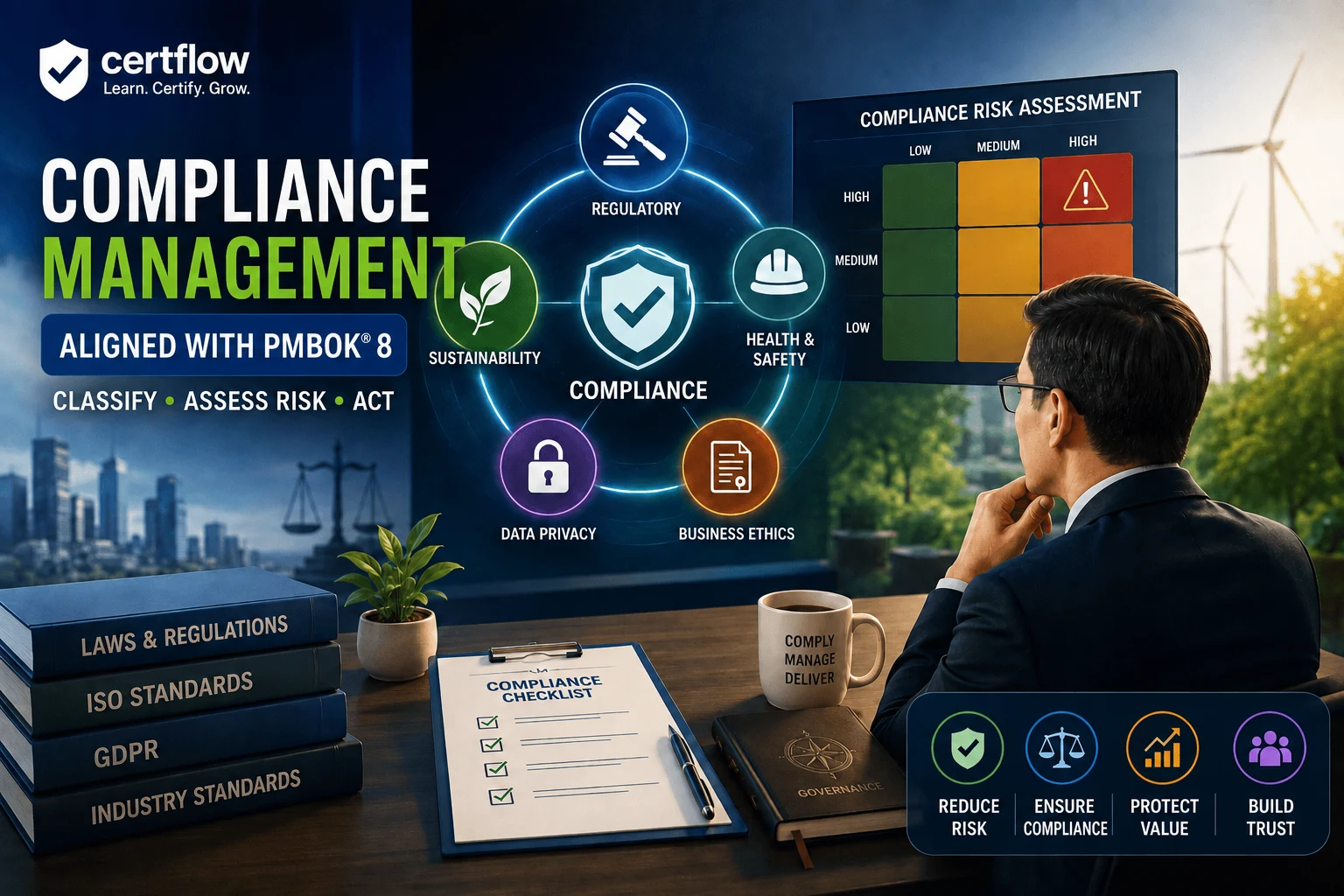
Compliance isn't just a legal checklist — it's real risk management. PMBOK 8 integrates compliance into the Business Environment domain.
1. Why Compliance Is Non-Negotiable
Many PMs treat compliance as a "side item" — something the legal team handles. In reality, compliance failures are one of the top causes of project termination.
PMBOK 8 addresses compliance in multiple contexts: governance framework enforcement, enterprise environmental factors, quality dimensions (conformity), and sustainability integration. Compliance is not a standalone performance domain — it runs through EVERY domain.
PMBOK® 8, Section 1.3.2: Organizational governance includes "enforcing legal, regulatory, and compliance requirements" and "defining ethical, social, and environmental responsibilities." Project governance must operate WITHIN these boundaries.
And in the PMP ECO, "Plan and manage project compliance" falls under the Business Environment Domain — emphasizing that compliance connects the project to the outside world: laws, regulations, industry standards, and societal expectations.
2. Compliance in the PMBOK 8 Context
PMBOK 8 does not have a dedicated chapter for compliance — instead, compliance is integrated throughout:
Performance Domain | Compliance Relevance
|
|---|---|
Governance | "Ensuring compliance with regulatory and legal requirements to maintain organizational accountability" |
Scope | Compliance requirements are PART OF scope — nonfunctional requirements |
Quality | "Conformity" is 1 of 7 quality dimensions: "Do deliverables comply with regulatory and industry standards?" |
Risk | Noncompliance is a risk — threats to compliance must appear in the risk register |
Stakeholders | Regulatory bodies are stakeholders — they must be engaged and managed |
Finance | Compliance costs (audits, certifications, training) must be included in the budget |
3. The 7-Enabler Framework for Managing Compliance
Group | Enabler | Core Question
|
|---|---|---|
Identify | Confirm compliance requirements | Which regulations apply to this project? |
Classify | Classify compliance categories | How should they be grouped for manageability? |
Assess | Determine potential threats | Which risks threaten compliance? |
Assess | Analyze consequences of noncompliance | What are the consequences of a violation? |
Act | Use methods to support compliance | What tools/processes will ensure compliance? |
Act | Determine approach and actions | What is the specific action plan? |
Monitor | Measure extent of compliance | At what level is the project currently compliant? |
4. Confirming and Classifying Compliance Requirements
Confirm Compliance Requirements
The PM must confirm compliance requirements BEFORE planning begins — because they affect scope, schedule, cost, and approach. Sources include: government regulations (federal, state, local), industry standards (ISO, IEEE, HIPAA, PCI-DSS), organizational policies (internal compliance, ethics codes), contractual obligations (SLAs, warranties, IP terms), and international requirements (cross-border data transfer, import/export).
PMBOK 8 Enterprise Environmental Factors lists: "Government or industry standards — regulatory agency regulations related to products, production, environment, safety, quality, and workmanship" and "Public health and safety regulations — government-imposed health protocols, travel restrictions, quarantine measures."
Classify Compliance Categories
Classification helps the PM manage compliance systematically — each category has different requirements, different owners, and different monitoring approaches.
Category | Includes | Example Regulations | Consequence of Noncompliance
|
|---|---|---|---|
Regulatory / Legal | Laws, government mandates | SOX, GDPR, FDA, building codes | Fines, lawsuits, project shutdown |
Health & Safety | Worker safety, public safety | OSHA, construction safety, hazmat | Injuries, fatalities, criminal liability |
Security | Data, physical, cyber security | PCI-DSS, ISO 27001, NIST | Data breaches, lawsuits, reputation |
Environmental / Sustainability | Environmental protection, emissions | EPA, carbon regulations, waste disposal | Fines, cleanup costs, community opposition |
Industry Standards | Professional/technical standards | ISO 9001, CMMI, IEEE, PMBOK | Quality issues, market rejection |
Contractual | Agreement obligations | SLAs, IP clauses, warranty terms | Penalties, termination, litigation |
Ethical | Professional conduct, fairness | PMI Code of Ethics, anti-corruption | License revocation, reputation damage |
💡 PMP Tip: When an exam question lists multiple compliance categories — the correct answer always prioritizes health & safety FIRST, then regulatory/legal, then contractual and standards. Safety of people is ALWAYS the highest priority.
5. Threats to Compliance and Consequences of Noncompliance
Determine Potential Threats
Threat | Description | Example
|
|---|---|---|
Knowledge gaps | Team doesn't know which regulations apply | Developer unaware that GDPR applies to EU users |
Evolving regulations | Regulations change mid-project | New data protection law enacted after design is complete |
Cross-jurisdiction complexity | Multinational project with differing regulations | Data residency requirements differ across EU, US, China |
Resource pressure | Tight deadline → team skips compliance steps | Security testing omitted to ship on time |
Third-party risk | Vendors/subcontractors don't comply | Subcontractor violates labor regulations |
Scope creep | New features added without assessing compliance impact | Payment feature added without PCI-DSS compliance |
Ambiguity | Regulations are unclear with multiple interpretations | "Reasonable security measures" — what counts as reasonable? |
Analyze Consequences of Noncompliance
Level | Consequence | Impact
|
|---|---|---|
Financial | Fines, penalties, lawsuits, cleanup costs | $$$$ — GDPR fines up to 4% global revenue |
Legal | Litigation, criminal charges, injunctions | Project shutdown, personal liability |
Operational | Product recall, rework, redesign | Schedule delay, cost overrun, resource waste |
Reputational | Public trust loss, media coverage, brand damage | Long-term business impact beyond project |
Strategic | Market access denied, partnerships lost | Business opportunity permanently lost |
Human | Injuries, health impacts, community harm | Irreversible — highest priority always |
PMBOK® 8, Section 1.3.1: "The project is terminated for other reasons such as legal, regulatory, or compliance issues." — Noncompliance can lead to project termination — not just fines.
6. Methods to Support Compliance
Proactive Methods — Build Compliance In
- Compliance Requirements Integration — Include compliance as PART OF scope (nonfunctional requirements, acceptance criteria, DoD). Not an "add-on" but a "built-in."
- Subject Matter Experts — Engage legal, regulatory, safety SMEs early — PMBOK 8 "Apply Expertise" function.
- Training — Train the team on relevant regulations. Knowledge gaps are threat #1.
- Compliance Checklists — PMBOK 8: checklists "ensure that a project or task is ready to start" — compliance checklists for each phase/sprint.
- Design for Compliance — Architecture decisions account for compliance from the start: data encryption by default, audit logging, role-based access.
Detective Methods — Find Noncompliance Early
- Audits — PMBOK 8: Quality audit "identifies good practices, nonconformities, gaps." Regular compliance audits — internal and external.
- Inspections — Verify deliverables meet compliance standards.
- Testing — Security testing, penetration testing, load testing, accessibility testing.
- Reviews — Phase gate reviews include compliance checkpoints: "Do deliverables comply with regulatory and industry standards?"
Corrective Methods — Fix Noncompliance
- Change requests — When compliance gaps are found, submit change requests to address them.
- Root cause analysis — Why did noncompliance occur? Process gap? Knowledge gap? Pressure?
- Corrective action plans — Timeline, responsible party, verification of fix.
- Escalation — Severe noncompliance escalated per governance framework — immediately for safety/legal issues.
7. Measuring Compliance — Metrics and Monitoring
Compliance Metrics
Metric | What It Measures | Example Target
|
|---|---|---|
Compliance completion % | % of requirements verified | 100% before go-live |
Open compliance issues | Number of unresolved issues | 0 critical, <5 medium |
Audit findings | Number of nonconformities from audits | 20% reduction vs. previous audit |
Training completion % | % of team trained on relevant regulations | 100% |
Time to resolve | Time from discovery to fix of compliance issue | <48 hours for critical |
Third-party compliance % | % of vendors meeting compliance requirements | 100% |
Continuous Monitoring
Compliance monitoring must be continuous, not event-based: regular compliance reviews (each phase or sprint), a compliance dashboard (RAG status for each category), regulatory change monitoring (scan for new/changed regulations), vendor compliance tracking, and an incident reporting mechanism.
PMBOK® 8 Check Results, Governance Domain: "Ensuring compliance with regulatory and legal requirements" — this is a mandatory outcome of the governance domain. The PM must demonstrate compliance at closure.
8. Predictive vs. Adaptive Compliance
Aspect | Predictive | Adaptive
|
|---|---|---|
Compliance planning | Detailed upfront, integrated into PM plan | Compliance requirements in DoD, sprint-level checks |
Verification | Phase gate reviews, formal inspections | Sprint reviews include compliance checks, automated testing |
Change impact | Compliance impact analysis for every change request | Product Owner considers compliance when reprioritizing backlog |
Documentation | Formal compliance records, audit trails | Lightweight but sufficient evidence (automated test results, acceptance records) |
Audits | Scheduled formal audits | Continuous — compliance checks built into CI/CD pipeline |
PMBOK 8: "For projects in heavily regulated environments, such as healthcare, there may be phase gates required for regulators to carefully assess" — regulated environments often need predictive elements EVEN in adaptive projects. Hybrid approach: agile development + predictive compliance gates.
9. PMP Exam Tips
📍 Tip 1 — Safety FIRST: When a question describes a conflict between schedule and safety compliance — safety ALWAYS wins. "Fast-track by skipping safety testing" = ALWAYS wrong. "Delay to ensure compliance" = usually right.
📍Tip 2 — Compliance = scope: Compliance requirements are PART OF scope — nonfunctional requirements. When a question says "team discovers new regulation mid-project" → submit a change request to add compliance activities to scope.
📍 Tip 3 — Regulatory bodies = stakeholders: When a regulatory body issues a new requirement → treat it as stakeholder management: identify, assess impact, engage, respond. NOT ignore or defer.
📍Tip 4 — Noncompliance escalation = immediate: When a question describes "team discovers potential regulatory violation" → escalate immediately per governance framework. Do NOT investigate first, do NOT wait for the next meeting.
10. Ten Scenario-Based Practice Questions
Question 1
Your e-commerce project is expanding to the European market. Two weeks before launch, a developer discovers that user data handling doesn't comply with GDPR. The PM says: "We'll fix it in the next release."
Is the PM's approach correct?
A. Yes — ship now, fix later to meet the deadline.
B. No — GDPR noncompliance exposes the organization to fines up to 4% of global revenue. Delay the launch, address GDPR compliance first, then launch when compliant. Compliance is non-negotiable.
C. Launch in non-EU markets first while fixing GDPR.
D. Get legal to sign a waiver accepting the risk.
Question 2
A construction project's safety officer reports that a subcontractor's workers are not wearing required fall protection at 20 feet. The subcontractor says: "We always work this way — it's faster."
What should you do FIRST?
A. Document the violation and discuss at the next safety meeting.
B. Stop the unsafe work IMMEDIATELY, ensure workers have proper fall protection, then investigate root cause and implement corrective actions with the subcontractor.
C. Issue a formal warning to the subcontractor.
D. Report to OSHA and let them handle it.
Question 3
Your agile software project adds a payment feature in Sprint 7. The team builds it quickly without considering PCI-DSS compliance. Sprint review: the PO loves it.
What compliance risk was created?
A. No risk — the PO accepted the feature.
B. Scope creep introduced a compliance gap. Payment features require PCI-DSS compliance (data encryption, access controls, audit trails). The feature must NOT be released until compliance is verified. The DoD should include compliance checks for any feature handling sensitive data.
C. PCI-DSS only applies to payment companies, not e-commerce.
D. Compliance can be added in a future sprint.
Question 4
A pharmaceutical project is in Phase 2 clinical trials. New FDA guidance is published that changes data submission requirements. The team has already collected 6 months of data under old requirements.
What should you do?
A. Continue under old requirements since the project started before the change.
B. Assess the impact of new guidance on existing data and future collection, consult regulatory affairs SME, develop a compliance plan, submit a change request if scope/schedule/cost are affected, and communicate with the FDA about transition approach.
C. Start over with new requirements.
D. Wait for FDA to formally mandate the change.
Question 5
Your project's compliance audit reveals 3 minor findings and 1 major finding related to data access controls. The auditor gives 30 days to remediate. The PM has addressed the 3 minor findings but says the major finding "requires too much rework — we'll accept the risk."
Is this approach acceptable?
A. Yes — risk acceptance is a valid strategy.
B. No — a MAJOR audit finding related to data access controls likely involves regulatory requirements that cannot be "risk accepted" by the PM. Escalate to sponsor and compliance team, develop a remediation plan, and address within the 30-day window.
C. Request an extension from the auditor.
D. Document the decision and move on.
Question 6
Your project outsources data processing to a vendor in another country. The vendor's data center doesn't meet your organization's security standards, but their prices are 40% lower.
What compliance consideration is MOST critical?
A. The cost savings justify accepting lower security standards.
B. Third-party compliance is the PM's responsibility. Verify the vendor meets ALL applicable security and data protection requirements (including cross-border data transfer regulations). Lower cost does NOT justify noncompliance.
C. Add security requirements to the contract and trust the vendor to comply.
D. Use the vendor for non-sensitive data only.
Question 7
Your team is under intense pressure to deliver by quarter-end. The QA lead says: "We need 2 more weeks for security testing." The sponsor says: "Ship now — we'll patch any issues."
How should you handle this?
A. Follow the sponsor's direction — they have authority over the project.
B. Present the compliance risk transparently: what specific security tests are pending, what vulnerabilities might exist, what the consequences of a breach could be (fines, data loss, reputation), and recommend the sponsor make an informed decision with full visibility of the risk.
C. Ship a limited release without sensitive features.
D. Document the sponsor's decision and ship as directed.
Question 8
Your organization operates in 5 countries. Each has different environmental regulations for waste disposal from your manufacturing project. Tracking compliance across all jurisdictions is becoming overwhelming.
What approach should you take?
A. Comply with the strictest country's regulations — that covers all others.
B. Create a compliance matrix categorizing requirements by jurisdiction, identify common requirements versus jurisdiction-specific ones, assign ownership for each, and establish monitoring for regulatory changes across all 5 countries.
C. Hire a compliance consultant for each country.
D. Delegate to local teams and trust their knowledge.
Question 9
During a sprint retrospective, a developer admits they bypassed the code review process to meet a deadline. The bypassed code handles patient health data in a healthcare application.
What is the compliance implication?
A. No issue — the code works and tests passed.
B. Bypassing code review for health data handling is a HIPAA compliance risk — unreviewed code may contain vulnerabilities exposing protected health information. Conduct immediate code review, assess any data exposure, implement controls to prevent bypassing reviews for compliance-sensitive code, and address the cultural pressure that led to the bypass.
C. Add the code review to the next sprint's tasks.
D. The developer should be reprimanded for not following process.
Question 10
At project closure, you discover that environmental compliance documentation for the construction project is incomplete. The operations team needs this documentation for ongoing compliance reporting to regulators.
What should you do?
A. Close the project — documentation can be completed by operations.
B. Delay closure until compliance documentation is complete. Transfer verified and complete compliance records to the operations team. Incomplete compliance documentation creates regulatory risk for the organization beyond the project.
C. Archive what exists and note the gap in lessons learned.
D. Ask the regulatory compliance team to complete the documentation.
Answers
Question 1: Answer: B
— GDPR violations carry severe penalties. "Fix later" creates legal exposure from Day 1. PMBOK 8: compliance with regulatory requirements is a governance outcome. Launching non-compliant is not a PM decision to make — it requires sponsor/legal sign-off at minimum, and most organizations would not accept this risk.
Question 2: Answer: B
— Safety compliance is IMMEDIATE — people's lives are at risk. PMBOK 8: safety is the highest priority. Stop the hazard FIRST, then investigate and correct. Documentation (A) and warnings (C) are too slow when lives are at stake.
Question 3: Answer: B
— PCI-DSS applies to ANY system handling payment card data. PO acceptance doesn't override compliance requirements. PMBOK 8: compliance is part of scope. Adding features without compliance assessment = compliance gap. DoD should include "meets applicable regulatory requirements."
Question 4: Answer: B
— Regulatory changes mid-project require systematic assessment. The PM should engage SMEs, assess impact, plan response, and communicate proactively. Ignoring (A) risks rejection at approval. Starting over (C) may be excessive — some existing data may be compliant. Waiting (D) is passive and risky.
Question 5: Answer: B
— Risk acceptance for compliance issues is different from project risks. Major findings, especially related to data security, typically involve regulatory obligations that cannot be waived by the PM. The PM should escalate — this is a governance decision, not an operational one.
Question 6: Answer: B
— Third-party risk is a major compliance threat. PMBOK 8: the PM must ensure vendor compliance. Cost savings never justify regulatory noncompliance. Contractual clauses (C) alone aren't enough without verification and monitoring. The PM must verify, not just trust.
Question 7: Answer: B
— PMBOK 8 Be an Accountable Leader: "integrity — willingness to share bad news early." The PM must present the compliance risk transparently — the sponsor can still decide to ship, but it must be an INFORMED decision, not an uninformed one. Documenting without informing (D) is CYA, not leadership.
Question 8: Answer: B
— PMBOK 8 ECO: "classify compliance categories." A structured approach (compliance matrix) makes multi-jurisdiction compliance manageable. Strictest standard (A) may not cover jurisdiction-specific requirements (e.g., specific reporting formats). Local delegation (D) without central coordination risks gaps. A matrix provides visibility and accountability.
Question 9: Answer: B
— Healthcare data = HIPAA compliance. Bypassing quality processes for compliance-sensitive code creates regulatory risk. PMBOK 8: "Embed Quality Into Processes and Deliverables." The fix is both technical (review the code NOW) and systemic (prevent bypass, address deadline pressure). Reprimanding (D) without fixing the system doesn't prevent recurrence.
Question 10: Answer: B
— PMBOK 8 closure: "Verify that all contractual, regulatory, legal, social, and environmental obligations have been met." Incomplete compliance documentation = unfulfilled closure criterion. The PM should not close until regulatory obligations are documented and transferred. This protects both the project AND the organization.
11. Conclusion
Compliance management connects the project to the outside world — laws, regulations, safety standards, and societal expectations. Three key takeaways:
- Compliance is scope, not an add-on — Regulatory requirements, safety standards, data privacy, environmental obligations — these are all nonfunctional requirements that belong in scope. The PM must integrate compliance into planning from day one, not "bolt it on" near go-live. PMBOK 8: "conformity" is 1 of 7 quality dimensions.
- Safety ALWAYS wins over schedule — When deadline and compliance conflict — compliance wins, especially health & safety. The PM must present trade-offs transparently so the sponsor can make an informed decision. "Ship now, fix later" for compliance = gambling with the organization's future.
- Classify, monitor, escalate — 7 compliance categories, each with different owners, different consequences, different monitoring approaches. A compliance matrix enables systematic management. Continuous monitoring — not "check once then forget." And when violations occur — escalate immediately per governance framework, especially for safety and legal issues.
PMBOK® 8, Section 3.7: "By integrating sustainability into project management, organizations can align with the triple bottom line — balancing social equity, environmental stewardship, and economic prosperity." Compliance is the foundation for achieving the triple bottom line — without compliance, sustainability is just slogans.
Frequently Asked Questions (FAQ)
How is compliance risk in a project different from business risk?
Business risk: failing to meet objectives, cost overrun, schedule delay — these can be accepted, transferred, or mitigated according to risk appetite. Compliance risk: violating regulations, laws, or standards — cannot simply be ignored or accepted. Consequences include fines, legal action, project shutdown, and reputational damage. Compliance risk must be identified early and addressed with a clear compliance plan.
How does PMBOK 8 approach sustainability and ESG compliance?
PMBOK 8 adds Environmental, Social, and Governance (ESG) considerations to business environment analysis. PMs need to consider: the environmental impact of project outputs, the social impact on stakeholders and community, and the organization's governance standards. ESG compliance is increasingly important, especially for international projects and publicly listed companies.
When a project audit uncovers noncompliance, how should the PM respond?
The process: (1) Acknowledge findings — without being defensive. (2) Root cause analysis — why did noncompliance occur? (3) Develop a corrective action plan with specific timelines. (4) Escalate to Sponsor and PMO. (5) Implement corrections. (6) Verify remediation. (7) Document lessons learned to prevent recurrence. PMBOK 8: transparency matters more than self-protection.
Now that you understand project compliance management — it's time to put it into practice with real exam questions.
Try Free PMP Practice Questions →
Official References: