What is adaptive planning — and why does Agile not mean "no planning"? This article covers the 4 planning levels from Daily Standup to Product Vision using the PMI framework for PMP 2026.
"Agile has no plan" — this is the most common misconception. In reality, Agile plans at multiple levels — from daily planning to a long-term product vision. What sets it apart is that Agile plans accept change, are continuously refined, and are elaborated progressively over time — rather than trying to produce a perfect plan from the start.
PMI calls this Adaptive Planning. And with 60% of PMP 2026 exam questions related to Agile/Hybrid, you must understand clearly how planning works at each level: daily, iteration, release, and high-level.
This article walks through the full Agile Planning Onion — from the inside out, from detail to big picture.
What Is Adaptive Planning? — The PMI Definition
Adaptive Planning is an approach to project planning where plans are built and refined continuously in short cycles — rather than trying to produce a complete, detailed plan at the very beginning of the project.
The core difference compared to Predictive Planning:
Predictive Planning | Adaptive Planning | |
When to plan? | Upfront (one big plan) | Continuously, each iteration |
Level of detail | Fully detailed from the start | Progressive elaboration — rolling wave |
When requirements change | Change request, formal approval | Update the backlog, re-prioritize |
Best when? | Clear requirements, low change | Unclear requirements, frequent change |
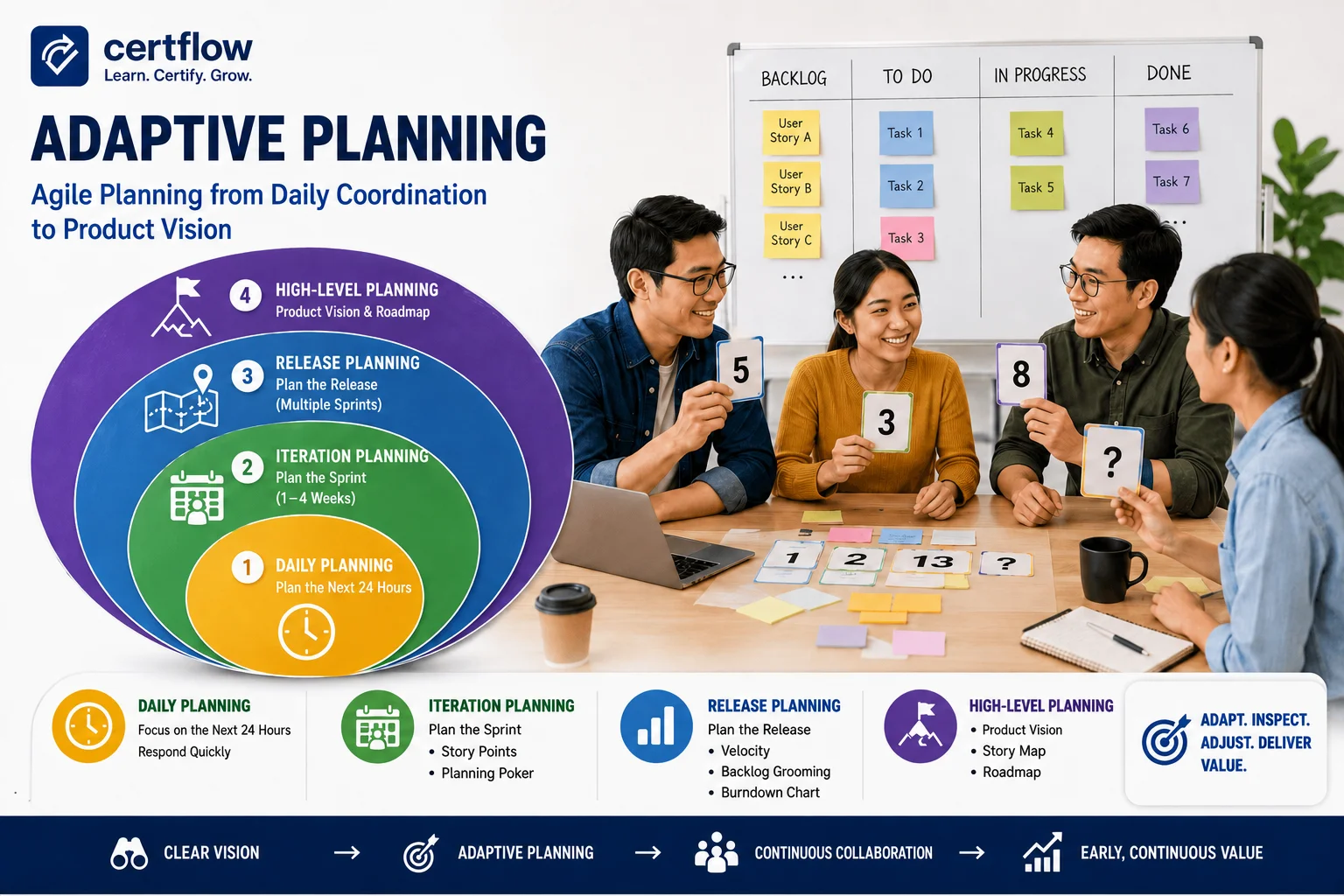
In Adaptive Planning, the plan is organized into multiple levels — from the most granular (daily) to the long-term strategic (product vision). This is the Agile Planning Onion model that PMI uses in PMP exam materials.
📍 PMP Exam Tip on Adaptive Planning: When a question describes a team "planning one sprint at a time and adjusting after each cycle" → that is Adaptive Planning. When asked "what should the PM do when requirements change in an Agile project?" → "update the product backlog and re-prioritize with the Product Owner", not "submit a change request".
Agile Planning Onion — 4 Planning Levels
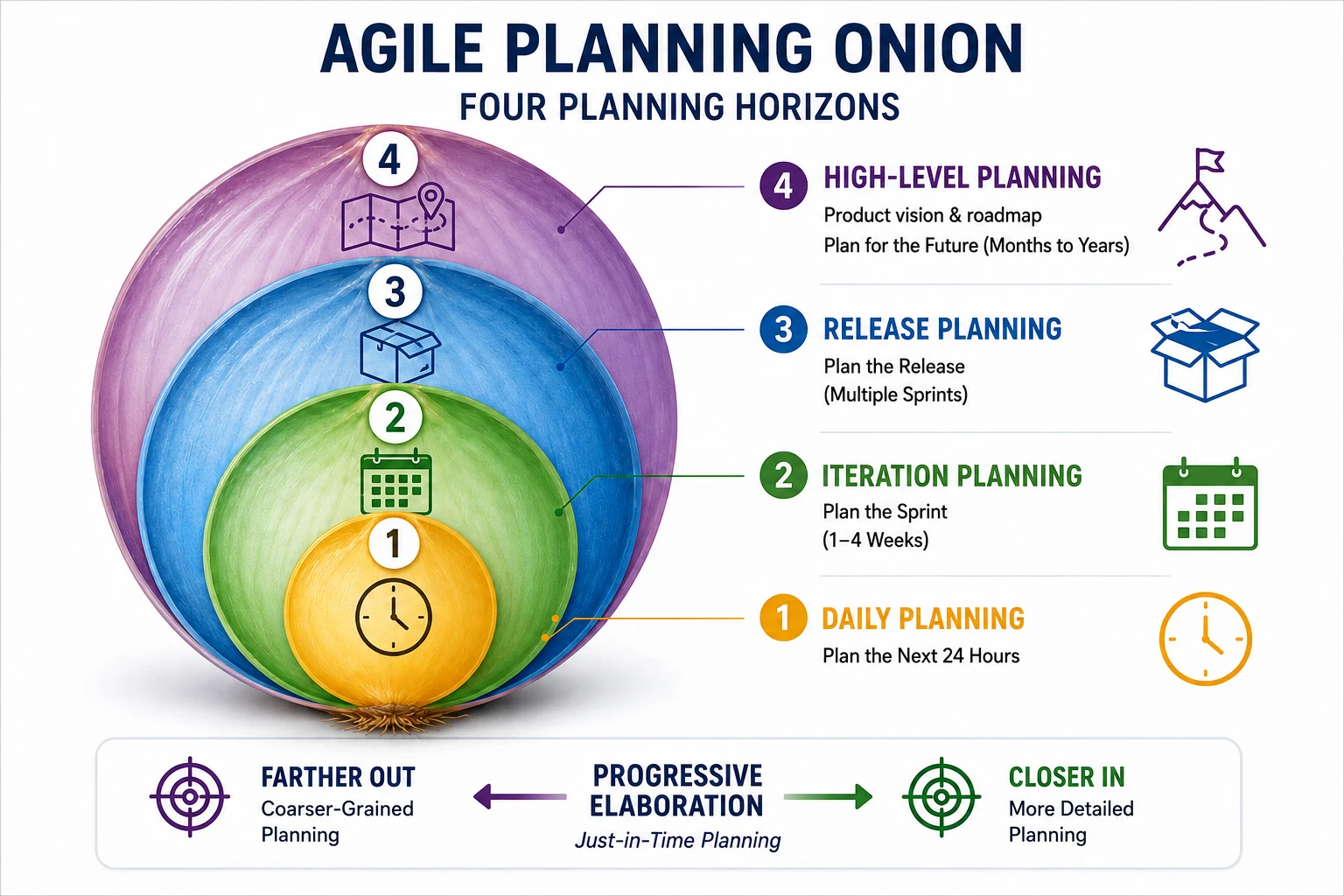
Agile planning is described as an onion — multiple nested layers:
Innermost layer: Daily Planning — plan for the next 24 hours
Layer 2: Iteration Planning — plan for a sprint (1–4 weeks)
Layer 3: Release Planning — plan for a release (multiple sprints)
Outermost layer: High-Level Planning — product vision and roadmap
The further out you go, the more coarse-grained the plan. The further in, the more detailed. This is the principle of progressive elaboration — or in Agile terms, just-in-time planning.
Level 1: Daily Planning
The most detailed level — planning for the next 24 hours through the Daily Scrum (covered in the Scrum Framework section).
🌟 Quick recap: 15 minutes, 3 questions (What did I do yesterday? What will I do today? Any impediments?). Purpose: synchronize the team and replan for the new day. NOT a status report. NOT a problem-solving session.
Level 2: Iteration Planning — Planning for a Sprint
This is the level the PMP exam tests most frequently for Agile planning.
Two Halves of Iteration Planning
First Half — WHAT | Second Half — HOW |
PO presents the backlog items to develop in the sprint | Team breaks items down into the smallest possible tasks |
Team selects the items they believe are achievable | Discuss how to implement them |
Confirm acceptance criteria | Commit to completing within the timebox |
Story Points — Relative Estimation
Why not estimate in hours? Because everyone works at a different pace — "this task will only take me 2 hours" leads to arguments. Story points use relative estimation — comparing the relative complexity between items.
How it works:
Select one story as a baseline (e.g., 1 point)
Compare other stories to the baseline — twice as complex? → 2 points. Five times? → 5 points.
Story points capture all 3 factors: complexity, work effort, AND risk
Use the Fibonacci sequence (1, 2, 3, 5, 8, 13, 21...) because humans distinguish relative differences well — it's easier to tell apart 1 vs 2 than 17 vs 18.
Planning Poker — The Most Popular Estimation Technique
A collaborative estimation game — the most widely used technique in Agile:
A facilitator (PO, SM, or team member) reads a user story
Each person selects a Fibonacci card for their estimate
Count to 3 → everyone reveals their card simultaneously (avoids anchoring bias)
If the range is small and there is rough consensus → choose the largest estimate
If the range is large → outliers explain their reasoning, then repeat the round
📍Exam Tip: Planning Poker uses the Fibonacci sequence, cards are revealed simultaneously (to avoid bias), and when there is consensus → choose the largest estimate. When a question asks "which estimation technique requires team consensus" → Planning Poker.
Ideal Time vs Real Time
Ideal Time (Effort) | Real Time (Duration) |
The time to complete a task if working on it exclusively, with no interruptions, and everything needed is available | Actual elapsed time — including breaks, distractions, and delays |
Easy to estimate | Hard to estimate — must be derived from ideal time |
Burndown Chart
A chart tracking remaining work over time within a sprint. Y-axis = remaining effort (story points or hours). X-axis = time (days). The Sprint Backlog is updated daily.
How to read a burndown chart:
- Actual line below the ideal line: Team is ahead of schedule → great performance
- Actual line close to the ideal line: On track — exactly as planned
- Actual line flat or trending upward: Team is stuck or scope has grown → intervention needed
- Actual line far above the ideal line: Too late — the sprint goal is at risk
Key distinction: The Sprint Backlog can grow with new tasks discovered during the sprint — "work emerges." This differs from a traditional fixed plan.
Level 3: Release Planning — Planning Across Multiple Sprints
A release is a group of iterations whose combined output is a valuable deliverable handed over to users.
What Is Release Planning?
- WHY: Determines which stories will be worked on in which iterations for the upcoming release
- WHO: All stakeholders — PO, team, sponsor, users
- WHEN: Before each new release begins
- OUTPUT: Shared understanding of the release goal, a list of stories, an iteration roadmap, and an outline for future releases
Velocity — The Team's Productivity Measure
Velocity = the number of story points completed per iteration.
Velocity is used for forecasting: if a team has an average velocity of 36 points/sprint and 180 points remain in the backlog → approximately 5 sprints needed.
⚠️ Important notes:
Velocity only stabilizes after a few sprints — the first sprint must be estimated based on team capacity
Do not compare velocity between teams — each team has its own story point definitions
Velocity is a planning metric, not a performance metric
Estimating First-Sprint Velocity
When no historical data is available: estimate based on each team member's capacity, identify the top-priority stories you can commit to → the total points become your initial velocity estimate. Many teams add a buffer for the first few sprints due to high uncertainty.
Backlog Grooming (Refinement)
An ongoing process of adding detail, adjusting estimates, and updating priorities in the backlog:
New stories may be added
Existing stories may be reprioritized or removed
Large stories may be sliced into smaller chunks
All changes must be discussed in the next planning meeting
Slicing User Stories — Breaking Down Epics
Epics = large user stories that span multiple iterations. They must be broken down into stories that fit within a single sprint. There is no single "right" way to slice — you can divide by:
User flow (each step in a journey)
Business rules
Data variations
Platform/interface
Affinity Estimating
Groups items into similar categories — provides a quick comparative view. Makes it easy to see whether stories with the same estimate are truly comparable in size. Commonly used in release planning when you need to estimate many items quickly.
Types of Iterations
Iteration 0: Optional — a setup stage that produces no customer deliverables. Used to prepare the environment, tools, and key architecture decisions.
Iteration H (Hardening): Prepares the accepted deliverable for release — stabilizes code, completes final documentation, performs additional testing, and compiles final assemblies.
💡 Pro Tip: When an exam question asks "how to determine how many iterations a release needs" → calculate Number of story points / Velocity. When asked "how to predict first-sprint velocity without historical data" → use team capacity estimation.
Level 4: High-Level Planning — Product Vision
The outermost layer — most coarse-grained, yet the foundation for every layer inside.
Product Vision — The Long-Term Direction
Vision is the desired end state — a set of objectives and outcomes. Why does it matter? Because a shared vision enables good relationships and alignment throughout the project.
Elevator Statement (Elevator Pitch)
A short description of the product — brief enough to deliver in an elevator ride. Template:
For: [target customer]
Who need: [customer need]
[Product name] is a [product category] that [key benefit]
Unlike [competitor], our product [unique differentiator]
The PO creates and owns the elevator statement, but the whole team contributes when building it.
Story Map
A tool to map out priorities early in planning:
Backbone: Stories describing essential functions — what the system needs to work at a basic level
Walking Skeleton: The smallest version that meets the most fundamental customer needs
Other stories are arranged below in descending priority order
Product Roadmap
The team balances customer priorities with projected capacity, outlining the plan for each release. A roadmap typically includes one or more story maps showing what will be delivered in each release. Used to communicate the plan to the PO and stakeholders.
T-shirt Sizing
A high-level estimation tool — useful in the initiation stage when precision is not yet needed:
XS, S, M, L, XL, XXL
Fast, intuitive, and suitable for coarse-grained estimates
Can later be converted to story points when more detail is required
Coarse-Grained Requirements
Initially keep requirements at a high level, then progressively refine them. Why:
Keeps the overall design balanced, prevents over-developing any one area
Defers implementation decisions to the "last responsible moment"
Allows progressive refinement as more is learned
Summary: Adaptive Planning Framework
Level | Scope | Frequency | Key Tools/Techniques |
Daily Planning | Next 24 hours | Daily | Daily Scrum, Scrum Board |
Iteration Planning | 1 Sprint (1–4 weeks) | Start of each sprint | Planning Poker, Story Points, Burndown Chart |
Release Planning | Multiple sprints | Start of each release | Velocity, Backlog Grooming, Affinity Estimating |
High-Level Planning | Entire product | Project initiation | Product Vision, Elevator Pitch, Story Map, Roadmap, T-shirt Sizing |
⚠️ Key reminders:
- Planning Onion: Daily → Iteration → Release → High-Level (detailed → big picture)
- Story Points: Relative, Fibonacci-based, includes complexity + effort + risk
- Planning Poker: Reveal simultaneously, outliers explain, choose largest when consensus
- Velocity = story points / sprint — for planning only, do not compare across teams
- Burndown Chart: Remaining work vs time — below the ideal line = on track or ahead
- Iteration 0: Setup, no deliverables. Iteration H: Hardening, prepare for release.
- Backlog Grooming: Continuously refine — add, remove, reprioritize, slice
- Epic → Stories: Slice down to fit within 1 sprint
- Elevator Pitch: For [who], Who need [what], [Product] is [category] that [benefit], Unlike [competitor]
- Story Map: Backbone (essential) → Walking Skeleton (minimum) → Priority stories
- T-shirt Sizing: XS–XXL — coarse-grained for high-level planning
- Last Responsible Moment: Defer decisions until they are needed — not a moment sooner
Adaptive Planning is the piece that ties all Agile knowledge into a complete system. If you understand how planning operates at each level, you will be able to answer the majority of Agile questions on the PMP — from estimation and velocity to release forecasting and product visioning.
Practice calculating velocity, reading burndown charts, and working through Planning Poker scenarios on CertFlow — these question types are easy points if you have the concepts locked in.
Frequently Asked Questions (FAQ)
How does adaptive planning differ from predictive planning?
Predictive planning: create a detailed plan upfront (Waterfall) — suitable when requirements are stable and change is minimal. Adaptive planning: plan at multiple levels, with progressive elaboration — suitable when requirements are unclear or frequently changing. Hybrid approaches use both.
What are release planning and iteration planning?
Release planning: determines which features will be included in the next release, the overall timeline, and business goals. Typically planned 3–6 sprints in advance. Iteration/Sprint planning: details a specific sprint — the team commits to which user stories to deliver, estimates effort, and identifies specific tasks. Release = big picture; Iteration = detailed execution.
How should a Daily Standup be run according to Scrum?
Daily Standup (15 minutes, standing): each team member answers 3 questions: (1) What did I do yesterday? (2) What will I do today? (3) Do I have any blockers? Purpose: synchronize the team and surface blockers early — it is not a status report to the SM. The SM removes blockers after the meeting, not during it.
Now that you understand Adaptive Planning — it's time to put it into practice with real exam questions.
Try Free PMP Practice Questions →
Official References: