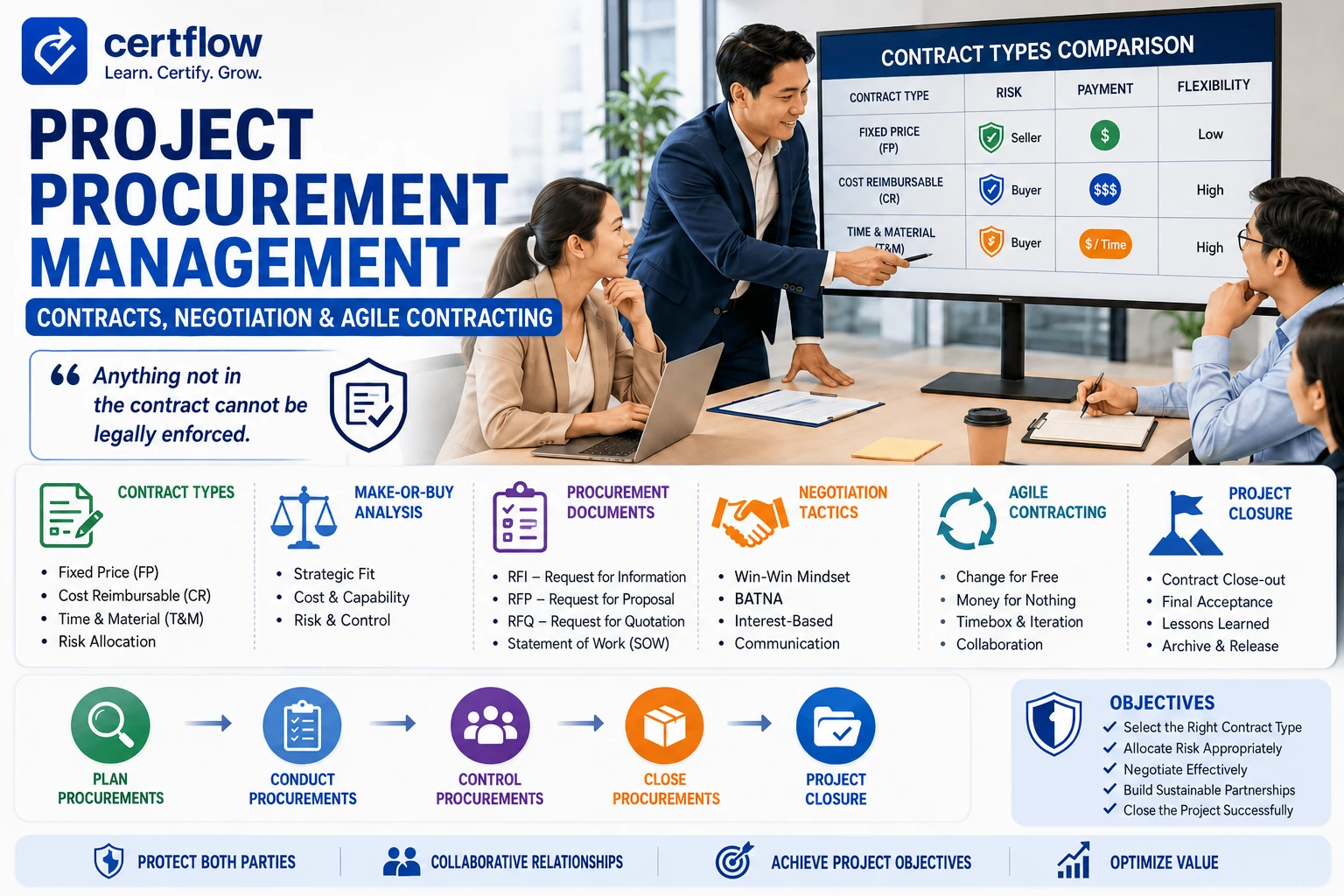
Choosing the wrong contract type can sink a project before it starts. You'll compare fixed price, cost reimbursable, T&M, and agile contracting approaches.
"Anything not in the contract cannot be legally enforced" — this sounds simple, but it is the source of countless project disputes. Procurement management is not just about "buying things" — it is the art of structuring the buyer-seller relationship so that both parties are protected and the project achieves its objectives.
This topic also includes Project Closure — the formal project-closing process that many PMs overlook. Both subjects appear regularly on the PMP exam, especially questions about contract types and risk allocation.
What Is Procurement?
Procurement is the process of acquiring products, services, or results from outside the project team. The core relationship: Buyer (the client, the purchasing organization) ↔ Agreement/Contract ↔ Seller (vendor, supplier, contractor).
The seller moves through a lifecycle: Bidder (competing for the contract) → Selected source (chosen) → Contracted supplier (under contract).
Contract Types — Must-Know Knowledge
This is the most frequently tested area within Procurement on the PMP. The three main contract types:
1. Fixed Price (FP) — Fixed Cost
The seller commits to completing the work at an agreed-upon price. Any cost overruns are absorbed by the seller.
Variant | Description | Example |
FFP (Firm Fixed Price) | Completely fixed price — no adjustment | Contract = $1,100,000. Cost overrun = seller's loss. |
FPIF (FP Incentive Fee) | Fixed price + bonus for hitting targets | $1,100,000 + $10,000/month if delivered early |
FPEPA (FP Economic Price Adj.) | Fixed price + adjustment tied to an economic index | $1,100,000 + adjustment based on next year's CPI |
Purchase Order | Simple purchase order — typically unilateral | Purchase 30 laptops |
2. Cost Reimbursable (CR) — Cost Reimbursement
The buyer pays the seller's actual costs plus a fee. Appropriate when scope is not yet clearly defined.
Variant | Description |
CPFF (Cost Plus Fixed Fee) | Cost + a fixed fee ($100,000) |
CPPC (Cost Plus % of Costs) | Cost + a percentage of costs as fee (10%) |
CPIF (Cost Plus Incentive Fee) | Cost + bonus for meeting performance targets |
CPAF (Cost Plus Award Fee) | Cost + an award fee based on the buyer's subjective evaluation |
3. Time & Material (T&M) — Time and Materials
A hybrid between FP and CR. The buyer pays by the hour plus materials. Suitable for urgent needs, unclear scope, or staff augmentation. Example: $100/hour + expenses.
Buyers typically add a "Not to Exceed" clause to cap the total cost.
Risk Allocation — Who Bears the Risk?
This is a KEY exam point:
Seller Risk | Buyer Risk | |
← Highest seller risk ——————————————— Highest buyer risk → | ||
FFP → FPIF → T&M | CPIF → CPFF → CPPC |
Fixed Price: Seller bears the most risk (fixed price, cost overrun = seller's loss). Cost Reimbursable: Buyer bears the most risk (pays actual costs, seller has no incentive to reduce costs).
📍Exam Tip: "Scope is clear" → Fixed Price. "Scope is unclear" → Cost Reimbursable. "Need speed, short-term" → T&M. When a question asks "which contract type has the highest risk for the buyer" → CPPC (buyer pays cost + % of cost = seller has no reason to economize).
Plan Procurement Management
Decide what to buy externally, how to buy it, and identify potential sellers.
Make-or-Buy Analysis
Decide whether to do it in-house or purchase/outsource:
Reasons to BUY | Reasons to MAKE |
Lack internal capacity/capability | Have idle resources available |
Want to leverage external expertise | Want direct control |
Shift risk (cost, time, scope) to the seller | Confidential or sensitive information |
Source Selection Methods
- Least Cost: Select the lowest price
- Qualifications Only: Select based solely on capability
- Quality-based: Select the highest technical score
- Quality and Cost-based: Combine both criteria
- Fixed Budget: Select the best technical proposal within a fixed budget
- Sole Source: Only one seller is available
Procurement Documents
Document | Purpose | When Used |
RFI (Request for Information) | Gather information about seller capabilities | When researching the market |
RFP (Request for Proposal) | Request detailed proposals on approach | When technical capability is the primary concern |
RFQ (Request for Quote) | Request a price quotation | When the decision is primarily price-based |
IFB (Invitation for Bid) | Formal invitation to bid | Inviting contractors/suppliers to submit offers |
NDA (Non-Disclosure Agreement) | Protect confidential information | When sharing sensitive information |
LOI (Letter of Intent) | Letter of intent — NOT a contract | When the buyer wants to signal intent to hire |
Procurement Statement of Work (SOW)
A detailed description of the scope covered by the contract — including project objectives, work description, specifications, schedule, and work location. The SOW may be revised throughout the procurement process until it is incorporated into the signed agreement.
Roles: PM vs Procurement Manager
Procurement Manager | Project Manager |
Manages procurement processes | Participates to ensure contract contains project needs |
Ensures compliance with purchasing policies | Integrates contract work into the project |
Determines contract types and procurement documents | Manages risks related to the contract |
Negotiates terms and contracts | Coordinates change management for the contract |
Conduct Procurements — Selecting a Seller
Receive proposals from sellers, evaluate them, select a seller, and sign the contract.
Key Steps
- Advertise: Expand the list of potential sellers
- Bidder Conference: A meeting with prospective sellers before they submit proposals — ensures all sellers understand the requirements equally and that NONE receives preferential treatment
- Receive & Evaluate Proposals: All proposals must be evaluated using the same criteria and methods
- Short-list: Narrow down to a few top candidates
- Presentations & Negotiations: Short-listed sellers present, then negotiate
- Award Contract: Sign the formal agreement
Negotiation Tactics — Know These for the Exam
Tactic | Description |
Deadline | Strategic delay — artificially prolonging negotiations |
Good guy/Bad guy | One negotiator is conciliatory, the other is demanding |
Limited Authority | "I don't have authority to decide" — a withdrawal tactic |
Missing Man | "The decision-maker isn't here" — an unreasonable delay tactic |
Fair and Reasonable | Propose arbitration to resolve the dispute |
Fait Accompli | "It's already done" — a done deal |
🌟 The goal of negotiation: a fair and reasonable price + a good working relationship. The PM may not necessarily be the lead negotiator.
Control Procurements — Monitor and Control
Manage the procurement relationship, monitor performance, make changes, and close out contracts.
Risk by Contract Type — How to Respond
Contract Type | Risk to Buyer | How to Control |
Fixed Price | Seller cuts scope/quality to protect profit (bait and switch) | Audit seller work, ensure SOW is clear, watch for excessive change orders |
Cost Reimbursable | Seller pads invoices, adds unnecessary resources | Audit every invoice, tie payments to milestones, verify resource quality |
T&M | Seller pads hours | Keep to a fixed duration, require deliverables by milestone dates, provide day-to-day direction |
Claims Administration
A claim is when the seller asserts that the buyer caused damages → a demand for compensation. Unresolved claims = contested changes. If unresolved → disputes → appeals → ADR (Alternative Dispute Resolution) → and ultimately litigation (the least desirable outcome).
Procurement Closure
The buyer (typically through a procurement administrator) sends a formal written notice to the seller confirming contract completion. The PM team must evaluate all deliverables and compare them against the contract BEFORE initiating closure.
Agile Contracting — Contracts for Agile Projects
Agile involves constantly evolving scope — so how is a contract structured? PMI introduces 4 special clauses:
Clause | Description | Risk Addressed |
Change for Free | Add new features at NO EXTRA COST if features of equal effort are removed from a lower priority. Customer must participate in every iteration. | Changing requirements (adding features) |
Money for Nothing | Allows the customer to terminate the project early when the remaining backlog no longer provides sufficient ROI. Customer must participate. | Changing requirements (reducing scope) |
Graduated Fixed-Price | Different hourly rates for early, on-time, and late delivery. Both parties share risk and reward. | Schedule overruns |
Fixed-Price Work Packages | Fixed price for each small work package — reduces estimation risk. Additional funding must be separately justified. | Scope overruns |
Master Service Agreement (MSA): In complex environments, an MSA governs the overall engagement, with adaptive scope placed in an appendix. Scope changes do not affect the overall contract.
💡 Pro Tip: Agile contracting appears frequently on the PMP. Remember: "Change for Free" = swap features of equal effort. "Money for Nothing" = terminate early when ROI is low. Both require the customer to participate in every iteration — if they don't, the contract reverts to T&M.
Project Closure — Formal Project Closing
Every project must be formally closed — whether it was completed successfully, cancelled, or transitioned to operations.
Administrative Closure includes:
Obtain final acceptance from the sponsor/customer
Transfer ownership of deliverables to assigned stakeholders
Obtain financial, legal, and administrative closure
Distribute the final report to all stakeholders
Collate lessons learned through a comprehensive project review
Archive project documents
Measure customer satisfaction
Final Report
A summary of project performance, including:
Summary description of the project/phase
Scope objectives — criteria and evidence that completion criteria were met
Schedule objectives — planned vs actual milestones, reasons for variances
Cost objectives — acceptable range, actual costs, reasons for variances
Quality objectives — criteria used, summary of validation information
📍Exam Tip: When a question describes a project that has been cancelled → formal closure must still be performed. Answers like "release the team immediately" or "move to the next project" are almost always wrong. The correct answer: perform closure activities — settle contracts, release resources, document lessons learned, archive records.
Summary: Procurement & Closure Framework
Process | Purpose | Key Output |
Plan Procurement | Decide what to buy and how | Procurement Management Plan, SOW, Bid Documents |
Conduct Procurement | Select seller, sign contract | Selected Sellers, Agreements |
Control Procurement | Monitor performance, manage changes | Closed Procurements, Updates |
Close Project/Phase | Formal project closing | Final Report, Lessons Learned, Archived Docs |
🌟 Key reminders:
- FFP: Highest seller risk / CPPC: Highest buyer risk
- Clear scope → FP / Unclear scope → CR / Need speed → T&M
- RFI: gather information / RFP: request proposal / RFQ: request quote
- Bidder Conference: all sellers treated equally
- FP risk: seller cuts scope/quality → audit work
- CR risk: seller pads invoices → audit every invoice
- T&M risk: seller pads hours → keep to a fixed duration
- Claims → Disputes → ADR → Litigation (least desirable)
- Change for Free: swap features / Money for Nothing: terminate early
- Graduated FP: different rates for early/on-time/late
- MSA: overall contract + adaptive appendix
- Every project requires formal closure — even cancelled ones
- Final Report: scope + schedule + cost + quality objectives vs actuals
Procurement Management and Project Closure complete this PMP knowledge series. From the Introduction to this point, you have covered all the core knowledge areas. The next step: work through comprehensive practice exams on CertFlow to connect all this knowledge into natural, confident responses in the exam room.
Frequently Asked Questions (FAQ)
What are the 3 basic contract types in PMP and who bears the higher risk?
Fixed Price (FP): fixed cost — risk falls on the vendor. Cost Reimbursable (CR): reimburse actual costs plus a fee — risk falls on the buyer. Time & Materials (T&M): pay by hour and materials — risk is shared. The rule of thumb: clear scope → FP; uncertain scope → CR or T&M. PMP often asks: who bears the risk when costs exceed the budget.
What are FPIF, CPFF, and CPIF, and how do they differ?
FPIF (Fixed Price Incentive Fee): fixed price + bonus for exceeding targets. CPFF (Cost Plus Fixed Fee): reimburse cost + a fixed fee regardless of performance. CPIF (Cost Plus Incentive Fee): reimburse cost + a higher fee for better performance. CPAF (Cost Plus Award Fee): fee based on the buyer's subjective evaluation. Remember: incentive variants encourage the vendor to perform well.
How does Agile contracting differ from traditional contracting?
Traditional contracts: define a fixed scope upfront — appropriate for predictive projects. Agile contracting: flexible scope, often using T&M or IDIQ (Indefinite Delivery, Indefinite Quantity), or Fixed Price per Sprint — allows requirement changes without renegotiating each time.
Now that you understand project procurement management — it's time to put it into practice with real exam questions.
Try Free PMP Practice Questions →
Official References: