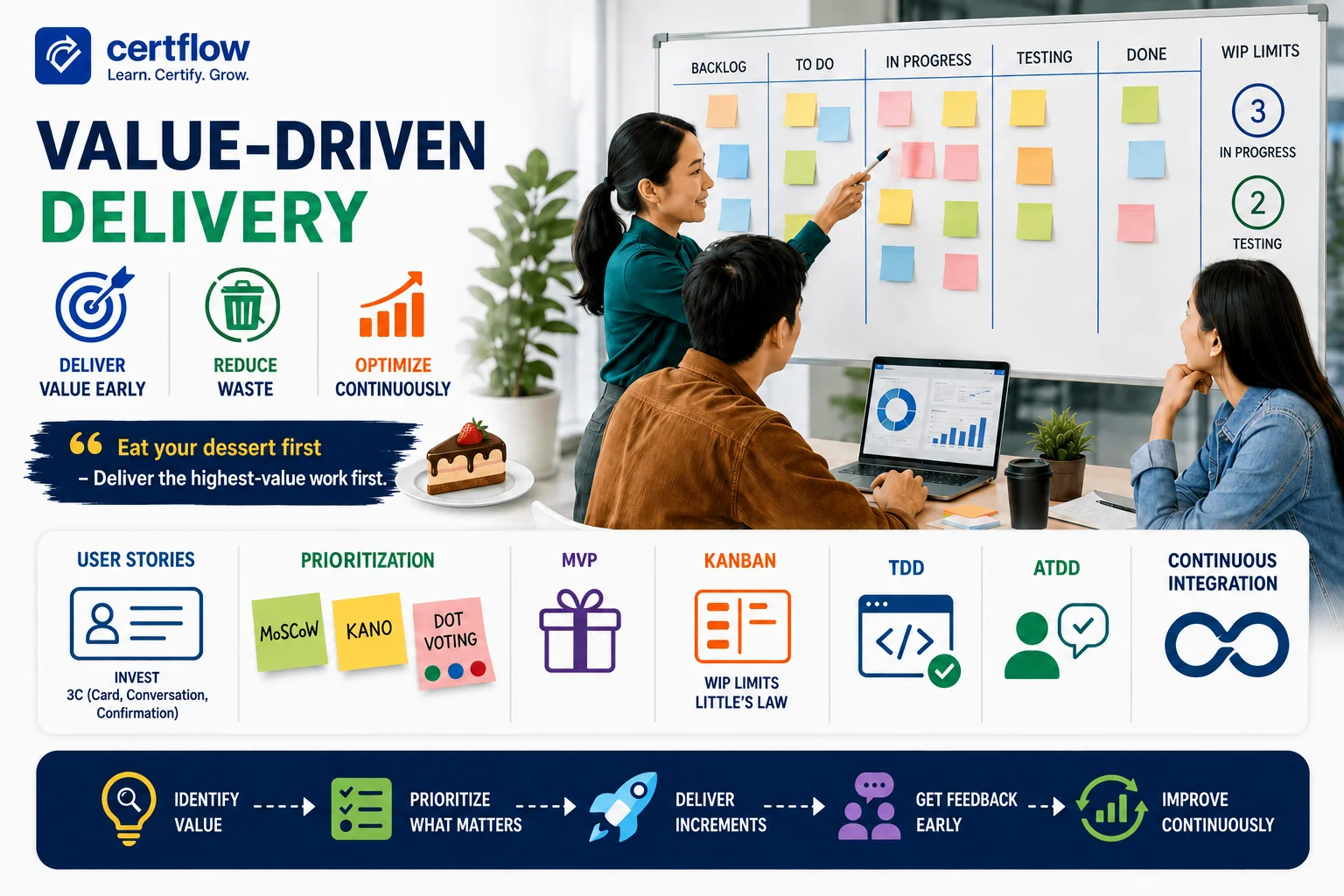
Delivering on time isn't enough — you must deliver the right value. You'll explore user stories, MVP, backlog prioritization, and Kanban to maximize value.
In traditional projects, you deliver the entire product at the end — after 6 months, 12 months, or longer. If the product goes in the wrong direction, you only find out when it's too late. Agile flips that logic: deliver the highest-value pieces first, get feedback early, then adjust. Or as the saying goes: "Eat your dessert first!"
Value-driven Delivery is the central philosophy of Agile — and a topic that has been significantly expanded in the ECO 2026. This article walks through the complete cycle: identifying value, prioritizing, delivering, and validating — with all the tools and techniques the PMP requires.
Value, Non-value, Anti-value — Three Types of Activity
Before talking about delivery, you need to understand what "value" means in this context:
Type | Definition | Examples |
Value | Activities that directly contribute to the product/project objective | Implementing customer-requested features, fixing critical bugs, improving UX |
Non-value (Waste) | Activities that do NOT directly contribute to the objective | Unnecessary documentation, pointless meetings, features few people use |
Anti-value | Activities that actively HARM the objective | Introducing bugs, implementing features that reduce usability, spending time on low-priority work instead of critical tasks |
Value-driven delivery = maximize value + minimize waste + eliminate anti-value. Simple in concept — far more challenging in practice.
Identifying Value: User Stories
In Agile, requirements are expressed as User Stories — brief descriptions of a feature from the user's perspective.
User Story Format
As a [user role], I want [goal], so that [reason].
Example: "As a registered user, I want to log in, so I can access subscriber-only content."
Three key parts: who wants it (role), what they want (goal), and why (business value). The "so that" clause is especially important — it forces the team to understand why a feature is needed, not just what it does.
3C of User Stories
- Card: A physical card — brief, tangible, something you can hold in your hand
- Conversation: Discussions between customers, users, developers, and testers — primarily verbal, supplemented by documentation
- Confirmation: Formal confirmation that the goal has been met — this is the acceptance criteria
INVEST — Criteria for a Good User Story
A well-written user story must satisfy INVEST:
- Independent: Independent of other stories — can be developed and delivered on its own
- Negotiable: Open to negotiation — not a rigid contract
- Valuable: Delivers value to the user or the business
- Estimable: Can be estimated — if you can't estimate it, the story is too large or too vague
- Small: Small enough to fit within a single iteration/sprint
- Testable: Can be tested — must have clear acceptance criteria
📍Exam Tip: INVEST appears frequently in PMP questions. When a question describes a user story that is "too large" → it violates S (Small). When it "can't be estimated" → it violates E (Estimable). When it "depends on another story" → it violates I (Independent).
Acceptance Criteria vs Definition of Done
Acceptance Criteria | Definition of Done (DoD) | |
Describes | What the product does | What the team has done |
Quality of | Product — from the user's perspective | Work — from the process perspective |
Applies to | This specific backlog item | All backlog items universally |
Achieved when | Verified by testing | Agreed upon within the team |
Risk-Adjusted Backlog
Risk is also anti-value — choices that lead to rework or future problems do not deliver real value, they only create the illusion of progress. Risk response activities are added to the backlog and prioritized based on their anti-value impact. The result: a single prioritized list that helps the team focus simultaneously on value delivery AND risk reduction.
Prioritizing Value — What Gets Done First?
With a Product Backlog containing hundreds of items, the PO needs objective tools to prioritize. The PMP exam requires you to know several techniques:
MoSCoW
- Must have: Core — without it the system is worthless
- Should have: Important — without it the system doesn't work properly
- Could have: Useful — adds value but not mandatory
- Would like to have: Nice-to-have — noted but unlikely to be included this time
Kano Analysis
Classifies customer needs into 4 groups based on their relationship with satisfaction:
- Delighters/Exciters: Customers don't expect them, but when discovered they generate excitement — creates competitive advantage
- Satisfiers: More is better — a linear relationship with satisfaction
- Dissatisfiers: Their absence causes disappointment; their presence is taken for granted — must have them but they don't create excitement
- Indifferent: Presence or absence makes no difference — should be eliminated, minimized, or deferred
Hotel example: Dissatisfier = clean bed linens, hot water (expected). Satisfier = fast free Wi-Fi, HD TV (more is better). Delighter = a birthday cake with a handwritten note on the guest's birthday (a genuine surprise!).
Other Techniques
- Requirement Prioritization Model: Score benefit, penalty, cost, and risk (1–9) → calculate a weighted formula
- Dot Voting / Multi-voting: Each stakeholder receives a fixed number of dots to allocate among options — fast but susceptible to power dynamics
- Monopoly Money / 100-Point Method: Give stakeholders "play money" equal to the project budget and ask them to allocate it to features → reveals true priorities
- Relative Prioritization/Ranking: A single ordered priority list, no buckets (high/medium/low) — simply ask "which item is more important than this one?"
💡 Pro Tip: On the PMP exam, when a question says "stakeholders rate everything as High priority" → simple schemes have failed. You need a stronger technique: MoSCoW, Kano, or Relative Ranking, which force clear differentiation.
Delivering Value — MVP and Kanban
Minimum Viable Product (MVP)
An MVP is a set of features complete enough to be useful to users, but small enough to deliver early. The goal: start capturing business benefits before the full project is finished.
An MVP is not a low-quality product — it is a product focused on core value, with everything unnecessary stripped away.
Kanban Method
Kanban is a method for managing the flow of work. Its 5 core principles:
- Visualize the Workflow: Create a Kanban board with columns (To Do, In Progress, Done)
- Limit Work in Progress (WIP): Cap the number of tasks at each stage — prevents overload
- Manage Flow: Continuously improve flow, identify and address bottlenecks
- Make Process Policies Explicit: Clearly define how work is handled at each stage
- Implement Feedback Loops: Encourage feedback at every level
WIP Limits — Why They Matter
Work In Progress (WIP) — work that has been started but not yet completed — is the source of many problems:
- Consumes invested capital without generating a return
- Creates bottlenecks in the workflow
- Increases the risk of rework if changes are needed
- Any required changes → expensive scrap and rework
WIP Limits prevent the team from taking on too much at once → helps identify bottlenecks, reduces risk, and optimizes throughput. The principle: optimize throughput, not resource utilization — finish fewer things completely, rather than starting many things and leaving them half done.
Theory of Constraints
Most changes in a system have only a small impact. Only a few variables (constraints/bottlenecks), when improved, significantly affect overall performance. Find the bottleneck → focus improvement efforts there → maximum benefit.
Little's Law — A Formula Worth Remembering
Cycle Time = WIP / Throughput
Example: WIP = 15 items, Throughput = 3 items/sprint → Cycle Time = 5 sprints to work through the entire queue.
Want to reduce Cycle Time? Two ways: reduce WIP (do fewer things at once) or increase Throughput (process faster).
Lead Time vs Cycle Time
- Lead Time: From when an item is requested to when it is delivered — includes all waiting time
- Cycle Time: From when work begins to when it is done — counts only active processing time
Batch Processing vs Continuous Flow
Imagine a noodle shop: blanch noodles (1 min) → add toppings and broth (30 sec) → serve (3 min).
- Batch processing (finish 10 bowls before serving any): slow, high WIP
- Continuous flow (serve each bowl as soon as it's ready): faster, low WIP, customers get their food sooner
Agile favors continuous flow because it delivers value to the customer earlier.
Cumulative Flow Diagram
A tracking and forecasting tool — provides insight into issues, cycle times, and projected completion dates. The vertical distance shows WIP. The horizontal distance shows cycle time. If the WIP zone expands → there is a problem.
Verifying & Validating Value
You've delivered — but did you deliver the right value for the customer? Verification and validation must happen continuously, not only at the end.
Test-Driven Development (TDD)
Write the test BEFORE writing the code. The Red-Green-Clean cycle:
- Red: Write the test → test fails (because no code exists yet)
- Green: Write code until the test passes
- Clean (Refactor): Clean up the code for readability and maintainability — without changing behavior
Acceptance Test-Driven Development (ATDD)
An extension of TDD — shifts focus from code tests to business requirement tests. The 4D cycle:
- Discuss: Discuss requirements with the PO and team
- Distill: Distill clear acceptance criteria
- Develop: Develop code to pass the acceptance tests
- Demo: Demo to the PO
ATDD enforces a very detailed discussion of the Definition of Done at the requirement level for each item.
Continuous Integration (CI)
Integrate new code into the repository frequently — small commits, often. Benefits: find and resolve problems as early as possible, before they accumulate into larger issues. Typically combined with automated unit tests.
Other Testing Methods
- Exploratory Testing: Relies on the tester's autonomy, skill, and creativity — discovers unexpected behavior that scripted tests miss
- Usability Testing: Observes end users interacting with the system — surfaces UX issues that developers overlook
Summary: Value-Driven Delivery Framework
Phase | Purpose | Key Tools/Techniques |
Identify Value | Determine what value to deliver | User Stories, 3C, INVEST, Risk-adjusted Backlog |
Prioritize Value | Decide what to do first | MoSCoW, Kano, Dot Voting, Monopoly Money, Relative Ranking |
Deliver Value | Deliver early and continuously | MVP, Kanban, WIP Limits, Little's Law, Continuous Flow |
Verify & Validate | Ensure the right value is delivered | TDD (Red-Green-Clean), ATDD, CI, Exploratory/Usability Testing |
Key reminders:
- Value > Non-value (Waste) > Anti-value — maximize, minimize, eliminate
- User Story: As a [role], I want [goal], so that [reason]
- INVEST: Independent, Negotiable, Valuable, Estimable, Small, Testable
- 3C: Card, Conversation, Confirmation
- Acceptance Criteria = product quality / DoD = process quality
- MoSCoW: Must > Should > Could > Would
- Kano: Delighters > Satisfiers > Dissatisfiers > Indifferent
- MVP: Smallest thing that delivers value to users
- WIP Limits: Optimize throughput, not utilization
- Little's Law: Cycle Time = WIP / Throughput
- TDD: Red (fail) → Green (pass) → Clean (refactor)
- ATDD: Discuss → Distill → Develop → Demo
- CI: Small commits + frequent + automated tests
Value-driven Delivery is where Agile truly lives — not in the ceremonies or artifacts, but in how you think about value, prioritization, and delivery. Practice prioritization, MVP, and Kanban scenarios on CertFlow — this is the knowledge that connects the Scrum Framework to real-world Agile project management.
Frequently Asked Questions (FAQ)
How does Value-Driven Delivery differ from the traditional deliverable-driven approach?
Deliverable-driven: focuses on completing tasks and milestones — success means delivering on time, within scope. Value-driven: focuses on the real value users receive — success means user satisfaction and business objectives achieved. A project can deliver exactly on scope and still fail to create business value.
What is an MVP and why does it matter in Agile?
MVP (Minimum Viable Product): the minimum version of a product that is sufficient to deliver value to users and gather real feedback. MVP matters because it reduces waste (you don't build features nobody uses), validates assumptions early, and allows the team to learn and adjust before committing fully.
How do you prioritize a product backlog effectively?
Common methods include: MoSCoW (Must/Should/Could/Won't), Value vs Effort matrix (highest ROI first), WSJF (Weighted Shortest Job First — commonly used in SAFe), and Cost of Delay. PMI does not prescribe a single method — the PM must choose what fits the context and work alongside the Product Owner and stakeholders.
Now that you understand Value-Driven Delivery — it's time to put it into practice with real exam questions.
Try Free PMP Practice Questions →
Official References: