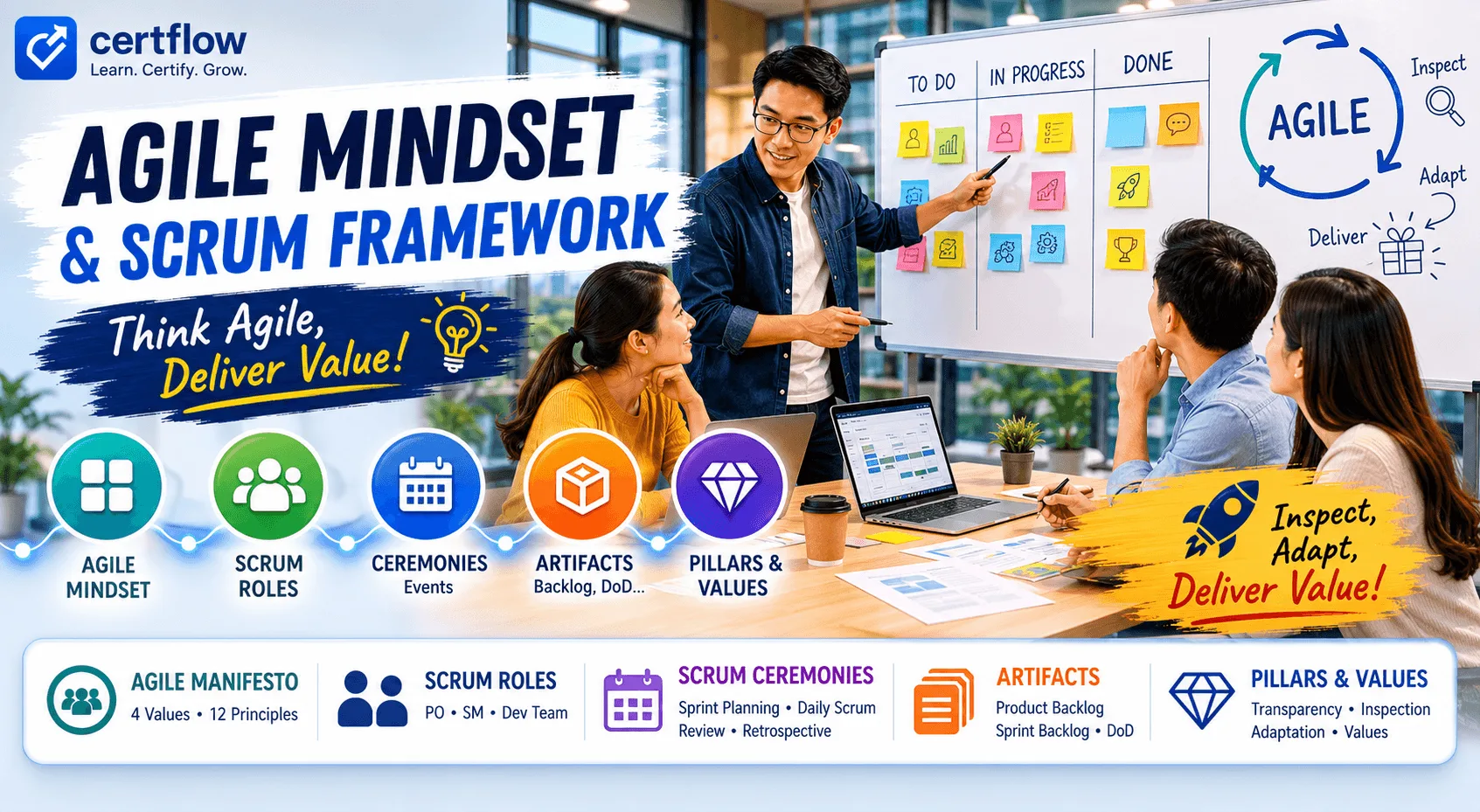
What is Scrum Mindset — and why does it matter for the PMP exam? This guide covers the Agile Manifesto, 12 principles, and the full Scrum Framework to help you confidently answer 60% of PMP 2026 questions.
"We didn't do anything wrong, but somehow, we lost." — This is what Nokia's CEO said when selling the phone division to Microsoft in 2013. Nokia didn't do anything wrong by their own standards — the problem was that their standards no longer fit the world around them. They were a hardware company in a software era. They relied on sequential processes while Apple used "deep collaboration" — every department working in parallel, continuously.
The Nokia story is the classic example of why Agile exists. And with roughly 60% of PMP 2026 exam questions related to Agile/Hybrid, this is no longer an "optional add-on" — it is a core requirement.
This article covers the full scope of Agile Mindset and Scrum Framework — from history and the Agile Manifesto to 12 Agile Principles, Scrum Roles, Ceremonies, Artifacts, and Values.
Why Agile? — The Difference Between Two Eras
To understand Agile, compare two work environments:
Industrial Revolution | Information / Knowledge Revolution |
Slow-changing environment | Fast-changing environment |
Stable and certain | Adapt to change |
Tangible products (physical goods) | Intangible products (software, services) |
Maximize output per resource | People are assets, not costs |
Demands compliance | Demands creativity |
Command and control | Empower and self-organize |
Predictive/Waterfall was built for the industrial era — when requirements are clear, change is rare, and processes can be repeated. Agile was built for the knowledge era — when requirements are ambiguous, change is constant, and creativity matters more than compliance.
Agile Manifesto — 4 Core Values
In 2001, 17 software developers gathered at Snowbird, Utah. They realized they shared a common way of thinking — and wrote the Agile Manifesto with 4 values:
- Individuals and interactions over processes and tools
- Working software over comprehensive documentation
- Customer collaboration over contract negotiation
- Responding to change over following a plan
⚠️ Note: "over" does not mean the right side is unimportant. Both sides have value — but when you must choose, prioritize the left side.
📍PMP Exam Tip: When an Agile question asks you to choose between "follow the process" and "talk to the team" → choose "talk to the team" (individuals and interactions over processes). When choosing between "update documentation" and "deliver a working increment" → choose "deliver the working increment."
12 Agile Principles — Know Them All
The Manifesto comes with 12 guiding principles. Here they are grouped into 4 themes for easier recall:
Group 1: Deliver Value
- #1: Customer satisfaction through early and continuous delivery
- #3: Deliver working software frequently — weeks rather than months
- #7: Working software is the primary measure of progress
Group 2: Welcome Change
- #2: Welcome changing requirements, even late in development
- #10: Simplicity — the art of maximizing the amount of work NOT done
Group 3: People & Collaboration
- #4: Business people and developers must work together daily throughout the project
- #5: Build projects around motivated individuals — trust them to get the job done
- #6: Face-to-face conversation is the most effective form of communication
- #11: The best architectures, requirements, and designs emerge from self-organizing teams
Group 4: Continuous Improvement
- #8: Sustainable development — maintain a constant pace indefinitely, no sprint-and-crash
- #9: Continuous attention to technical excellence and good design
- #12: The team regularly reflects on how to become more effective, then adjusts accordingly
What Is Scrum Mindset? — The Core Thinking PMP Requires
Before learning the Scrum Framework (roles, ceremonies, artifacts), you need to understand why you use Scrum — and that is the Scrum Mindset.
Scrum Mindset is the set of values, beliefs, and work attitudes that allow an individual or team to run Scrum in its true spirit — not just follow the mechanics. Many teams hold Sprints, Daily Standups, and Retrospectives yet still fail because they lack this foundational mindset.
According to The Scrum Guide 2020, Scrum is built on Empiricism — every decision must come from observed reality, not theoretical plans:
"Scrum employs an iterative, incremental approach to optimize predictability and to control risk."
— The Scrum Guide 2020
3 Components of Scrum Mindset
Empiricism | Make decisions based on what you actually observe each Sprint — not on rigid upfront plans. Every Sprint is a small experiment. |
Self-Management | The team organizes itself and owns accountability — no one assigns tasks each day. The Scrum Master does not assign work; the Product Owner does not micromanage. |
Continuous Improvement | The Sprint Retrospective is not just a closing meeting — it is the team's opportunity to improve how they work, not just what they produce. |
📍 PMP Exam Tip: When a question describes a Scrum team with a problem — check whether they follow the process correctly but lack the mindset. Classic example: a team running Daily Standups but only reporting status without discussing blockers → missing Empiricism. The correct answer is typically: "The Scrum Master should coach the team on Scrum Values and the inspect & adapt mindset."
Common Misconceptions About Agile
Four misconceptions you must correct before sitting the PMP exam:
- "Agile has no Plan" → False. Agile DOES plan — but the plan accepts and adapts to change rather than being rigid.
- "Agile has no Documentation" → False. Agile DOES document — but at the "last responsible moment," not all upfront.
- "Agile has no Process" → False. Agile DOES have processes — but they are defined by the team itself, not imposed top-down.
- "Agile has no Contract" → False. Agile DOES have contracts — but contracts that allow for change, with both parties embracing Agile methodology.
Agile is a Mindset — not a methodology. Scrum, Kanban, and XP are specific frameworks/methods. Agile is the mindset behind all of them.
Scrum Framework — The Most Widely Used Framework
Scrum is the most popular framework within Agile — and the one PMP tests most frequently. Scrum was created by Jeff Sutherland and Ken Schwaber, inspired by the 1986 paper "The New New Product Development Game" by Takeuchi and Nonaka.
What Is Scrum?
- A framework for solving complex adaptive problems
- Lightweight — minimal rules
- Simple to understand
- Difficult to master
Scrum is grounded in Empirical Process Control Theory (Empiricism): knowledge comes from experience, and decisions are based on what is known. It takes an iterative and incremental approach to optimize predictability and manage risk.
Scrum = 3 Roles + 4 Ceremonies + 3 Artifacts + Values
3 Scrum Roles
Product Owner
- Maximize value of the product and the work of the development team
- Manage the Product Backlog — owns, prioritizes, and clarifies items
- Represents the business — the "voice of the customer"
- Accept or reject work results
- Is ONE person, not a committee
Scrum Master
- Servant Leader — serves the team, does not give orders
- Coaches the team and stakeholders on Scrum
- Ensures the Scrum framework is properly followed
- Removes impediments — clears obstacles for the team
- Shields the team from external interruptions
- Equivalent to an Agile Project Manager
Developers (Development Team)
- Create and evolve the product — the people who actually build it
- Self-organizing: Decide for themselves how to accomplish the work
- Cross-functional: Possess all the skills needed to complete the work without external dependencies
- Size: typically 12 people or fewer
- Shared ownership — collectively accountable for outcomes
T-shaped vs I-shaped People
- T-shaped (Generalizing Specialists): Deep expertise in one area, but able to contribute in adjacent areas — reduces bottlenecks and handoffs
- I-shaped: Deep expertise in only one area — prone to creating bottlenecks
Agile teams favor T-shaped individuals because cross-functional teams need people who can flex across roles.
Exam Tip: When a question asks "who manages the Product Backlog" → Product Owner (NOT the Scrum Master or PM). When asked "who removes impediments" → Scrum Master. When asked "who decides HOW to do the work" → Development Team (self-organizing). Confusing roles is one of the most common exam mistakes.
4 Scrum Ceremonies (Events)
Sprint — The Container Event
A sprint is a fixed-length timebox — typically 1–4 weeks — during which the team creates a product increment. A sprint is like a mini project.
- Timeboxed: Fixed duration, not extended
- No change that endangers the Sprint Goal: No mid-sprint changes that would undermine the goal
- Output: A potentially shippable product increment
Sprint Goal: The objective the team will achieve during the sprint — it guides the team on "why" they are building this particular increment.
Definition of Done (DoD): A shared understanding of what "complete" means — ensures transparency and prevents misunderstandings. The DoD can evolve over time — later sprints may apply stricter criteria than earlier ones.
1. Sprint Planning
- Timeboxed: Up to 8 hours for a one-month sprint
- Attendees: The entire Scrum team
- Activities:
+ PO presents the updated Product Backlog
+ PO and team discuss to ensure shared understanding
+ Team forecasts what can be delivered in the sprint
+ Team defines the Sprint Goal
+ Team plans HOW to achieve the goal
- Output: Sprint Backlog (selected items + plan)
2. Daily Scrum (Daily Standup)
- Timeboxed: 15 minutes
- Same time, same place, same people, same questions
- 3 questions: What did I do yesterday? What will I do today? Are there any impediments?
Daily Scrum is NOT:
- A status meeting to report to the Scrum Master
- A problem-solving session or technical deep-dive
- A way to identify who is behind schedule
Daily Scrum IS:
- A synchronization session — aligning the team's shared understanding
- An inspection and replanning session for the next 24 hours
- A commitment made among peers
3. Sprint Review
- Informal meeting — NOT a status meeting
- The team demos the increment to the PO to collect feedback
- PO accepts or rejects work results
- Encourages collaboration and identifies next priorities
- Looks forward: "what are the next things to optimize value"
4. Sprint Retrospective
- A very open and honest meeting
- The team reflects: What went well? What didn't? What can we improve?
- Output: identified improvements to implement in the next sprint
- This is where continuous improvement happens — Agile Principle #12
Review vs Retrospective — Know the Difference: Review = inspect the PRODUCT (demo to PO, collect product feedback). Retrospective = inspect the PROCESS (team examines how they work together). Both are important and serve different purposes.
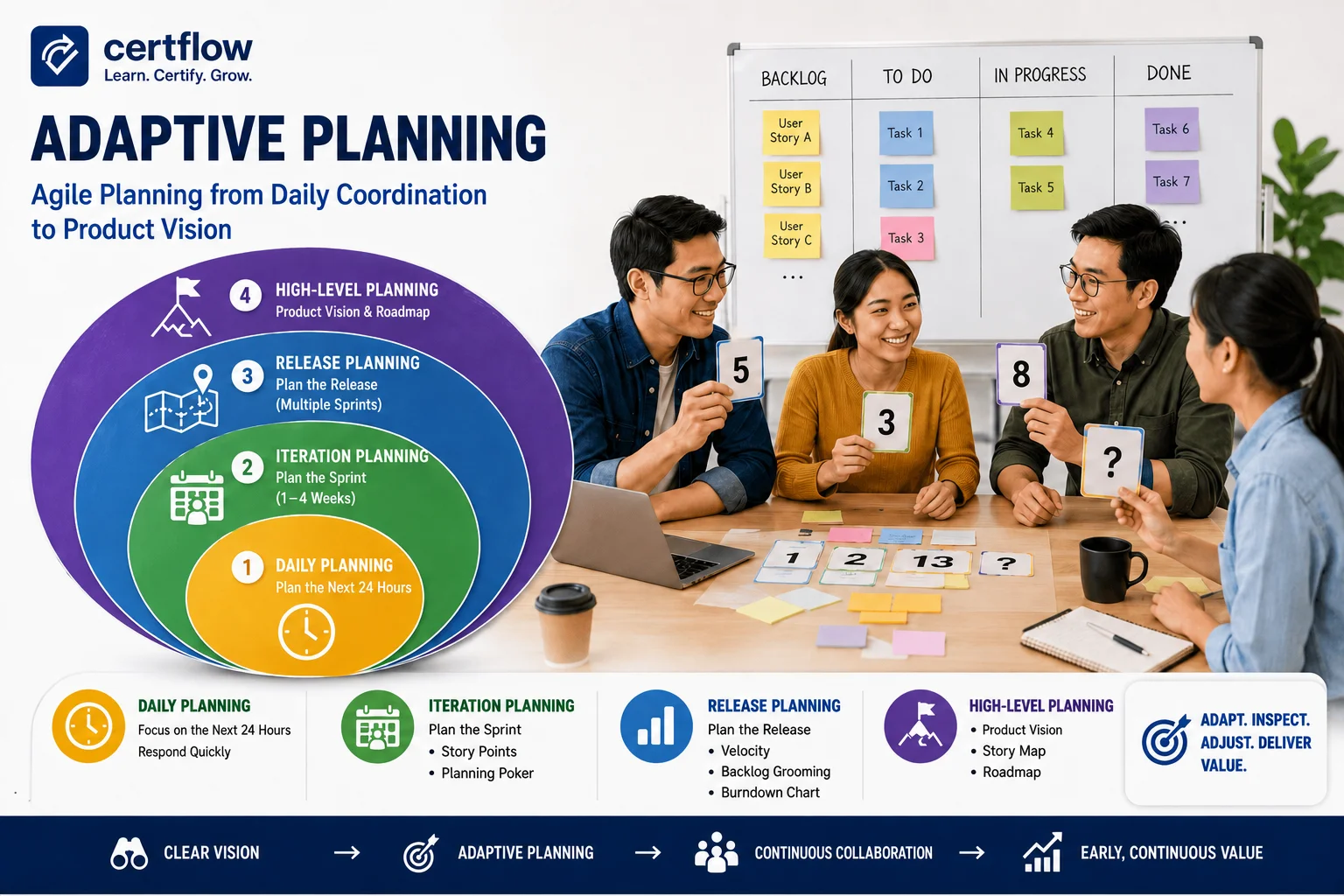
→ Adaptive Planning: 4 Agile Planning Levels
3 Scrum Artifacts
Artifact | Description | Managed by |
Product Backlog | A prioritized list of all work needed to build the product — features, functions, requirements, enhancements, fixes. Dynamic and continuously updated. | Product Owner |
Sprint Backlog | The subset of the Product Backlog selected for a specific sprint + the plan for achieving the Sprint Goal. Highly visible. | Development Team |
Product Increment | The portion of the product completed during a sprint — must meet the Definition of Done. Potentially shippable. | Development Team + PO (accept/reject) |
Incremental vs Iterative — Know the Difference
Incremental: Building the product in pieces — each sprint adds a new piece to the product
Iterative: Improving the product through repeated cycles — each cycle refines and improves
Scrum combines both: iterative AND incremental.
Scrum vs Traditional — Comparison Table
Agile/Scrum | Traditional PM |
Scrum Master | Project Manager |
Sprint (iteration) | Project phase, milestones |
4 Ceremonies | PDCA cycle |
Daily Standup | Status report |
Product Backlog / Sprint Backlog | WBS |
Shippable Increment | Deliverables |
3 Pillars & 5 Values
3 Pillars of Empiricism
- Transparency: Every significant aspect must be visible to those responsible for the outcome
- Inspection: Regularly examine artifacts and progress to detect variance
- Adaptation: When deviation exceeds acceptable limits → adjust immediately
5 Scrum Values
- Commitment: Commit to the Sprint Goal and team objectives
- Courage: Have the courage to face difficult problems and speak the truth
- Focus: Stay focused on the Sprint Goal, avoid distractions
- Openness: Be open about work and challenges
- Respect: Respect each other as capable and independent individuals
Summary: Scrum Framework Cheat Sheet
Component | Details |
Roles | Product Owner (value), Scrum Master (process), Developers (product) |
Events | Sprint Planning (what + how), Daily Scrum (15 min sync), Sprint Review (demo product), Retrospective (improve process) |
Artifacts | Product Backlog (PO owns), Sprint Backlog (Team owns), Increment (done = DoD) |
Pillars | Transparency, Inspection, Adaptation |
Values | Commitment, Courage, Focus, Openness, Respect |
💡 Quick reminders:
- Agile = Mindset, Scrum = Framework
- 4 Manifesto values: Individuals > Process, Working software > Docs, Collaboration > Contract, Responding to change > Following plan
- PO owns the Product Backlog — only the PO adds/prioritizes items
- Scrum Master = Servant Leader — serves, does not command
- Team = Self-organizing + Cross-functional
- Daily Scrum ≠ status report — it is a synchronization meeting
- Review = inspect product, Retrospective = inspect process
- DoD = shared understanding of what "complete" means
- Sprint Goal = WHY the team builds this increment
- T-shaped > I-shaped for Agile teams
Agile and Scrum account for roughly 60% of the PMP 2026 exam — master this section and you've covered more than half the test. Practice Scrum role, ceremony, and artifact scenarios on CertFlow — pay special attention to clearly distinguishing PO vs SM vs Team, and Review vs Retrospective. These are exactly the areas where exam questions set traps.
Frequently Asked Questions (FAQ)
What are the 4 values of the Agile Manifesto?
The Agile Manifesto (2001) has 4 values: (1) Individuals and interactions over processes and tools; (2) Working software over comprehensive documentation; (3) Customer collaboration over contract negotiation; (4) Responding to change over following a plan. Note: the items on the right still have value — Agile simply prioritizes the items on the left.
How does a Scrum Master differ from a traditional Project Manager?
A traditional PM manages timelines, budgets, and resources, and is accountable for deliverables. A Scrum Master is a servant leader — removing impediments, shielding the team from interruptions, and coaching on the Scrum process, but NOT assigning work or managing the team. The SM serves the team, the PO, and the organization — not as a boss.
What are Velocity and Story Points used for in Scrum?
Story Points: a unit of measure for the relative complexity/effort of a user story — not hours of work. Velocity: the average number of story points a team completes per sprint — used to forecast delivery capacity. Example: team velocity = 40 SP/sprint, 200 SP remaining in the backlog → estimated 5 sprints to complete.
Now that you understand Agile Mindset & Scrum Framework — it's time to put it into practice with real exam questions.
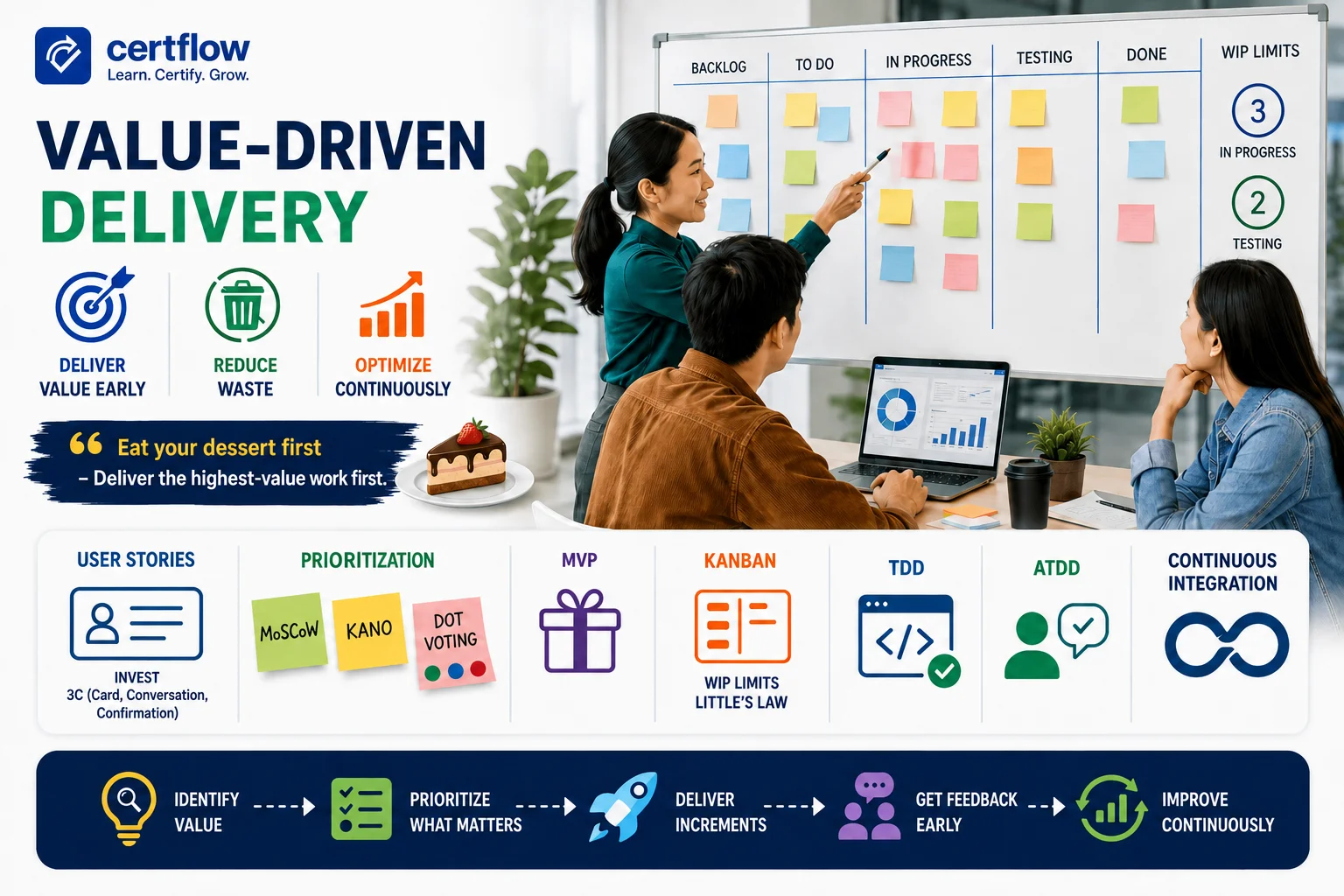
Next article: Value-Driven Delivery: Deliver Value Early for the PMP Exam
Adaptive planning: Agile planning from daily to product vision
Try Free PMP Practice Questions →
Official References: