Môi trường kinh doanh thay đổi có thể làm dự án của bạn obsolete giữa chừng. PMBOK 8 dạy PM cách monitor EEFs và PESTLE để adapt kịp thời. Tìm hiểu ngay.
1. Tại sao PM phải "nhìn ra ngoài"?
Hầu hết PM tập trung vào bên TRONG: schedule, budget, team, deliverables. Nhưng PMBOK 8 nêu rõ: dự án tồn tại trong hệ sinh thái rộng lớn hơn — và hệ sinh thái đó thay đổi liên tục.
PMBOK® 8, Section 1.1: "The project management landscape has undergone significant changes, shaped by evolving global challenges such as climate change, resource constraints, geopolitical instability, and widening inequalities, alongside advancements in technology like artificial intelligence."
PM không scan external environment = PM bị blind-sided. Regulations mới có thể invalidate toàn bộ scope. Competitor mới có thể kill business case. Technology mới có thể make your approach obsolete. Market shifts có thể change customer needs.
Task này thuộc Business Environment Domain — nhấn mạnh: PM phải là "radar" cho dự án, liên tục quét thế giới bên ngoài và đánh giá tác động.
2. Enterprise Environmental Factors — External
PMBOK 8 (Section 2.2.1.2) liệt kê 7 categories EEFs external mà PM phải monitor:
Category | Ví dụ PMBOK 8 | Impact tiềm năng |
|---|---|---|
Marketplace conditions | Competitors, customer behavior, market share, brand recognition | Business case validity, feature priorities, time-to-market pressure |
Social and cultural | Political climate, codes of conduct, ethics, perceptions | Stakeholder expectations, compliance, reputation risk |
Legal restrictions | Laws related to security, data protection, employment, procurement | Scope changes, compliance requirements, timeline impact |
Government/industry standards | Regulatory agency regulations on products, environment, safety, quality | Quality requirements, testing standards, certification needs |
Physical environment | Working conditions, weather, geopolitical issues | Schedule delays, site access, team safety |
Emerging technologies | AI, automation, blockchain, IoT | Approach changes, new capabilities, skill requirements |
Public health and safety | Health protocols, travel restrictions, quarantine measures | Team availability, work arrangements, supply chain |
3. Framework 3 enablers
Enabler | Câu hỏi cốt lõi | Frequency |
|---|---|---|
Survey changes | Điều gì đang thay đổi bên ngoài? | Continuous scanning |
Assess and prioritize impact | Thay đổi nào ảnh hưởng đến scope/backlog? Mức nào? | When changes detected |
Continually review | Có thay đổi mới nào cần chú ý không? | Ongoing — built into rhythm |
4. Survey: Quét thay đổi — PESTLE và các frameworks
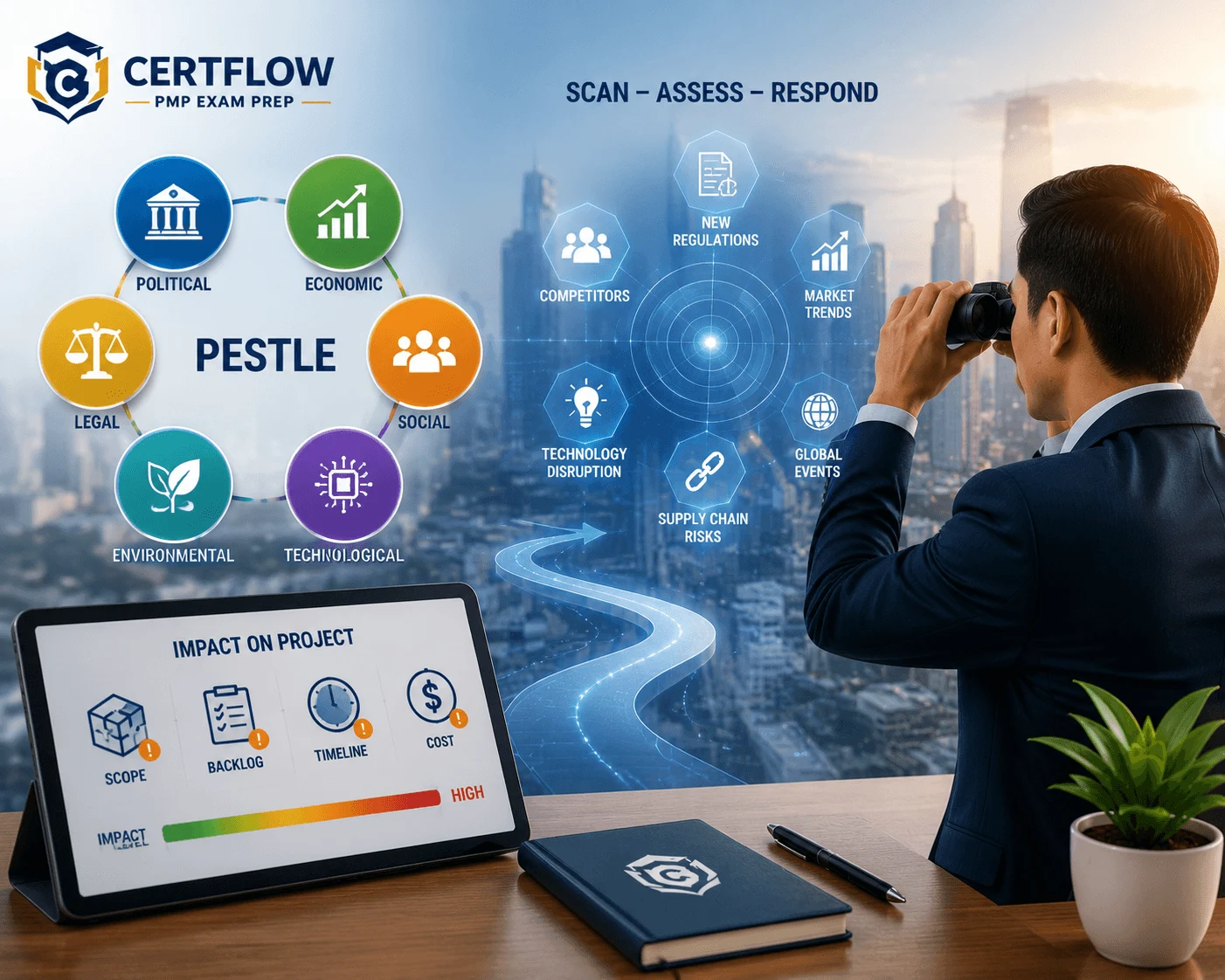
PESTLE Analysis — Framework quét toàn diện
PMBOK 8 liệt kê PESTLE là tool cho risk identification: "PESTLE (political, economic, sociocultural, technological, legal, environmental) — prompt lists to identify sources of overall project risk."
Dimension | Quét cái gì | Ví dụ thay đổi | Impact on project |
|---|---|---|---|
Political | Chính sách chính phủ, ổn định chính trị, thuế, trade policies | Sanctions mới, election results, trade wars | Market access, vendor availability, costs |
Economic | Kinh tế vĩ mô, lạm phát, lãi suất, tỷ giá | Recession, inflation spike, currency devaluation | Budget constraints, funding availability, procurement costs |
Sociocultural | Xu hướng xã hội, demographics, consumer behavior | Remote work trend, sustainability consciousness, Gen Z preferences | Product features, user expectations, team management |
Technological | Công nghệ mới, disruption, digital transformation | AI advancement, new platform, competitor innovation | Approach change, feature requirements, skills needed |
Legal | Luật mới, regulations, compliance requirements | GDPR-like laws, safety regulations, labor laws | Scope additions, compliance activities, timeline |
Environmental | Climate, sustainability regulations, natural disasters | Carbon tax, extreme weather, environmental standards | Scope (sustainability), costs, site access, supply chain |
Các frameworks bổ sung từ PMBOK 8
- TECOP (Technical, Environmental, Commercial, Operational, Political) — PMBOK 8 liệt kê cùng PESTLE như prompt lists cho risk identification.
- VUCA (Volatility, Uncertainty, Complexity, Ambiguity) — PMBOK 8: dùng để đánh giá mức độ bất ổn của môi trường. High VUCA = cần adaptive approach + frequent scanning.
- SWOT External — Opportunities và Threats trong SWOT analysis capture external factors ảnh hưởng đến dự án.
Sources for Environmental Scanning
Industry publications và research reports
Regulatory body announcements và public consultations
Competitor analysis và market intelligence
Technology news và innovation tracking
Economic forecasts và financial news
Stakeholder network insights (informal intelligence)
AI-powered monitoring tools — PMBOK 8 mới: GenAI và data analytics cho risk identification
5. Assess: Đánh giá và ưu tiên tác động lên scope/backlog
Khi thay đổi được detected, PM phải trả lời 5 câu hỏi:
1. Relevance — Thay đổi này có liên quan đến dự án không?
2. Impact magnitude — Nếu có, ảnh hưởng lớn hay nhỏ?
3. Urgency — Cần respond ngay hay có thời gian?
4. Scope/Backlog impact — Scope cần thay đổi thế nào?
5. Business case validity — Business case có còn hợp lệ không?
Impact Assessment Matrix
Low Urgency | High Urgency | |
|---|---|---|
High Impact | Plan strategically — Develop response plan, submit CR, adjust roadmap | Act immediately — Emergency response, escalate, adjust scope now |
Low Impact | Monitor — Log, track, reassess periodically | Quick response — Minor adjustment, update backlog |
Impact on Scope/Backlog — Predictive vs. Adaptive Response
Scenario | Predictive Response | Adaptive Response |
|---|---|---|
New regulation | Submit change request → CCB evaluates → update scope baseline | Add compliance stories to backlog → PO prioritizes → address in upcoming sprints |
Competitor launches | Reassess business case → may change scope/timeline via CR | PO reprioritizes backlog for differentiating features → accelerate key items |
Technology disruption | Impact analysis → may change approach/architecture via CR | Spike to evaluate new tech → if viable, pivot approach in next sprints |
Economic downturn | Budget review → may reduce scope or extend timeline | Reduce sprint team size → focus on highest-value items only |
Supply chain disruption | Vendor analysis → alternative sourcing → schedule adjustment | Identify alternatives in sprint planning → adjust DoD if materials change |
PMBOK® 8, Section 3.4: "If misalignment persists or the project is unlikely to deliver the intended value, it may be best to terminate the effort." — Khi external changes fundamentally invalidate business case, termination is responsible leadership.
6. Review: Giám sát liên tục
Environmental scanning không phải hoạt động "một lần" — phải được built into project rhythm:
Frequency | Activity | Participants |
|---|---|---|
Weekly | Quick scan: any news, regulations, competitor moves? | PM + key team members |
Monthly | Formal review: PESTLE update, business case check, risk register refresh | PM + Sponsor + Key stakeholders |
Quarterly | Strategic review: business environment trends, project relevance, portfolio alignment | Steering committee |
Event-driven | Immediate assessment when major external event occurs | PM + relevant SMEs + Sponsor |
PMBOK 8 nhấn mạnh: "A value delivery system works most effectively when information and feedback are shared consistently among all components, keeping the system aligned with strategy and attuned to the environment."
Integration với Risk Management
External environment changes feed directly into risk management: new regulation = new risk or opportunity. Competitor move = threat or opportunity. Technology advancement = opportunity or obsolescence risk. PM phải ensure external scanning results flow into risk register, stakeholder analysis, và business case reviews.
7. Predictive vs. Adaptive response
Aspect | Predictive | Adaptive |
|---|---|---|
Response mechanism | Formal change requests, CCB evaluation, baseline updates | Backlog reprioritization, sprint-level adaptation |
Speed of response | Slower — formal process required | Faster — PO can reprioritize each sprint |
Scope adjustment | Formal scope change with impact analysis | Scope naturally flexible — add/remove backlog items |
Business case review | Phase gates, milestone reviews | Sprint reviews, release planning |
Advantage | Thorough analysis before change | Rapid response to market changes |
Risk | May be too slow for fast-moving environments | May react too quickly without sufficient analysis |
PMBOK® 8, Section 4.3.3: "Adaptive approaches may fit better in an organizational culture that more easily embraces uncertainty while emphasizing flexible thinking and innovation." — High VUCA environments benefit from adaptive approaches that can respond to external changes faster.
8. Mẹo thi PMP
📍Mẹo 1 — External change ≠ automatic scope change: Khi đề mô tả external change — đáp án đúng là "assess impact FIRST," KHÔNG phải immediately change scope. Analyze relevance, magnitude, urgency — THEN decide action.
📍Mẹo 2 — Business case must remain valid: Khi đề mô tả "competitor launches similar product" hoặc "market shifts significantly" — đáp án thường bao gồm "reassess business case" hoặc "evaluate if project still delivers intended value."
📍Mẹo 3 — EEFs are INPUTS, not controllable: PM cannot change external EEFs — but must RESPOND to them. Khi đề hỏi "what should PM do about new regulation?" — answer is adapt the project, NOT try to change the regulation.
📍Mẹo 4 — Continuous, not periodic: Environmental scanning is ONGOING. Khi đề hỏi "when should PM review external environment?" — "continuously" or "regularly throughout" is correct, NOT "at project start only."
9. Mười câu hỏi trắc nghiệm tình huống
Question 1
Your e-commerce project is 6 months in. A new data privacy law is announced, effective in 4 months. Your current architecture doesn't comply.
What should you do FIRST?
A. Immediately redesign the architecture for compliance.
B. Assess the impact: determine what specific aspects of the new law affect your project, analyze scope/schedule/cost implications, and present options with trade-offs to the sponsor and CCB.
C. Wait until the law takes effect to see if it's enforced.
D. Add compliance to the risk register and monitor.
Question 2
A major competitor launches a product with 80% of your planned features — 3 months before your planned launch. Your project's ROI was based on first-mover advantage.
What should you do?
A. Accelerate the project to launch sooner.
B. Add more features to differentiate.
C. Conduct urgent business value reassessment: first-mover advantage is gone, original ROI is invalid. Present options — accelerate with reduced scope (MVP), pivot to differentiate on unique value, or recommend termination if value no longer justifies investment.
D. Continue as planned — your product will be more complete.
Question 3
Your construction project in Southeast Asia is impacted by a sudden currency devaluation of 30%. Imported materials now cost significantly more. The project budget was approved in local currency.
What type of external change is this, and what should you assess?
A. Political change — wait for currency stabilization.
B. Economic change — assess impact on procurement costs, evaluate alternative local materials, request budget adjustment through change control, and add currency risk monitoring going forward.
C. This is a force majeure — activate insurance.
D. Negotiate with vendors to absorb the currency impact.
Question 4
Your agile team is building a mobile payment app. A major tech company announces a new free payment API that could replace your custom-built payment module — saving 4 sprints of work.
How should you respond?
A. Immediately switch to the new API.
B. Add a spike to the next sprint to evaluate the API's capabilities, security, reliability, and licensing terms. If viable, work with PO to reprioritize backlog — replacing custom development with API integration and redirecting saved capacity to higher-value features.
C. Continue with custom development — dependencies on external APIs are risky.
D. Wait until the API is proven in the market.
Question 5
A global supply chain disruption affects your manufacturing project. Key components have 6-month lead times instead of 6 weeks. The critical path is severely impacted.
What should you do?
A. Wait for supply chains to normalize.
B. Assess the full impact: identify affected components, evaluate alternative suppliers/materials, analyze schedule and cost implications, develop response options (alternative sourcing, design changes, phased delivery), and present to sponsor with recommendations.
C. Switch to a completely different design that uses available materials.
D. Stockpile materials from other sources at higher cost.
Question 6
Your healthcare IT project has been in development for 8 months. A new AI-powered diagnostic tool is published in a leading medical journal, showing 95% accuracy — far exceeding your planned rule-based approach (70% accuracy).
What should you evaluate?
A. Ignore — the project scope is already defined and approved.
B. Evaluate whether adopting the AI approach would significantly enhance the project's value proposition. Assess: technical feasibility, licensing, integration complexity, team skills, timeline impact, and whether the enhanced accuracy justifies the change in approach. Present findings to stakeholders.
C. Immediately pivot to the AI approach.
D. Add AI as a future phase enhancement.
Question 7
Midway through your project, the organization announces a strategic pivot from B2B to B2C. Your project was designed for B2B customers.
What is the MOST significant concern?
A. The project scope needs updating for B2C requirements.
B. The project's entire VALUE PROPOSITION may be invalidated. The business case was built for B2B — B2C has different customer needs, pricing models, volumes, support requirements, and success metrics. The PM should escalate for a fundamental reassessment: should the project continue, pivot, or terminate?
C. Add B2C features to the existing B2B scope.
D. This is an organizational issue, not a project issue.
Question 8
Your project team doesn't monitor external changes. Six months in, you discover that a key regulation changed 3 months ago, and your deliverable is now non-compliant. Rework will cost $200K and delay by 2 months.
What process failure occurred?
A. Risk management failure — the regulation should have been in the risk register.
B. The team failed to "continually review the external business environment for impacts on project scope/backlog." Had regular environmental scanning been in place, the regulation change would have been detected early — when response was cheaper and less disruptive.
C. The legal department should have alerted the project team.
D. The sponsor should have been monitoring regulations.
Question 9
Your PESTLE analysis reveals: Political (stable), Economic (recession risk), Sociocultural (remote work trend), Technological (AI disruption), Legal (new data law), Environmental (carbon tax coming). Your software project is most sensitive to Technology and Legal.
How should you prioritize your scanning efforts?
A. Monitor all 6 dimensions equally.
B. Focus scanning intensity on Technology and Legal (highest relevance), maintain routine monitoring on Economic and Sociocultural (moderate relevance), and light monitoring on Political and Environmental (lower relevance for this project).
C. Only monitor Technology and Legal — others aren't relevant.
D. Assign each dimension to a different team member.
Question 10
A new international trade restriction affects one of your project's key vendors, who can no longer export components to your country. You have 3 months of inventory but the project needs 9 more months of supply.
What is the BEST response approach?
A. Use the 3 months to find a replacement vendor.
B. Develop a multi-pronged response: immediately begin qualifying alternative vendors, assess whether design modifications could use locally-available components, negotiate with the current vendor for any possible workarounds, stockpile available inventory, and present a phased response plan with contingencies to the sponsor.
C. Pause the project until the trade restriction is lifted.
D. Escalate to the organization's trade compliance team.
10. Kết quả
Question 1
Answer: B — ECO: "Assess and prioritize the impact on project scope/backlog." Before acting, PM must understand the SPECIFIC impact. Not all aspects may affect the project. Assessment enables informed decisions — not knee-jerk reactions (A) or dangerous delay (C).
Question 2
Answer: C — The external change fundamentally alters the business case. PMBOK 8: "If the project is unlikely to deliver intended value, it may be best to terminate." The PM must reassess VALUE, not just speed (A) or features (B). Continuing unchanged (D) ignores the reality.
Question 3
Answer: B — PESTLE "E" = Economic. Currency devaluation directly impacts procurement costs. PM should: quantify the impact, explore alternatives (local materials), request formal budget adjustment, and establish ongoing currency monitoring. Waiting (A) and hoping vendors absorb (D) are passive.
Question 4
Answer: B — This is an OPPORTUNITY from external technology change. PMBOK 8 agile: spikes investigate uncertainty. Evaluate before committing (not A). Ignoring (C) wastes 4 sprints. Waiting too long (D) may miss the competitive advantage. The spike provides data for informed decision-making.
Question 5
Answer: B — Systematic assessment before action. PMBOK 8's holistic approach: evaluate ALL options. Waiting (A) is passive. Complete redesign (C) may be disproportionate. Stockpiling (D) adds cost without full analysis. The PM should present a range of options with trade-offs.
Question 6
Answer: B — External technology change may create an OPPORTUNITY. PMBOK 8: "Positive risks may positively affect objectives." The PM should evaluate — not ignore (A) or pivot without analysis (C). AI with 95% vs 70% could be transformative for value — but feasibility must be assessed first.
Question 7
Answer: B — A strategic pivot is the most fundamental external change possible. It doesn't just change scope — it may invalidate the entire business case. PMBOK 8: "projects enable organizations to make necessary changes." But when the organization's direction changes fundamentally, the project's relevance must be reassessed at the highest level.
Question 8
Answer: B — ECO explicitly requires "continually review the external business environment." 3-month detection delay is a scanning failure. While legal (C) and sponsor (D) can help, the PM is responsible for ensuring external monitoring is in place. Early detection = cheaper response.
Question 9
Answer: B — Not all PESTLE dimensions are equally relevant to every project. PM should prioritize scanning based on project sensitivity — intensive monitoring where impact is highest, routine elsewhere. Ignoring dimensions entirely (C) risks blind spots. Equal effort (A) wastes resources on low-relevance areas.
Question 10
Answer: B — PMBOK 8's holistic approach: don't rely on one strategy. Multiple parallel actions maximize chances of resolution. 3 months is a window, not a deadline — PM should use it strategically. Pausing (C) wastes time. Single-strategy (A) is risky if the alternative vendor search fails.
11. Tổng kết
External environment scanning kết nối dự án với thực tế thế giới bên ngoài — đảm bảo dự án không chỉ "đúng plan" mà còn "đúng hướng" trong bối cảnh luôn thay đổi.
Ba takeaways:
1. Scan continuously, not once — PESTLE, TECOP, VUCA là frameworks cho environmental scanning — nhưng scanning phải continuous, built into project rhythm (weekly quick scan, monthly formal review, quarterly strategic review). Thế giới không đợi milestone reviews để thay đổi.
2. Assess impact BEFORE react — Không phải mọi external change đều cần response. Relevance → Magnitude → Urgency → Scope impact → Business case validity — 5 câu hỏi này filter noise từ signal. React quá nhanh = wasted effort. React quá chậm = missed opportunity hoặc non-compliance.
3. Business case is your compass — when it breaks, reassess everything — External changes có thể invalidate business case hoàn toàn (competitor kills first-mover advantage, strategic pivot changes market, regulation makes approach impossible). PM phải dũng cảm escalate: "Dự án này còn đáng làm không?" PMBOK 8: "it may be best to terminate the effort."
PMBOK® 8, Section 2.1: "A value delivery system works most effectively when information and feedback are shared consistently among all components, keeping the system aligned with strategy and attuned to the environment."
Câu Hỏi Thường Gặp (FAQ)
PESTLE analysis trong quản lý dự án gồm những yếu tố nào?
Political: regulations, government policies, political stability. Economic: market conditions, inflation, exchange rates, funding availability. Social: demographics, cultural trends, workforce changes. Technological: new technologies, automation, cybersecurity. Legal: compliance requirements, IP laws, labor laws. Environmental: sustainability requirements, climate risks, resource constraints. Mỗi dimension có thể tạo ra threats hoặc opportunities cho dự án.
Enterprise Environmental Factors (EEFs) khác Organizational Process Assets (OPAs) như thế nào?
EEFs: yếu tố từ môi trường bên ngoài và bên trong tổ chức mà team không kiểm soát được — culture, market conditions, regulatory environment, competitor landscape. OPAs: assets của tổ chức mà team CÓ THỂ sử dụng — templates, processes, lessons learned, historical data. EEFs = constraints và context; OPAs = tools và knowledge.
PM nên review EEFs và PESTLE như thế nào trong vòng đời dự án?
Không phải chỉ lúc planning. Best practice: (1) Initial assessment khi lập kế hoạch — xác định key EEFs ảnh hưởng project. (2) Monitor triggers đã xác định — regulatory changes, market shifts, technology releases. (3) Quarterly reviews cho dự án dài hạn. (4) Immediate review khi có major external events. Kết quả reviews có thể dẫn đến change requests hoặc project replanning.
Bạn đã nắm vững đánh giá môi trường kinh doanh — giờ là lúc luyện tập với câu hỏi thi thật.
Nguồn tham khảo chính thức:
Bạn đã sẵn sàng luyện tập chưa?
Thử CertFlow miễn phí — 10 câu hỏi, không cần đăng ký.
Bắt Đầu Miễn Phí