Dự án không có cơ chế cải tiến liên tục sẽ mắc lại lỗi cũ. PMBOK 8 tích hợp continuous improvement vào Business Environment domain. Bài này hướng dẫn cách áp dụng.
1. Tại sao "cải tiến liên tục" thường chỉ là khẩu hiệu?
Một PMO Director nhận ra: 3 dự án liên tiếp thất bại vì cùng nguyên nhân — vendor management kém. Mỗi dự án đều có lessons learned session cuối cùng. Mỗi session đều ghi nhận "cần cải thiện vendor management." Nhưng không ai đưa lessons learned vào quy trình — dự án tiếp theo bắt đầu từ zero, không có vendor evaluation checklist, không có escalation thresholds, không có performance monitoring framework.
Continuous improvement thất bại không phải vì thiếu awareness — mà vì thiếu 3 cầu nối: từ lessons learned → process changes → organizational assets.
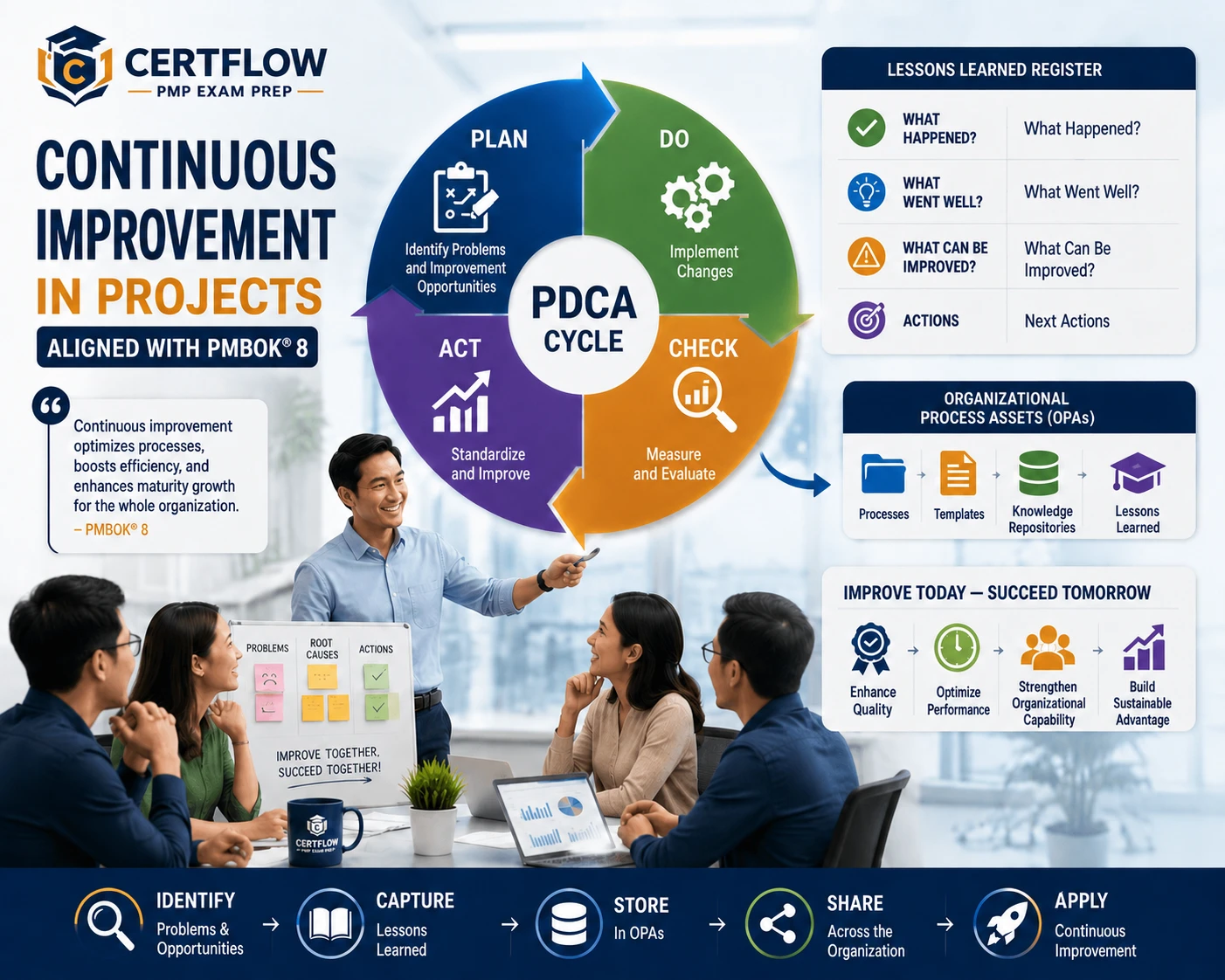
PMBOK® 8, Section 3.5: "Adopting a continuous improvement mindset optimizes processes, boosts efficiency, and enhances maturity growth for the whole organization, leading to better project outcomes and overall organizational success for present and future endeavors."
2. Continuous Improvement trong PMBOK 8
PMBOK 8 tích hợp continuous improvement ở nhiều nơi — đây không phải hoạt động riêng biệt mà là tư duy xuyên suốt:
Nơi xuất hiện | Vai trò CI |
|---|---|
Principle 5: Embed Quality | "Foundational to embedding quality is continuous improvement and waste elimination" |
Tailoring (Section 3.4.4) | "Implement Ongoing Improvement" — tailoring process includes continuous feedback loop |
Manage Project Knowledge | Lessons learned register, knowledge sharing, converting tacit → explicit |
Retrospectives | Sprint-level improvement mechanism in adaptive |
After-Action Reviews | Event-based learning in predictive |
Close Project | Final lessons learned, update OPAs, archive knowledge |
3. Framework 3 enablers
Enabler | Câu hỏi cốt lõi | Output |
|---|---|---|
Utilize lessons learned | Lessons từ quá khứ có được ÁP DỤNG vào hiện tại? | Improved practices, fewer repeated mistakes |
Update CI processes | Quy trình cải tiến có đang hoạt động hiệu quả? | Better retrospectives, feedback loops, action tracking |
Update OPAs | Tài sản tổ chức có phản ánh kiến thức mới nhất? | Updated templates, checklists, policies, knowledge repos |
4. Utilize Lessons Learned — Không chỉ capture, mà ÁP DỤNG
Lessons Learned Register vs. Repository
Lessons Learned Register | Lessons Learned Repository | |
|---|---|---|
Scope | DỰ ÁN hiện tại | TOÀN BỘ tổ chức |
Timing | Tạo sớm, cập nhật LIÊN TỤC, finalize khi close | Nhận input từ registers khi projects close |
Content | Category, description, impact, recommendations, proposed actions | Aggregated lessons across projects, searchable |
Managed by | PM + Team | PMO / Knowledge Management team |
🌟 PMBOK® 8: "Lessons learned are incorporated during the ongoing processes, not only at the end of the project." + "The lessons learned register is created as an output of the Manage Project Knowledge process EARLY in the project. Thereafter it is used as an input and updated as an output in MANY processes throughout the project."
3 cấp độ áp dụng Lessons Learned
Cấp độ | Mô tả | Ví dụ | Impact |
|---|---|---|---|
1. Within project | Áp dụng lessons từ phases/sprints trước vào phases/sprints sau | Sprint 3 retrospective → improve DoD cho Sprint 4 | Immediate — project hiện tại |
2. Across projects | Áp dụng lessons từ projects trước vào project mới | Previous vendor issues → create vendor evaluation checklist | Medium-term — projects tương lai |
3. Organizational | Lessons thay đổi policies, templates, standards | Pattern of estimation failures → update estimation methodology | Long-term — toàn tổ chức |
Hầu hết tổ chức dừng ở cấp 1 (nếu may mắn). Cấp 2 và 3 đòi hỏi cơ chế chuyển giao có hệ thống — đây là vai trò của PMO và OPAs.
"Utilize" — Không chỉ "Read"
Khi bắt đầu dự án mới, PM phải: review lessons learned repository cho dự án tương tự, identify applicable lessons, incorporate vào project planning (risk register, estimates, communication plan), và reference lessons trong kick-off/team meetings. PMBOK 8: "Lessons learned from previous projects can be used in the current project."
PMBOK® 8 Enhancement: "Tools that connect people to information can be enhanced by adding an element of interaction (e.g., including a 'contact me' function so users can get in touch with the originators of the lessons)." — Lessons sống khi có người giải thích context, không chỉ text trên giấy.
5. Update Continuous Improvement Processes
Quy trình cải tiến bản thân nó cũng cần được cải tiến! PM phải thường xuyên đánh giá: retrospectives có đang tạo ra actionable insights không? Action items có được implemented không? Feedback loops có đang closed không? Và metrics cho improvement có đang được tracked không?
Khi CI Process cần update
Signal | Nguyên nhân có thể | Action |
|---|---|---|
Same issues recurring | Action items không được implement | Add tracking mechanism, assign owners, set deadlines |
Team disengaged in retros | Format stale, no visible results | Rotate formats, show impact of past improvements |
Lessons learned vague | Poor facilitation, no structure | Use structured formats (What/So What/Now What), train facilitators |
Knowledge silos | No cross-team sharing mechanism | Communities of Practice, knowledge fairs, cross-project reviews |
OPAs outdated | No process to update from lessons | Establish regular OPA review cycles, assign PMO ownership |
PMBOK 8 Tailoring for Continuous Improvement
PMBOK® 8, Section 3.4.4: "Periodic reviews, such as retrospectives or lessons learned, help assess the effectiveness of current approaches and identify areas for improvement through tailoring. Teams that do not use retrospectives can rely on issues, threats, quality metrics, and stakeholder feedback to determine if further tailoring is needed."
6. Update Organizational Process Assets (OPAs)
OPAs là "bộ nhớ dài hạn" của tổ chức. Khi OPAs không được update, mỗi dự án phải reinvent the wheel.
2 categories OPAs — PMBOK 8
Category | Mô tả | Updated by projects? | Ví dụ |
|---|---|---|---|
Policies, processes, procedures | Established by PMO or organizational functions | Thường KHÔNG — needs org approval | Quality policies, safety procedures, estimation standards, templates |
Knowledge repositories | Living collections of data and information | CÓ — updated throughout project | Lessons learned repos, historical data, risk databases, metrics repos |
PM's role trong updating OPAs
Knowledge repositories — PM trực tiếp update: lessons learned register → repository khi close, risk data, financial data, project files archived.
Policies and procedures — PM đề xuất changes dựa trên lessons learned. VD: "3 projects had vendor issues → propose vendor management policy update." PM recommends, PMO/management approves.
Templates and checklists — PM cải thiện templates based on experience. VD: estimation template thiếu risk buffer column → add it cho projects tương lai.
PMBOK® 8: "The OPAs also include the organization's lessons learned from previous projects and historical information. OPAs are inputs to many project management processes. Since OPAs are internal to the organization, the project team members may be able to update and add to the OPAs as necessary throughout the project."
Close Project → OPA Updates
PMBOK 8 Close Project activities bao gồm: "Manage knowledge sharing and transfer," "Archive project information for future organizational use," "Collect suggestions for improving organizational policies and procedures." Đây là cơ hội cuối cùng — nhưng không nên là cơ hội DUY NHẤT — để update OPAs.
7. PDCA và các frameworks cải tiến
PDCA Cycle — Foundation of CI
Plan — Identify improvement opportunity, analyze root cause, develop improvement plan
Do — Implement improvement on small scale (pilot, one sprint, one team)
Check — Measure results, compare with expected outcomes. Did it work?
Act — If successful → standardize (update OPAs, rollout). If not → learn, adjust, cycle again.
CI Frameworks từ PMBOK 8
Framework | Focus | Mechanism |
|---|---|---|
PDCA | Iterative improvement cycle | Plan → Do → Check → Act → repeat |
Retrospectives | Sprint/iteration-level reflection | "What worked, what didn't, what to improve" — EVERY sprint |
After-Action Reviews | Event-based learning | "What happened, why, how to improve" — after milestones |
Lean | Waste elimination | Value stream mapping, 7 wastes identification |
Kaizen | Small, daily improvements | Everyone contributes micro-improvements continuously |
Communities of Practice | Cross-project knowledge sharing | Expert groups sharing best practices organically |
Predictive vs Adaptive CI
Aspect | Predictive | Adaptive |
|---|---|---|
CI mechanism | Phase reviews, milestone post-mortems, end-of-project LL sessions | Sprint retrospectives (EVERY sprint), iteration reviews |
Frequency | Periodic — after phases/milestones | Continuous — built into rhythm (every 2 weeks) |
Scope | Process improvement for current + future projects | Process AND product improvement for current sprint |
OPA updates | Primarily at project closure | Ongoing — DoD evolves, working agreements update |
8. Mẹo thi PMP
📍Mẹo 1 — Lessons learned = THROUGHOUT: Khi đề hỏi "when should lessons learned be captured?" — đáp án là throughout the project, KHÔNG phải "at project closure." PMBOK 8 nêu rõ: "incorporated during ongoing processes, not only at the end."
📍Mẹo 2 — OPAs: 2 categories: Policies/procedures = established by PMO, rarely changed by projects. Knowledge repositories = updated by projects throughout. Khi đề hỏi "which OPA can the PM update directly?" — knowledge repos (lessons, historical data, risk databases).
📍Mẹo 3 — Retrospective ≠ blame session: Khi đề mô tả "team avoids discussing problems in retrospectives" — đáp án liên quan đến psychological safety, NOT "make retrospectives mandatory" hay "PM forces discussion."
📍Mẹo 4 — CI is about ACTION: Khi đề mô tả "same issues keep recurring despite retrospectives" — the problem is NOT the retrospective — it's that action items aren't implemented. The improvement LOOP is broken at "Act."
9. Mười câu hỏi trắc nghiệm tình huống
Question 1
You're starting a new data migration project. A similar project failed 6 months ago in your organization. The lessons learned repository has extensive documentation from that project.
What should you do FIRST?
A. Start fresh — each project is unique.
B. Review the lessons learned repository, identify applicable insights, incorporate them into your project's risk register, estimates, and planning documents, and contact the previous PM for context on key lessons.
C. Copy the previous project's plan and modify it.
D. Assign a team member to summarize the lessons in a presentation.
Question 2
After 8 sprints, your team's retrospective has become routine: same format, same complaints, same action items that nobody follows up on. Attendance has dropped from 100% to 60%.
What is the ROOT CAUSE and what should you do?
A. The team is tired of retrospectives — reduce frequency to monthly.
B. The continuous improvement process itself needs improvement. Action items are not being implemented (broken PDCA loop), the format is stale, and there's no visible impact. Redesign: vary the format, ensure action items have owners and deadlines, track implementation, and show the team how past improvements made a difference.
C. Make retrospective mandatory and enforce attendance.
D. Replace retrospectives with a satisfaction survey.
Question 3
Your organization has no standard vendor evaluation checklist despite 5 projects having vendor-related issues in the past year. Each PM creates their own ad-hoc evaluation criteria.
What OPA update should you propose?
A. Each PM should continue creating their own — flexibility is important.
B. Propose that the PMO create a standardized vendor evaluation checklist based on lessons learned from the 5 problematic projects — incorporating evaluation criteria, monitoring frequency, escalation thresholds, and performance metrics. This becomes a policies/procedures OPA.
C. Add vendor risks to every project's risk register.
D. Hire a vendor management specialist for the organization.
Question 4
During project closure, you prepare to update the organizational lessons learned repository. The team says: "We already did retrospectives every sprint — everything is captured."
Is additional lessons learned activity needed at closure?
A. No — sprint retrospectives already captured everything.
B. Yes — closure lessons are different from sprint retrospectives. Sprint retros focus on immediate process improvements. Closure lessons should capture project-LEVEL insights: overall approach effectiveness, stakeholder management patterns, estimation accuracy analysis, and strategic recommendations for the organization.
C. Just compile the sprint retrospective notes and submit.
D. Only capture lessons if the project had significant problems.
Question 5
Your PMO has a lessons learned repository with 2,000 entries from 50+ projects. PMs rarely use it because "it takes too long to find relevant lessons" and "most entries are too vague to be useful."
How should you improve this?
A. Mandate that all PMs review the repository at project start.
B. Improve the repository: implement categorization/tagging (by project type, domain, phase), require structured entries (situation/impact/recommendation/action), add search functionality, include "contact me" links to lesson originators, and curate top lessons by category.
C. Delete old entries and start fresh.
D. Replace the repository with a wiki.
Question 6
Your team successfully implemented a new testing approach in Sprint 5 that reduced defects by 40%. The team is excited but continues using it only within their project.
What continuous improvement opportunity is being missed?
A. No opportunity missed — the improvement is working for this project.
B. The improvement should be shared across the organization. Document the approach, present it at a community of practice meeting, propose updating the testing standards OPA, and make it available for other teams to adopt and adapt.
C. Wait until project closure to document and share.
D. Let other teams discover it on their own.
Question 7
The organization's project estimation template hasn't been updated in 3 years. Recent projects consistently overrun by 20-30%. Historical data shows the template doesn't account for integration testing effort or regulatory compliance activities.
What should you recommend?
A. Each PM should add their own buffer for these activities.
B. Propose updating the estimation template (OPA) to include explicit line items for integration testing and regulatory compliance, informed by historical overrun data. This prevents future projects from making the same estimation error.
C. Replace the template with a new one from industry best practices.
D. Use bottom-up estimating instead of the template.
Question 8
A junior PM asks: "Our project has some unique processes that worked really well. Can I update the organization's project management methodology to include them?"
What is the correct approach?
A. Yes — PM can directly update organizational methodology.
B. PM should document the processes and PROPOSE updates through the appropriate channel (PMO, methodology governance). Policies and procedures OPAs are "usually established by the PMO or another function" and require organizational approval — PM cannot unilaterally change them.
C. No — organizational methodology should not change based on one project.
D. Add them to the lessons learned and hope someone adopts them.
Question 9
Your organization runs 20 similar projects annually. Each PM independently develops their risk register from scratch. There's no organizational risk database or risk categories template.
What CI action would have the highest organizational impact?
A. Train all PMs on better risk identification techniques.
B. Create an organizational risk database (OPA) aggregating common risks across similar projects, with historical probability data, proven response strategies, and lessons learned — so each PM starts from a knowledge base rather than from zero.
C. Hire a risk management specialist for the PMO.
D. Require all PMs to use the same risk register template.
Question 10
After implementing a continuous improvement initiative 6 months ago, the PMO asks: "How do we know if our CI program is working?"
What metrics should they track?
A. Number of lessons learned entries submitted.
B. Track both ACTIVITY metrics (retrospectives held, lessons captured, OPAs updated) AND OUTCOME metrics (reduction in repeated issues, estimation accuracy improvement, defect rate trends, project success rate, time-to-value improvement). CI success = organizational outcomes improving, not just activities happening.
C. Number of retrospectives conducted per project.
D. Employee satisfaction with the CI process.
Đáp án
Question 1: Answer: B
— ECO: "Utilize lessons learned." PMBOK 8: "Lessons learned from previous projects can be used in the current project." The PM should actively incorporate relevant lessons into planning — not ignore them (A), blindly copy (C), or delegate without personal understanding (D). The "contact me" function recommendation from PMBOK 8 supports reaching out to the previous PM.
Question 2: Answer: B
— The CI process isn't working because the "Act" step of PDCA is broken. PMBOK 8: "Periodic reviews help assess the effectiveness of current approaches and identify areas for improvement." The process itself needs tailoring — not elimination (A), enforcement (C), or replacement with something passive (D).
Question 3: Answer: B
— ECO: "Update organizational process assets." A pattern of vendor issues across 5 projects = organizational gap, not project gap. The fix should be organizational: standardized OPA (checklist + policy) informed by accumulated lessons. Individual risk registers (C) don't prevent the pattern.
Question 4: Answer: B
— Sprint retrospectives capture tactical, sprint-level insights. Project closure captures strategic, project-level lessons: was the overall approach right? Were estimations accurate across the project? What organizational patterns emerged? PMBOK 8 lists final lessons learned as a distinct closure activity. Compiling retro notes (C) misses the strategic layer.
Question 5: Answer: B
— PMBOK 8: "Methods for codifying explicit knowledge" + "enhanced by adding a 'contact me' function." The repository exists but is unusable — the process needs improvement. Mandating use (A) without fixing usability = forced frustration. The fix is structural: categorize, structure, search, connect people.
Question 6: Answer: B
— ECO: "Update OPAs." A 40% defect reduction is significant organizational value — not sharing it means other projects miss the benefit. PMBOK 8: "Communities of practice may generate insights that lead to improved processes." Don't wait until closure (C) — share now while the knowledge is fresh and people are excited.
Question 7: Answer: B
— This is a textbook OPA update based on lessons learned pattern. The template (policies/procedures OPA) needs updating to reflect organizational reality. Individual buffers (A) are ad-hoc. Generic industry template (C) may not fit the organization. Bottom-up (D) doesn't fix the template for others.
Question 8: Answer: B
— PMBOK 8: "Policies, processes, and procedures are not updated as part of the project work. They are established by the PMO or another function. These assets can be updated only by following the appropriate organizational policies." PM's role: propose based on evidence. PMO's role: evaluate and approve. The enthusiasm is right; the process must be followed.
Question 9: Answer: B
— ECO: "Update OPAs." 20 similar projects = massive opportunity for cross-project learning. An organizational risk database turns individual project knowledge into organizational knowledge. PMBOK 8: "historical information and lessons learned" are OPAs specifically designed for this purpose. Template alone (D) provides structure but not knowledge.
Question 10: Answer: B
— PMBOK 8 warns about Hawthorne Effect: measuring only activity (lessons captured) incentivizes volume over quality. True CI success = organizational outcomes improving. Are fewer mistakes repeating? Are estimates more accurate? Are defect rates declining? Activity metrics confirm the process exists; outcome metrics confirm it works.
10. Tổng kết
Continuous improvement là cầu nối giữa kinh nghiệm quá khứ và thành công tương lai — nhưng chỉ khi PM biến lessons thành actions, actions thành processes, và processes thành organizational assets. Ba takeaways:
1. Lessons learned phải được ÁP DỤNG, không chỉ được GHI — Register đầy mà không ai đọc = waste. PM phải: review repository khi bắt đầu dự án mới, incorporate relevant lessons vào planning, và reference lessons khi ra quyết định. PMBOK 8: "Lessons learned are incorporated during ongoing processes, not only at the end."
2. CI process cũng cần CI — Retrospectives stale? Action items không tracked? Repository không ai dùng? Quy trình cải tiến bản thân nó cũng cần được cải tiến. PDCA áp dụng cho chính CI process: Plan improvements → Do (pilot) → Check (measure) → Act (standardize or adjust).
3. OPAs là legacy — update chúng là đầu tư cho tương lai — Templates, checklists, policies, knowledge repositories — đây là "bộ nhớ dài hạn" của tổ chức. PM update knowledge repos trực tiếp, propose policy/procedure updates qua PMO. Mỗi project nên leave the organization BETTER than it found it — qua OPA updates.
PMBOK® 8, Section 2.1.6.6: "Effective knowledge-sharing mechanisms foster a collaborative, evidence-based working environment throughout the project. Through these mechanisms, valuable insights are captured, shared, and utilized to enhance project outcomes and drive continuous improvement."
Câu Hỏi Thường Gặp (FAQ)
PDCA cycle áp dụng trong quản lý dự án như thế nào?
Plan: lập kế hoạch cải tiến dựa trên data và analysis. Do: thực hiện thay đổi theo quy mô nhỏ/pilot trước. Check: đo lường kết quả, so sánh với baseline. Act: nếu hiệu quả — standardize và scale; nếu không — điều chỉnh plan và lặp lại. Trong agile, PDCA xảy ra mỗi sprint: planning → execution → review → retrospective.
Retrospective hiệu quả có những yếu tố nào?
Retrospective tốt gồm: Safe space (tạo bầu không khí không blame, focus on process not people), Structured format (Start/Stop/Continue, What went well/What needs improvement, Sailboat model), Actionable outcomes (mỗi improvement item có owner và due date), và Follow-up (kiểm tra action items từ retro trước). Frequency: sau mỗi sprint hoặc milestone.
Lessons Learned được lưu như thế nào để thực sự có ích cho dự án sau?
Common failure: lessons learned file vào drawer, không ai đọc. Best practices: (1) Organize theo category (risk, communication, technical, procurement...); (2) Searchable format — wiki, SharePoint, hay Confluence; (3) Include context: dự án nào, conditions nào để lessons áp dụng; (4) Review mandatory trong project planning phase; (5) Assign 'lessons owner' trong PMO để curate.
Bạn đã nắm vững cải tiến liên tục trong dự án — giờ là lúc luyện tập với câu hỏi thi thật.
Bài tiếp theo: Hỗ Trợ Thay Đổi Tổ Chức: Đánh Giá Văn Hóa theo PMBOK 8
Nguồn tham khảo chính thức:
Bạn đã sẵn sàng luyện tập chưa?
Thử CertFlow miễn phí — 10 câu hỏi, không cần đăng ký.
Bắt Đầu Miễn Phí