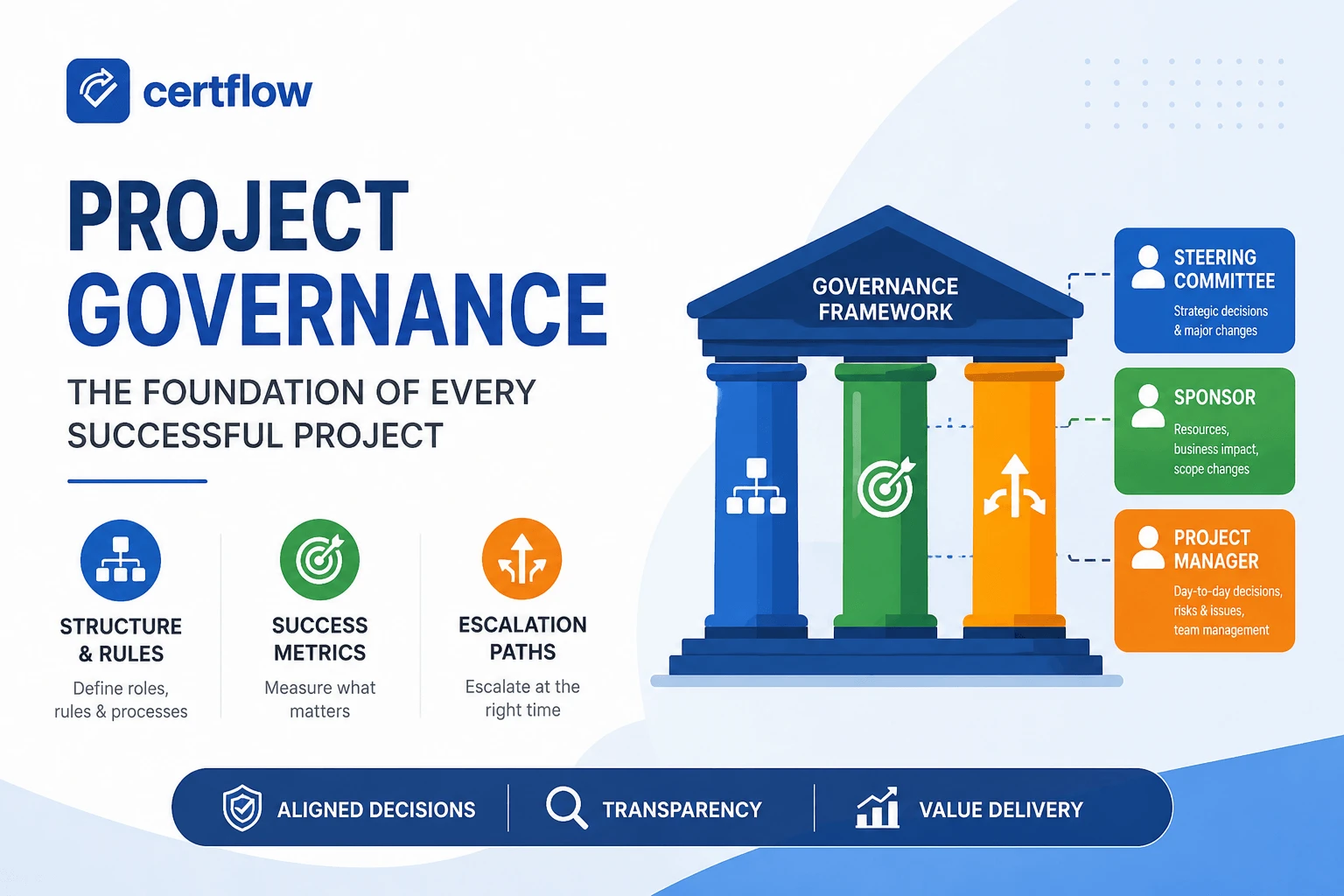
Governance tốt không phải là bureaucracy — mà là hệ thống quyết định rõ ràng. PMBOK 8 xây dựng governance để dự án thích nghi nhanh mà vẫn có kiểm soát.
1. Tại sao governance không phải "thêm giấy tờ" mà là "nền tảng quyết định"?
Hãy tưởng tượng: dự án phần mềm cho ngân hàng. Tuần 6, một developer commit code trực tiếp vào production mà không qua review. Tuần 8, team lead thay đổi kiến trúc database mà không thông báo PM. Tuần 10, stakeholder yêu cầu thêm tính năng và team thực hiện luôn mà không qua change control. Tuần 12, dự án chaos — không ai biết "version nào là version đúng."
Nguyên nhân? Không phải thiếu kỹ năng — mà thiếu governance: ai có quyền quyết định gì, quy trình nào phải tuân thủ, và khi nào cần escalate.
PMBOK® 8, Section 2.1: "Governance consists of the framework, functions, and processes that guide project management decisions and activities to optimize the project's value delivery. This governance framework is holistic and integrative, considering all other performance domains."
Governance không phải bureaucracy — nó là hệ thống bảo vệ giúp dự án ra quyết định đúng, đúng lúc, bởi đúng người.
2. Organizational Governance vs. Project Governance
Organizational Governance | Project Governance | |
|---|---|---|
Scope | Toàn bộ tổ chức | Một dự án cụ thể |
Thiết lập bởi | Executive committee, board of directors | PM + Sponsor + Steering committee |
Bao gồm | Corporate policies, compliance, financial controls, ethics standards | Decision-making models, change control, escalation, phase gates, roles |
Mục tiêu | Strategic alignment, transparency, compliance across organization | Value delivery, aligned decisions, controlled changes within project |
Mối quan hệ | Sets the boundaries within which projects operate | Operates WITHIN organizational governance, tailored cho project-specific needs |
PMBOK® 8, Section 1.3.2: "While organizational governance provides the overall direction and control for the entire organization, project governance focuses on the specific processes and frameworks to manage individual projects effectively. Both are essential for ensuring projects contribute to the organization's strategic objectives."
3. Framework 3 enablers governance
Enabler | Câu hỏi cốt lõi | Ví dụ outputs |
|---|---|---|
Structure, rules, procedures, reporting, ethics, policies (qua OPAs) | Ai quyết định gì? Quy trình nào bắt buộc? Giá trị đạo đức nào áp dụng? | RACI matrix, change control process, communication plan, ethics guidelines |
Define success metrics | Dự án "thành công" nghĩa là gì? Đo bằng gì? | KPIs, acceptance criteria, business case targets, balanced scorecard |
Escalation paths and thresholds | Khi nào escalate? Lên ai? Threshold bao nhiêu? | Escalation matrix, variance thresholds, decision authority levels |
4. Enabler 1: Thiết lập cấu trúc, quy tắc, và OPAs
Governance Structure — Ai quyết định gì?
Body | Vai trò governance | Quyết định tiêu biểu |
|---|---|---|
Steering Committee | Strategic oversight, resolve escalations, approve major changes | Go/no-go ở phase gates, budget increases, scope changes lớn |
Sponsor | Champion, funding authority, decision-maker for strategic issues | Business case validity, resource allocation, project continuation |
CCB (Change Control Board) | Evaluate và approve/reject changes to baselines | Change requests: scope, schedule, cost baseline changes |
PM | Day-to-day decisions, operational management | Task assignment, minor schedule adjustments, contingency use |
PMO | Standards, templates, portfolio alignment, methodology guidance | Process compliance, best practices, cross-project coordination |
Rules and Procedures — OPAs
PMBOK 8 phân OPAs thành 2 categories:
Policies, processes, procedures: Not updated as part of project — established by PMO or organizational functions. Bao gồm: quality policies, safety procedures, ethics standards, risk management procedures, audit/approval processes.
Organizational knowledge repositories: Updated BY the project. Bao gồm: configuration management repos, financial data repos, historical information and lessons learned, issue/defect management repos, metrics repos, project files from previous projects.
Ethics — PMBOK 8 perspective
PMBOK 8 Be an Accountable Leader: "Integrity and honesty, with a willingness to acknowledge risk, share bad news early, and ensure status reports provide an accurate depiction." Governance phải bao gồm ethics guidelines: transparency in reporting, conflicts of interest disclosure, data privacy compliance, và fair treatment of team members and vendors.
Reporting — Structured information flow
Governance xác định: ai báo cáo cho ai, frequency nào, format gì, escalation khi nào. PMBOK 8: "Key management members are kept apprised of the project" — bao gồm operational status, resource requirements, known risks, strategic assumptions, benefits realized, decision tracking.
5. Enabler 2: Định nghĩa success metrics
Governance phải trả lời: "Thành công trông như thế nào?" — trước khi dự án bắt đầu.
Hai chiều đánh giá thành công — PMBOK 8
PMBOK® 8, Section 2.1.2: "The assessment of project success requires the evaluation of two important dimensions: the success of project outcomes (value realization) and the success of project management processes (execution excellence)."
Dimension | Đo cái gì | Metrics ví dụ |
|---|---|---|
Outcome Success | Value delivery — dự án có tạo ra giá trị mong đợi? | ROI, NPV, customer satisfaction, adoption rate, business KPIs |
Process Success | Execution quality — PM processes có hiệu quả? | On-time, on-budget, scope accuracy, CPI, SPI, defect rate |
PMBOK 8 nhấn mạnh: outcome success > process success. Dự án đúng hạn, đúng budget nhưng không tạo value = thất bại. Dự án trễ hạn nhưng tạo value lớn = có thể vẫn thành công.
SMART Success Metrics
Mỗi metric phải đáp ứng SMART: Specific (cụ thể), Measurable (đo được), Achievable (khả thi), Realistic (thực tế), Time-bound (có deadline). Ví dụ: "Tăng NPS từ 35 lên 55 trong 6 tháng sau go-live" thay vì "Cải thiện customer satisfaction."
Phase Gates / Quality Gates — Checkpoints đánh giá
PMBOK 8: "Phase gates include a review to check that the desired outcomes have been achieved before proceeding. The project's performance is compared to project and business documents. A decision (go/no-go) is made."
Các quyết định tại phase gate: Continue to next phase, Continue with modification, End the project, Remain in phase, Repeat phase elements, hoặc Park the project temporarily.
6. Enabler 3: Escalation paths và thresholds
Governance phải xác định rõ: khi nào PM cần escalate, lên ai, và qua kênh nào. Không có escalation path rõ ràng = PM bị kẹt giữa, quyết định bị trì hoãn, hoặc escalate sai người.
Escalation Matrix
Issue Type | Threshold | Escalate To | Timeframe |
|---|---|---|---|
Cost variance | >10% of baseline | Sponsor → Steering Committee | Within 48 hours |
Schedule delay | >2 weeks on critical path | Sponsor | Within 24 hours |
Scope change | Any change to baseline | CCB | Before implementation |
Quality issue | Critical defect in production | Sponsor + Quality Lead | Immediately |
Resource conflict | Impacts critical path | Resource Manager → Sponsor | Within 48 hours |
Stakeholder escalation | Unresolved after 2 attempts | Sponsor | After documented attempts |
Ethical/compliance issue | Any violation | Legal/Compliance + Sponsor | Immediately |
Decision Authority Levels
Decision Type | PM Authority | Sponsor Authority | Steering Committee |
|---|---|---|---|
Daily operational decisions | Full authority | — | — |
Use contingency reserve | Full authority | Informed | — |
Use management reserve | Request | Approve | Informed |
Scope baseline change | Submit CR | CCB member | Approve (major) |
Budget increase >10% | Request | Request | Approve |
Project termination | Recommend | Recommend | Approve |
Mẹo PMP: Khi đề thi mô tả PM "unable to resolve an issue" — đáp án đúng thường là "escalate through the defined escalation path." KHÔNG phải "resolve it unilaterally" (overstep authority) hay "wait for it to resolve itself" (passive).
7. Governance trong Predictive vs. Adaptive
Aspect | Predictive | Adaptive |
|---|---|---|
Governance weight | Comprehensive — formal processes, heavy documentation | Lightweight — "just enough," self-governing teams |
Decision-making | Centralized — PM/CCB/Steering Committee | Distributed — team self-organizes within guardrails |
Change control | Formal CCB process, baseline updates | PO reprioritizes backlog, continuous adaptation |
Phase gates | Formal phase-end reviews, go/no-go | Sprint reviews, iteration reviews, release gates |
Reporting | Formal status reports, dashboards, EVM | Information radiators, burndown/burnup, demos |
Ethics/compliance | Same — applies regardless of approach | Same — applies regardless of approach |
PMBOK® 8, Tailoring: "Governance can be tailored: lightweight for adaptive methods; moderate or combined for hybrid; and comprehensive for large, predictive portfolios. For lean/agile approaches, governance may be provided by the project team only in the artifacts and events of the project."
PMBOK 8 cũng đề cập guided self-governance cho agile: "Agile teams are empowered to make decisions about their work processes, priorities, and problem-solving approaches — essentially, self-governance. These teams manage their work with light governance and clear-set boundaries and guardrails."
8. Mẹo thi PMP
Mẹo 1 — Governance = right-sized: Không phải "more = better." Agile projects cần lightweight governance. Regulatory projects cần comprehensive. Khi đề mô tả "small agile team complains about excessive paperwork" → answer liên quan đến tailoring governance to fit the approach.
Mẹo 2 — Outcome success > Process success: Khi đề mô tả "project on-time, on-budget but stakeholders unhappy" → project is NOT fully successful. PMBOK 8 measures both dimensions.
Mẹo 3 — CCB cho baseline changes: Mọi change request ảnh hưởng baselines (scope, schedule, cost) phải qua CCB. PM KHÔNG có quyền đơn phương thay đổi baselines.
Mẹo 4 — Escalate through defined path: Khi PM không thể resolve → escalate per governance. Đừng skip levels (PM → CEO directly) trừ khi governance cho phép.
9. Mười câu hỏi trắc nghiệm tình huống
Question 1
You're starting a new project and the sponsor asks: "Do we need a governance framework? It sounds like bureaucracy." The project is a medium-complexity software development with 15 team members and 3 external vendors.
How should you respond?
A. Agree — governance adds overhead for a medium project. Keep it informal.
B. Explain that governance is not bureaucracy but a decision-making framework. For this project: establish a RACI matrix, change control process, escalation paths, success metrics, and vendor oversight — tailored to the project's complexity.
C. Implement full enterprise governance regardless of project size.
D. Let the team self-organize without formal governance.
Question 2
Your project's cost variance reaches 12%, exceeding the 10% threshold defined in the governance framework. The PM wants to investigate first before escalating.
Is the PM's approach correct?
A. Yes — investigate first to present a complete picture.
B. No — the governance framework specifies escalation at >10%. PM should escalate within the defined timeframe WHILE investigating. Governance thresholds exist to ensure timely visibility, not to wait until analysis is complete.
C. It depends on whether the sponsor wants to be informed.
D. Skip escalation and implement corrective actions.
Question 3
A new PMO mandates that all projects, regardless of size, must follow a 25-step change control process. Your agile team of 5 delivering a 3-month internal tool finds the process crippling — changes that should take minutes take weeks.
What should you do?
A. Follow the 25-step process — organizational standards must be respected.
B. Ignore the process and use agile practices instead.
C. Work with the PMO to tailor the change control process for agile projects — maintaining the governance intent (oversight, approval, tracking) while reducing the process overhead to fit the project's scale and approach.
D. Escalate to the sponsor to get an exemption.
Question 4
Your project has no defined success metrics beyond "deliver the software by December." After delivery, the sponsor says: "It's on time, but is it successful? I don't know."
What governance gap caused this?
A. The sponsor should have defined success metrics.
B. Success metrics were never established during governance setup. The PM should have worked with stakeholders to define BOTH outcome metrics (business value, adoption, satisfaction) AND process metrics (on-time, on-budget, quality) — making success measurable and verifiable.
C. "Deliver by December" is a sufficient success metric.
D. Success can only be measured after the project has been in production for 6 months.
Question 5
During a phase gate review, the steering committee discovers that a key quality metric is below threshold but the project is on schedule and budget. The PM recommends proceeding to the next phase.
Should the steering committee approve?
A. Yes — schedule and budget are more important than one quality metric.
B. The steering committee should assess the impact of the quality shortfall on the project's value proposition, determine if corrective action can address it, and make an informed go/no-go decision — not automatically proceed despite a failed criterion.
C. No — any failed criterion should block phase progression.
D. Defer the decision to the PM since they know the details best.
Question 6
A team member discovers that a vendor has been submitting inflated invoices by 15%. The PM is unsure whether to report it — the vendor relationship is important and the amounts are within budget.
What should the PM do?
A. Ignore it since costs are within budget.
B. Report the issue through the governance framework's ethics/compliance channel immediately. Inflated invoices are an integrity issue regardless of budget impact — governance and ethics policies require transparency and reporting.
C. Discuss it privately with the vendor first.
D. Deduct the overcharges from future payments.
Question 7
Your agile team has been self-organizing successfully for 6 sprints. A new executive stakeholder demands that all technical decisions must be approved by a governance board before implementation.
How should you handle this?
A. Implement the governance board as requested — executives have authority.
B. Explain the agile self-governance model, show evidence of successful decision-making, and propose a compromise: the team continues self-governing within defined guardrails, with major architectural decisions reviewed by the governance board.
C. Refuse — agile teams don't need external governance.
D. Escalate to the sponsor to override the executive.
Question 8
Your project's RACI matrix shows the functional manager as "Accountable" for resource allocation. However, the PM has been directly allocating resources without consulting the functional manager for 3 months.
What governance issue does this represent?
A. No issue — the PM is being efficient.
B. The PM is violating the governance framework. The RACI matrix defines authority — bypassing it undermines governance, damages trust with the functional manager, and sets a precedent that governance rules are optional.
C. The RACI matrix needs updating to reflect reality.
D. The functional manager should have spoken up sooner.
Question 9
The organization has no PMO and no standard project governance. You're the PM for a high-visibility project with significant regulatory requirements.
What should you establish?
A. No governance — the organization doesn't require it.
B. Copy governance from another organization's template.
C. Work with the sponsor and key stakeholders to establish project-specific governance: decision-making authority (RACI), change control process, escalation paths with thresholds, success metrics, reporting cadence, compliance framework, and ethical guidelines — all tailored to this project's complexity and regulatory needs.
D. Ask the sponsor to set up a governance board before you start.
Question 10
At project inception, you define success metrics: CPI ≥ 0.95, SPI ≥ 0.90, customer satisfaction ≥ 80%, and zero critical defects post-launch. At closure: CPI = 0.97, SPI = 0.88, satisfaction = 92%, and 2 critical defects in first month (resolved within 48 hours).
Is the project successful?
A. No — SPI and defects missed targets.
B. Partially successful — 2 of 4 metrics met, 2 missed.
C. Evaluate holistically: CPI exceeded target, satisfaction far exceeded target (92% vs 80%), SPI slightly below (0.88 vs 0.90), and defects occurred but were resolved quickly. Present a balanced assessment — largely successful with minor schedule deviation and resolved quality issues.
D. Yes — the satisfaction score compensates for the other misses.
Đáp án :
Question 1: Answer: B
— PMBOK 8: "Governance consists of the framework, functions, and processes that guide decisions to optimize value delivery." With 15 people and 3 vendors, informal governance will create confusion. But it should be RIGHT-SIZED — not enterprise-level bureaucracy.
Question 2: Answer: B
— Governance thresholds are triggers, not suggestions. The PM can investigate AND escalate simultaneously — "we've exceeded the 10% threshold, here's what we know so far, and here's our investigation plan." Delaying escalation defeats the purpose of thresholds.
Question 3: Answer: C
— PMBOK 8: "Governance can be tailored: lightweight for adaptive methods." The intent of change control (visibility, approval, tracking) can be maintained with a lighter process. Ignoring (B) violates organizational governance. Blindly following (A) creates waste. Tailoring in collaboration with PMO is the right approach.
Question 4: Answer: B
— PMBOK 8: "Assessment requires two dimensions: success of outcomes and success of processes." A delivery date is ONE process metric — it says nothing about value. The governance framework should have defined multi-dimensional success metrics at the start.
Question 5: Answer: B
— PMBOK 8: phase gates compare "performance to business documents. A decision is made." Quality below threshold is a flag that requires analysis — automatic approval (A) ignores governance, automatic rejection (C) is rigid, and deferring (D) undermines the steering committee's role.
Question 6: Answer: B
— PMBOK 8 Be an Accountable Leader: "Integrity and honesty." Ethical issues must be reported through proper channels regardless of financial materiality. Ignoring (A) enables fraud. Private discussion (C) may be appropriate AFTER reporting. The governance framework exists precisely for situations like this.
Question 7: Answer: B
— PMBOK 8: agile teams operate with "light governance and clear-set boundaries and guardrails." The executive's concern (oversight) is valid; the team's need (autonomy) is also valid. A compromise with guardrails respects both. Blanket governance (A) kills agility. Refusing (C) ignores legitimate oversight needs.
Question 8: Answer: B
— If the RACI says the functional manager is Accountable, the PM must follow that governance. If the RACI doesn't reflect reality, it should be FORMALLY updated through governance processes (C is partially right but B is the core issue). Governance rules that aren't enforced = no governance at all.
Question 9: Answer: C
— PMBOK 8: "Project governance is the adaptable framework that guides project management activities." Even without a PMO, the PM must establish project-level governance. Especially with regulatory requirements, governance is critical. Tailored to THIS project's needs — not copied blindly (B) or ignored (A).
Question 10: Answer: C
— PMBOK 8: success requires evaluating BOTH outcome (satisfaction = 92%, excellent) AND process (CPI = strong, SPI = slightly below, defects = resolved). A holistic assessment recognizes that not all metrics carry equal weight — 92% satisfaction is a stronger indicator of value delivery than a minor SPI miss.
10. Tổng kết
Governance là "luật chơi" của dự án — khi được thiết lập đúng, nó tạo điều kiện cho quyết định nhanh, minh bạch, và có trách nhiệm. Ba takeaways:
Right-size governance, don't eliminate it — Agile cần lightweight governance, không phải zero governance. Regulatory projects cần comprehensive governance, không phải bureaucracy. PM phải tailor governance cho context — nhưng mọi dự án đều cần: ai quyết định gì, quy trình thay đổi, escalation khi nào, và thành công đo bằng gì.
Define success before you start — "Thành công" phải measurable, multi-dimensional, và agreed-upon TRƯỚC khi dự án bắt đầu. PMBOK 8 yêu cầu 2 chiều: outcome success (value) VÀ process success (execution). Chỉ đo "on-time, on-budget" = mất 50% bức tranh.
Escalation paths save projects — PM không có quyền giải quyết mọi thứ — và không nên. Governance xác định rõ: vấn đề nào PM tự xử, vấn đề nào escalate, lên ai, trong bao lâu. Không có escalation path = PM bị kẹt, quyết định bị trì hoãn, và vấn đề nhỏ thành thảm họa.
PMBOK® 8, Section 2.1: "To help ensure continuous improvement, feedback loops are incorporated into the governance framework, allowing for periodic reviews, lessons learned, and iterative adjustments to governance practices."
Câu Hỏi Thường Gặp (FAQ)
Project Governance Framework trong PMBOK 8 bao gồm những yếu tố gì?
Governance framework gồm: (1) Roles và responsibilities — ai quyết định gì (PM, Sponsor, Steering Committee, PMO); (2) Decision-making authority levels — ngưỡng nào PM tự quyết, ngưỡng nào cần escalate; (3) Escalation paths — khi có vấn đề vượt thẩm quyền PM, báo cáo cho ai theo thứ tự nào; (4) Meeting cadence — khi nào họp governance meetings; (5) Reporting requirements — report gì cho ai.
PM nên escalate vấn đề cho Sponsor khi nào và không nên khi nào?
Nên escalate: issues vượt thẩm quyền PM (scope changes lớn, budget overruns >10%, key risks trở thành issues), khi cần quyết định ảnh hưởng đến strategic objectives, hoặc khi stakeholder conflict cấp độ cao cần authority resolution. Không nên escalate: technical details, team conflicts PM có thể resolve, minor risks trong management reserve.
PMO (Project Management Office) có vai trò gì trong project governance?
PMO có thể đóng 3 vai trò: Supportive (cung cấp templates, training, support — ít authority nhất), Controlling (require compliance với PM standards và frameworks), Directive (control projects trực tiếp — authority cao nhất). Role của PMO trong governance phụ thuộc vào loại PMO của tổ chức — PM cần hiểu để work effectively.
Bạn đã nắm vững governance dự án — giờ là lúc luyện tập với câu hỏi thi thật.
Bài tiếp theo: Quản Lý Compliance Dự Án: Phân Loại Rủi Ro & Hành Động
Nguồn tham khảo chính thức:
Bạn đã sẵn sàng luyện tập chưa?
Thử CertFlow miễn phí — 10 câu hỏi, không cần đăng ký.
Bắt Đầu Miễn Phí