Xung đột trong dự án không phải lúc nào cũng xấu — nhưng xử lý sai sẽ phá hủy team. PMBOK 8 dạy PM 5 kỹ thuật và khi nào dùng mỗi loại.
1. Xung đột là tất yếu — nhưng không phải lúc nào cũng xấu
Nhiều PM coi xung đột như "cháy nhà" — cần dập tắt ngay lập tức. Nhưng PMBOK 8 có góc nhìn khác hẳn:
PMBOK® 8, Section 5 — Conflict Management: "Successful conflict management results in greater productivity and positive working relationships. When managed properly, differences of opinion can lead to increased creativity and better decision-making."
Xung đột có hai mặt:
Xung đột xây dựng (Constructive) | Xung đột phá hoại (Destructive) | |
|---|---|---|
Biểu hiện | Tranh luận về ý tưởng, giải pháp, phương pháp | Công kích cá nhân, giấu thông tin, phá hoại ngầm |
Kết quả | Quyết định tốt hơn, giải pháp sáng tạo hơn | Mất trust, giảm morale, team tan rã |
PM nên | Khuyến khích và facilitate | Can thiệp ngay và giải quyết |
PM giỏi không triệt tiêu mọi xung đột — mà tạo ra môi trường nơi xung đột xây dựng được khuyến khích, còn xung đột phá hoại được phát hiện sớm và xử lý dứt điểm.
2. Bảy nguồn gốc xung đột phổ biến nhất trong dự án
PMBOK 8 xác nhận: "Sources of conflict include scarce resources, scheduling priorities, and personal work styles." Mở rộng hơn, 7 nguồn xung đột phổ biến nhất theo thứ tự từ hay gặp nhất → ít gặp nhất:
Thứ tự | Nguồn gốc | Ví dụ thực tế |
|---|---|---|
1 | Lịch trình (Schedules) | Bất đồng về deadline, thứ tự ưu tiên, timeline |
2 | Ưu tiên dự án (Project priorities) | Quan điểm khác nhau về tầm quan trọng các phần việc |
3 | Nguồn lực (Resources) | Tranh chấp phân bổ nhân sự, thiết bị giữa các team |
4 | Ý kiến kỹ thuật (Technical opinions) | Bất đồng về giải pháp, công nghệ, kiến trúc |
5 | Thủ tục hành chính (Administrative) | Cách báo cáo, quy trình phê duyệt, documentation |
6 | Chi phí (Cost) | Ngân sách, ước tính chi phí, phân bổ tài chính |
7 | Tính cách (Personality) | Phong cách làm việc, giá trị cá nhân khác biệt |
💡 Mẹo thi PMP: "Schedules" là nguồn xung đột #1 phổ biến nhất. "Personality" là ít phổ biến nhất. Đề thi thường hỏi "what is the MOST common source of conflict?" — đừng nhầm với "personality clashes" vì nó nghe có vẻ drama hơn.
3. Framework 6 bước quản lý xung đột theo ECO
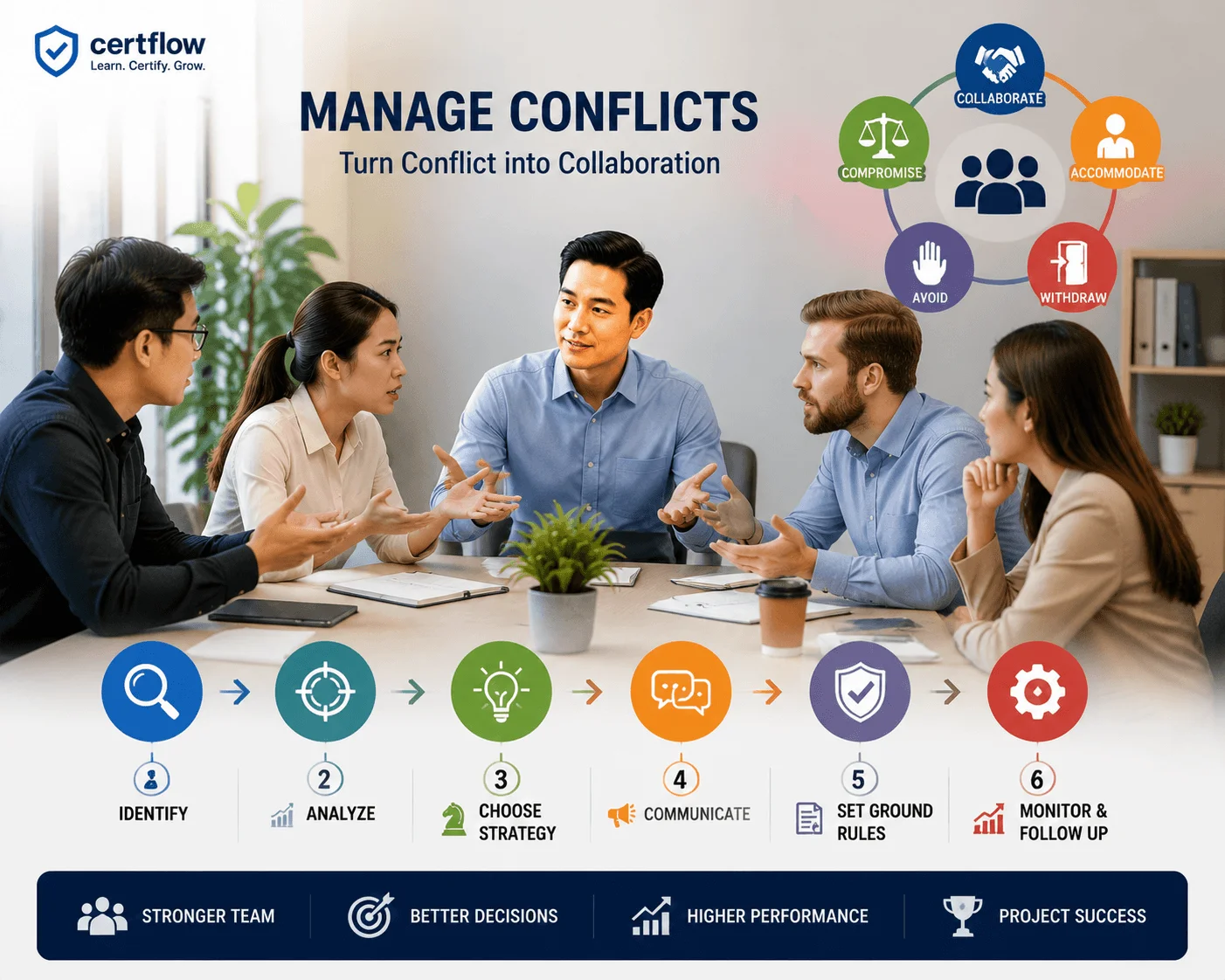
PMP ECO xác định 6 enablers cho Manage Conflicts, tạo thành một quy trình hoàn chỉnh từ phòng ngừa đến xử lý:
Nhóm | Bước | Enabler | Câu hỏi trả lời |
|---|---|---|---|
Phân tích | 1 | Identify conflict sources | Xung đột đến từ đâu? |
Phân tích | 2 | Analyze the context | Bối cảnh xung quanh xung đột như thế nào? |
Hành động | 3 | Implement agreed-on resolution strategy | Áp dụng kỹ thuật nào để giải quyết? |
Truyền thông | 4 | Communicate principles | Mọi người có biết quy tắc xử lý xung đột? |
Phòng ngừa | 5 | Establish ground rules environment | Có quy tắc nào để phòng xung đột? |
Phòng ngừa | 6 | Manage and rectify violations | Làm gì khi quy tắc bị vi phạm? |
⚠️ Lưu ý: mặc dù bước 5-6 (phòng ngừa) liệt kê cuối, trong thực tế bạn nên thiết lập ground rules TRƯỚC — ngay từ khi hình thành nhóm. Thứ tự trong ECO phản ánh logic phân tích (khi xung đột xảy ra), nhưng PM giỏi sẽ đầu tư vào phòng ngừa ngay từ đầu.
4. Bước 1-2: Nhận diện nguồn gốc và phân tích bối cảnh
Bước 1: Identify Conflict Sources
Xung đột có triệu chứng (symptoms) và nguyên nhân gốc (root cause). PM cần phân biệt: hai developer cãi nhau về code style là triệu chứng — nguyên nhân gốc có thể là tranh chấp về quyền kiểm soát kiến trúc, áp lực deadline dẫn đến stress, hoặc thiếu coding standards rõ ràng.
Kỹ thuật nhận diện: quan sát hành vi team (ai né tránh ai, ai thường bất đồng), lắng nghe trong daily standups và retrospectives, phân tích patterns (xung đột lặp lại ở đâu, khi nào), và one-on-one conversations (nhiều xung đột ẩn chỉ bộc lộ trong private).
Bước 2: Analyze the Context
Không phải mọi xung đột đều xử lý giống nhau. PMBOK 8 liệt kê 5 yếu tố bối cảnh quyết định bạn nên dùng kỹ thuật nào:
Yếu tố bối cảnh | Câu hỏi cần trả lời | Ảnh hưởng đến lựa chọn kỹ thuật |
|---|---|---|
Importance and intensity | Vấn đề này quan trọng đến đâu? | Quan trọng → Collaborate. Nhỏ → Smooth hoặc Avoid |
Time pressure | Có bao nhiêu thời gian để giải quyết? | Gấp → Force hoặc Compromise. Có thời gian → Collaborate |
Relative power | Ai có quyền lực hơn? | Quyền lực ngang → Compromise. Chênh lệch → cẩn trọng hơn |
Importance of relationship | Mối quan hệ này quan trọng ra sao? | Rất quan trọng → Smooth hoặc Collaborate. Không → Force có thể OK |
Long-term vs. short-term | Cần giải pháp lâu dài hay tạm thời? | Lâu dài → Collaborate. Tạm thời → Compromise |
Ví dụ: xung đột giữa PM và sponsor về timeline — sponsor có quyền lực cao hơn (power), mối quan hệ rất quan trọng (relationship), và cần giải pháp lâu dài (long-term). → Collaborate hoặc Compromise phù hợp, Force sẽ phản tác dụng.
5. Năm kỹ thuật giải quyết xung đột — chọn đúng cho đúng tình huống
PMBOK 8 định nghĩa chính xác: "There are five general techniques for resolving conflict. Each technique has its place and use." Không có kỹ thuật nào luôn đúng — mỗi kỹ thuật phù hợp với một bối cảnh khác nhau.
Kỹ thuật | Định nghĩa PMBOK 8 | Kết quả | Khi nào dùng |
|---|---|---|---|
Withdraw / Avoid | "Retreating from an actual or potential conflict; postponing the issue to be better prepared or to be resolved by others." | Lose-Lose | Vấn đề nhỏ, cần "hạ nhiệt," thiếu thông tin |
Smooth / Accommodate | "Emphasizing areas of agreement rather than areas of difference; conceding one's position to maintain harmony and relationships." | Lose-Win | Duy trì mối quan hệ quan trọng, xung đột nhẹ |
Compromise / Reconcile | "Searching for solutions that bring some degree of satisfaction to all parties to temporarily or partially resolve the conflict." | Lose-Lose* | Quyền lực ngang nhau, cần giải pháp tạm thời |
Force / Direct | "Pushing one's viewpoint at the expense of others; usually enforced through a power position to resolve an emergency." | Win-Lose | Tình huống khẩn cấp, quyết định an toàn, không có thời gian |
Collaborate / Problem-Solve | "Incorporating multiple viewpoints and insights from differing perspectives; requires a cooperative attitude and open dialogue that typically leads to consensus." | Win-Win | Vấn đề quan trọng, đủ thời gian, cần giải pháp lâu dài |
Nguyên tắc vàng cho PMP: PMI luôn ưu tiên Collaborate/Problem-Solve (Win-Win) là phương pháp tốt nhất để giải quyết xung đột lâu dài. Trong đề thi, nếu có lựa chọn này và tình huống cho phép thời gian — hãy chọn Collaborate. Chỉ chọn kỹ thuật khác khi tình huống nêu rõ ràng rằng không thể collaborate (VD: emergency, deadline cực gấp, safety issue).
Ma trận lựa chọn nhanh
Relationship quan trọng | Relationship không quan trọng | |
|---|---|---|
Issue quan trọng | Collaborate — Cả vấn đề lẫn quan hệ đều cần bảo vệ | Force — Vấn đề cần giải quyết nhanh, quan hệ chấp nhận tổn thương |
Issue không quan trọng | Smooth — Nhường nhịn để giữ quan hệ | Withdraw — Không đáng để đầu tư thời gian |
Compromise nằm ở giữa: khi issue và relationship đều ở mức trung bình, hoặc khi cần giải pháp tạm thời nhanh.
6. Bước 3-4: Thực thi chiến lược và truyền đạt nguyên tắc
Bước 3: Implement an Agreed-on Resolution Strategy
Từ khóa quan trọng nhất: "agreed-on" — chiến lược giải quyết phải được các bên đồng thuận, không phải PM đơn phương quyết định.
Quy trình chuẩn: Phân tích bối cảnh (bước 1-2) → Lựa chọn kỹ thuật phù hợp → Trình bày các phương án cho các bên → Đạt đồng thuận → Thực hiện → Theo dõi kết quả → Ghi lessons learned.
PMBOK 8 cũng nêu rõ vai trò của nhóm:
PMBOK® 8: "If the differences become a negative factor, project team members are initially responsible for their resolution. If conflict escalates, the project manager should help facilitate a satisfactory resolution."
Nghĩa là: PM không nên nhảy vào giải quyết mọi xung đột. Bước đầu tiên luôn là để nhóm tự xử lý. PM chỉ can thiệp khi xung đột leo thang hoặc nhóm không thể tự giải quyết.
Bước 4: Communicate Conflict Management Principles
PM cần truyền đạt rõ ràng cho cả nhóm nội bộ lẫn stakeholder bên ngoài về nguyên tắc xử lý xung đột của dự án. PMBOK 8 gợi ý 4 nguyên tắc giao tiếp khi xung đột:
- Keep communication open and respectful — "It is important to keep a safe environment to explore the source of the conflict. Without a safe environment, people will stop communicating."
- Focus on the issues, not the people — "Conflicts should not be personal. The focus is on resolving the situation, not casting blame."
- Focus on the present and future, not the past — "If something similar happened previously, bringing up the past will not resolve the current situation."
- Search for alternatives together — "This collaboration can create more constructive relationships... moves the conflict into a problem-solving space."
7. Bước 5-6: Thiết lập ground rules và xử lý vi phạm
Bước 5: Establish Ground Rules
Phòng bệnh hơn chữa bệnh. PMBOK 8 nêu rõ: "Team ground rules, group norms, and solid project management practices, such as communication planning and role definition, can reduce the amount of conflict."
Team Charter là công cụ chính — PMBOK 8 định nghĩa nó bao gồm: team values, communication guidelines, decision-making criteria and processes, conflict resolution processes, meeting guidelines, và team agreements.
Điều quan trọng nhất: nhóm phải tham gia soạn ground rules, không phải PM áp đặt. PMBOK 8: discussing areas like "codes of conduct, communication, decision-making, and meeting etiquette allows team members to discover values that are important to one another." Quá trình thảo luận ground rules bản thân nó đã là hoạt động team building.
Bước 6: Manage and Rectify Violations
Ground rules chỉ có giá trị khi được thực thi nhất quán. Quy trình 5 bước xử lý vi phạm:
- Nhận diện — Phát hiện vi phạm qua quan sát, phản hồi từ team, hoặc retrospectives
- Trao đổi riêng — Nói chuyện private với người vi phạm, tìm hiểu nguyên nhân
- Nhắc nhở và cam kết — Nhắc lại ground rules, yêu cầu cam kết tuân thủ
- Theo dõi — Quan sát hành vi sau khi nhắc nhở
- Leo thang nếu cần — Nếu vi phạm tiếp tục, sử dụng formal procedures
PMBOK® 8: "Conflict should be addressed early and usually in private, using a direct, collaborative approach. If disruptive conflict continues, formal procedures may be used, including disciplinary actions."
🌟 PM cũng cần nhớ: "All project team members share responsibility for ensuring the rules documented in the team charter are followed." — Trách nhiệm tuân thủ không chỉ thuộc về PM mà của cả nhóm.
8. Emotional Intelligence — Vũ khí bí mật của PM
PMBOK 8 liệt kê Emotional Intelligence (EI) như một tool riêng biệt trong Lead the Team — và nó cực kỳ quan trọng cho quản lý xung đột.
PMBOK® 8, Section 5: "Emotional intelligence is the ability to identify, assess, and manage the personal emotions of oneself and other people, as well as the collective emotions of groups of people."
Bốn trụ cột EI ứng dụng cho xung đột:
Trụ cột | Định nghĩa | Ứng dụng khi xung đột |
|---|---|---|
Self-awareness | Hiểu cảm xúc, mục tiêu, điểm mạnh/yếu bản thân | Nhận ra khi cảm xúc cá nhân đang chi phối quyết định |
Self-management | Kiểm soát phản ứng bốc đồng, suy nghĩ trước khi hành động | Không phản ứng nóng vội trong tình huống căng thẳng |
Social awareness | Empathy — hiểu cảm xúc và quan điểm người khác | Thấy được mối lo thật sự đằng sau lập trường bề mặt |
Relationship management | Xây dựng và duy trì mối quan hệ hiệu quả | Duy trì trust sau khi xung đột được giải quyết |
🌟 PMBOK 8 nhấn mạnh: "A project manager should invest in their personal emotional intelligence by improving inbound (self-management and self-awareness) and outbound (relationship management) competencies." EI không phải tài năng bẩm sinh — nó là kỹ năng có thể rèn luyện.
9. Mẹo thi PMP về Conflict Management
📍 Mẹo 1 — Default answer = Collaborate: Khi câu hỏi không nêu rõ time pressure hoặc emergency — đáp án mặc định luôn là Collaborate/Problem-Solve (Win-Win). Chỉ chọn kỹ thuật khác khi tình huống nêu rõ constraint (VD: "the deadline is tomorrow," "this is a safety issue").
📍 Mẹo 2 — "Address early, in private": PMBOK 8 nói rõ: xung đột nên được giải quyết sớm và thường là riêng tư. Khi đề thi hỏi "what should the PM do FIRST?" — đáp án thường KHÔNG phải "address it publicly in the meeting" hay "send an email to the whole team."
📍 Mẹo 3 — Team solves first, PM facilitates: Khi xung đột giữa team members — PM nên let team try to resolve first, chỉ can thiệp khi escalates. Đáp án "PM directly resolves the conflict" thường sai trừ khi đề nêu "the team has already tried and failed."
📍 Mẹo 4 — Escalation is not failure: Khi PM đã cố gắng resolve mà không thành — escalate to management/HR là bước tiếp theo hợp lý. PMBOK 8: "If disruptive conflict continues, formal procedures may be used." Escalation KHÔNG phải thất bại — đó là quản lý đúng quy trình.
10. Mười câu hỏi trắc nghiệm tình huống
Question 1
Two senior developers disagree about the database architecture. Developer A wants NoSQL for flexibility; Developer B insists on relational for data integrity. Both have valid technical arguments, and the decision will significantly impact long-term maintainability. There is no time pressure.
What conflict resolution technique should you apply?
A. Force/Direct — Choose the solution you believe is best since you're the PM.
B. Compromise — Use NoSQL for some modules and relational for others.
C. Collaborate/Problem-Solve — Facilitate a workshop where both developers analyze requirements together and reach consensus.
D. Smooth/Accommodate — Ask Developer A to accept Developer B's approach to maintain harmony.
Question 2
During a daily standup, a team member publicly criticizes another's code quality, calling it "sloppy and unprofessional." The criticized member looks visibly upset. Other team members appear uncomfortable.
What should you do FIRST?
A. Address the criticism publicly during the standup to set an example about respectful behavior.
B. Redirect the standup to focus on progress updates, then speak privately with the criticizing team member about the ground rules.
C. Ask both team members to resolve the issue between themselves.
D. Document the incident in the issue log and discuss at the next retrospective.
Question 3
A client representative and your site engineer have been arguing for two weeks about structural support placement. The disagreement is delaying the critical path. Both have rejected each other's proposals twice.
What approach is MOST appropriate?
A. Compromise — place supports in an intermediate location.
B. Bring in an independent structural expert to provide data, then facilitate a collaborative discussion based on the expert's findings.
C. Apply Force — go with the engineer's recommendation since they're responsible for site execution.
D. Escalate to the sponsor for a binding decision.
Question 4
You are assembling a new team from three departments. During the kickoff, you notice tension between marketing and engineering — they have a history of blaming each other for failures in previous projects.
What is the BEST proactive approach?
A. Separate them into different work streams to avoid interaction.
B. Facilitate the creation of a team charter with conflict resolution processes, communication guidelines, and team agreements — with input from all members.
C. Meet individually with each department to mediate past grievances.
D. Set clear expectations that past conflicts won't be tolerated.
Question 5
A team member from India consistently misses code review deadlines, causing US team delays. Investigation reveals the deadlines fall during their evening family time due to the 12-hour time zone difference. The US team is frustrated.
How should you approach this conflict?
A. Remind the Indian member they agreed to the ground rules and must comply.
B. Remove them from the code review rotation.
C. Analyze the root cause (time zone context), then facilitate a collaborative schedule adjustment that works for both parties while meeting project needs.
D. Alternate the review deadline between time zones each sprint.
Question 6
During a retrospective, a junior team member says: "I feel like my ideas are always dismissed by the senior members. I've stopped suggesting improvements." Two seniors immediately become defensive.
What should you do?
A. Thank the junior member for honesty, defuse the defensiveness, and facilitate a discussion about creating a safer environment for all ideas.
B. Ask the junior member to provide specific examples so seniors can respond.
C. Move on and address privately after the meeting.
D. Remind the team that retrospectives are about process, not personal issues.
Question 7
Your vendor consistently delivers components below quality standards. When you raise concerns, their PM says "everything is on track." This has happened three times. Your QA team rejects the deliverables each time.
What is the BEST approach?
A. Issue a formal notice of non-compliance referencing contract terms.
B. Organize a joint review session with both teams to examine specifications together, identify where misunderstandings occur, and establish a shared quality checklist.
C. Accept deliverables with minor defects to maintain the timeline.
D. Replace the vendor.
Question 8
Two experienced team members have a strong personal dislike for each other. Despite two private conversations, their behavior is creating a toxic atmosphere — whispering in meetings, refusing to collaborate, and making passive-aggressive comments.
What should you do NEXT?
A. Separate them into different work streams.
B. Escalate to their functional managers and/or HR, as the conflict has moved beyond what informal methods can resolve.
C. Try one more collaborative discussion with both in the room.
D. Wait for their performance review to address formally.
Question 9
The project sponsor says: "I need this feature delivered by Friday — no excuses." The lead developer says: "It's technically impossible in 3 days without cutting quality significantly." Both look at you.
How should you handle this?
A. Support the sponsor — they have authority over the project.
B. Support the developer — technical reality should drive decisions.
C. Present the trade-offs transparently: what's achievable by Friday, what the quality risks are, and what alternatives exist — let the sponsor make an informed decision.
D. Propose a compromise of partial delivery by Friday.
Question 10
You notice that a team member has been privately complaining about your management style to other members, calling you a "micromanager." Team morale has declined and some members seem hesitant to share updates with you.
What is the BEST approach?
A. Confront the team member and explain that undermining the PM is unprofessional.
B. Ignore the complaints and focus on delivering results.
C. Reflect on the feedback with self-awareness, then have an open, non-defensive conversation with the team member to understand their perspective and collaboratively adjust your approach.
D. Raise the issue at the next team meeting for transparent discussion.
Đáp án
Question 1: Answer: C
— This is a significant technical decision with long-term impact and no time pressure. PMBOK 8: Collaborate "incorporates multiple viewpoints and insights from differing perspectives." Both developers have valid arguments — collaboration may reveal a solution that combines the best of both approaches.
Question 2: Answer: B
— PMBOK 8: "Conflict should be addressed early and usually in private." Addressing it publicly could embarrass both parties and escalate. Leaving them alone (C) ignores a ground rule violation. Waiting for retrospective (D) delays too long. Redirect the standup first, then address privately.
Question 3: Answer: B
— After two weeks of failed negotiation, new input is needed. An expert provides objective data that breaks the deadlock and enables collaboration. Compromise (A) may create a technically unsound solution. Force (C) damages client relationship. Escalating (D) is premature when there's still a collaborative option.
Question 4: Answer: B
— PMBOK 8: "The team charter establishes clear expectations... Early commitment to clear guidelines decreases misunderstandings and increases productivity" and "works best when the team develops it." Separating (A) avoids the issue. Past mediation (C) doesn't establish forward-looking rules. Top-down expectations (D) lack buy-in.
Question 5: Answer: C
— The root cause is a time zone conflict, not poor work ethic. PMBOK 8 emphasizes cultural awareness and adapting communication strategies. Enforcing rules without context (A) ignores legitimate constraints. Removing them (B) wastes talent. Imposed compromise (D) lacks collaboration.
Question 6: Answer: A
— This is a ground rules and psychological safety issue. PMBOK 8's Build an Empowered Culture emphasizes creating environments where team members "contribute ideas freely." Asking for examples (B) puts a vulnerable person on the spot. Moving on (C) signals the concern isn't valued. Dismissing as "personal" (D) shuts down feedback.
Question 7: Answer: B
— This is a recurring conflict with a pattern. PMBOK 8's Be an Accountable Leader: "explore the root cause of the issue and identify acceptable adjustments." Joint review = Collaborate/Problem-Solve. Formal notice (A) may be needed later but isn't the first step. Compromising quality (C) undermines value. Replacement (D) is premature.
Question 8: Answer: B
— PMBOK 8: "If disruptive conflict continues, formal procedures may be used, including disciplinary actions." Two private attempts have failed — the informal route is exhausted. Separation (A) is a workaround. Another conversation (C) is unlikely to succeed. Waiting (D) lets the toxic environment persist.
Question 9: Answer: C
— The PM's role is to facilitate informed decisions, not take sides. PMBOK 8: leaders demonstrate "transparency" and "integrity — willingness to share bad news early." Present facts, show options, let the authority decide. Siding with either (A, B) creates Win-Lose. Proposing compromise (D) without stakeholder input is premature.
Question 10: Answer: C
— PMBOK 8 emphasizes EI: "Self-awareness is the ability to conduct a realistic self-assessment — understanding our own emotions, goals, motivations, strengths, and weaknesses." The complaint may contain valid feedback. Confronting (A) confirms the "doesn't trust" perception. Ignoring (B) lets morale deteriorate. Public discussion (D) could embarrass the team member. Private, self-aware dialogue models the trust and openness being questioned.
11. Tổng kết
Quản lý xung đột không phải "dập lửa" — mà là kiến tạo môi trường nơi bất đồng trở thành động lực sáng tạo. Ba takeaways chính:
- Phân tích trước khi hành động — Nhận diện nguồn gốc (7 sources) + phân tích bối cảnh (5 factors) TRƯỚC khi chọn kỹ thuật. Chọn sai kỹ thuật vì không hiểu bối cảnh sẽ khiến xung đột leo thang thay vì giải quyết.
- Collaborate là mặc định, nhưng không phải duy nhất — Win-Win là lý tưởng cho giải pháp lâu dài. Nhưng khi tình huống khẩn cấp (Force), khi cần giữ quan hệ (Smooth), khi cần giải pháp tạm (Compromise) — PM phải linh hoạt. Biết KHI NÀO dùng kỹ thuật nào là kỹ năng quan trọng nhất.
- Phòng ngừa > Chữa trị — Ground rules, team charter, và clear role definition ngay từ đầu sẽ giảm đáng kể số xung đột phát sinh. Và khi vi phạm xảy ra — xử lý sớm, riêng tư, nhất quán. Đừng đợi đến khi "cháy nhà" mới hành động.
PMBOK® 8: "The success of project managers in managing their project teams often depends on their ability to resolve conflicts." — Quản lý xung đột không phải kỹ năng "nice to have." Nó là kỹ năng sống còn của PM.
Câu Hỏi Thường Gặp (FAQ)
5 kỹ thuật giải quyết xung đột trong PMP là gì và khi nào dùng?
Collaborating/Confronting: tìm giải pháp win-win — dùng khi relationship quan trọng và vấn đề phức tạp. Compromising: cả hai nhường một phần — dùng khi cần quyết định nhanh. Smoothing/Accommodating: giảm căng thẳng tạm thời — dùng khi cần thời gian. Forcing: áp dụng quyền lực — dùng trong khủng hoảng. Withdrawing/Avoiding: rút lui — ít dùng nhất, dùng khi vấn đề không quan trọng.
Theo PMBOK 8, PM nên ưu tiên kỹ thuật nào khi giải quyết xung đột?
PMBOK 8 và hầu hết câu hỏi thi PMP ưu tiên Collaborating/Problem Solving — vì nó tạo ra giải pháp tốt nhất và bảo vệ relationships lâu dài. Tuy nhiên, không có one-size-fits-all: PM cần đánh giá urgency, importance of relationship, và power dynamics để chọn technique phù hợp.
Conflict productive khác destructive như thế nào?
Productive conflict: bất đồng về ideas, approach, hoặc priorities — tạo ra better decisions khi được quản lý tốt. Destructive conflict: attack cá nhân, hidden agendas, hoặc passive aggression — làm hại team trust và performance. PM role: turn destructive into productive bằng cách focus on interests, not positions.
Bạn đã nắm vững quản lý xung đột dự án — giờ là lúc luyện tập với câu hỏi thi thật.
Bài tiếp theo: Dẫn Dắt Nhóm Dự Án: 7 Năng Lực Lãnh Đạo theo PMBOK 8
Quản lý nhóm dự án: từ tuyển người đến giải quyết xung đột theo PMP
Nguồn tham khảo chính thức:
Bạn đã sẵn sàng luyện tập chưa?
Thử CertFlow miễn phí — 10 câu hỏi, không cần đăng ký.
Bắt Đầu Miễn Phí