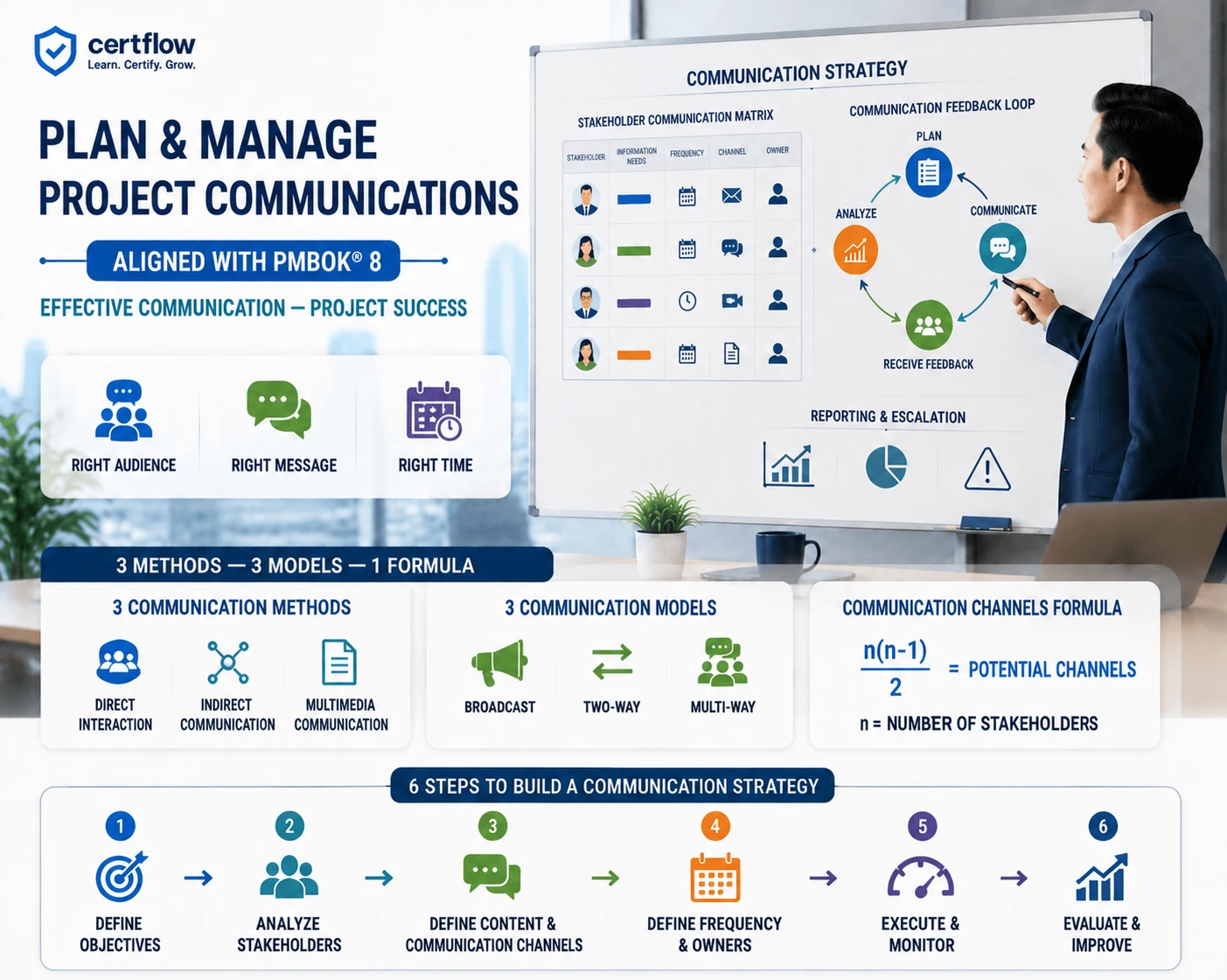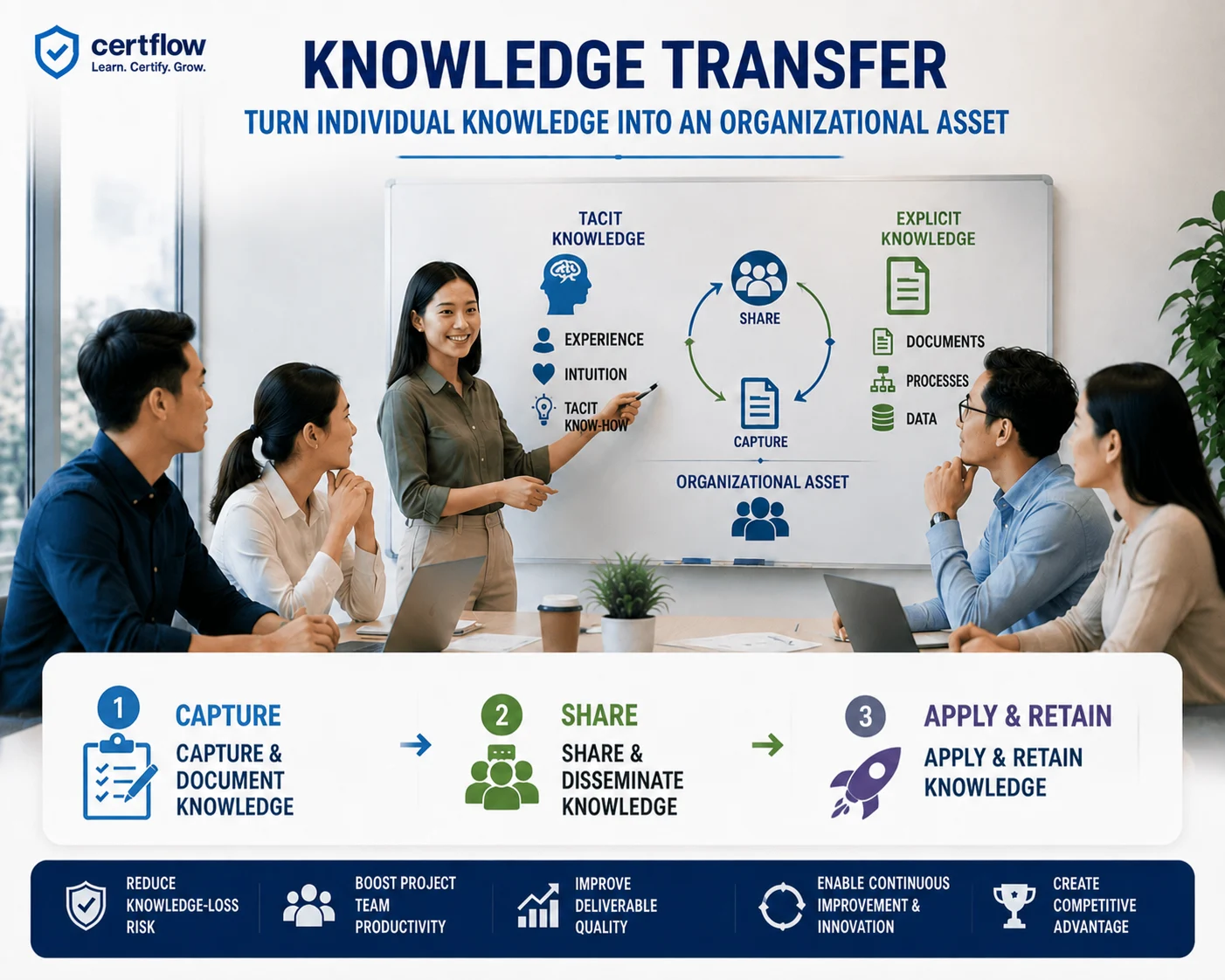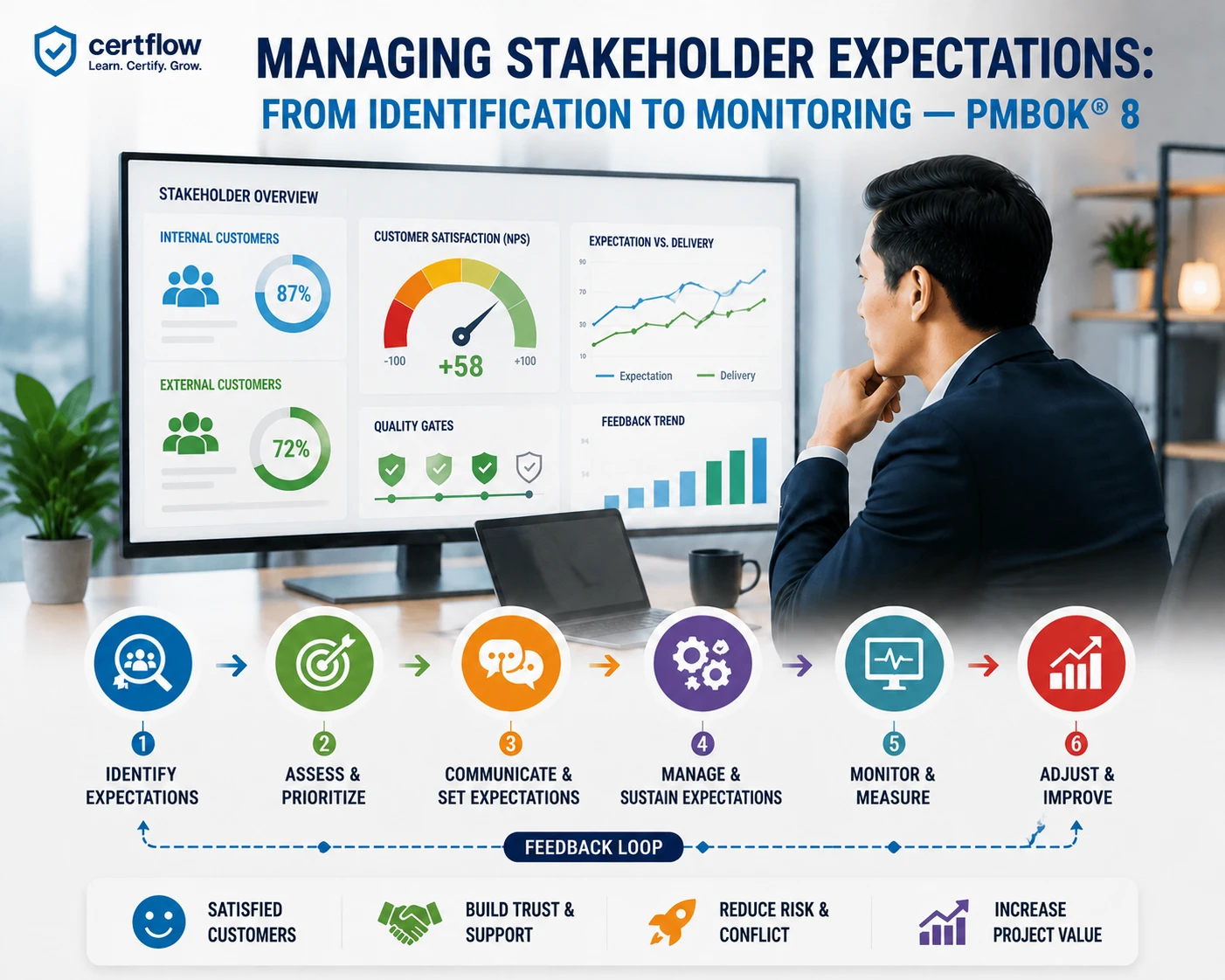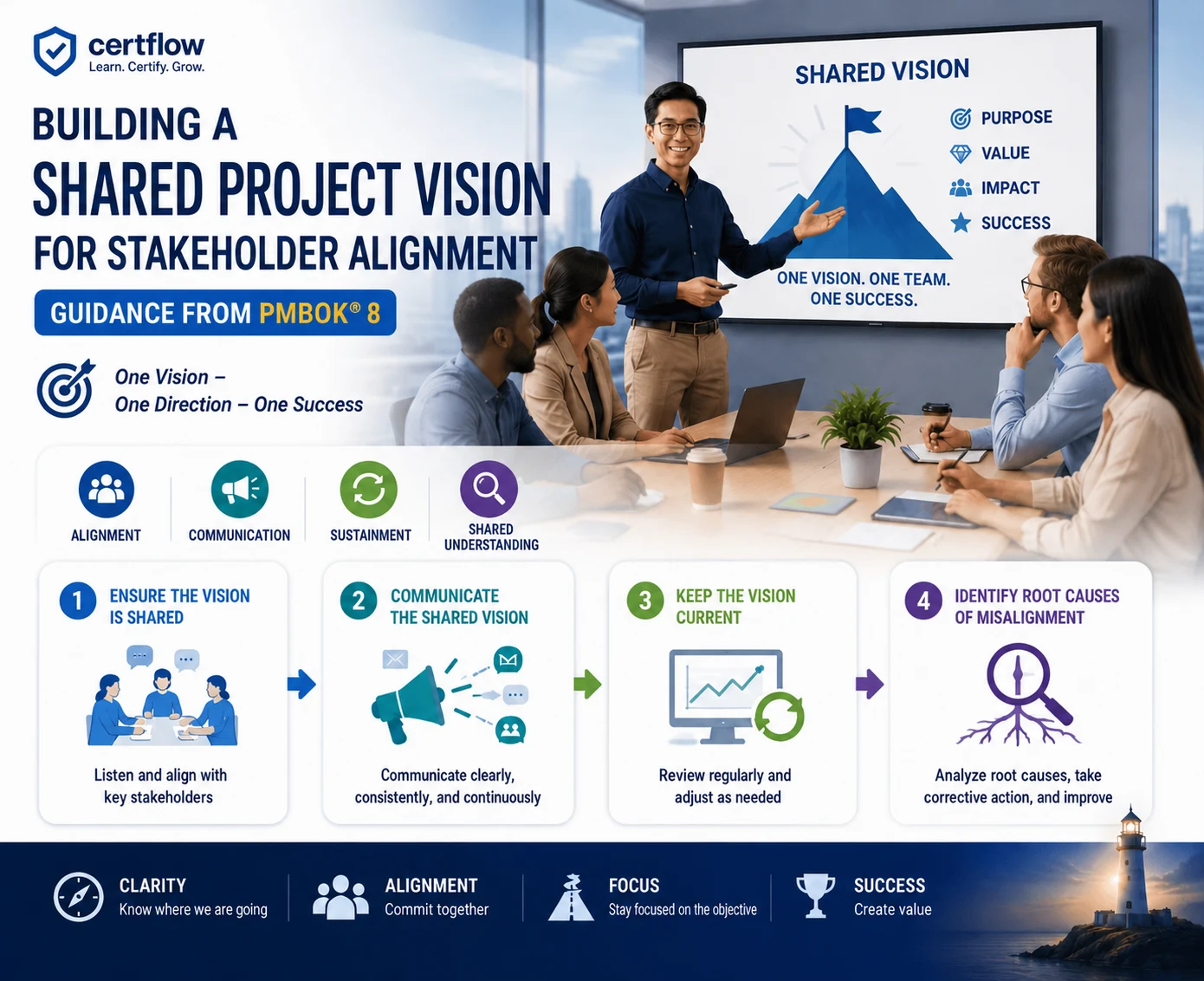
Dự án không có tầm nhìn chung giống như con thuyền không có la bàn. PMBOK 8 đặt shared vision làm nền tảng People domain. Bài này hướng dẫn cách xây dựng.
1. Câu chuyện thực tế: Dự án "thành công" mà không ai hài lòng
Một công ty logistics khởi động dự án xây dựng hệ thống quản lý kho mới. CFO muốn giảm 20% chi phí vận hành. VP Operations muốn tăng tốc độ xử lý đơn hàng gấp đôi. IT Director muốn hiện đại hóa toàn bộ technology stack. Đội sales muốn real-time inventory visibility để hứa với khách hàng chính xác hơn.
Mỗi bên đều nghĩ dự án phục vụ mục tiêu của mình. PM lao vào lập kế hoạch dựa trên requirements từ tất cả các bên — mà chưa bao giờ đặt câu hỏi: "Rốt cuộc, chúng ta đang xây cái gì và tại sao?"
Sáu tháng sau, dự án giao đúng thời hạn. Nhưng CFO bất mãn vì chi phí không giảm như kỳ vọng. Operations thất vọng vì hệ thống tối ưu cho reporting hơn là tốc độ xử lý. IT Director hài lòng với công nghệ nhưng thừa nhận nó over-engineered. Sales vẫn chưa có real-time visibility.
Nguyên nhân gốc rễ? Không có tầm nhìn chung. Mỗi stakeholder có "vision" riêng, và dự án cố gắng thỏa mãn tất cả mà không hội tụ chúng thành một hướng duy nhất.
Đây chính là lý do PMP ECO đặt "Develop a Common Vision" làm Task đầu tiên trong People Domain — vì không có tầm nhìn chung, mọi thứ sau đó đều xây trên nền tảng lung lay.
2. Tầm nhìn chung là gì — và không phải là gì?
Trước khi đi vào cách thực hiện, hãy phân biệt rõ tầm nhìn chung với những thứ hay bị nhầm lẫn:
Khái niệm | Định nghĩa | Ví dụ |
|---|---|---|
Vision (Tầm nhìn) | Bức tranh về trạng thái mong muốn khi dự án thành công — WHY dự án tồn tại | "Trở thành đơn vị logistics có tốc độ giao hàng nhanh nhất khu vực trong 18 tháng" |
Objectives (Mục tiêu) | Targets cụ thể, đo được — WHAT cần đạt | "Giảm thời gian xử lý đơn từ 48h xuống 12h" |
Scope (Phạm vi) | Công việc cần thực hiện — HOW để đạt mục tiêu | "Xây hệ thống WMS với 5 modules, triển khai tại 3 kho" |
Requirements | Specifications chi tiết — WHAT sản phẩm phải có | "Hệ thống hỗ trợ barcode scanning, tích hợp ERP" |
Tầm nhìn chung = Vision được tất cả key stakeholders hiểu, chấp nhận, và cam kết. "Chung" (common/shared) là từ khóa quan trọng nhất — một vision statement đẹp đẽ treo trên tường mà không ai tin hoặc hiểu thì không có giá trị.
PMBOK® 8, Section 2.6.2.4.1: "The vision and objectives are communicated throughout the project and are essential for understanding. This communication includes referencing the intended outcomes when the project team makes decisions and solves problems."
Tầm nhìn đóng vai trò bộ lọc quyết định: khi gặp xung đột về priorities, scope, hoặc approach, nhóm có thể hỏi "Quyết định nào phù hợp hơn với tầm nhìn dự án?" — và có câu trả lời rõ ràng.
3. Framework 4 bước xây dựng tầm nhìn chung
PMP ECO xác định 4 enablers cho task này, tạo thành một quy trình logic:
Bước | Enabler | Câu hỏi trả lời | Thời điểm |
|---|---|---|---|
1 | Ensure a shared vision with key stakeholders | Stakeholders có cùng hiểu tầm nhìn không? | Initiating — khi dự án bắt đầu |
2 | Promote the shared vision | Mọi người có biết và nhớ tầm nhìn không? | Liên tục — mọi lúc mọi nơi |
3 | Keep the vision current | Tầm nhìn có còn phù hợp với thực tế không? | Khi bối cảnh thay đổi |
4 | Identify root cause of misunderstanding | Tại sao có người hiểu sai? Gốc rễ ở đâu? | Khi phát hiện misalignment |
⚠️ Lưu ý: đây không phải 4 bước tuần tự rồi kết thúc — mà là chu trình liên tục. Bạn có thể đang ở bước 2 (promote) và phát hiện cần quay lại bước 1 (re-ensure) vì có stakeholder mới. Hoặc đang ở bước 3 (update) và cần bước 4 (root cause) khi nhóm phản ứng tiêu cực với thay đổi.
4. Bước 1: Đảm bảo tầm nhìn được chia sẻ với key stakeholders
Đây là bước nền tảng — và cũng là bước mà nhiều PM bỏ qua nhanh nhất. "Shared" không có nghĩa là PM gửi email thông báo tầm nhìn — mà là stakeholders thật sự tham gia vào quá trình hình thành tầm nhìn đó.
Tại sao "shared" khác "informed"?
Informed (Thông báo) | Shared (Chia sẻ) | |
|---|---|---|
Hướng đi | Một chiều: PM → Stakeholders | Hai chiều: PM ↔ Stakeholders |
Sự tham gia | Passive: đọc, nghe, ghi nhận | Active: đóng góp, tranh luận, cam kết |
Commitment | Thấp: "Tôi biết rồi" | Cao: "Tôi tin và cam kết" |
Kết quả | Compliance — làm vì phải | Ownership — làm vì muốn |
Cách thực hiện
Thu thập đầu vào: Nghiên cứu business case, project charter, và organizational strategy. PMBOK 8 nêu: project charter cung cấp "understanding that facilitates efficient resource allocation" — và trong adaptive, charter có thể là "concise vision statements."
Tổ chức Vision Workshop: Mời key stakeholders cùng thảo luận ba câu hỏi cốt lõi: "Tại sao dự án này tồn tại?", "Thành công trông như thế nào?", "Giá trị nào sẽ được tạo ra cho ai?"
Xác nhận alignment: Sau workshop, yêu cầu mỗi stakeholder diễn giải lại tầm nhìn bằng ngôn ngữ của họ. Nếu các phiên bản khác nhau đáng kể — tầm nhìn chưa thật sự "shared."
PMBOK® 8, Section 2.1.1: "A clearly articulated business case enables stakeholder alignment on priorities and constraints, and provides team members with a broader context that informs their work."
5. Bước 2: Truyền bá tầm nhìn chung
Tầm nhìn chỉ có giá trị khi mọi người đều biết, hiểu, và nhớ. Thử nghĩ xem: nếu bạn hỏi bất kỳ thành viên nhóm nào "Dự án này nhằm mục đích gì?" — họ có trả lời được không?
PM cần trở thành "người kể chuyện" — liên tục kết nối công việc hàng ngày với tầm nhìn lớn.
Lồng ghép vào mọi hoạt động
PMBOK 8 nêu rõ: tầm nhìn và mục tiêu cần được tham chiếu khi nhóm ra quyết định và giải quyết vấn đề. Trong thực tế, điều này nghĩa là: khi phân công task, giải thích task đó đóng góp như thế nào vào mục tiêu lớn. Khi có tranh luận về priorities, quay lại tầm nhìn làm tiêu chí phân xử. Khi onboard thành viên mới, tầm nhìn là thứ đầu tiên họ cần hiểu — trước cả technical requirements.
Các kênh truyền bá hiệu quả
- Predictive: Kickoff meeting, phase reviews, milestone celebrations, steering committee presentations, project dashboards
- Adaptive: Sprint goals liên kết với vision, sprint reviews demos, product roadmap sessions, daily standups (khi cần realign)
- Cả hai: Information radiators (vision board treo tại workspace), onboarding packages, town halls, newsletters
PMBOK® 8, Section 2.6.2.4.2: "Shared understanding can be achieved when the purpose of the project and the benefits that it will provide are held in common with the team. Shared understanding is closely related to project alignment, which helps ensure that the project's goals and activities are in line with the organization's mission and strategy."
6. Bước 3: Giữ tầm nhìn luôn cập nhật
Tầm nhìn không phải tài liệu "viết xong rồi cất đi." Trong một thế giới biến động, bối cảnh kinh doanh có thể thay đổi đáng kể giữa chừng dự án — và tầm nhìn cần phản ánh thực tế mới.
Khi nào cần đánh giá lại tầm nhìn?
Thị trường thay đổi đáng kể (đối thủ mới, regulation mới, công nghệ mới)
Sponsor hoặc key stakeholder thay đổi (người mới có priorities khác)
Business case không còn hợp lý (ROI giảm, chi phí tăng vượt kiểm soát)
Dự án chuyển sang phase mới với context khác
Organizational strategy pivot
PMBOK® 8, Section 3.4: "Desired outcomes should be clearly described, iteratively assessed, and updated throughout the project life cycle using quality gates, feedback loops, and regular reviews. The project team should adapt to changes and continuously evaluate alignment with the desired outputs, baselines, business case, and intended outcomes."
Cập nhật ≠ Thay đổi liên tục
PM cần cân bằng giữa ổn định (nhóm cần một "ngôi sao Bắc" cố định để hướng tới) và thích ứng (tầm nhìn phải phản ánh thực tế). Mỗi lần cập nhật phải có lý do rõ ràng, được thống nhất với key stakeholders, và truyền thông rộng rãi. Thay đổi tầm nhìn mà không communicate = tạo ra nhiều misunderstanding hơn.
Và trong trường hợp tầm nhìn thay đổi hoàn toàn đến mức dự án không còn giá trị — PM cần dũng cảm đề xuất: có nên dừng không? PMBOK 8 nêu rõ: "If misalignment persists or the project is unlikely to deliver the intended value, it may be best to terminate the effort."
7. Bước 4: Tìm nguyên nhân gốc khi tầm nhìn bị hiểu sai
Đây là enabler đòi hỏi kỹ năng phân tích sâu nhất. Khi phát hiện nhóm hoặc stakeholder hiểu sai tầm nhìn, phản ứng phổ biến của PM là nhắc lại — nói rõ hơn, gửi email thêm lần nữa, tổ chức meeting giải thích. Nhưng nếu vấn đề là cách truyền đạt, thì nhắc lại bằng cách cũ không giải quyết được gì.
ECO yêu cầu PM phải "break down situations to identify the root cause" — tìm hiểu TẠI SAO hiểu sai, không chỉ SỬA hiểu sai.
Mô hình phân tích nguyên nhân gốc
Nguyên nhân gốc | Dấu hiệu nhận biết | Giải pháp |
|---|---|---|
Tầm nhìn quá trừu tượng | Mỗi người diễn giải khác nhau, không ai nêu được ví dụ cụ thể | Cụ thể hóa bằng outcomes đo được, user stories, hoặc "definition of success" |
Kênh truyền thông sai | Team nói "chưa bao giờ nghe" dù PM đã gửi email | Dùng interactive communication thay vì push. Lồng ghép vào meetings, standups |
Khác biệt văn hóa | Team đa quốc gia — một nhóm "hiểu" nhưng nhóm khác không | Adapt communication style, dùng visual aids, confirm understanding bằng cách yêu cầu paraphrase |
Stakeholder mới chưa onboard | Người mới join giữa chừng, bỏ lỡ context ban đầu | Tạo onboarding package cho tầm nhìn, assign "vision buddy" giải thích 1-on-1 |
Tầm nhìn không liên kết với daily work | Team nói "vision hay nhưng chẳng liên quan đến việc tôi làm" | Kết nối mỗi task/story với mục tiêu lớn. Trả lời: "Task này đóng góp vào vision bằng cách nào?" |
Xung đột lợi ích ẩn | Stakeholder "đồng ý" nhưng hành động ngược lại | 1-on-1 riêng tư để hiểu unstated concerns, negotiate trade-offs minh bạch |
PMBOK® 8, Section 3.3: "Embracing a holistic perspective is crucial for managing project complexity, as it enables project managers to grasp the overall situation and the connections among different project components. This method aids in pinpointing the root causes of challenges and tackling them efficiently."
Công cụ phân tích
5 Whys:
Hỏi "Tại sao?" liên tiếp 5 lần để đào sâu từ triệu chứng đến nguyên nhân gốc. Ví dụ: "Team hiểu sai scope" → Tại sao? → "Họ không hiểu priority" → Tại sao? → "Tầm nhìn không nêu rõ priority nào quan trọng nhất" → Tại sao? → "Vision workshop chỉ có PM và sponsor, không có team leads" → Tại sao? → "PM nghĩ team leads sẽ được thông báo sau" → Root cause: Key stakeholders bị exclude khỏi quá trình hình thành tầm nhìn.
Fishbone Diagram (Ishikawa):
Phân loại nguyên nhân theo các nhánh: People (ai hiểu sai? tại sao?), Process (quy trình communicate có lỗ hổng?), Communication (kênh nào bị miss?), Culture (yếu tố văn hóa nào ảnh hưởng?), Timing (thời điểm communicate có phù hợp?), Content (nội dung có rõ ràng?).
8. Mẹo thi PMP về Common Vision
📍 Mẹo 1 — "What should the PM do FIRST?": Khi câu hỏi mô tả stakeholders có kỳ vọng xung đột nhau — đáp án đúng thường là "facilitate a vision alignment workshop" hoặc "bring stakeholders together to develop a shared understanding," KHÔNG phải "escalate to sponsor" hay "create the vision and communicate it."
📍 Mẹo 2 — New stakeholder joins: Khi đề thi giới thiệu stakeholder mới có vision khác — đáp án đúng là "engage them to understand their perspective, then facilitate reassessment with ALL key stakeholders." KHÔNG phải "ask them to accept the existing vision" (quá cứng nhắc) hay "change the vision to match theirs" (quá vội vàng).
📍 Mẹo 3 — Team hiểu sai tầm nhìn: Khi team hành động lệch hướng — đáp án tốt nhất luôn bắt đầu bằng "investigate the root cause of the misunderstanding," KHÔNG phải "repeat the vision" hay "send an email clarifying." PMI muốn thấy PM phân tích nguyên nhân, không chỉ sửa triệu chứng.
📍 Mẹo 4 — Vision trong Agile: Khi context là adaptive/agile — tầm nhìn thường được thể hiện qua product vision statement, product roadmap, và sprint goals. Product Owner own product vision; PM facilitate alignment. Nếu câu hỏi hỏi "ai chịu trách nhiệm product vision trong Scrum?" — đáp án là Product Owner.
9. Mười câu hỏi trắc nghiệm tình huống
Question 1
You are assigned as PM for a new ERP implementation. During the first stakeholder meeting, the CFO expects the system to primarily reduce costs, the VP of Operations believes it should improve process efficiency, and the IT Director wants to modernize the technology stack. Each believes their priority should be the primary focus.
What should you do FIRST?
A. Escalate the conflicting expectations to the project sponsor for resolution.
B. Facilitate a vision alignment workshop to develop a shared understanding of the project's purpose and expected outcomes.
C. Document each stakeholder's expectations separately in the stakeholder register and proceed with planning.
D. Create a project charter based on the CFO's expectations since finance typically has the highest priority.
Question 2
Your software development project is at the 4-month mark. During a sprint review, you notice two sub-teams building features that conflict with each other. When you investigate, each team lead provides a different interpretation of the project's goals.
What is the BEST approach?
A. Assign a technical lead to standardize specifications across both teams.
B. Conduct a root cause analysis to understand why the teams have different interpretations of the project vision, then realign them.
C. Report the conflict to the sponsor and wait for direction.
D. Schedule additional code reviews to catch conflicting features earlier.
Question 3
Midway through a hospital construction project, the regional health authority changes its patient care guidelines, significantly impacting facility design requirements. The original vision was centered on building a traditional patient ward.
What should you do regarding the project vision?
A. Continue with the original vision since the project charter was already approved.
B. Submit a change request and let the change control board decide.
C. Work with key stakeholders to reassess and update the project vision to reflect the new guidelines, then communicate the updated vision broadly.
D. Add the new requirements to scope without changing the overall vision.
Question 4
You have just taken over a troubled agile project. The previous PM left abruptly. During your first retrospective, several team members say they don't understand why the project matters or how their work contributes to organizational goals. Morale is low and velocity has dropped 30%.
What is your FIRST priority?
A. Review the backlog and reprioritize items based on business value.
B. Rebuild and communicate a clear project vision that connects the team's daily work to organizational objectives.
C. Conduct one-on-one meetings to understand each team member's personal concerns.
D. Establish new team norms and a team charter.
Question 5
You are managing a distributed team across the US, India, and Germany. After distributing the project vision document, the India team reports that they find the vision "unclear and difficult to relate to." The US and Germany teams reported no issues.
What should you do?
A. Send the document again with a Japanese translation.
B. Ask the India team lead to explain the vision to the team in their own way.
C. Investigate the root cause — whether it's language, cultural context, or relevance — and adapt the communication approach accordingly.
D. Assume it's a language barrier and hire a professional translator.
Question 6
During a project status meeting, the sponsor says: "I think we should focus on delivering the minimum viable product as fast as possible." The lead developer argues: "We need to build a scalable architecture first, or we'll accumulate technical debt." The team looks to you for guidance.
How should you handle this in relation to the project vision?
A. Side with the sponsor since they have higher authority.
B. Side with the developer since technical debt will cost more long-term.
C. Facilitate a discussion to align both perspectives with the project vision and determine how to balance speed and sustainability.
D. Table the discussion and conduct a formal cost-benefit analysis.
Question 7
A new executive stakeholder joins your infrastructure project at the 6-month mark and says: "I wasn't part of the original vision discussions, and I have a completely different view of what success looks like."
What is the MOST appropriate response?
A. Politely explain the existing vision and ask the executive to align with it.
B. Immediately revise the vision to incorporate the executive's perspective.
C. Engage the executive in dialogue to understand their perspective, then facilitate a reassessment of the vision with all key stakeholders.
D. Document the executive's concerns in the issue log and continue.
Question 8
Your agile team's product owner informs you that recent customer research shows the target market has shifted significantly. The original vision of targeting millennials with social media campaigns may no longer be the most valuable approach.
What should you do?
A. Continue with the current vision through the planned sprints, then reassess.
B. Immediately pivot based on the product owner's recommendation.
C. Collaborate with the product owner and key stakeholders to evaluate the new data, and update the project vision if the evidence supports a change.
D. Add the new target market as a secondary objective while keeping the original vision.
Question 9
Over the last three sprint retrospectives, team members repeatedly say they feel their work "doesn't matter" and that they're "just checking boxes." Velocity has dropped 20%.
What is the MOST LIKELY root cause?
A. The team is burned out — implement shorter sprints.
B. The team has lost connection to the project vision — reconnect daily work to the project's purpose and value.
C. The team needs better tools — invest in automation.
D. The team lacks technical skills — arrange training.
Question 10
You manage a cross-functional project involving engineering, marketing, and customer success. Each team tracks different success metrics: code coverage, leads generated, and NPS respectively. Recently, the teams have been making decisions that optimize their own metrics but conflict with each other.
What is the BEST way to address this fragmentation?
A. Accept that different teams naturally have different metrics and focus on coordinating deliverables.
B. Ask all teams to adopt engineering's metrics since the project is primarily a tech initiative.
C. Facilitate a cross-functional alignment session to connect each team's metrics to the overarching project vision and define shared success criteria.
D. Create a dashboard tracking all metrics equally.
Đáp án:
Question 1: Answer: B
— The PM should first facilitate alignment among key stakeholders to develop a shared vision. PMBOK 8: "A clearly articulated business case enables stakeholder alignment on priorities and constraints." Escalating immediately is premature. Documenting separately doesn't resolve the misalignment. Favoring one stakeholder creates a Win-Lose dynamic.
Question 2: Answer: B
— The root problem is a misunderstanding of the project vision, not a technical issue. The ECO specifically requires PMs to "break down situations to identify the root cause of a misunderstanding of the vision." Code reviews and standardization treat symptoms. Waiting for the sponsor is too passive.
Question 3: Answer: C
— The ECO requires PMs to "keep the vision current." When external conditions change significantly, the vision must be reassessed collaboratively. PMBOK 8: outcomes should be "iteratively assessed and updated." Ignoring the change undermines project value. Adding scope without updating the vision creates misalignment.
Question 4: Answer: B
— The core issue is that the team lacks shared understanding of the project's purpose. PMBOK 8: "Shared understanding can be achieved when the purpose of the project and the benefits that it will provide are held in common with the team." While one-on-ones and norms are valuable, re-establishing the vision is the foundation — everything else flows from there.
Question 5: Answer: C
— The ECO requires PMs to "break down situations to identify the root cause of a misunderstanding." Simply translating assumes a linguistic problem — but it could be cultural (different values emphasis), contextual (different market realities), or structural (different communication preferences). PMBOK 8's Adopt a Holistic View principle encourages "pinpointing the root causes of challenges."
Question 6: Answer: C
— This is a vision alignment issue. The PM should refer back to the shared vision to guide the discussion. PMBOK 8's Be an Accountable Leader: "holding discussions to explore the root cause of the issue and identify acceptable adjustments." The vision serves as the north star — if it emphasizes rapid time-to-market, MVP makes sense; if long-term platform growth, architecture matters more.
Question 7: Answer: C
— A new executive IS a key stakeholder. Ignoring their input risks losing support. Immediately changing without consulting others violates the collaborative principle. The correct approach: engage AND reassess with all stakeholders. The ECO requires "help ensure a shared vision with key stakeholders" — continuously, not just once.
Question 8: Answer: C
— PMBOK 8: "In adaptive projects, the project team collaborates with the customer to determine which features are worth the investment." Changes to the vision should be evidence-based and collaboratively decided — not unilaterally or delayed when data supports action. The ECO requires PMs to "keep the vision current."
Question 9: Answer: B
— When team members say their work "doesn't matter," this signals disconnection from the vision. PMBOK 8: "Vision and objectives are communicated throughout the project and are essential for understanding... referencing the intended outcomes when the project team makes decisions and solves problems." The ECO's "promote the shared vision" means continuously connecting daily work to purpose.
Question 10: Answer: C
— Different metrics are fine, but they must ladder up to a shared vision. PMBOK 8's Build an Empowered Culture: "full clarity on individual roles, responsibilities, team agreements, and guiding processes." A cross-functional session ensures each team understands how their work and metrics contribute to the common vision — not just their silo.
10. Tổng kết
Tầm nhìn chung là nền tảng đầu tiên của mọi dự án thành công — và là Task đầu tiên trong People Domain không phải ngẫu nhiên. Ba takeaways chính:
- "Shared" nghĩa là đồng kiến tạo, không phải thông báo — Tầm nhìn mà stakeholders không tham gia xây dựng sẽ không có ownership. Workshop, dialogue, và collaborative definition tạo ra commitment thật sự — email và slides thì không.
- Tầm nhìn là bộ lọc quyết định, không phải poster treo tường — Giá trị thực sự của tầm nhìn thể hiện khi nhóm gặp xung đột priorities, scope creep, hoặc stakeholder mới. "Quyết định nào phù hợp hơn với tầm nhìn?" — câu hỏi này giải quyết 80% tranh luận.
- Khi hiểu sai xảy ra, tìm nguyên nhân gốc — đừng chỉ nhắc lại — Hiểu sai tầm nhìn là triệu chứng. Nguyên nhân có thể là: vision quá trừu tượng, kênh communication sai, khác biệt văn hóa, hoặc xung đột lợi ích ẩn. 5 Whys và Fishbone Diagram giúp tìm ra gốc rễ.
PMBOK® 8, Section 3.6: "Leadership is not exclusive to any specific role; in different moments of the project, a team member, stakeholder, or professional may take the leadership seat. Leadership is different from authority — leadership is about inspiring and motivating others through leading by example."
PM không cần "vĩ đại" để tạo tầm nhìn — PM cần lắng nghe, hội tụ, và kiên trì truyền bá. Tầm nhìn chung tốt nhất không phải do PM viết ra — mà là do cả nhóm cùng tin vào.
Câu Hỏi Thường Gặp (FAQ)
Project Vision Statement khác Project Charter như thế nào?
Project Charter: tài liệu chính thức do Sponsor ký, authorize dự án và bổ nhiệm PM — bao gồm objectives, constraints, high-level scope. Project Vision Statement: đơn giản hơn, tập trung vào 'tại sao' và 'đích đến' — written in human language để team nhớ và connect với nó. Vision giải thích WHY; Charter giải thích WHAT.
Làm thế nào để tạo ra shared vision khi team có nhiều quan điểm khác nhau?
Kỹ thuật hiệu quả: Vision Workshop — tập hợp key stakeholders, dùng facilitation tools như dot voting và affinity mapping để tìm điểm chung. Bắt đầu từ: 'Dự án thành công trông như thế nào sau 1 năm?' Ghi nhận tất cả ý kiến, cluster theo theme, và draft vision statement từ themes chung nhất.
PMBOK 8 nhấn mạnh điều gì về leadership và vision trong People domain?
PMBOK 8 nhấn mạnh PM là 'servant leader' — tạo môi trường để team tự tin, sáng tạo và align với mục tiêu. Vision phải được PM communicate liên tục, không chỉ kick-off một lần. Trong meetings, reviews, và retrospectives — PM phải keep connecting work back to the vision.
Bạn đã nắm vững xây dựng tầm nhìn chung dự án — giờ là lúc luyện tập với câu hỏi thi thật.
Bài tiếp theo: Quản Lý Xung Đột Dự Án: 5 Kỹ Thuật & 6 Bước theo PMBOK 8
Kiến thức nền tảng quản lý dự án: vai trò PM và project lifecycle
Nguồn tham khảo chính thức:
Bạn đã sẵn sàng luyện tập chưa?
Thử CertFlow miễn phí — 10 câu hỏi, không cần đăng ký.
Bắt Đầu Miễn Phí