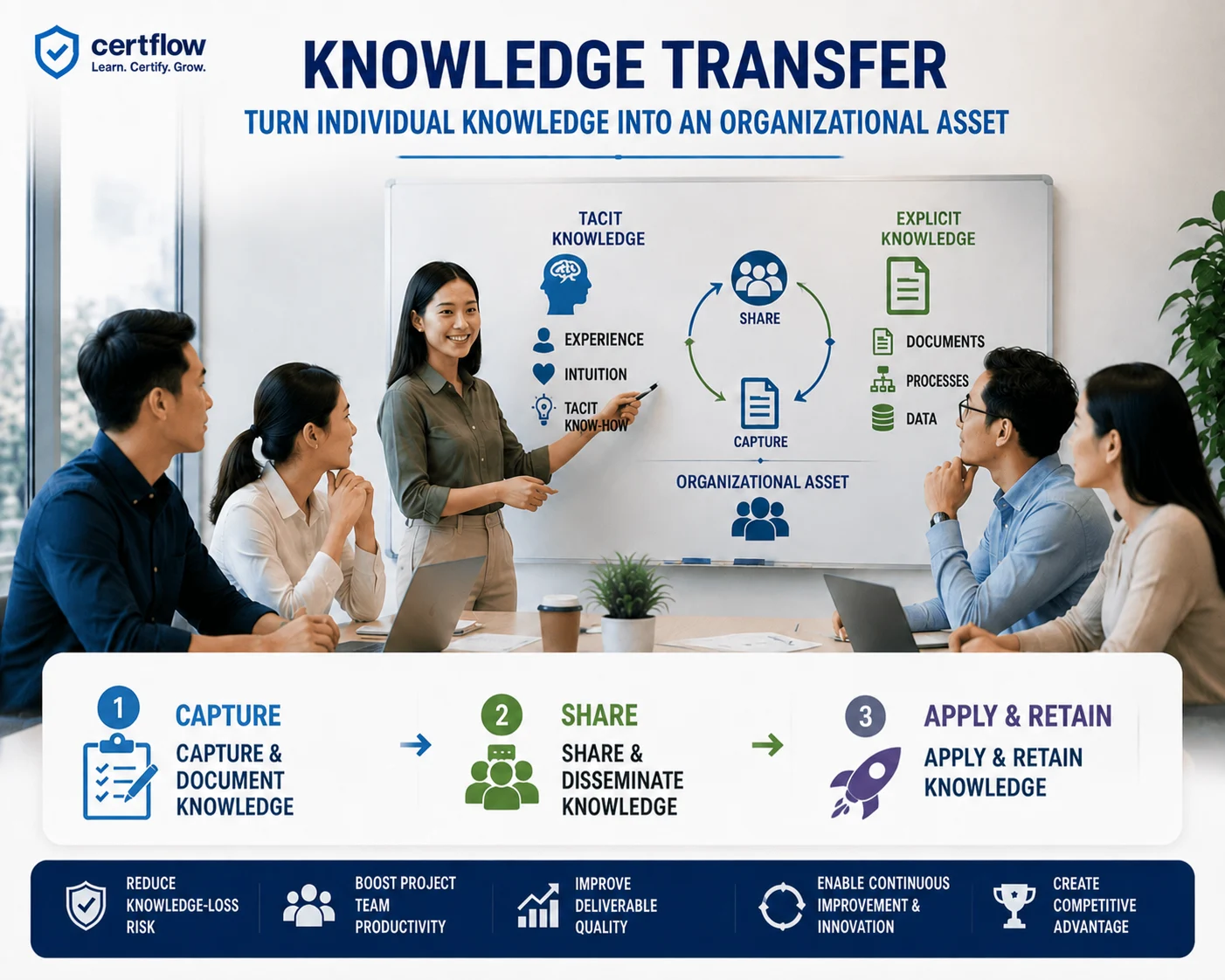
Khi key member rời dự án, knowledge đi theo họ. PMBOK 8 xem knowledge transfer là trách nhiệm PM, không phải tùy chọn. Bài này hướng dẫn cách làm đúng.
1. Tại sao knowledge transfer là "bảo hiểm" quan trọng nhất của dự án?
Hình dung tình huống: bạn quản lý dự án migration hệ thống ngân hàng. Developer lead — người duy nhất hiểu data mapping logic giữa hệ thống cũ và mới — thông báo nghỉ việc trong 4 tuần. Không có tài liệu nào mô tả logic này. Không ai khác trong team hiểu. 4 tuần để transfer 8 năm kiến thức tích lũy.
Đây không phải tình huống giả định — nó xảy ra hàng ngày trong mọi tổ chức. Và hậu quả: delay hàng tháng, budget overrun, quality issues, thậm chí dự án bị cancel.
PMBOK 8 dành nguyên một quy trình — Manage Project Knowledge — cho vấn đề này, vì kiến thức là tài sản quý giá nhất nhưng cũng dễ mất nhất của dự án.
PMBOK® 8, Section 2.1.6.6: "Managing knowledge involves more than just documenting explicit knowledge for sharing. Codified explicit knowledge lacks context and is open to different interpretations. Tacit knowledge has further context but is difficult to codify."
2. Tacit vs. Explicit Knowledge — Hai loại kiến thức, hai cách quản lý
Đây là phân biệt quan trọng nhất trong knowledge management — và là nền tảng cho mọi thứ sau đó.
Explicit Knowledge | Tacit Knowledge | |
|---|---|---|
Định nghĩa PMBOK 8 | "Formal and systematic; can be codified using words, pictures, or numbers" | "Embedded in a person's mind, highly personal, difficult to articulate" |
Đặc điểm | Codifiable, structured, easily communicated | Personal, experience-based, challenging to transfer |
Ví dụ | SOPs, technical docs, lessons learned register, templates, checklists | "Vendor X hay delay 2 tuần — cần buffer thêm." Kiến thức này không có trong tài liệu nào. |
Chia sẻ qua | Databases, documents, manuals, web searches | Conversations, interactions, mentoring, shadowing |
Hạn chế | "Lacks context, open to different interpretations" | "Difficult to formalize and communicate" |
PMBOK® 8: "Tacit knowledge resides in the minds of individual experts or in social groups and is often shared through conversations and interactions. An important objective of knowledge management is converting tacit knowledge into explicit knowledge when possible."
Nhiều PM chỉ quản lý explicit knowledge (viết tài liệu, cập nhật wiki). Nhưng tacit knowledge — insights, kinh nghiệm, "gut feelings," biết ai thực sự quyết định trong tổ chức — thường có giá trị gấp nhiều lần. PM giỏi quản lý cả hai.
AI và Knowledge — Điểm mới PMBOK 8
PMBOK® 8: "The latest AI technologies, such as interview bots, add new, strong capabilities in capturing and sharing both tacit and explicit knowledge." Tuy nhiên: "Significant risks are associated with the use of AI, including unintentionally exposing sensitive information and experiencing AI hallucinations. Projects should have responsible AI policies to manage the related knowledge."
3. Framework 3 bước knowledge transfer theo ECO
Bước | Enabler | Câu hỏi cốt lõi | Thời điểm |
|---|---|---|---|
1 | Identify critical knowledge | Kiến thức nào không thể mất? | Đầu dự án + khi thay đổi nhân sự |
2 | Gather knowledge | Làm sao thu thập cả explicit lẫn tacit? | Liên tục, không chỉ cuối dự án |
3 | Foster environment | Tại sao người ta không chia sẻ? Làm sao thay đổi? | Từ ngày đầu tiên |
4. Bước 1: Nhận diện kiến thức critical
Không phải mọi kiến thức đều cần transfer — PM phải xác định kiến thức nào là critical cho thành công dự án.
4 loại kiến thức critical
Loại | Mô tả | Ví dụ | Rủi ro nếu mất |
|---|---|---|---|
Domain / Industry | Hiểu biết về ngành, quy định, thị trường | Compliance requirements trong healthcare, building codes | Violations, fines, rework |
Technical | Kỹ năng kỹ thuật chuyên sâu, kiến trúc, legacy systems | Chỉ 1 developer hiểu cách legacy API hoạt động | Project stall, quality issues |
Organizational | Quy trình nội bộ, văn hóa, stakeholder dynamics | "Ai thực sự phê duyệt decisions? Informal power ở đâu?" | Political mistakes, stakeholder mismanagement |
Project-Specific | Quyết định đã đưa ra, lý do, workarounds đã áp dụng | "Tại sao chọn microservices thay vì monolith?" | Repeat mistakes, wrong architectural decisions |
Single Point of Failure (SPOF)
Khi kiến thức critical chỉ nằm trong đầu MỘT người — đó là rủi ro lớn nhất. PMBOK 8 liên kết knowledge management với risk management: nếu người đó rời đi, dự án bị ảnh hưởng nghiêm trọng.
Cách nhận diện SPOF: Knowledge mapping — liệt kê kiến thức cần cho mỗi work package, ai sở hữu, có backup không? Risk register — xem risks "key person leaves." Retrospectives — nhóm tự nhận diện knowledge gaps. "Bus factor" — nếu người này bị xe bus đâm (hoặc trúng xổ số nghỉ việc), dự án có tiếp tục được không?
Mẹo PMP: Khi đề thi hỏi "key team member is leaving" — đáp án tốt nhất luôn liên quan đến proactive knowledge transfer (pair with others, document critical knowledge, mentoring handoff) chứ KHÔNG phải "try to retain them" hoặc "find a replacement with same skills."
5. Bước 2: Thu thập kiến thức — Tools cho từng loại
PMBOK 8 cung cấp hai bộ tools riêng biệt cho hai loại kiến thức. Đây là sự phân biệt quan trọng vì dùng sai tool cho sai loại kiến thức sẽ không hiệu quả.
Information Management — Cho Explicit Knowledge
PMBOK 8: "Information management tools are effective for sharing simple, unambiguous, codified explicit knowledge."
Lessons Learned Register — Ghi nhận LIÊN TỤC, không chỉ cuối dự án. PMBOK 8: "Lessons learned are incorporated during the ongoing processes, not only at the end of the project."
PMIS — Document management systems, wikis, knowledge bases.
Methods for codifying — Templates, checklists, SOPs, runbooks, architecture decision records.
Information gathering — Web searches, published articles, industry reports.
PMBOK® 8 Enhancement tip: "Tools that connect people to information can be enhanced by adding an element of interaction (e.g., including a 'contact me' function so users can get in touch with the originators of the lessons)." — Kiến thức sống khi có người giải thích, không chỉ là text trên giấy.
Knowledge Management — Cho Tacit Knowledge
PMBOK 8: "Knowledge management tools connect people so they can work together to create new knowledge, share tacit knowledge, and integrate the knowledge of diverse team members."
Tool | Mô tả | Khi nào dùng |
|---|---|---|
Retrospectives | "Workshop to explore work and results to improve both process and product." Conducted frequently. | Cuối mỗi sprint/iteration — tối thiểu |
Storytelling | PMBOK 8 mới: "Powerful tool for conveying lessons learned through narratives. Makes information relatable and memorable." | Khi cần transfer context-rich experience |
After-Action Reviews | "Structured process: what happened, why, how to improve." Originating from U.S. Army. | Sau events quan trọng (go-live, major incident, milestone) |
Communities of Practice | Nhóm chuyên gia chia sẻ domain knowledge. "May generate insights that lead to improved processes." | Cross-project, ongoing knowledge sharing |
Knowledge fairs/cafés | Events informal để experts chia sẻ, hỏi đáp, networking. | Quarterly hoặc khi cần cross-pollination |
Work shadowing | Quan sát expert làm việc, học qua observation. | Onboarding, succession planning |
Training with interaction | Không chỉ đọc tài liệu — học qua tương tác, thực hành. | Khi cần transfer hands-on skills |
AI Interview Bots | PMBOK 8 mới: AI phỏng vấn experts, convert tacit → explicit. | Khi cần capture knowledge at scale. Cần responsible AI policies. |
6. Bước 3: Tạo môi trường khuyến khích chia sẻ
Đây là enabler quan trọng nhất — công cụ và quy trình vô nghĩa nếu văn hóa không khuyến khích chia sẻ.
Tại sao người ta KHÔNG chia sẻ?
Rào cản | Mindset | Giải pháp |
|---|---|---|
Sợ mất "quyền lực" | "Knowledge = power. Chia sẻ = mất lợi thế" | Reward sharing behavior, ghi nhận người chia sẻ nhiều nhất |
Không có thời gian | "Deadline gấp, viết tài liệu là luxury" | Build documentation time vào sprint/schedule, documentation sprints |
Không thấy giá trị | "Viết wiki không ai đọc" | Demonstrate value — show how past lessons saved time/money |
Thiếu trust | "Nếu chia sẻ sai lầm, sẽ bị đánh giá" | Psychological safety — celebrate learning from failures |
Không có cơ chế | "Không biết chia sẻ ở đâu, cho ai" | Clear channels, easy-to-use platforms, communities of practice |
4 cách PM tạo môi trường chia sẻ
PMBOK® 8: "Tacit knowledge can be shared within a project by fostering a collaborative and trust-filled environment. Creating opportunities for knowledge transfer through open communication, mentoring relationships, and team-building activities."
1. Psychological Safety — Mọi người chỉ chia sẻ khi cảm thấy an toàn. PM modeling desired behaviors: chia sẻ sai lầm của chính mình trước, celebrate lessons từ failures, đảm bảo không ai bị blame khi thừa nhận gaps.
2. Face-to-face & Interactions — PMBOK 8: "Encouraging face-to-face interactions and hosting regular brainstorming sessions can help make implicit knowledge more accessible." Colocation, pair programming, mob programming, cross-functional workshops — tất cả tạo cơ hội cho tacit knowledge flow tự nhiên.
3. Recognition — Ghi nhận và khen thưởng người chia sẻ kiến thức. Tích hợp knowledge sharing vào team charter và performance criteria. "Knowledge contribution" nên được coi trọng như "code contribution."
4. Built-in Rituals — Retrospectives mỗi sprint. Lunch-and-learn sessions. Pair rotations — thay đổi cặp làm việc để spread knowledge. Onboarding buddies — người mới được ghép với người có kinh nghiệm. Documentation sprints — dành thời gian riêng cho documentation.
7. Knowledge Transfer khi đóng dự án
PMBOK 8 (Section 2.1.6.9) liệt kê knowledge transfer là hoạt động bắt buộc khi close project:
Predictive: Manage knowledge sharing and transfer. Identify and document lessons learned. Archive project information for future organizational use. Transfer products/services to production/operations. Collect suggestions for improving organizational policies.
Adaptive: Facilitate knowledge-sharing sessions. Hold final retrospective. Document key decisions, architecture rationale, and technical debt.
Sai lầm phổ biến nhất: "Chúng tôi sẽ viết lessons learned khi kết thúc dự án." PMBOK 8 cảnh báo: "Determining how and when lessons learned and retrospectives will be conducted throughout the project helps support knowledge management." — Đợi đến cuối = mất phần lớn kiến thức vì mọi người đã quên hoặc đã rời đi.
8. Mẹo thi PMP về Knowledge Management
📍 Mẹo 1 — Key person leaving: Khi đề mô tả "critical team member is leaving" — đáp án đúng luôn là proactive knowledge transfer (pair with others, document, mentor). KHÔNG phải "retain them" (outside PM's control), "find replacement" (doesn't preserve knowledge), hay "ask them to finish all work before leaving" (unrealistic).
📍 Mẹo 2 — Lessons learned = continuous: Khi câu hỏi hỏi "when should lessons learned be captured?" — đáp án là THROUGHOUT the project, KHÔNG phải "at the end." PMBOK 8 nêu rõ: "incorporated during ongoing processes, not only at the end."
📍 Mẹo 3 — Tacit > Documentation alone: Khi đề mô tả "team member discovered a workaround" — đáp án tốt nhất thường bao gồm BOTH interactive sharing (demo, workshop) AND documentation. Chỉ viết tài liệu = mất context. Chỉ nói miệng = không lưu lại.
📍 Mẹo 4 — Environment > Tools: Khi đề hỏi "why doesn't the team share knowledge?" — đáp án thường liên quan đến environment/culture (lack of trust, no time allocated, no incentive), KHÔNG phải "wrong tools" hoặc "not enough documentation."
9. Mười câu hỏi trắc nghiệm tình huống
Question 1
Your project's lead database architect, the only person who understands complex data migration logic, will leave in 4 weeks. No documentation exists for this critical area.
What should you do FIRST?
A. Request HR to make a counteroffer.
B. Immediately begin knowledge transfer: pair the architect with others for hands-on sessions, have them document the logic, record video walkthroughs, and ensure at least two people can perform the work.
C. Start recruiting a replacement with similar experience.
D. Ask the architect to complete all migration work before leaving.
Question 2
Your agile team runs retrospectives every sprint, but the same issues keep recurring. The lessons learned register has 47 entries but nobody reads it.
What is the ROOT CAUSE?
A. The team lacks discipline — enforce mandatory reading.
B. The retrospective format is stale — try different techniques.
C. Knowledge is captured but not integrated into processes. Transform retrospective action items into concrete changes to DoD, working agreements, or sprint practices.
D. Cancel retrospectives and replace with monthly workshops.
Question 3
A senior developer in India discovered an innovative workaround for a recurring integration issue. He mentioned it casually in a standup, but teams in the US, Germany, and Brazil don't seem to have noticed.
How should you ensure this knowledge is transferred?
A. Ask the developer to document the workaround on the wiki.
B. Send an email highlighting the workaround.
C. Organize a live demo session where the developer demonstrates the workaround, followed by Q&A, then document it on the wiki with a "contact me" link for follow-up.
D. Add the workaround to the coding standards.
Question 4
A new team member joins midway. They're technically skilled but have no context about past decisions or stakeholder dynamics. After a week reading comprehensive documentation, they say they feel "overwhelmed and lost."
What is the MOST effective onboarding approach?
A. Give them more time — they'll absorb the docs eventually.
B. Assign them a small, well-defined task to build confidence.
C. Pair them with an experienced team member (buddy system) who shares tacit knowledge through daily collaboration, explains the "why" behind decisions, and introduces them to stakeholders.
D. Schedule presentations where each team member explains their area.
Question 5
Three similar projects run simultaneously in your organization. Each team independently solves similar technical challenges, sometimes arriving at different solutions. No cross-project knowledge sharing exists.
What should you recommend?
A. Consolidate under one PM for consistency.
B. Create a standardized technical approach all must follow.
C. Establish a Community of Practice where technical leads regularly share solutions, challenges, and best practices — enabling organic knowledge transfer without forcing standardization.
D. Create a shared Slack channel for updates.
Question 6
You're using AI tools to capture project knowledge through automated expert interviews. A team member raises concerns that the AI extracted and stored a client's proprietary process information without authorization.
What should you do?
A. Remove the specific client information and continue using the tool.
B. Immediately pause the AI tool, assess the data exposure scope, consult legal/compliance, implement responsible AI policies, and only resume with proper safeguards.
C. Reassure the team the tool is organizationally approved and data is stored securely.
D. Switch to manual knowledge capture and discontinue AI tools.
Question 7
Your development team created extensive technical documentation for the operations team who will support the product post-launch. Operations says they don't understand it because it's "written by developers, for developers."
What is the BEST approach?
A. Ask developers to rewrite in simpler language.
B. Hire a technical writer to translate.
C. Organize collaborative sessions where developers walk operations through the system hands-on, then co-create operations-focused documentation (runbooks, troubleshooting guides) reflecting operations' actual needs.
D. Schedule formal presentations of the system architecture.
Question 8
During a retrospective, a team member admits they made a significant architectural mistake three sprints ago but didn't speak up because they were afraid of blame. Other members are frustrated because weeks of work may need refactoring.
What does this reveal about the knowledge transfer environment?
A. The team needs code review gates to catch mistakes earlier.
B. Thank the member for honesty, acknowledge frustration, then address BOTH the technical issue AND the psychological safety gap — if team members fear sharing mistakes, critical knowledge won't transfer and problems compound silently.
C. Focus on fixing the technical issue first; discuss culture later.
D. Implement a blameless post-incident review process.
Question 9
Your 2-year project has had several team composition changes. New members frequently ask: "Why did we choose this approach?" and "What alternatives were considered?" The original decision-makers have all left. Documentation shows WHAT was decided but not WHY.
What knowledge management failure occurred?
A. The previous PM should have written better meeting minutes.
B. Tacit knowledge (reasoning, context, alternatives) was never converted to explicit knowledge. For future projects, implement decision journals that capture context, alternatives, trade-offs, and rationale — plus mentoring overlaps during team transitions.
C. The organization should prevent team members from leaving without proper handoff.
D. This is inevitable in long projects — help the current team accept the existing approach.
Question 10
During project closing, the sponsor asks: "What did we learn that will help the organization?" Your team has a lessons learned register with 47 entries, but most are vague: "communication should be better" with no actionable insights.
What does this reveal, and what should you do?
A. Train the team on writing better lessons learned entries.
B. Filter to the top 5-10 most impactful lessons.
C. The gathering mechanism exists but quality was poor because deep reflection wasn't facilitated. Organize a structured final retrospective using After-Action Reviews or Storytelling to extract meaningful, actionable insights. For future projects, improve retrospective facilitation from the start.
D. This is normal — the real value was in the discussions, not documentation.
Đáp án
Question 1: Answer: B
— This is a classic SPOF scenario. The priority is capturing and transferring knowledge using multiple methods (pairing = tacit, documentation = explicit, video = both). Retention (A) is outside PM's control. Replacement (C) doesn't preserve knowledge. Rushing work (D) doesn't build team capability.
Question 2: Answer: C
— PMBOK 8: "Codified explicit knowledge lacks context and is open to different interpretations." A register nobody reads = explicit knowledge failing to transfer. The fix: connect lessons to actionable process changes. "Lessons learned entries may be analyzed to identify common issues that can be addressed by changes to project procedures."
Question 3: Answer: C
— The workaround is TACIT knowledge. PMBOK 8: "Knowledge management tools connect people to share tacit knowledge." A live demo transfers context that documentation alone misses. The "contact me" function aligns with PMBOK 8's enhancement tip. Documentation alone (A, B) captures the explicit form but loses the WHY and WHEN.
Question 4: Answer: C
— PMBOK 8: "Tacit knowledge is often shared through conversations and interactions." Documentation "lacks context." A buddy system transfers tacit knowledge through daily interaction — the new member learns not just WHAT but WHY, not just WHO but HOW. Presentations (D) are one-directional. More reading (A) amplifies the problem.
Question 5: Answer: C
— PMBOK 8: "Communities of practice and subject matter experts may generate insights that lead to improved control processes." CoPs enable organic exchange without rigid standardization (B) that may not fit each project's context. Consolidation (A) is structural overreaction. A Slack channel (D) is a tool without structure for meaningful exchange.
Question 6: Answer: B
— PMBOK 8: "Significant risks are associated with AI, including unintentionally exposing sensitive information. Projects should have responsible AI policies." This is a data governance issue requiring immediate action. Simply removing data (A) doesn't fix the systemic risk. Reassurance (C) ignores a legitimate concern. Abandoning AI (D) is overreaction.
Question 7: Answer: C
— Developers' docs capture THEIR explicit knowledge but not the tacit context operations needs. PMBOK 8: "Encouraging face-to-face interactions helps make implicit knowledge more accessible." Co-creating ensures docs are written FOR the audience. Rewriting (A) still lacks operations context. Presentations (D) are one-directional.
Question 8: Answer: B
— PMBOK 8: knowledge sharing requires a "collaborative and TRUST-FILLED environment." Fear of blame is the #1 blocker — especially knowledge about mistakes, which is often the MOST valuable. The PM must validate honesty (modeling desired behavior), then address psychological safety systemically, then the technical problem. Blameless reviews (D) are good but the root issue is broader.
Question 9: Answer: B
— PMBOK 8: "An important objective of knowledge management is converting tacit knowledge into explicit knowledge when possible." The WHY behind decisions is tacit knowledge that left when people did. Meeting minutes (A) capture discussions but not structured reasoning. Retention policies (C) are impractical. Accepting knowledge loss (D) wastes organizational learning.
Question 10: Answer: C
— PMBOK 8 lists After-Action Reviews, Storytelling, and Retrospectives as separate tools for knowledge management — each extracts different types of insights. Vague entries = gathering technique was too superficial. Training alone (A) doesn't fix facilitation. Filtering (B) doesn't improve quality. Dismissing documentation value (D) fails the organization — OPA updates are a key output.
10. Tổng kết
Knowledge Transfer là task cuối cùng trong People Domain — nhưng ảnh hưởng của nó kéo dài vượt xa dự án hiện tại. Ba takeaways:
1. Tacit knowledge là vàng — explicit knowledge là bản đồ vàng — Cả hai đều cần. Tài liệu không ai đọc là waste. Insights không ai ghi lại sẽ mất khi người sở hữu rời đi. PM phải sử dụng ĐÚNG tool cho ĐÚNG loại kiến thức: Information Management cho explicit, Knowledge Management cho tacit.
2. Liên tục, không phải cuối dự án — "Chúng tôi sẽ viết lessons learned khi xong" là sai lầm phổ biến nhất. PMBOK 8 nêu rõ: lessons learned phải được ghi nhận LIÊN TỤC. Kiến thức tốt nhất được thu thập ngay khi nó "nóng" — chờ 6 tháng rồi nhớ lại thì đã muộn.
3. Môi trường > Công cụ — Wiki tốt nhất cũng vô dụng nếu team không muốn chia sẻ. Psychological safety, recognition, built-in rituals (retrospectives, pair rotations, onboarding buddies), và leadership modeling — đây là nền tảng. Khi người ta CẢM THẤY an toàn và được ghi nhận, kiến thức sẽ chảy tự nhiên.
PMBOK® 8, Section 2.1.6.6: "Effective knowledge-sharing mechanisms foster a collaborative, evidence-based working environment throughout the project. Through these mechanisms, valuable insights are captured, shared, and utilized to enhance project outcomes and drive continuous improvement."
Câu Hỏi Thường Gặp (FAQ)
Explicit knowledge và tacit knowledge khác nhau thế nào trong dự án?
Explicit knowledge: có thể document và share dễ dàng — process docs, templates, lessons learned reports, runbooks. Tacit knowledge: knowledge 'trong đầu' người có kinh nghiệm — judgment calls, intuitions, relationship knowledge, know-how từ thực tế. Explicit dễ transfer; tacit khó hơn nhiều và cần mentoring, shadowing, pair working để chuyển.
Làm thế nào để capture tacit knowledge trước khi member rời team?
Kỹ thuật: (1) Knowledge interviews — structured conversations về decisions, reasoning, và lessons. (2) Shadowing — junior member làm việc cùng senior trong 2-4 tuần trước khi họ rời. (3) Pair programming/working — transfer qua việc làm thực tế. (4) After-action reviews — debrief sau mỗi significant event. (5) Community of Practice — create forum cho knowledge sharing ongoing.
Organizational Process Assets (OPA) cập nhật như thế nào sau dự án?
OPAs bao gồm: templates, processes, policies, procedures, historical databases, và lessons learned repository. Sau dự án, PM cần update: lessons learned database (cả successes và failures), estimate databases (actuals vs planned), updated templates phản ánh improvements. PMBOK 8 coi OPA updates là deliverable của project closure, không phải optional activity.
Bạn đã nắm vững knowledge transfer trong dự án — giờ là lúc luyện tập với câu hỏi thi thật.
Bài tiếp theo: Lập Kế Hoạch Truyền Thông Dự Án theo PMBOK 8
Nguồn tham khảo chính thức:
Bạn đã sẵn sàng luyện tập chưa?
Thử CertFlow miễn phí — 10 câu hỏi, không cần đăng ký.
Bắt Đầu Miễn Phí