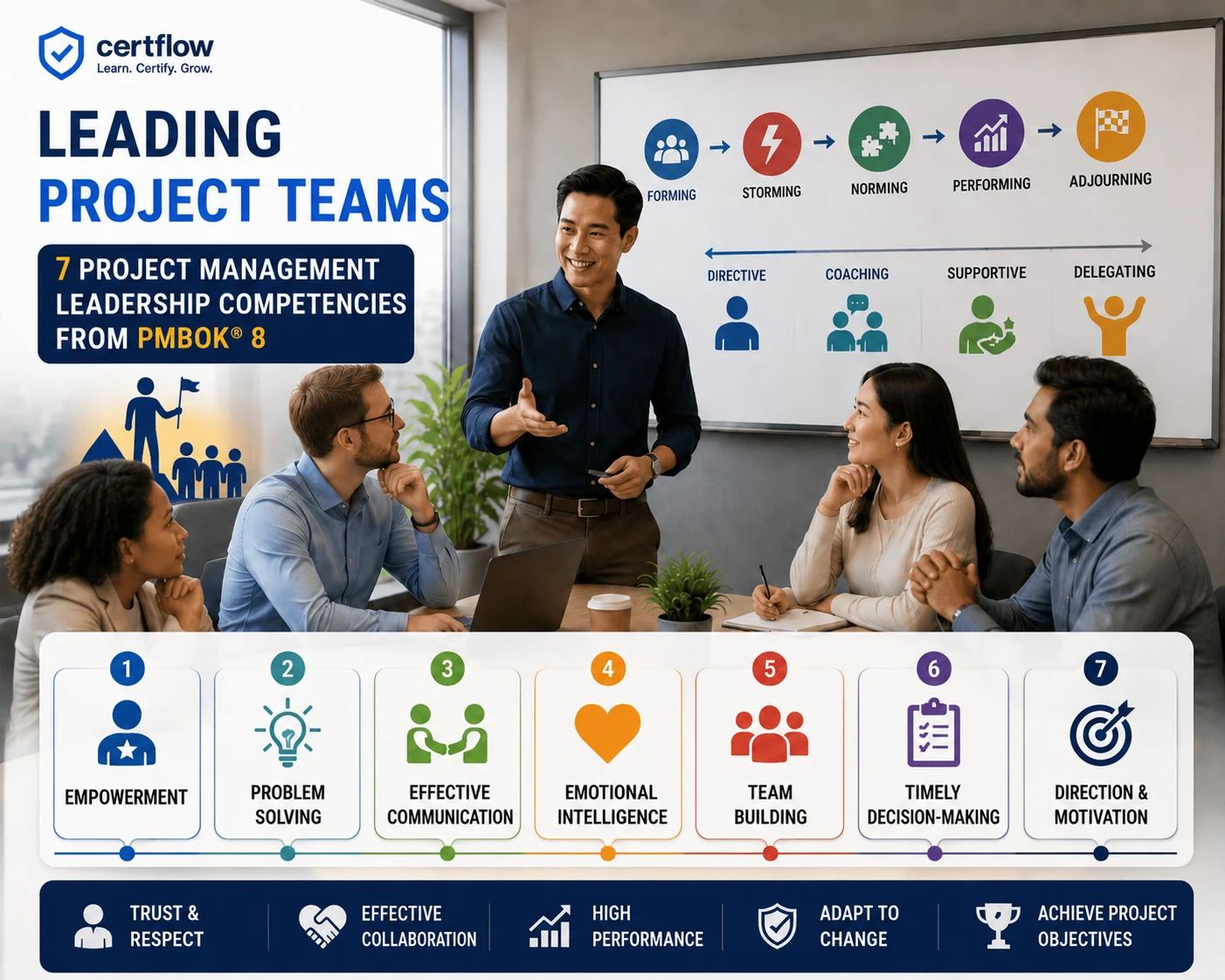
PMBOK 8 định nghĩa lại vai trò PM: không phải người ra lệnh mà là servant leader. 7 năng lực lãnh đạo này là nền tảng để build high-performing team.
1. Leadership vs. Management — PM cần cả hai
Nhiều PM xuất sắc trong việc quản lý schedule, budget, và scope — nhưng lại loay hoay khi team mất motivation, senior developer muốn nghỉ việc, hoặc hai nhóm không chịu hợp tác. Vấn đề là: họ manage tốt nhưng chưa lead.
PMBOK 8 phân biệt rõ ràng:
Management Activities | Leadership Activities | |
|---|---|---|
Focus | Quy trình, kế hoạch, đo lường | Con người, cảm hứng, trao quyền |
Câu hỏi | "Task này hoàn thành chưa?" | "Bạn cần gì để thành công?" |
Kết quả | Efficiency — làm đúng việc | Effectiveness — làm việc đúng |
PMBOK 8 | "Focus on the means of meeting objectives" | "Focus on people — influencing, motivating, listening, enabling" |
PMBOK® 8, Section 5 — Leadership: "Project management is more than just working with numbers, templates, charts, graphs, and computing systems. A common denominator in all projects is people. People can be counted, but they are not numbers."
Đây là lý do ECO đặt "Lead the Project Team" là Task bao quát nhất trong People Domain — với 7 enablers, nhiều hơn bất kỳ task nào khác.
2. Framework 7 enablers lãnh đạo nhóm
Nhóm | Enabler | Câu hỏi cốt lõi |
|---|---|---|
Nền tảng | Establish expectations at team level | Nhóm có biết "luật chơi" không? |
Nền tảng | Establish clear roles and responsibilities | Ai làm gì, ai chịu trách nhiệm? |
Trao quyền | Empower the team | Nhóm có quyền tự quyết trong phạm vi? |
Hỗ trợ | Solve problems | PM giúp nhóm giải quyết vấn đề ra sao? |
Hỗ trợ | Represent the voice of the team | PM có bảo vệ và đại diện cho nhóm không? |
Đa dạng | Support varied experiences, skills, perspectives | Sự khác biệt có được tận dụng làm lợi thế? |
Chiến lược | Determine appropriate leadership style | PM có điều chỉnh cách dẫn dắt theo bối cảnh? |
Hãy đi sâu vào từng nhóm.
3. Thiết lập kỳ vọng và vai trò rõ ràng
Establish Expectations — Team Charter và Ground Rules
Mọi nhóm cần biết "luật chơi" ngay từ đầu. PMBOK 8 xác định Team Charter là công cụ chính, bao gồm: team values, communication guidelines, decision-making criteria and processes, conflict resolution processes, meeting guidelines, và team agreements.
Điều quan trọng nhất: nhóm phải tham gia xây dựng team charter, không phải PM áp đặt.
PMBOK® 8, Section 5: "Discussing areas such as codes of conduct, communication, decision-making, and meeting etiquette allows team members to discover values that are important to one another." — Quá trình thảo luận ground rules bản thân nó đã là hoạt động team building.
Establish Clear Roles — RACI Matrix
Khi không ai biết "ai chịu trách nhiệm," mọi người đều nghĩ "đó không phải việc của tôi" — hoặc tệ hơn, nhiều người cùng làm một việc mà không biết.
PMBOK 8 đề cập RACI Matrix là công cụ chính:
Ký hiệu | Vai trò | Ý nghĩa | Quy tắc |
|---|---|---|---|
R | Responsible | Người thực hiện công việc | Có thể nhiều người |
A | Accountable | Người chịu trách nhiệm cuối cùng | Chỉ MỘT người duy nhất |
C | Consulted | Được tham vấn trước khi quyết định | Two-way communication |
I | Informed | Được thông báo sau khi quyết định | One-way communication |
PMBOK® 8: "A RACI matrix is a useful tool to ensure the clear assignment of roles... ensures that there is only one person accountable for any one task to avoid confusion about who is ultimately in charge."
4. Trao quyền cho nhóm — Empower, không micromanage
Đây là enabler mà nhiều PM gặp khó khăn nhất — vì trao quyền đòi hỏi buông bỏ kiểm soát, điều đi ngược bản năng của người quen quản lý.
PMBOK® 8, Section 2.6.2.4.2: "Project team members who feel empowered to make decisions about the way they work and about specific details in the deliverables being produced — even under limited range — perform better and have a higher degree of satisfaction than those who are micromanaged."
Daniel Pink — 3 yếu tố motivation nội tại
PMBOK 8 trích dẫn mô hình của Daniel Pink về intrinsic motivation — nền tảng cho empowerment:
Yếu tố | Định nghĩa PMBOK 8 | PM áp dụng bằng cách |
|---|---|---|
Autonomy | "The desire to direct one's own life... determining how, where, and when to accomplish work" | Cho nhóm tự quyết cách thực hiện, flexible hours, work from home options |
Mastery | "The desire to do excellent work, learn, and achieve goals" | Cơ hội học hỏi, mentoring, stretch assignments, career development |
Purpose | "Knowing the project vision and how work contributes to achieving that vision" | Kết nối daily work với project vision, giải thích WHY không chỉ WHAT |
Servant Leadership — PM phục vụ nhóm
PMBOK® 8, Section 5: "Servant leadership is the practice of leading the team by focusing on understanding and addressing the needs and development of team members in order to enable the highest possible team performance."
Servant leader không hỏi "nhóm đã làm gì cho dự án?" mà hỏi "tôi có thể làm gì để nhóm thành công?" — loại bỏ impediments, cung cấp resources, tạo safe environment, coach và mentor.
5. Giải quyết vấn đề và đại diện tiếng nói nhóm
Solve Problems — Tools từ PMBOK 8
Six Thinking Hats® — kỹ thuật brainstorming nhóm giúp phân tích vấn đề từ 6 góc nhìn khác nhau:
Hat | Góc nhìn | Câu hỏi đặt ra |
|---|---|---|
Blue | Tổng quan, facilitator | "Chúng ta đang giải quyết vấn đề gì?" |
White | Dữ liệu, facts | "Chúng ta biết gì? Thiếu data gì?" |
Red | Cảm xúc, intuition | "Gut feeling của mọi người là gì?" |
Black | Phê phán, risks | "Điều gì có thể sai? Rủi ro gì?" |
Yellow | Lạc quan, benefits | "Cơ hội và lợi ích là gì?" |
Green | Sáng tạo, alternatives | "Còn cách nào khác không?" |
Ngoài ra, PMBOK 8 cũng nhấn mạnh Critical Thinking: "Recognize, analyze, and resolve problems; identify bias, unstated assumptions, and values."
Về decision-making, PMBOK 8 cảnh báo: "Decisions can be made unilaterally. This has the advantage of being fast but is prone to errors. Unilateral decision-making can also demotivate people who are impacted by the decision." — PM nên involve nhóm trong quyết định khi có thể.
Represent the Voice of the Team
PM là cầu nối giữa nhóm và stakeholders bên ngoài. Cụ thể: bảo vệ nhóm khỏi áp lực không hợp lý từ sponsor hoặc client. Truyền đạt trung thực concerns và recommendations lên management. Đấu tranh cho resources mà nhóm cần. Đảm bảo nhóm được ghi nhận cho thành tựu — không phải PM lấy credit.
PMBOK® 8, Section 2.6.2.4.2: "Project team members who are recognized for the work they put in and the performance that they achieve are more likely to continue to perform well. Even the simple act of showing appreciation reinforces positive team behaviors."
6. Hỗ trợ sự đa dạng và chọn phong cách lãnh đạo phù hợp
Support Diversity
PMBOK 8 nhấn mạnh: "A diverse project team can enrich the project environment to create a more inclusive space by bringing together different perspectives." PM cần: tạo psychological safety để mọi người dám đóng góp, tận dụng đa dạng làm lợi thế (nhiều góc nhìn = giải pháp tốt hơn), nhận biết và xử lý bias trong nhóm.
Về cultural awareness, PMBOK 8 định nghĩa: "Understanding of the differences among individuals, groups, and organizations and adapting the project's communication strategy in the context of these differences."
Determine Appropriate Leadership Style
PMBOK 8 nêu rõ: không có one-size-fits-all. PM phải linh hoạt điều chỉnh phong cách theo tình huống.
Leadership Style | Mô tả | Phù hợp khi |
|---|---|---|
Servant Leadership | PM phục vụ nhóm — loại bỏ barriers, enable performance | Agile teams, mature teams, innovation projects |
Centralized | Decision-making tập trung vào PM hoặc nhóm nhỏ | Predictive, new teams, high-compliance environments |
Distributed | Decision-making phân tán cho nhóm, self-organizing | Adaptive/agile, experienced teams, creative projects |
Situational | Điều chỉnh theo maturity: Directive → Coaching → Supporting → Delegating | Mọi context — PM adapt theo tình huống cụ thể |
Transformational | Truyền cảm hứng vượt kỳ vọng, phát triển tiềm năng | Change initiatives, turnaround projects |
PMBOK® 8: "Leadership is not exclusive to any specific role; in different moments of the project, a team member, stakeholder, or professional may take the leadership seat. Leadership is different from authority — leadership is about inspiring and motivating others through leading by example."
7. Tuckman Ladder — Hiểu nhóm đang ở đâu để dẫn dắt đúng cách
PMBOK 8 đề cập Tuckman Ladder như một tool chính trong Lead the Team. PM cần nhận biết nhóm đang ở giai đoạn nào để điều chỉnh approach phù hợp:
Giai đoạn | Đặc điểm (PMBOK 8) | PM nên làm gì |
|---|---|---|
Forming | "Team members meet and learn about the project. Members tend to be independent and not as open." | Directive: set expectations, clarify roles, facilitate introductions |
Storming | "Team begins to address project work. If not collaborative, environment can become counterproductive." | Coaching: guide through disagreements, reinforce ground rules |
Norming | "Team begins to work together and adjust habits. Members learn to trust one another." | Supporting: step back gradually, encourage collaboration |
Performing | "Teams function as a well-organized unit." | Delegating: empower team, focus on strategic support |
Adjourning | Hoàn thành, giải tán, celebrate | Recognize, celebrate, facilitate knowledge transfer |
PMBOK® 8, Section 5: "Although it is common for these stages to occur in order, it is not uncommon for a team to get stuck in a particular stage or regress to an earlier stage. Projects with team members who worked together in the past may also skip a stage."
Đặc biệt lưu ý: khi thành viên mới join hoặc thành viên cũ rời đi, nhóm thường regress về giai đoạn trước (thường là Storming hoặc Forming). PM phải nhận ra dấu hiệu này và adjust approach.
8. High-Performing Teams — 9 yếu tố từ PMBOK 8
PMBOK 8 (Section 2.6.2.4.2) xác định 9 đặc điểm của đội dự án hiệu suất cao — đây là mục tiêu cuối cùng của mọi hoạt động Lead the Team:
Yếu tố | Ý nghĩa |
|---|---|
Open communication | Môi trường an toàn cho brainstorming, problem-solving, trust |
Shared understanding | Cùng hiểu mục đích, goals, và cách đạt được |
Shared ownership | Càng có ownership, hiệu suất càng cao |
Trust | Tin tưởng nhau → sẵn sàng nỗ lực thêm |
Collaboration | Làm cùng thay vì làm riêng → diverse ideas, better outcomes |
Adaptability | Thích ứng với thay đổi môi trường và tình huống |
Resilience | Phục hồi nhanh từ issues và failures |
Empowerment | Được trao quyền quyết định → hiệu suất cao + satisfaction |
Recognition | Được ghi nhận → tiếp tục perform well |
PM có thể dùng danh sách này như một health check: team bạn đang thiếu yếu tố nào? Đó chính là nơi cần đầu tư.
9. Mẹo thi PMP về Leadership
📍Mẹo 1 — Servant Leadership là default: PMI ưu tiên Servant Leadership. Khi câu hỏi mô tả PM "supports the team," "removes impediments," "enables success" — đó là servant leadership. Trừ khi tình huống nêu rõ cần directive approach (emergency, new team, compliance).
📍Mẹo 2 — RACI: chỉ MỘT Accountable: Khi đề thi mô tả "confusion about who is in charge" hoặc "multiple people think they're accountable" — đáp án thường là review/establish RACI matrix. Nhớ: nhiều Responsible OK, nhưng chỉ MỘT Accountable.
📍Mẹo 3 — Team composition changes = Tuckman regression: Khi đề mô tả "key member leaves" hoặc "new members join" và hỏi "what is the PM's MAIN concern?" — đáp án thường là "the team may regress to an earlier Tuckman stage," KHÔNG phải "find a replacement" hay "update the schedule."
📍Mẹo 4 — Empower, don't do: Khi junior team member struggles — đáp án tốt nhất là "mentor/coach them," KHÔNG phải "do the work yourself" hay "reassign the task." PMI muốn PM phát triển năng lực nhóm, không bypass nhóm.
10. Mười câu hỏi trắc nghiệm tình huống
Question 1
You've just been assigned to lead a newly formed project team. Members come from four departments and have never worked together. During the first meeting, everyone is polite but reserved — no one shares ideas or challenges anything.
What stage is the team in, and what should you do?
A. Storming — Use coaching to help them work through disagreements.
B. Forming — Use a directive approach: set clear expectations, establish ground rules, clarify roles, and facilitate introductions.
C. Norming — Step back and let the team self-organize since they seem to be getting along.
D. Performing — Delegate and let them manage their own work.
Question 2
Your team has been performing well for 3 months. You learn that 2 key members are being reassigned and 3 new members will join next week. The team is anxious.
What should you be MOST concerned about?
A. The new members may lack the right technical skills.
B. The team may regress to an earlier Tuckman stage and lose its high performance.
C. The schedule needs rebaselining for the transition.
D. The departing members must complete knowledge transfer.
Question 3
A senior developer consistently dominates sprint planning discussions, dismissing junior members' estimates as "unrealistic." Two juniors have stopped participating. The senior delivers excellent code.
What should you do?
A. Accept the situation since the senior has the most experience.
B. Have a private conversation about the impact of their behavior, then use facilitation techniques (like Planning Poker) that ensure equal participation.
C. Separate the senior from the juniors.
D. Ask the juniors to be more assertive.
Question 4
Your team proposes a new approach that could save 2 weeks but deviates from organizational standard procedures. The project has strict regulatory compliance requirements.
How should you respond?
A. Approve since the team is empowered to make decisions.
B. Reject because deviating from standards is too risky.
C. Acknowledge the initiative, then collaboratively evaluate regulatory implications before making a joint decision.
D. Escalate to the sponsor.
Question 5
The sponsor frequently contacts your team members directly, assigning tasks that conflict with the project plan. Team members are confused about priorities and velocity has dropped.
What should you do?
A. Ask team members to redirect the sponsor to you.
B. Meet with the sponsor to discuss the impact, agree on a communication protocol, and advocate for the team's capacity constraints.
C. Adjust the plan to include the sponsor's tasks.
D. Document the scope creep for the steering committee.
Question 6
A team member privately tells you they're overwhelmed and considering leaving. They've been working 60-hour weeks for a month. They are a critical resource with specialized skills.
What should you do FIRST?
A. Reassign some tasks immediately to reduce their workload.
B. Listen actively, acknowledge their contribution, and collaboratively develop a sustainable workload plan that addresses both their well-being and project needs.
C. Escalate to find a backup resource in case they leave.
D. Ask them to push through the current phase.
Question 7
You manage a distributed team across 3 time zones. The US team makes decisions in morning meetings that the India team consistently misses. India has expressed frustration that they're "always informed after the fact."
What should you do?
A. Record US meetings and share with India.
B. Move all decisions to async tools.
C. Redesign the meeting schedule and decision process to ensure equitable participation across all zones, combining synchronous overlap windows with async tools.
D. Ask India to adjust their schedule.
Question 8
The project methodology hasn't been decided. Your team has a mix of experienced agile practitioners and members who've only worked in waterfall. The project involves evolving requirements for a new customer portal.
How should you determine the approach?
A. Use agile since requirements are evolving — waterfall practitioners will adapt.
B. Use waterfall since some members aren't familiar with agile.
C. Assess project characteristics, team capabilities, and org context, then collaboratively design a hybrid approach that leverages both groups' strengths while providing training for gaps.
D. Let the team vote on methodology.
Question 9
Your project's RACI matrix shows the quality inspector as "Consulted" for design reviews. However, designs are consistently approved without consulting them. Last week, a design failed safety standards, requiring expensive rework.
What is the ROOT CAUSE?
A. The design team is incompetent.
B. The RACI matrix is clear but not being followed — reinforce adherence and implement process checks to ensure Consulted parties are engaged before decisions are finalized.
C. The quality inspector should be "Accountable" instead of "Consulted."
D. Add a formal sign-off gate.
Question 10
Your team just completed a challenging sprint delivering a key milestone ahead of schedule. During the sprint review, the sponsor acknowledges delivery but immediately starts discussing the next aggressive timeline. The team looks deflated.
What should you do?
A. Begin planning the next sprint to maintain momentum.
B. Thank the sponsor, then ensure the team receives proper recognition before transitioning to the next phase.
C. Ask the sponsor to delay the next discussion to give the team a break.
D. Let the team celebrate on their own time.
Đáp án
Question 1: Answer: B
— Politeness without engagement is classic Forming. PMBOK 8: "Team members tend to be independent and not as open in this phase." The PM should be more directive: set expectations, create the team charter, clarify roles, and build familiarity.
Question 2: Answer: B
— PMBOK 8: "It is not uncommon for a team to regress to an earlier stage." When composition changes significantly, teams often revert to Forming or Storming. While skills (A), schedule (C), and KT (D) matter, the team dynamics regression is the most fundamental concern.
Question 3: Answer: B
— The ECO requires PMs to "support the team's varied experiences, skills, and perspectives." PMBOK 8 emphasizes that empowered teams where all members contribute perform better. Address the behavior privately; use structured techniques to equalize participation. Telling juniors to "be more assertive" (D) blames the victims.
Question 4: Answer: C
— Empowerment works "even under limited range" (PMBOK 8). In regulated environments, the PM should recognize initiative (motivation) but ensure compliance (accountability). Collaborative evaluation honors both. Flat rejection (B) kills initiative.
Question 5: Answer: B
— The ECO requires PMs to "represent the voice of the team." The PM must directly and professionally engage the sponsor — not avoid it (A), passively accommodate (C), or defer to a committee (D). Advocate for the team with data showing the impact.
Question 6: Answer: B
— Servant leadership: focus on "understanding and addressing the needs of team members." FIRST listen and understand — don't reassign without understanding (A), escalate prematurely (C), or ignore well-being (D). PMBOK 8 now explicitly addresses employee well-being and quiet quitting.
Question 7: Answer: C
— The ECO requires supporting "varied experiences, skills, and perspectives." PMBOK 8 emphasizes cultural awareness and adapting communication. Recording (A) makes India passive. Full async (B) loses real-time benefits. Asking India to adjust (D) is inequitable. A balanced approach ensures all voices are equal.
Question 8: Answer: C
— PMBOK 8: "Leaders should be versatile and able to switch between different leadership styles." The ECO requires "determine an appropriate leadership style" and "support varied experiences." A hybrid approach considers BOTH project needs AND team capabilities. Voting (D) doesn't account for project requirements.
Question 9: Answer: B
— The RACI correctly identified the role — the problem is process adherence. PMBOK 8: establishing roles isn't enough; the PM must ensure they're exercised. The ECO's "establish clear roles and responsibilities" includes making sure those roles are actually followed. A sign-off (D) could help but the root cause is the process gap.
Question 10: Answer: B
— PMBOK 8: "Project team members who are recognized for the work they put in are more likely to continue to perform well. Even the simple act of showing appreciation reinforces positive team behaviors." The PM should ensure recognition happens AND respect the sponsor's needs — it's not either/or. "Represent the voice of the team" includes ensuring they're acknowledged.
11. Tổng kết
Lead the Project Team là task bao quát nhất trong People Domain — và cũng là kỹ năng định hình sự nghiệp PM. Ba takeaways chính:
- Lead people, manage processes — Management giữ dự án trên đường ray. Leadership giữ con người muốn ở trên đường ray đó. Cả hai đều cần, nhưng nhiều PM thiên lệch về management. PMBOK 8 nhắc nhở: "A common denominator in all projects is people."
- Style phải match context — Servant Leadership với team mature. Directive với team mới. Coaching khi Storming. Delegating khi Performing. PM cứng nhắc một style sẽ thất bại với đa dạng tình huống. Situational Leadership là meta-skill quan trọng nhất.
- Empower > Control — Micromanagement tạo compliance; empowerment tạo commitment. Team được trao quyền (Autonomy + Mastery + Purpose) perform tốt hơn VÀ hài lòng hơn. PM nên hỏi "tôi có thể làm gì cho nhóm?" thay vì "nhóm đã làm gì cho tôi?"
PMBOK® 8, Section 3.6: "Leadership is different from authority. Authority is the position of control given to individuals within the organization, whereas leadership is about inspiring and motivating others through leading by example."
Câu Hỏi Thường Gặp (FAQ)
Servant leadership trong PMBOK 8 khác leadership truyền thống như thế nào?
Traditional leadership: PM có authority, ra quyết định, team follow. Servant leadership (PMBOK 8): PM serve the team — remove impediments, provide resources, shield team from distractions. PM vẫn responsible cho outcomes nhưng empower team để tự quyết định HOW. Approach này đặc biệt phù hợp với agile teams và knowledge workers.
Emotional Intelligence (EI/EQ) trong quản lý dự án có vai trò gì?
EI gồm 4 thành tố: Self-awareness (nhận biết cảm xúc bản thân), Self-management (kiểm soát phản ứng), Social awareness (đọc hiểu cảm xúc người khác), và Relationship management (xây dựng và maintain relationships). PM có EI cao xử lý conflict tốt hơn, build trust nhanh hơn, và navigate stakeholder dynamics hiệu quả hơn.
Tuckman's team development model có ý nghĩa gì cho PM?
Tuckman mô tả team qua 4 giai đoạn: Forming (mới, còn ngại), Storming (xung đột và power struggles), Norming (tìm được working rhythm), Performing (high-performance, self-directed). PM cần nhận biết team đang ở giai đoạn nào để apply đúng leadership style: directive ở Forming/Storming, coaching ở Norming, delegating ở Performing.
Bạn đã nắm vững dẫn dắt nhóm dự án — giờ là lúc luyện tập với câu hỏi thi thật.
Bài tiếp theo: Gắn Kết Stakeholder: 6 Bước Chiến Lược theo PMBOK 8
Quản lý nhóm dự án: Tuckman model và conflict resolution theo PMP
Nguồn tham khảo chính thức:
Bạn đã sẵn sàng luyện tập chưa?
Thử CertFlow miễn phí — 10 câu hỏi, không cần đăng ký.
Bắt Đầu Miễn Phí