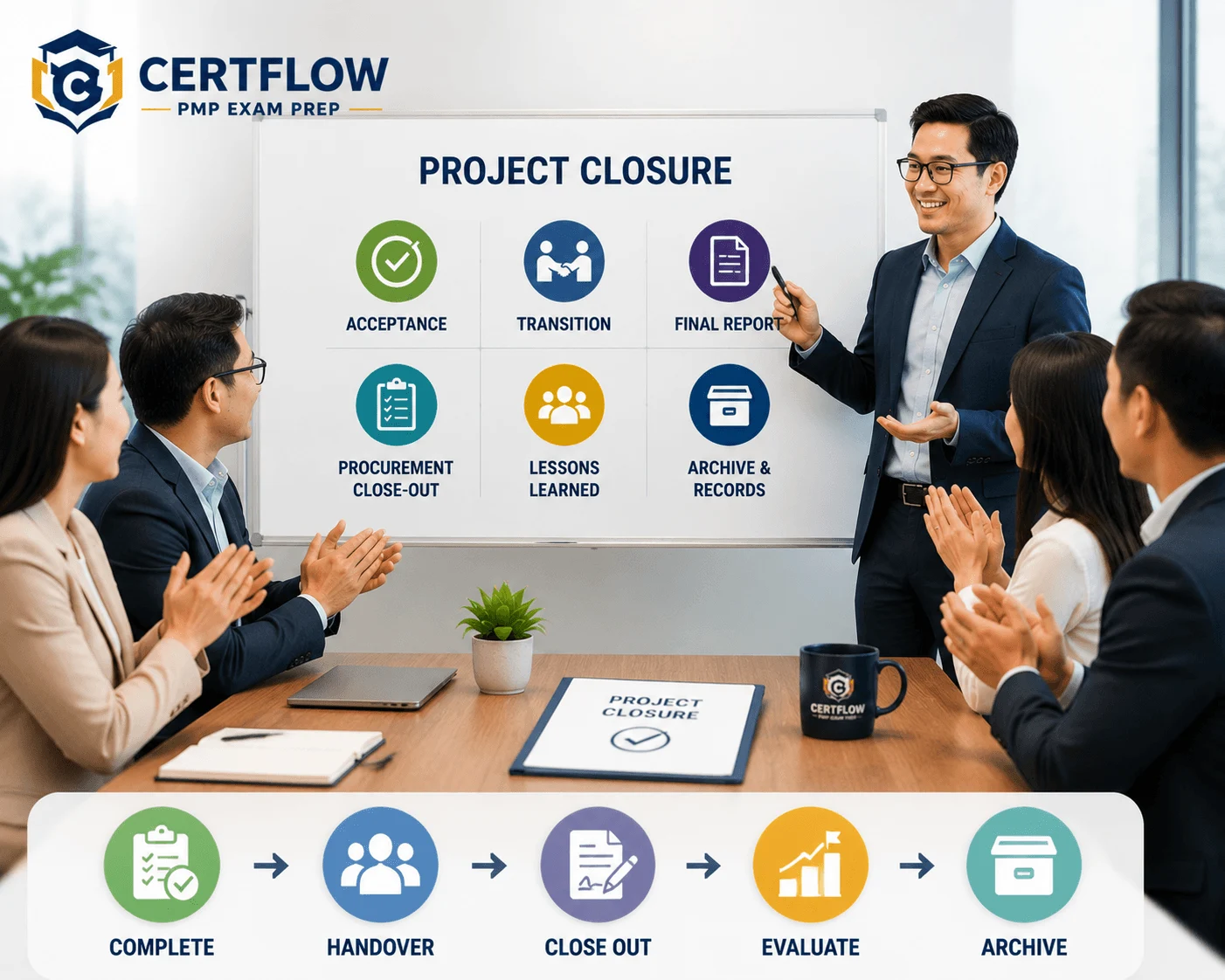
Kết thúc dự án đúng cách quan trọng không kém bắt đầu đúng cách. PMBOK 8 đặt closure là một phần quan trọng của vòng đời dự án. Bài này đi qua từng bước đóng dự án.
1. Tại sao closure là giai đoạn bị bỏ qua nhiều nhất?
Khi dự án gần xong, mọi người đã "mentally move on" — PM đang nghĩ về dự án tiếp theo, team members bị kéo sang assignment mới, sponsor mất interest vì value đã được deliver. Kết quả: closure bị cắt ngắn hoặc bỏ qua hoàn toàn.
Hậu quả? Contracts không close — vendor gửi invoice nhưng không ai verify. Lessons learned không capture — mọi sai lầm lặp lại. Operations không ready — team support nhận sản phẩm mà không biết cách vận hành. Stakeholder satisfaction không measure — PM không biết dự án thật sự thành công hay không.
PMBOK® 8, Section 2.1.6.9: "Close Project or Phase is the process of finalizing all activities related to the project or phase, including archiving knowledge, completing planned work, and releasing resources for new projects or operations."
2. Bốn enablers theo ECO — Framework đóng dự án
Bước | Enabler | Câu hỏi cốt lõi |
|---|---|---|
1 | Obtain stakeholder approval | Stakeholders có chấp nhận deliverables không? |
2 | Determine closure criteria | Criteria nào xác nhận dự án hoàn thành? |
3 | Validate readiness for transition | Operations team có sẵn sàng nhận sản phẩm? |
4 | Conclude activities | Tất cả hoạt động đóng đã hoàn tất chưa? |
3. Obtain Stakeholder Approval — Nghiệm thu chính thức
PMBOK 8 nêu rõ: "Confirm that deliverables have been delivered and formally accepted by the customer." Nghiệm thu không phải email "looks good" — mà là formal acceptance dựa trên acceptance criteria đã định nghĩa.
Predictive: Formal Acceptance Process
Deliverables verified qua Quality Control (inspection, testing)
Deliverables validated qua Validate Scope (customer acceptance)
Acceptance signed by authorized stakeholders (sponsor, customer representative)
Accepted deliverables documented và archived
Adaptive: Iteration-Based Acceptance
PMBOK 8: "Confirm that all acceptance criteria are met. Ensure that deliverables have been reviewed and accepted by the appropriate stakeholders." Trong agile, acceptance xảy ra mỗi sprint qua sprint reviews — closure là lần acceptance cuối cùng cho toàn bộ product.
🌟 Quan trọng: Nếu stakeholder KHÔNG chấp nhận deliverable — PM phải document lý do, assess impact, và determine next steps (rework, change request, dispute resolution, hoặc partial acceptance with conditions).
Measure Stakeholder Satisfaction
💡 PMBOK 8 liệt kê "Measure stakeholder satisfaction" là closure activity bắt buộc. Đây không phải courtesy — mà là data cho tổ chức: dự án có thật sự deliver value không? NPS, satisfaction surveys, interviews — tất cả phải thực hiện trước khi team giải tán.
4. Determine Closure Criteria — Khi nào "xong" thật sự là "xong"?
PM phải xác định closure criteria trước khi dự án bắt đầu — không phải lúc gần xong mới nghĩ ra.
Closure Criteria Checklist — PMBOK 8
Category | Criteria | Evidence |
|---|---|---|
Deliverables | Tất cả deliverables delivered và accepted | Signed acceptance documents |
Scope | Scope objectives met, completion criteria verified | Scope verification reports |
Quality | Quality objectives met, standards verified | Test reports, audit results |
Schedule | Milestones completed, actual vs planned dates | Schedule performance data |
Cost | Budget reconciled, final accounting complete | Cost reports, final EVM |
Contracts | All contracts formally closed, payments processed | Contract closure docs, procurement audit |
Compliance | Regulatory, legal, environmental obligations met | Compliance certificates, audit reports |
Knowledge | Lessons learned captured, knowledge transferred | Lessons learned register, final report |
Resources | Resources released, equipment returned | Release confirmations |
Stakeholders | Satisfaction measured, feedback collected | Survey results, NPS |
PMBOK® 8: "The project manager should ensure that all work is completed and that the objectives are met by reviewing the project management plan."
5. Validate Readiness for Transition
Đây là bước mà nhiều PM bỏ qua — và operations team trả giá. PMBOK 8 output: "Final product, service, or result transition" — chuyển giao từ project team sang người sẽ vận hành/duy trì sản phẩm.
Transition Readiness Checklist
Area | Câu hỏi đánh giá | Action nếu chưa ready |
|---|---|---|
Operations team | Có đủ người, đủ skills để support? | Training, staffing, knowledge transfer sessions |
Documentation | Runbooks, troubleshooting guides, architecture docs có đầy đủ? | Co-create docs với operations team |
Support processes | Help desk, escalation paths, SLAs đã thiết lập? | Set up support infrastructure trước go-live |
Environment | Production environment stable, monitoring in place? | Infrastructure verification, monitoring setup |
Outstanding issues | Open defects, technical debt documented? | Handover issue log với priorities |
Warranty | Post-launch support period defined? | Define warranty terms, transition support team |
💡 PMBOK 8 cũng nhấn mạnh: "Identify outstanding risks that should be accepted or transitioned to operations." — Risks không tự biến mất khi dự án close. Chúng phải được chuyển giao cùng sản phẩm.
6. Conclude Activities — Checklist đóng dự án hoàn chỉnh
PMBOK 8 liệt kê 12 closure activities cụ thể. Hãy chia thành 4 nhóm:
Nhóm 1: Administrative Closure
- Ensure all documents and deliverables updated, all issues resolved
- Collect and audit project records
- Assess project success or failure
- Archive project information for future organizational use
Nhóm 2: Knowledge and Learning
- Lessons learned — Identify and document lessons learned. PMBOK 8 Adaptive: "Facilitate knowledge-sharing sessions to transfer insights."
- Final retrospective — What went well? What didn't? What should the organization do differently?
- Knowledge transfer — Manage knowledge sharing and transfer to operations and the organization
Nhóm 3: Financial and Procurement
- Final accounting — Reconcile all costs, process final payments, close purchase orders
- Contract closure — Formally close all vendor/supplier contracts
- Procurement audit — PMBOK 8: "A structured review of the procurement process for completeness, accuracy, and effectiveness."
Nhóm 4: People and Stakeholders
- Resource release — Release team members, equipment, and facilities
- Recognition — Celebrate achievements, acknowledge contributions
- Stakeholder satisfaction — Measure and document
- Suggestions collection — Collect suggestions for improving organizational policies
Final Report — PMBOK 8
PMBOK 8 mô tả Final Report bao gồm: summary-level project description, scope objectives + completion evidence, quality objectives + verification, cost objectives + actual + variances, summary of validation for final product, schedule objectives + milestone dates + variances, risk summary, và any other relevant information.
PMBOK® 8: Final Report là tài liệu tổng kết cho tổ chức — nó trở thành OPA (Organizational Process Asset) cho các dự án tương lai. PM không viết final report = tổ chức mất một source quý giá.
Early Termination
PMBOK 8: "The Close Project or Phase process also includes establishing procedures to investigate and document reasons that the project may have been terminated before completion." Dự án bị cancel vẫn cần closure — thậm chí closure còn quan trọng hơn vì phải document tại sao bị cancel, lessons learned, remaining obligations, và impact.
7. Predictive vs. Adaptive Closure
Aspect | Predictive | Adaptive |
|---|---|---|
Acceptance | Formal sign-off on all deliverables | Final sprint review + overall product acceptance |
Closure criteria | All scope items verified, baselines reconciled | All acceptance criteria met, product ready for use |
Lessons learned | End-of-project sessions (should be throughout) | Final retrospective + compile sprint retrospectives |
Documentation | Formal archives: plans, reports, baselines | Working software + essential docs + decision records |
Transition | Formal handover to operations with full docs | Often already in production via CI/CD; formal handover of support |
Contract closure | Same — all contracts formally closed | Same — all contracts formally closed |
PMBOK® 8 Adaptive Closure: "Confirm that all acceptance criteria are met. Ensure deliverables reviewed and accepted. Facilitate knowledge-sharing sessions. Hold final retrospective. Document key decisions, architecture rationale, and technical debt."
8. Mẹo thi PMP
📍 Mẹo 1 — Lessons learned = throughout, not just end: PMBOK 8 nói rõ: "incorporated during ongoing processes, not only at the end." Khi đề hỏi "when should lessons learned be captured?" — đáp án là THROUGHOUT. Nhưng closing phase là cơ hội CUỐI CÙNG — đừng bỏ qua.
📍 Mẹo 2 — Cancelled projects STILL need closure: Khi dự án bị cancel — vẫn cần formal closure: document reasons, release resources, close contracts, capture lessons. "Project cancelled = no closure needed" luôn SAI.
📍 Mẹo 3 — Procurement audit = mandatory: Khi đề hỏi "what should be done during contract closure?" — procurement audit luôn nằm trong đáp án đúng. Nó review completeness, accuracy, effectiveness của procurement process.
📍 Mẹo 4 — Transition ≠ Just hand over: Transition bao gồm training, documentation, support setup, outstanding risks/issues transfer, và warranty period. "Give them the code and walk away" = wrong answer.
9. Mười câu hỏi trắc nghiệm tình huống
Question 1
Your project delivered all features, passed UAT, and the sponsor signed the acceptance document. However, the operations team says they're not ready to support the system — they haven't been trained and no runbooks exist.
Should you close the project?
A. Yes — the sponsor accepted the deliverables. Operations readiness is an operational issue.
B. No — readiness for transition is a closure criterion. Delay formal closure until operations is trained, documentation is complete, and support processes are in place.
C. Close the project but create a separate project for operations readiness.
D. Close the project and ask the sponsor to handle operations training.
Question 2
The project was cancelled at 60% completion due to a strategic pivot. The PM says: "Since we didn't finish, there's nothing to close. I'll release the team and start the new project."
Is the PM's approach correct?
A. Yes — cancelled projects don't need formal closure.
B. No — cancelled projects STILL require formal closure: document cancellation reasons, release resources, close contracts, settle financials, capture lessons learned, archive project info, and notify stakeholders.
C. Only close the contracts — everything else is unnecessary.
D. Have the PMO handle closure since the PM should focus on the new project.
Question 3
During project closure, you discover that one vendor contract was never formally closed. The vendor completed their work 4 months ago and final payment was made. The PM who managed that vendor has already left the organization.
What should you do?
A. The contract is effectively closed since work is done and payment made.
B. Formally close the contract: verify all deliverables were accepted, conduct a procurement audit, document vendor performance, and update organizational records.
C. Have legal close the contract since the PM left.
D. Send the vendor a contract closure notice and move on.
Question 4
The sponsor wants to skip the final retrospective because "the team is already moving to new assignments and it would be hard to gather everyone."
How should you respond?
A. Agree — the team is busy and forced retrospectives aren't productive.
B. Explain the value of final lessons learned for the organization, and propose an efficient format (90-minute focused session or async collection) that respects the team's time while capturing critical insights before institutional memory fades.
C. Conduct the retrospective without the sponsor's approval.
D. Send a lessons learned survey instead of a meeting.
Question 5
Your project's Final Report needs to be written. The sponsor asks: "What should be in it? Keep it practical."
Which elements should the Final Report include per PMBOK 8?
A. Just a summary of what was delivered and the final budget.
B. Project summary, scope objectives + completion evidence, quality objectives + verification, cost objectives + actuals + variances, schedule milestones + dates + variances, risk summary, validation of final product, and lessons learned.
C. A detailed log of all project activities from initiation to closure.
D. The project management plan updated with actual results.
Question 6
Your agile project delivered a product via CI/CD — features have been in production for months. The last sprint is complete and the product owner says "we're done." Operations has been supporting the product since Sprint 3.
What closure activities are still needed?
A. None — the product is already in production and operations is already supporting it.
B. Final sprint review for overall product acceptance, final retrospective, document architecture decisions and technical debt, formally close any vendor contracts, collect stakeholder satisfaction feedback, and create final report.
C. Just the final retrospective.
D. Archive the backlog and release the team.
Question 7
During closure, you find 3 open risks in the risk register that weren't fully mitigated. Two are related to system performance under peak load.
What should you do with these risks?
A. Close the risk register — the project is ending.
B. Document the open risks and formally transfer them to the operations team with recommended monitoring and response strategies.
C. Implement mitigations before closing the project.
D. Add them to the organization's enterprise risk register.
Question 8
The project is 95% complete. Two minor deliverables (help documentation and admin guide) remain, but the sponsor insists on closing immediately because "they're not critical." Budget and team are being reassigned.
What should you do?
A. Close the project — 95% is close enough.
B. Document the incomplete items, obtain formal acknowledgment from the sponsor that these deliverables are waived or deferred, and include this in the closure documentation to prevent future disputes.
C. Refuse to close until everything is 100% complete.
D. Complete the documents yourself after hours.
Question 9
Your team celebrated the go-live last week. This week, you ask the team to help write lessons learned. A developer says: "Why bother? Nobody reads those documents. Let's just move on."
How should you respond?
A. The developer has a point — lessons learned registers often go unread.
B. Acknowledge the concern, then explain that lessons learned have value beyond the document: the discussion itself builds team capability, specific insights can be applied to their NEXT project immediately, and well-captured lessons with "contact me" functions make them actionable for others.
C. Make it mandatory — it's part of the closure process.
D. Ask only senior members to contribute.
Question 10
Your construction project is complete. The client accepts the building. Six months later, a structural issue emerges. The client claims it's a project quality failure. Your team says the issue wasn't in the acceptance criteria.
What could have prevented this dispute?
A. More thorough testing before acceptance.
B. Clearer acceptance criteria AND a defined warranty period with specific post-closure support terms — both established during planning and formalized during closure. The closure process should have included comprehensive acceptance criteria covering long-term performance.
C. An extended project timeline for more quality checks.
D. A disclaimer in the closure documents.
Đáp án
Question 1: Answer: B
— PMBOK 8: closure includes "transfer products, services, or results to the next phase or into production/operations." Acceptance of deliverables ≠ readiness for transition. The PM should validate transition readiness BEFORE formal closure.
Question 2: Answer: B
— PMBOK 8: "Close Project or Phase also includes establishing procedures to investigate and document reasons the project may have been terminated before completion." Cancelled projects need closure even MORE — to capture why it failed, what was learned, and resolve all outstanding obligations.
Question 3: Answer: B
— PMBOK 8: "A procurement audit is a structured review of the procurement process for completeness, accuracy, and effectiveness." Payment ≠ closure. Formal closure includes verification, audit, performance documentation (OPA for future vendor selection), and proper contract termination.
Question 4: Answer: B
— PMBOK 8: "Identify and document lessons learned" is an explicit closure activity. The PM should advocate for it while being pragmatic about format. An efficient approach (focused session or hybrid) captures value without excessive disruption. Once the team disperses, these insights are lost forever.
Question 5: Answer: B
— PMBOK 8 Final Report specification includes all these elements. It's comprehensive but SUMMARY-level — not a detailed log (C) or just budget (A). The Final Report becomes an OPA for future projects.
Question 6: Answer: B
— Even with CI/CD and ongoing operations support, formal closure activities are still needed. PMBOK 8 Adaptive Closure: "Confirm acceptance criteria met, facilitate knowledge-sharing sessions, hold final retrospective, document key decisions and technical debt." Product in production ≠ project formally closed.
Question 7: Answer: B
— PMBOK 8: "Identify outstanding risks that should be accepted or transitioned to operations." Risks don't disappear when a project closes. The operations team must know what risks they're inheriting and how to monitor them. Closing the register (A) leaves operations blind.
Question 8: Answer: B
— If the sponsor chooses to close with incomplete items, it must be FORMAL — documented, acknowledged, and recorded. This protects the PM and the organization. PMBOK 8: "Ensure all documents and deliverables are updated and all issues are resolved" — if not resolved, they must be formally accepted as-is.
Question 9: Answer: B
— PMBOK 8 explicitly addresses this: "Tools that connect people to information can be enhanced by adding a 'contact me' function so users can reach the originators." The PM should make lessons learned VALUABLE, not just mandatory. When people see their insights helping future teams, they engage.
Question 10: Answer: B
— PMBOK 8: acceptance criteria should cover not just "what was built" but "how it should perform." Warranty terms define post-closure responsibility. The closure process should have formalized: what's covered, for how long, and who's responsible. Prevention during planning + formalization during closure = dispute prevention.
10. Tổng kết
Project closure là chương cuối của câu chuyện dự án — nhưng nó quyết định cách dự án được nhớ đến, tổ chức học được gì, và liệu sản phẩm có sống sót sau khi team giải tán.
Ba takeaways:
1. Closure is a process, not an event — Đóng dự án không phải "gửi email chúc mừng rồi giải tán." Nó bao gồm formal acceptance, knowledge transfer, procurement audit, financial reconciliation, lessons learned, resource release, và stakeholder satisfaction measurement. Mỗi bước đều có purpose — bỏ qua = để lại nợ cho tổ chức.
2. Transition ≠ Handover code — Operations team phải READY: trained, documented, equipped, và aware of outstanding risks/issues. PMBOK 8 đặt "final product transition" là output chính của closure. Sản phẩm không ai biết cách vận hành = sản phẩm chết.
3. Cancelled projects need closure too — Dự án bị cancel vẫn cần formal closure: document reasons, release resources, close contracts, capture lessons. Đặc biệt lessons learned từ dự án thất bại thường CÓ GIÁ TRỊ HƠN lessons từ dự án thành công — nếu bạn dám capture chúng.
PMBOK® 8: "Engaging relevant stakeholders is crucial to ensure a comprehensive closure process." — Closure là trách nhiệm tập thể, không chỉ của PM. Sponsor, team, operations, vendors — tất cả đều có vai trò.
Câu Hỏi Thường Gặp (FAQ)
Đóng dự án theo PMBOK 8 bao gồm những bước nào?
Đóng dự án gồm: (1) Obtain final product acceptance từ customer/sponsor; (2) Complete final performance reporting; (3) Update lessons learned và OPAs; (4) Archive project documents; (5) Release project resources (team, budget, equipment); (6) Close contracts với vendors. Bỏ sót bất kỳ bước nào đều tạo ra loose ends cho tổ chức.
Tại sao Lessons Learned quan trọng và làm thế nào để làm tốt?
Lessons Learned là organizational memory — giúp dự án tương lai tránh lỗi đã xảy ra và tận dụng thực tiễn tốt. Để effective: thu thập liên tục (không chỉ cuối dự án), include cả successes và failures, structure theo topic (technical, management, stakeholder), và đảm bảo được lưu vào OPA repository có thể search được.
Dự án bị cancel sớm thì đóng dự án như thế nào?
Dự án cancel cần administrative closure đầy đủ như dự án hoàn thành bình thường: document lý do cancel, hoàn trả resources, đóng contracts, archive documents và update lessons learned. PM không được bỏ qua closure chỉ vì project fail — các OPA updates vẫn có giá trị cho tổ chức.
Bạn đã nắm vững đóng dự án — giờ là lúc luyện tập với câu hỏi thi thật.
Nguồn tham khảo chính thức:
Bạn đã sẵn sàng luyện tập chưa?
Thử CertFlow miễn phí — 10 câu hỏi, không cần đăng ký.
Bắt Đầu Miễn Phí