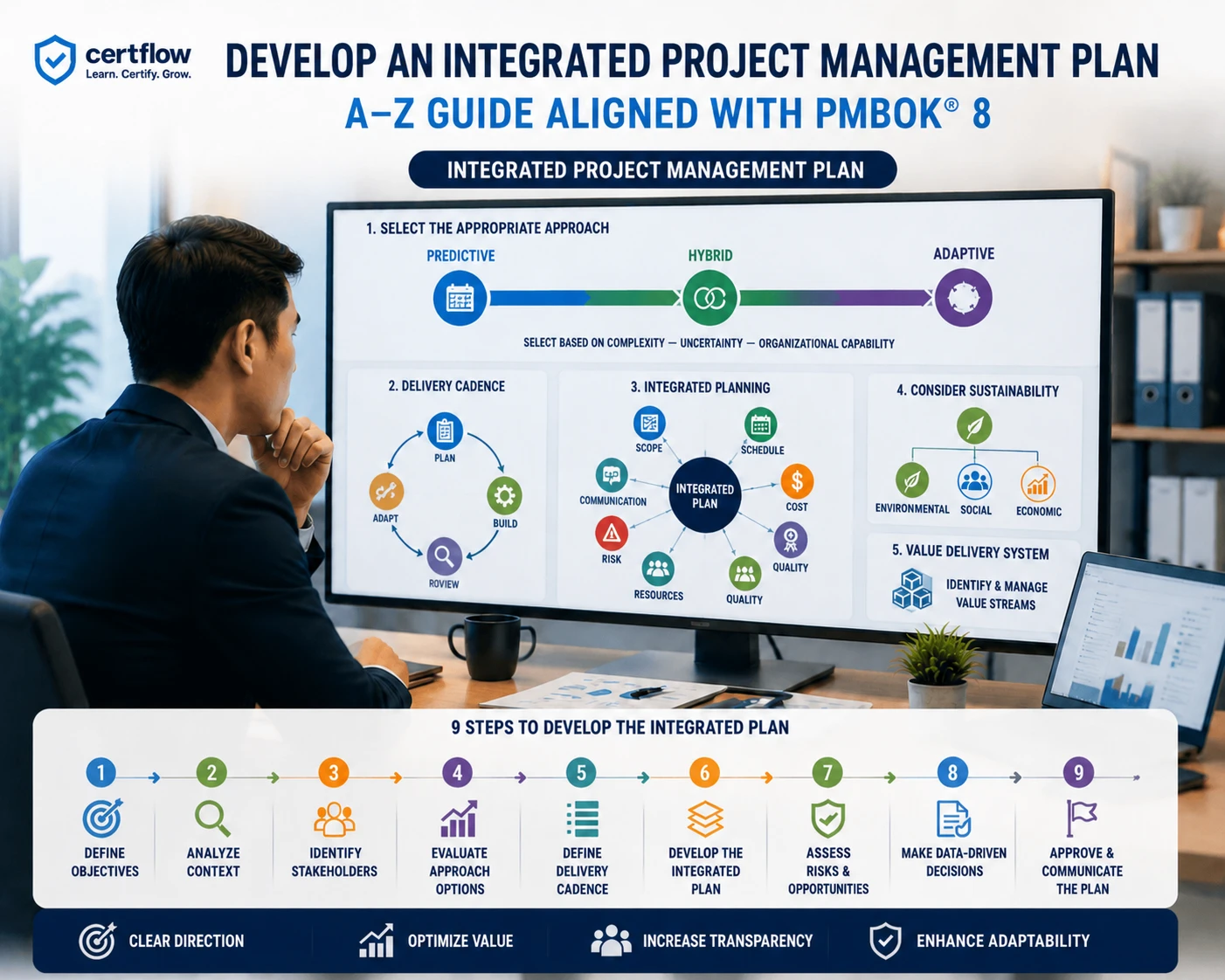
Project Management Plan không phải Gantt chart — đó là bộ tài liệu tích hợp điều hướng toàn bộ dự án. Bài này đi qua cách lập PMP đúng chuẩn PMBOK 8.
1. Tại sao "integrated" là từ khóa quan trọng nhất?
Nhiều PM có scope management plan, schedule management plan, cost management plan — nhưng chúng tồn tại riêng rẽ. Khi scope thay đổi, schedule không cập nhật. Khi resource biến động, cost baseline không phản ánh. Khi risk xảy ra, không ai biết impact lên stakeholder engagement.
Kết quả: mỗi plan đúng riêng lẻ nhưng tổng thể sai.
PMBOK® 8, Section 2.1.6.2: "The project management plan specifies how the project will be executed, monitored and controlled, and closed. Its content varies depending on the project's application context and complexity. The plan should also be adaptable enough to respond to the dynamic project environment — ideally, by following a progressive elaboration approach."
"Integrated" nghĩa là: mọi subsidiary plan liên kết với nhau, thay đổi ở một chỗ tự động trigger đánh giá ở các chỗ khác. Đây là lý do task này nặng nhất trong Process Domain — với 9 enablers.
2. Từ Business Case đến Integrated Plan — Luồng khởi tạo
PMBOK 8 mô tả luồng khởi tạo rõ ràng:
Bước | Tài liệu | Trả lời câu hỏi | Ai tạo?
|
|---|---|---|---|
1 | Business Case | TẠI SAO dự án tồn tại? ROI, value proposition? | Sponsor / Business |
2 | Project Charter | DỰ ÁN LÀ GÌ? Authorization, objectives, constraints? | Sponsor + PM |
3 | Project Management Plan | LÀM THẾ NÀO? Execute, monitor, control, close? | PM + Team |
PMBOK® 8: "A clearly articulated business case enables stakeholder alignment on priorities and constraints, and provides team members with a broader context that informs their work."
⚠️ Lưu ý quan trọng: trong adaptive environments, charter có thể là "concise vision statements" và plan có thể là "high-level roadmap + product backlog." PMBOK 8 không đòi hỏi tài liệu dày — mà đòi hỏi đủ thông tin để hành động đúng.
3. Framework 9 enablers lập kế hoạch tích hợp
Nhóm | Enabler | Câu hỏi cốt lõi
|
|---|---|---|
Đánh giá | Assess needs, complexity, magnitude | Dự án lớn/nhỏ, phức tạp đến đâu? |
Chiến lược | Recommend development approach | Predictive, Adaptive, hay Hybrid? |
Chiến lược | Determine critical info requirements | Sustainability, regulations, constraints nào? |
Chiến lược | Recommend execution strategy | Delivery cadence? Build/buy? Sourcing? |
Tạo plan | Create integrated plan | Subsidiary plans + baselines tích hợp thế nào? |
Ước tính | Estimate work effort and resources | Cần bao nhiêu người, bao lâu, bao nhiêu tiền? |
Kiểm tra | Assess dependencies, gaps, value | Plans có consistent không? Gaps ở đâu? |
Duy trì | Maintain the plan | Cập nhật khi nào? Progressive elaboration? |
Quyết định | Collect and analyze data | Data nói gì? AI/analytics hỗ trợ thế nào? |
4. Chọn Development Approach: Predictive, Adaptive, hay Hybrid?
Đây là quyết định chiến lược đầu tiên — và PMBOK 8 có một tuyên bố rất mạnh:
PMBOK® 8, Section 4.2.3: "Today, most projects require a hybrid approach, combining elements of both adaptive and predictive methodologies. Relying solely on one approach — whether adaptive or predictive — is no longer sufficient to address the diverse challenges and complexities that modern projects present."
Phổ Development Approaches
Predictive | Hybrid | Adaptive
| |
|---|---|---|---|
Còn gọi là | Waterfall, plan-driven | Mixed methods | Agile, iterative, incremental |
Requirements | Well-defined, stable | Mix of clear and evolving | Evolving, unclear |
Planning | Detailed upfront | Phased — detailed near, rough far | Rolling wave, just enough |
Delivery | Single at end | Phased or incremental | Periodic or continuous |
Change | Formal CCB process | Mix of formal and flexible | Backlog reprioritization |
Team | Specialist roles, PM assigns | Mix | Self-organizing, generalizing specialists |
Phù hợp khi | Stable scope, compliance, safety-critical | Most modern projects | High uncertainty, innovation, fast feedback |
3 nhóm yếu tố quyết định approach (PMBOK 8 Section 4.3)
Deliverable factors: Degree of innovation, requirements certainty, scope stability, ease of change, delivery options, risk, safety requirements, feedback value, regulations.
Project factors: Stakeholder involvement level, schedule constraints, financing uncertainty, project size and complexity, team experience, interdependencies.
Organization factors: Organizational structure (hierarchical → predictive; network → adaptive), culture (managing/directing → predictive; flexible/innovative → adaptive), organizational capability, team size and location.
4 Hybrid Patterns — PMBOK 8
Pattern | Mô tả | Ví dụ
|
|---|---|---|
Adaptive → Predictive | Adaptive development, predictive rollout | Software (agile) deployed in regulated environment (predictive) |
Simultaneous | Adaptive + Predictive chạy song song | IT system (agile) + data center build (predictive) |
Mostly Predictive + small Adaptive | Predictive dominant, adaptive elements | Construction + IoT sensors |
Mostly Adaptive + small Predictive | Adaptive dominant, predictive constraints | Software product + regulatory compliance docs |
💡Mẹo PMP: Khi đề mô tả "requirements are unclear and evolving" → adaptive. "Requirements well-defined, regulatory compliance" → predictive. "Software + hardware, software evolving + hardware fixed" → hybrid. Luôn match approach với CHARACTERISTICS, không chọn theo preference.
5. Delivery Cadence — 4 mô hình giao hàng
Cadence | Mô tả PMBOK 8 | Ví dụ
|
|---|---|---|
Single Delivery | "All outcomes at end of the project" | Xây nhà — chỉ dùng khi hoàn thành |
Multiple Deliveries | "Multiple components delivered at different times" | Drug development — Phase 1, 2, 3 trials |
Periodic Deliveries | "Regular and fixed delivery schedule" | Software release mỗi 2 tuần |
Continuous Delivery | "Incrementally delivering value on ongoing basis. Fostering responsiveness to customer feedback." | CI/CD pipeline — deploy liên tục |
6. Tạo kế hoạch tích hợp — Thành phần và baselines
PMBOK 8 Integrate and Align Project Plans (Section 2.1.6.2): "Integrating, aligning, and coordinating all plan components and consolidating them into a unified project management plan."
Subsidiary Plans từ tất cả Performance Domains
Scope management plan, Schedule management plan, Cost/Financial management plan, Quality management plan, Resource management plan, Communications management plan, Risk management plan, Stakeholder engagement plan, Change management plan, Configuration management plan.
3 Baselines = Performance Measurement Baseline (PMB)
Baseline | Bao gồm | Đo lường
|
|---|---|---|
Scope Baseline | Scope statement + WBS + WBS dictionary | Deliverable completion, scope creep % |
Schedule Baseline | Approved schedule model | SV, SPI, milestone completion |
Cost Baseline | Approved time-phased budget | CV, CPI, EAC, ETC |
Ba baselines kết hợp = Performance Measurement Baseline (PMB) — "chuẩn" để so sánh actual vs. planned.
PMBOK® 8: "The amount of time spent planning should be determined by the circumstances. The information gained from planning should be sufficient to move forward in an appropriate manner but not more detailed than necessary." — Không over-plan. Agile teams có thể dùng roadmap + backlog thay cho detailed PM plan.
7. Ước tính effort, đánh giá dependencies, và duy trì kế hoạch
6 Estimation Techniques — PMBOK 8
Technique | Mô tả | Accuracy | Khi nào dùng
|
|---|---|---|---|
Analogous | Dựa trên dự án tương tự | Thấp-TB | Sớm, ít data, cần nhanh |
Parametric | Statistical relationship (VD: $/m²) | TB-Cao | Có reliable parameters |
Bottom-up | Estimate từng work package, cộng lại | Cao nhất | Scope rõ, cần chính xác |
Multipoint (PERT) | (O + 4ML + P) / 6 | TB-Cao | Uncertainty cao, cần range |
Relative sizing | Story points, T-shirt sizing | TB | Agile, backlog prioritization |
Expert judgment | SME opinion | Variable | Novel work, insufficient data |
Assess Dependencies, Gaps, and Business Value
PM phải review consolidated plans để tìm:
Dependencies: Mandatory (hard logic — không thể thay đổi), Discretionary (soft logic — có thể thay đổi), External (ngoài tầm kiểm soát — vendor, regulator), Internal (trong team/org).
Gaps: Resource gaps (5 developers planned, 3 available), Skill gaps (cần AI expertise, không có), Schedule conflicts (2 activities cùng resource cùng ngày), Budget shortfalls.
Business value: PMBOK 8 giới thiệu Value Breakdown Structure (VBS): "A WBS with value estimates assigned to each element. Useful in determining whether a given scope element is truly mandatory."
Maintain the Integrated Plan
PMBOK 8: "Planning is an iterative or ongoing activity — progressive elaboration."
Predictive: Update qua formal change control (CCB approval → baseline updates). Adaptive: Continuous replanning qua backlog refinement, sprint planning. Hybrid: Formal baselines cho fixed elements + iterative planning cho evolving elements.
8. Data-Driven Decisions và Sustainability
Collect and Analyze Data
PMBOK® 8: "Project managers can leverage AI-powered tools to efficiently collect, analyze, and interpret data, generating actionable insights." + "Predictive analytics uses machine learning and current/historical data to discover patterns and predict future scenarios."
Data analysis tools: Earned Value Analysis (CPI, SPI, EAC, ETC), Variance Analysis, Trend Analysis, Root Cause Analysis, Alternative Analysis, Cost-Benefit Analysis, Regression Analysis.
Sustainability — Điểm mới PMBOK 8
ECO nhấn mạnh sustainability là "critical information requirement." PMBOK 8 dành nguyên Principle 5 cho chủ đề này:
PMBOK® 8, Section 3.7: "Integrating sustainability into project management means considering people, the planet, society, and value while performing project-related activities. By integrating sustainability, organizations can align with the triple bottom line — balancing social equity, environmental stewardship, and economic prosperity."
Sustainability tác động vào planning: scope (bao gồm sustainability activities), cost (green certifications budget), schedule (environmental assessment timelines), risk (compliance risks), stakeholders (community engagement), resources (green procurement). PM phải tích hợp sustainability vào TẤT CẢ subsidiary plans, không phải tạo plan riêng.
9. Mẹo thi PMP
📍Mẹo 1 — Hybrid là default hiện đại: PMBOK 8 nói rõ: "most projects require a hybrid approach." Khi đề thi mô tả dự án có cả elements cố định và elements evolving — đáp án thường là hybrid.
📍Mẹo 2 — "Sufficient, not more than necessary": Khi đề hỏi "how detailed should the plan be?" — đáp án đúng là right-sized based on complexity, KHÔNG phải "as detailed as possible" hoặc "follow organizational template regardless."
📍Mẹo 3 — Progressive elaboration: Khi đề mô tả "information changes during execution" — đáp án đúng là "update the plan through appropriate change control," KHÔNG phải "the plan should have captured this upfront."
📍Mẹo 4 — Integrated = holistic assessment: Khi scope changes → PM must assess impact on ALL subsidiary plans (schedule, cost, risk, quality, stakeholders), KHÔNG chỉ submit scope change request.
10. Mười câu hỏi trắc nghiệm tình huống
Question 1
You are assigned to develop a new medical device. Product must comply with FDA regulations and safety requirements are critical with well-documented specifications. However, the user interface component has evolving requirements based on usability studies with healthcare professionals.
What development approach should you recommend?
A. Predictive — regulatory requirements demand a fully planned approach.
B. Adaptive — to accommodate evolving UI requirements.
C. Hybrid — predictive for regulated hardware/firmware, adaptive for the evolving UI component.
D. Start adaptive, then transition to predictive once requirements stabilize.
Question 2
The sponsor asks: "How detailed should the plan be? Last project had a 200-page plan nobody read."
What guidance does PMBOK 8 provide?
A. As detailed as possible for a large project.
B. Follow organizational templates regardless of project size.
C. "Sufficient to move forward appropriately but not more detailed than necessary" — tailored to context and complexity.
D. Detailed predictive plan with all subsidiary plans fully developed before execution.
Question 3
Your team needs to estimate building a new warehouse. Historical data from three similar projects is available. The sponsor wants a quick, reasonably accurate estimate to secure funding.
Which estimation technique is MOST appropriate?
A. Bottom-up — decompose all work packages.
B. Analogous — use historical project data.
C. Multipoint (PERT) — calculate optimistic/likely/pessimistic.
D. Parametric — use cost-per-square-meter from historical data multiplied by planned square footage.
Question 4
Midway through a predictive project, a new competitor launches a similar product. The sponsor wants to accelerate delivery by 3 months and add new features. The project is currently on track.
How should you handle this?
A. Submit a change request to modify scope and schedule baselines.
B. Switch to adaptive to accommodate rapid changes.
C. Assess business case validity, conduct impact analysis across ALL subsidiary plans, present options with trade-offs, and if approved, update the integrated plan through formal change control.
D. Fast-track and crash the schedule.
Question 5
You discover that your software team cannot begin integration testing until an external vendor delivers a critical API. The vendor has a history of missing deadlines. This dependency is on the critical path.
What type of dependency is this, and what should you do?
A. Mandatory internal — add buffer time.
B. Discretionary external — find a workaround.
C. Mandatory external — add to risk register with mitigation strategies (mock API, contractual penalties, vendor monitoring, schedule buffer).
D. Internal dependency — negotiate earlier delivery.
Question 6
The board wants a detailed cost estimate for a full 18-month CRM project before approving budget. You've just completed the charter with limited scope definition. Requirements workshops haven't started.
How should you handle this estimation challenge?
A. Provide a bottom-up estimate using industry benchmarks.
B. Delay budget approval until requirements are defined.
C. Provide a Rough Order of Magnitude (-25% to +75%) based on analogous projects, clearly communicating the uncertainty range, and propose phased funding with more accurate estimates as requirements are elaborated.
D. Use parametric estimating based on expected users.
Question 7
You're developing the integrated plan for a smart building: predictive construction + adaptive IoT sensor system with rapidly evolving technology.
How should you structure the plan?
A. Single predictive plan — construction timeline governs all.
B. Two separate plans — one per stream, managed independently.
C. One integrated plan with the overall framework, allowing construction to follow predictive planning and IoT to follow adaptive planning, with clear integration points where streams must synchronize.
D. Start predictive for everything, switch to adaptive for IoT later.
Question 8
The project sponsor mentions sustainability as a key requirement. This is a first for your organization.
How should you incorporate sustainability into the plan?
A. Add a sustainability section to the charter only.
B. Hire a sustainability consultant for a separate plan.
C. Integrate sustainability across ALL subsidiary plans — scope (sustainable materials), schedule (environmental assessments), cost (green certifications), risk (compliance), stakeholders (community), resources (green procurement).
D. Focus on environmental sustainability only as it's most measurable.
Question 9
Your agile team has run for 6 sprints. The product backlog has 300+ items, priorities change every sprint, and there's no roadmap. Stakeholders can't predict when key features will be delivered.
What does this indicate?
A. Adaptive is failing — switch to predictive.
B. The backlog needs grooming — schedule refinement.
C. The project lacks sufficient high-level planning. Even adaptive needs a roadmap for major milestones. Implement a lightweight roadmap with quarterly goals, well-prioritized backlog, and regular stakeholder communication.
D. This is normal for agile — stakeholders must accept uncertainty.
Question 10
You're reviewing consolidated plans before project start. The resource plan assumes 5 developers (only 3 available), the critical path has zero float, and a high-probability vendor delay risk isn't reflected in the schedule. Start date is in 2 weeks.
What should you do?
A. Start and resolve issues during execution.
B. Escalate all issues and delay the start.
C. Address each gap: negotiate resources or adjust scope, add schedule buffers, update schedule for vendor risk — then present the revised integrated plan with trade-offs to the sponsor for approval.
D. Add all issues to the risk register with mitigation plans.
Đáp án
Question 1: Answer: C
— PMBOK 8 describes: "a project with two main deliverables, where one is developed using an adaptive approach and the other using a predictive approach." Regulated hardware needs predictive; evolving UI needs adaptive. Pure predictive (A) slows UI innovation; pure adaptive (B) risks compliance.
Question 2: Answer: C
— PMBOK 8: "The amount of time spent planning should be determined by the circumstances." A 200-page unread plan adds no value. PM should right-size planning to what stakeholders actually need.
Question 3: Answer: D
— Parametric uses statistical relationships between historical data and variables. With three similar projects and construction context, cost/sq-meter is a well-established parameter. Better accuracy-to-effort ratio than analogous (B). Bottom-up (A) too detailed for this stage. PERT (C) requires activity-level estimates not yet available.
Question 4: Answer: C
— PMBOK 8's Adopt a Holistic View: "decisions consider all interconnected elements." A significant environment change requires holistic assessment — not just a scope change (A), wholesale methodology switch (B), or schedule-only tactics (D). Assess business case FIRST, then analyze across all dimensions.
Question 5: Answer: C
— PMBOK 8: "External dependencies involve a relationship between project activities and non-project activities outside the project team's control." The dependency is EXTERNAL (vendor) and MANDATORY (can't test without API). PM should identify the risk, develop multiple mitigations, and add buffer.
Question 6: Answer: C
— PMBOK 8 emphasizes progressive elaboration. Early on, only rough estimates are possible. PM should be transparent about uncertainty (ROM range), use available data, and propose a refinement mechanism. Delaying (B) may lose the opportunity. Bottom-up (A) creates false precision at this stage.
Question 7: Answer: C
— PMBOK 8: "Construction project with IT integration — a hybrid approach is appropriate during a construction project (predictive) that involves building a smart building with complex IT systems (adaptive)." KEY: one INTEGRATED plan (not two separate ones) with different approaches and clear integration points.
Question 8: Answer: C
— PMBOK 8: "By integrating sustainability, organizations align with the triple bottom line — social equity, environmental stewardship, and economic prosperity." Sustainability should be woven INTO existing plans, not separated. A standalone plan (B) risks disconnection. Limiting to environment only (D) ignores social and economic pillars.
Question 9: Answer: C
— PMBOK 8: "Some project teams consider a simple, high-level roadmapping exercise as sufficient for initial planning." An unmanageable backlog with no roadmap = under-planning, not agile. The fix: add appropriate structure (roadmap, prioritization) without abandoning adaptiveness.
Question 10: Answer: C
— These are plan GAPS, not just risks. PMBOK 8's Integrate and Align process ensures "all management plans and baselines are integrated and alignments verified." Starting with known gaps (A) is reckless. Simple escalation (B) doesn't propose solutions. Just adding to risk register (D) doesn't fix plan inconsistencies.
11. Tổng kết
Develop an Integrated Project Management Plan là task nền tảng nhất của Process Domain — mọi thứ sau đó phụ thuộc vào plan này. Ba takeaways:
1. "Integrated" = mọi thứ liên kết — Scope thay đổi → schedule, cost, risk, stakeholders, resources đều cần re-assess. Plan tốt không phải plan dày — mà là plan mà mọi thành phần reference lẫn nhau. PMBOK 8 gọi đây là "holistic view."
2. Hybrid là approach mặc định hiện đại — PMBOK 8 nói thẳng: "most projects require a hybrid approach." PM phải biết KHI NÀO dùng predictive, KHI NÀO adaptive, và CÁCH kết hợp cả hai. 4 hybrid patterns từ PMBOK 8 cho bạn template thực tế.
3. "Sufficient, not more than necessary" — Over-planning là waste. Under-planning là risk. Goldilocks zone: đủ thông tin để hành động đúng, đủ linh hoạt để adapt khi thực tế thay đổi. Progressive elaboration — lập kế hoạch chi tiết khi đủ thông tin, không phải ngày đầu tiên.
PMBOK® 8, Section 3.3: "Embracing a holistic perspective is crucial for managing project complexity, as it enables project managers to grasp the overall situation and the connections among different project components. This method aids in pinpointing the root causes of challenges and tackling them efficiently."
Câu Hỏi Thường Gặp (FAQ)
Project Management Plan và Project Charter khác nhau như thế nào?
Project Charter: tài liệu authorize dự án, bổ nhiệm PM và xác định high-level scope — thường do Sponsor ký. Project Management Plan: kế hoạch chi tiết do PM lập, gồm tất cả subsidiary plans (scope, schedule, cost, risk, communication...) và baselines. Charter đến trước, PMP đến sau.
Subsidiary plans trong Project Management Plan gồm những gì?
Subsidiary plans gồm: Scope Management Plan, Requirements Management Plan, Schedule Management Plan, Cost Management Plan, Quality Management Plan, Resource Management Plan, Communications Management Plan, Risk Management Plan, Procurement Management Plan, và Stakeholder Engagement Plan. Mỗi plan mô tả cách manage từng knowledge area.
Tailoring trong PMBOK 8 có nghĩa là gì khi lập kế hoạch?
Tailoring là điều chỉnh processes, methods và artifacts cho phù hợp với context của dự án — không áp dụng cứng nhắc mọi quy trình PMBOK. PMBOK 8 nhấn mạnh tailoring nhiều hơn các phiên bản trước: PM cần xem xét complexity, size, duration và stakeholder requirements để quyết định apply những gì.
Bạn đã nắm vững lập kế hoạch quản lý dự án tích hợp — giờ là lúc luyện tập với câu hỏi thi thật.
Bài tiếp theo: Quản Lý Scope Dự Án: Định Nghĩa & Phân Rã theo PMBOK 8
Đánh giá tình trạng dự án: metrics và reporting theo PMBOK 8
Nguồn tham khảo chính thức:
Bạn đã sẵn sàng luyện tập chưa?
Thử CertFlow miễn phí — 10 câu hỏi, không cần đăng ký.
Bắt Đầu Miễn Phí