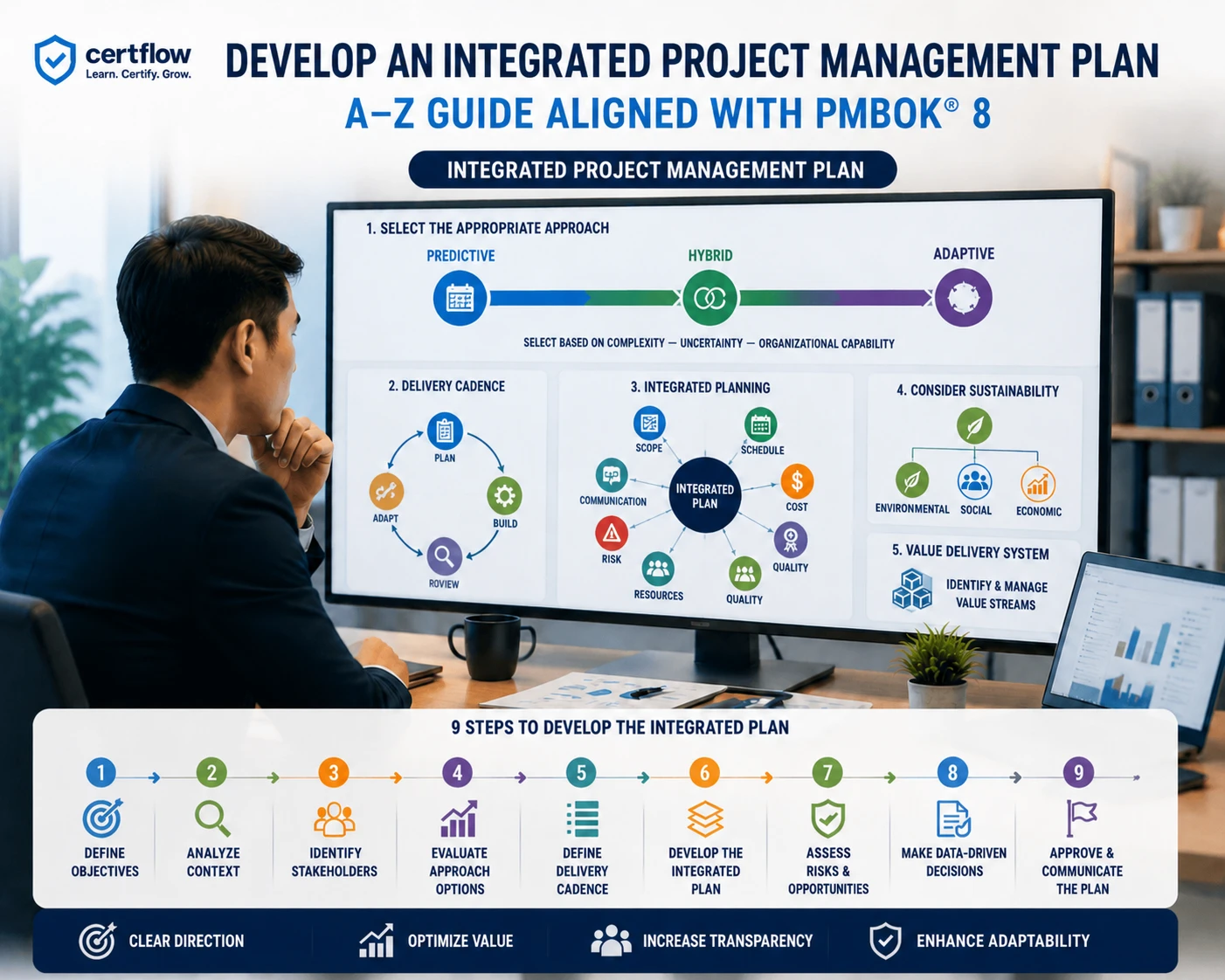
The project management plan isn't just a Gantt chart — it's the full set of documents that governs every decision from kickoff to closure.
1. Why Is "Integrated" the Most Important Keyword?
Many PMs have a scope management plan, a schedule management plan, and a cost management plan — but they exist in silos. When scope changes, the schedule is not updated. When resources fluctuate, the cost baseline does not reflect it. When a risk materializes, nobody knows the impact on stakeholder engagement.
The result: each individual plan is correct, but the whole is wrong.
PMBOK® 8, Section 2.1.6.2: "The project management plan specifies how the project will be executed, monitored and controlled, and closed. Its content varies depending on the project's application context and complexity. The plan should also be adaptable enough to respond to the dynamic project environment — ideally, by following a progressive elaboration approach."
"Integrated" means: all subsidiary plans are linked to each other — a change in one place automatically triggers a review in others. This is why this task carries the most weight in the Process Domain — with 9 enablers.
2. From Business Case to Integrated Plan — The Initiation Flow
PMBOK 8 describes a clear initiation flow:
Step | Document | Answers the question | Who creates it?
|
|---|---|---|---|
1 | Business Case | WHY does the project exist? ROI, value proposition? | Sponsor / Business |
2 | Project Charter | WHAT IS THE PROJECT? Authorization, objectives, constraints? | Sponsor + PM |
3 | Project Management Plan | HOW? Execute, monitor, control, close? | PM + Team |
PMBOK® 8: "A clearly articulated business case enables stakeholder alignment on priorities and constraints, and provides team members with a broader context that informs their work."
⚠️ Key Point: in adaptive environments, the charter may be "concise vision statements" and the plan may be "a high-level roadmap + product backlog." PMBOK 8 does not require thick documents — it requires enough information to act correctly.
3. The 9-Enabler Integrated Planning Framework
Group | Enabler | Core question
|
|---|---|---|
Assess | Assess needs, complexity, magnitude | How large and complex is the project? |
Strategy | Recommend development approach | Predictive, Adaptive, or Hybrid? |
Strategy | Determine critical info requirements | What sustainability requirements, regulations, or constraints apply? |
Strategy | Recommend execution strategy | Delivery cadence? Build/buy? Sourcing? |
Create plan | Create integrated plan | How are subsidiary plans and baselines integrated? |
Estimate | Estimate work effort and resources | How many people, how long, how much will it cost? |
Review | Assess dependencies, gaps, value | Are plans consistent? Where are the gaps? |
Maintain | Maintain the plan | When to update? How does progressive elaboration work? |
Decide | Collect and analyze data | What does data say? How do AI/analytics support decisions? |
4. Choosing the Development Approach: Predictive, Adaptive, or Hybrid?
This is the first strategic decision — and PMBOK 8 makes a very strong statement:
PMBOK® 8, Section 4.2.3: "Today, most projects require a hybrid approach, combining elements of both adaptive and predictive methodologies. Relying solely on one approach — whether adaptive or predictive — is no longer sufficient to address the diverse challenges and complexities that modern projects present."
The Development Approach Spectrum
Predictive | Hybrid | Adaptive
| |
|---|---|---|---|
Also known as | Waterfall, plan-driven | Mixed methods | Agile, iterative, incremental |
Requirements | Well-defined, stable | Mix of clear and evolving | Evolving, unclear |
Planning | Detailed upfront | Phased — detailed near, rough far | Rolling wave, just enough |
Delivery | Single at end | Phased or incremental | Periodic or continuous |
Change | Formal CCB process | Mix of formal and flexible | Backlog reprioritization |
Team | Specialist roles, PM assigns | Mix | Self-organizing, generalizing specialists |
Best suited when | Stable scope, compliance, safety-critical | Most modern projects | High uncertainty, innovation, fast feedback |
3 Factor Groups for Choosing Your Approach (PMBOK 8 Section 4.3)
Deliverable factors: Degree of innovation, requirements certainty, scope stability, ease of change, delivery options, risk, safety requirements, feedback value, regulations.
Project factors: Stakeholder involvement level, schedule constraints, financing uncertainty, project size and complexity, team experience, interdependencies.
Organization factors: Organizational structure (hierarchical → predictive; network → adaptive), culture (managing/directing → predictive; flexible/innovative → adaptive), organizational capability, team size and location.
4 Hybrid Patterns — PMBOK 8
Pattern | Description | Example
|
|---|---|---|
Adaptive → Predictive | Adaptive development, predictive rollout | Software (agile) deployed in regulated environment (predictive) |
Simultaneous | Adaptive + Predictive running in parallel | IT system (agile) + data center build (predictive) |
Mostly Predictive + small Adaptive | Predictive dominant, adaptive elements | Construction + IoT sensors |
Mostly Adaptive + small Predictive | Adaptive dominant, predictive constraints | Software product + regulatory compliance docs |
💡 PMP Exam Tip: When the exam describes "requirements are unclear and evolving" → adaptive. "Requirements well-defined, regulatory compliance" → predictive. "Software + hardware, software evolving + hardware fixed" → hybrid. Always match the approach to project CHARACTERISTICS, not personal preference.
5. Delivery Cadence — 4 Delivery Models
Cadence | PMBOK 8 Description | Example
|
|---|---|---|
Single Delivery | "All outcomes at end of the project" | Building a house — only usable when complete |
Multiple Deliveries | "Multiple components delivered at different times" | Drug development — Phase 1, 2, 3 trials |
Periodic Deliveries | "Regular and fixed delivery schedule" | Software release every 2 weeks |
Continuous Delivery | "Incrementally delivering value on ongoing basis. Fostering responsiveness to customer feedback." | CI/CD pipeline — continuous deployment |
6. Creating the Integrated Plan — Components and Baselines
PMBOK 8 Integrate and Align Project Plans (Section 2.1.6.2): "Integrating, aligning, and coordinating all plan components and consolidating them into a unified project management plan."
Subsidiary Plans Across All Performance Domains
Scope management plan, Schedule management plan, Cost/Financial management plan, Quality management plan, Resource management plan, Communications management plan, Risk management plan, Stakeholder engagement plan, Change management plan, Configuration management plan.
3 Baselines = Performance Measurement Baseline (PMB)
Baseline | Includes | Measures
|
|---|---|---|
Scope Baseline | Scope statement + WBS + WBS dictionary | Deliverable completion, scope creep % |
Schedule Baseline | Approved schedule model | SV, SPI, milestone completion |
Cost Baseline | Approved time-phased budget | CV, CPI, EAC, ETC |
The three baselines combined = the Performance Measurement Baseline (PMB) — the "standard" for comparing actual vs. planned performance.
PMBOK® 8: "The amount of time spent planning should be determined by the circumstances. The information gained from planning should be sufficient to move forward in an appropriate manner but not more detailed than necessary." — Do not over-plan. Agile teams can use a roadmap + backlog instead of a detailed PM plan.
7. Estimating Effort, Assessing Dependencies, and Maintaining the Plan
6 Estimation Techniques — PMBOK 8
Technique | Description | Accuracy | When to use
|
|---|---|---|---|
Analogous | Based on similar past projects | Low–Medium | Early stage, limited data, speed required |
Parametric | Statistical relationship (e.g., $/m²) | Medium–High | Reliable parameters available |
Bottom-up | Estimate each work package, then aggregate | Highest | Scope defined, precision required |
Multipoint (PERT) | (O + 4ML + P) / 6 | Medium–High | High uncertainty, range needed |
Relative sizing | Story points, T-shirt sizing | Medium | Agile, backlog prioritization |
Expert judgment | SME opinion | Variable | Novel work, insufficient data |
Assessing Dependencies, Gaps, and Business Value
The PM must review consolidated plans to identify:
Dependencies: Mandatory (hard logic — cannot be changed), Discretionary (soft logic — can be changed), External (outside the team's control — vendor, regulator), Internal (within the team/organization).
Gaps: Resource gaps (5 developers planned, 3 available), Skill gaps (AI expertise required but unavailable), Schedule conflicts (2 activities sharing the same resource on the same day), Budget shortfalls.
Business value: PMBOK 8 introduces the Value Breakdown Structure (VBS): "A WBS with value estimates assigned to each element. Useful in determining whether a given scope element is truly mandatory."
Maintaining the Integrated Plan
PMBOK 8: "Planning is an iterative or ongoing activity — progressive elaboration."
Predictive: Update through formal change control (CCB approval → baseline updates). Adaptive: Continuous replanning through backlog refinement and sprint planning. Hybrid: Formal baselines for fixed elements + iterative planning for evolving elements.
8. Data-Driven Decisions and Sustainability
Collecting and Analyzing Data
PMBOK® 8: "Project managers can leverage AI-powered tools to efficiently collect, analyze, and interpret data, generating actionable insights." + "Predictive analytics uses machine learning and current/historical data to discover patterns and predict future scenarios."
Data analysis tools: Earned Value Analysis (CPI, SPI, EAC, ETC), Variance Analysis, Trend Analysis, Root Cause Analysis, Alternative Analysis, Cost-Benefit Analysis, Regression Analysis.
Sustainability — What's New in PMBOK 8
The ECO emphasizes sustainability as a "critical information requirement." PMBOK 8 dedicates an entire Principle 5 to this topic:
PMBOK® 8, Section 3.7: "Integrating sustainability into project management means considering people, the planet, society, and value while performing project-related activities. By integrating sustainability, organizations can align with the triple bottom line — balancing social equity, environmental stewardship, and economic prosperity."
Sustainability affects planning across every dimension: scope (include sustainability activities), cost (green certification budget), schedule (environmental assessment timelines), risk (compliance risks), stakeholders (community engagement), resources (green procurement). PMs must integrate sustainability into ALL subsidiary plans — not create a separate plan for it.
9. PMP Exam Tips
📍 Tip 1 — Hybrid is the modern default: PMBOK 8 states clearly: "most projects require a hybrid approach." When the exam describes a project with both fixed and evolving elements — hybrid is typically the answer.
📍 Tip 2 — "Sufficient, not more than necessary": When the exam asks "how detailed should the plan be?" — the correct answer is right-sized based on complexity, NOT "as detailed as possible" or "follow organizational templates regardless."
📍 Tip 3 — Progressive elaboration: When the exam describes "information changes during execution" — the correct answer is "update the plan through appropriate change control," NOT "the plan should have captured this upfront."
📍 Tip 4 — Integrated = holistic assessment: When scope changes → the PM must assess the impact on ALL subsidiary plans (schedule, cost, risk, quality, stakeholders), NOT just submit a scope change request.
10. Ten Scenario-Based Practice Questions
Question 1
You are assigned to develop a new medical device. Product must comply with FDA regulations and safety requirements are critical with well-documented specifications. However, the user interface component has evolving requirements based on usability studies with healthcare professionals.
What development approach should you recommend?
A. Predictive — regulatory requirements demand a fully planned approach.
B. Adaptive — to accommodate evolving UI requirements.
C. Hybrid — predictive for regulated hardware/firmware, adaptive for the evolving UI component.
D. Start adaptive, then transition to predictive once requirements stabilize.
Question 2
The sponsor asks: "How detailed should the plan be? Last project had a 200-page plan nobody read."
What guidance does PMBOK 8 provide?
A. As detailed as possible for a large project.
B. Follow organizational templates regardless of project size.
C. "Sufficient to move forward appropriately but not more detailed than necessary" — tailored to context and complexity.
D. Detailed predictive plan with all subsidiary plans fully developed before execution.
Question 3
Your team needs to estimate building a new warehouse. Historical data from three similar projects is available. The sponsor wants a quick, reasonably accurate estimate to secure funding.
Which estimation technique is MOST appropriate?
A. Bottom-up — decompose all work packages.
B. Analogous — use historical project data.
C. Multipoint (PERT) — calculate optimistic/likely/pessimistic.
D. Parametric — use cost-per-square-meter from historical data multiplied by planned square footage.
Question 4
Midway through a predictive project, a new competitor launches a similar product. The sponsor wants to accelerate delivery by 3 months and add new features. The project is currently on track.
How should you handle this?
A. Submit a change request to modify scope and schedule baselines.
B. Switch to adaptive to accommodate rapid changes.
C. Assess business case validity, conduct impact analysis across ALL subsidiary plans, present options with trade-offs, and if approved, update the integrated plan through formal change control.
D. Fast-track and crash the schedule.
Question 5
You discover that your software team cannot begin integration testing until an external vendor delivers a critical API. The vendor has a history of missing deadlines. This dependency is on the critical path.
What type of dependency is this, and what should you do?
A. Mandatory internal — add buffer time.
B. Discretionary external — find a workaround.
C. Mandatory external — add to risk register with mitigation strategies (mock API, contractual penalties, vendor monitoring, schedule buffer).
D. Internal dependency — negotiate earlier delivery.
Question 6
The board wants a detailed cost estimate for a full 18-month CRM project before approving budget. You've just completed the charter with limited scope definition. Requirements workshops haven't started.
How should you handle this estimation challenge?
A. Provide a bottom-up estimate using industry benchmarks.
B. Delay budget approval until requirements are defined.
C. Provide a Rough Order of Magnitude (-25% to +75%) based on analogous projects, clearly communicating the uncertainty range, and propose phased funding with more accurate estimates as requirements are elaborated.
D. Use parametric estimating based on expected users.
Question 7
You're developing the integrated plan for a smart building: predictive construction + adaptive IoT sensor system with rapidly evolving technology.
How should you structure the plan?
A. Single predictive plan — construction timeline governs all.
B. Two separate plans — one per stream, managed independently.
C. One integrated plan with the overall framework, allowing construction to follow predictive planning and IoT to follow adaptive planning, with clear integration points where streams must synchronize.
D. Start predictive for everything, switch to adaptive for IoT later.
Question 8
The project sponsor mentions sustainability as a key requirement. This is a first for your organization.
How should you incorporate sustainability into the plan?
A. Add a sustainability section to the charter only.
B. Hire a sustainability consultant for a separate plan.
C. Integrate sustainability across ALL subsidiary plans — scope (sustainable materials), schedule (environmental assessments), cost (green certifications), risk (compliance), stakeholders (community), resources (green procurement).
D. Focus on environmental sustainability only as it's most measurable.
Question 9
Your agile team has run for 6 sprints. The product backlog has 300+ items, priorities change every sprint, and there's no roadmap. Stakeholders can't predict when key features will be delivered.
What does this indicate?
A. Adaptive is failing — switch to predictive.
B. The backlog needs grooming — schedule refinement.
C. The project lacks sufficient high-level planning. Even adaptive needs a roadmap for major milestones. Implement a lightweight roadmap with quarterly goals, well-prioritized backlog, and regular stakeholder communication.
D. This is normal for agile — stakeholders must accept uncertainty.
Question 10
You're reviewing consolidated plans before project start. The resource plan assumes 5 developers (only 3 available), the critical path has zero float, and a high-probability vendor delay risk isn't reflected in the schedule. Start date is in 2 weeks.
What should you do?
A. Start and resolve issues during execution.
B. Escalate all issues and delay the start.
C. Address each gap: negotiate resources or adjust scope, add schedule buffers, update schedule for vendor risk — then present the revised integrated plan with trade-offs to the sponsor for approval.
D. Add all issues to the risk register with mitigation plans.
Answer Key
Question 1: Answer: C
— PMBOK 8 describes: "a project with two main deliverables, where one is developed using an adaptive approach and the other using a predictive approach." Regulated hardware needs predictive; evolving UI needs adaptive. Pure predictive (A) slows UI innovation; pure adaptive (B) risks compliance.
Question 2: Answer: C
— PMBOK 8: "The amount of time spent planning should be determined by the circumstances." A 200-page unread plan adds no value. The PM should right-size planning to what stakeholders actually need.
Question 3: Answer: D
— Parametric uses statistical relationships between historical data and variables. With three similar projects and construction context, cost/sq-meter is a well-established parameter. Better accuracy-to-effort ratio than analogous (B). Bottom-up (A) too detailed for this stage. PERT (C) requires activity-level estimates not yet available.
Question 4: Answer: C
— PMBOK 8's Adopt a Holistic View: "decisions consider all interconnected elements." A significant environment change requires holistic assessment — not just a scope change (A), wholesale methodology switch (B), or schedule-only tactics (D). Assess the business case FIRST, then analyze across all dimensions.
Question 5: Answer: C
— PMBOK 8: "External dependencies involve a relationship between project activities and non-project activities outside the project team's control." The dependency is EXTERNAL (vendor) and MANDATORY (can't test without API). The PM should identify the risk, develop multiple mitigations, and add buffer.
Question 6: Answer: C
— PMBOK 8 emphasizes progressive elaboration. Early on, only rough estimates are possible. The PM should be transparent about uncertainty (ROM range), use available data, and propose a refinement mechanism. Delaying (B) may lose the opportunity. Bottom-up (A) creates false precision at this stage.
Question 7: Answer: C
— PMBOK 8: "Construction project with IT integration — a hybrid approach is appropriate during a construction project (predictive) that involves building a smart building with complex IT systems (adaptive)." KEY: one INTEGRATED plan (not two separate ones) with different approaches and clear integration points.
Question 8: Answer: C
— PMBOK 8: "By integrating sustainability, organizations align with the triple bottom line — social equity, environmental stewardship, and economic prosperity." Sustainability should be woven INTO existing plans, not separated. A standalone plan (B) risks disconnection. Limiting to environment only (D) ignores social and economic pillars.
Question 9: Answer: C
— PMBOK 8: "Some project teams consider a simple, high-level roadmapping exercise as sufficient for initial planning." An unmanageable backlog with no roadmap = under-planning, not agile. The fix: add appropriate structure (roadmap, prioritization) without abandoning adaptiveness.
Question 10: Answer: C
— These are plan GAPS, not just risks. PMBOK 8's Integrate and Align process ensures "all management plans and baselines are integrated and alignments verified." Starting with known gaps (A) is reckless. Simple escalation (B) doesn't propose solutions. Just adding to the risk register (D) doesn't fix plan inconsistencies.
11. Summary
Developing an Integrated Project Management Plan is the most foundational task in the Process Domain — everything that follows depends on this plan. Three key takeaways:
1. "Integrated" = everything is connected — When scope changes → schedule, cost, risk, stakeholders, and resources all need to be reassessed. A good plan is not a thick plan — it is a plan where every component references every other. PMBOK 8 calls this the "holistic view."
2. Hybrid is the modern default approach — PMBOK 8 says it directly: "most projects require a hybrid approach." The PM must know WHEN to use predictive, WHEN to use adaptive, and HOW to combine both. The 4 hybrid patterns from PMBOK 8 give you practical templates.
3. "Sufficient, not more than necessary" — Over-planning is waste. Under-planning is risk. The Goldilocks zone: enough information to act correctly, with enough flexibility to adapt when reality changes. Progressive elaboration — plan in detail when you have enough information, not on day one.
PMBOK® 8, Section 3.3: "Embracing a holistic perspective is crucial for managing project complexity, as it enables project managers to grasp the overall situation and the connections among different project components. This method aids in pinpointing the root causes of challenges and tackling them efficiently."
Frequently Asked Questions (FAQ)
How does the Project Management Plan differ from the Project Charter?
The Project Charter is the document that authorizes the project, appoints the PM, and defines the high-level scope — typically signed by the Sponsor. The Project Management Plan is a detailed plan developed by the PM that includes all subsidiary plans (scope, schedule, cost, risk, communication, etc.) and the baselines. The Charter comes first; the Project Management Plan comes after.
What subsidiary plans are included in the Project Management Plan?
Subsidiary plans include: Scope Management Plan, Requirements Management Plan, Schedule Management Plan, Cost Management Plan, Quality Management Plan, Resource Management Plan, Communications Management Plan, Risk Management Plan, Procurement Management Plan, and Stakeholder Engagement Plan. Each plan describes how to manage that particular knowledge area.
What does tailoring mean in PMBOK 8 when it comes to planning?
Tailoring means adjusting processes, methods, and artifacts to fit the specific context of the project — not rigidly applying every PMBOK process. PMBOK 8 emphasizes tailoring more than previous editions: PMs need to consider complexity, size, duration, and stakeholder requirements to determine what to apply and to what extent.
Now that you understand integrated project management planning — it's time to practice with real exam questions.
Next article: Project Scope Management: Definition & Decomposition according to PMBOK 8
Evaluating project status: metrics and reporting according to PMBOK 8
Try Free PMP Practice Questions →
Official References: