Dashboard xanh nhưng dự án đang chết — vì bạn đo sai thứ. PMBOK 8 nhấn mạnh metrics phải measure outcomes, không chỉ outputs. Bài này hướng dẫn xây dựng metrics đúng.
1. Tại sao "evaluate status" là kỹ năng sống còn?
Hãy tưởng tượng: dự án phát triển app mobile. Team báo cáo velocity ổn định 20 points/sprint. Burndown chart đẹp. Tất cả metrics xanh. Nhưng sau go-live, customer support tickets tăng 300%. Users phàn nàn navigation khó hiểu. NPS giảm từ 45 xuống 15.
Vấn đề? Team đo output (velocity, features completed) nhưng không đo outcome (user satisfaction, usability). Dashboard xanh nhưng dự án đang thất bại.
PMBOK® 8, Section 2.1.6.7: "Monitor and Control Project Performance is the process of tracking, reviewing, and reporting the overall project progress. The key benefits: stakeholders understand the current state, recognize actions taken, and gain visibility into the future project status."
Evaluate Project Status không chỉ là "check progress" — mà là hệ thống cảnh báo sớm giúp PM phát hiện vấn đề trước khi chúng trở thành thảm họa.
2. Leading vs Lagging Indicators — Đo đúng thứ
Đây là phân biệt quan trọng nhất trong measurement — và là điều nhiều PM bỏ qua.
Leading Indicators | Lagging Indicators | |
|---|---|---|
Timing | Dự báo TƯƠNG LAI — cảnh báo sớm | Đo QUÁKHỨ — xác nhận kết quả |
Giá trị | Cho phép PHÒNG NGỪA | Cho phép ĐÁNH GIÁ |
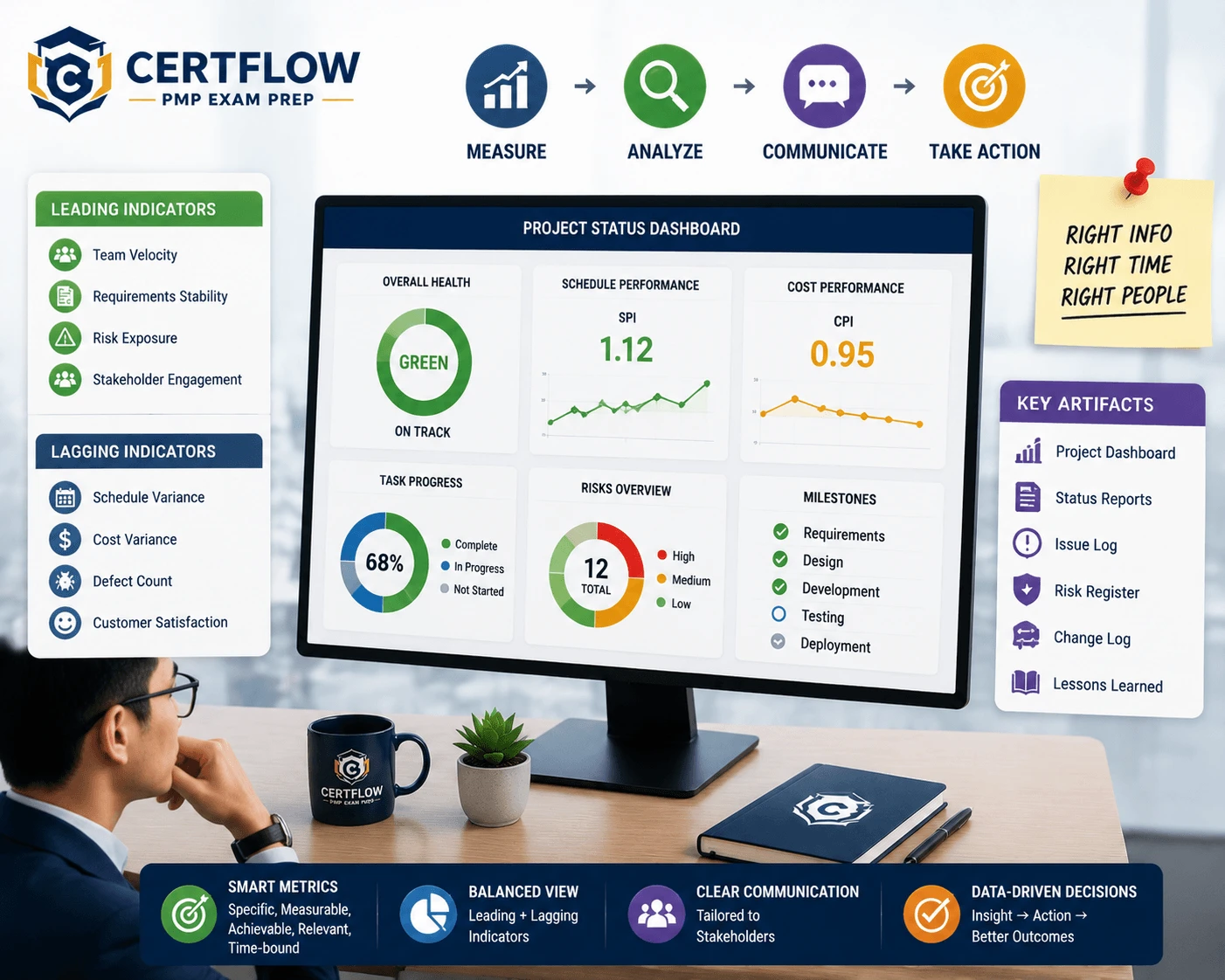
Ví dụ | Stakeholder attendance giảm, team morale thấp, defect trend tăng, velocity declining | SPI, CPI, NPS, schedule variance, deliverables completed, customer complaints |
Hành động | Investigate và adjust TRƯỚC khi impact | Root cause analysis và corrective action SAU impact |
PMBOK® 8: "Lagging indicators can also be used to find correlations between outcomes and environmental variables. For example, a schedule variance may show a correlation with project team member dissatisfaction." — Lagging indicators không chỉ đo kết quả mà có thể reveal root causes ẩn.
PM giỏi theo dõi cả hai — leading indicators để phòng ngừa, lagging indicators để xác nhận và learn.
3. Framework 8 enablers đánh giá tình trạng
Nhóm | Enabler | Câu hỏi cốt lõi |
|---|---|---|
Design | Develop metrics, analysis, reconciliation | Đo cái gì, phân tích thế nào? |
Artifacts | Identify and tailor artifacts | Cần tài liệu/artifact gì cho dự án này? |
Artifacts | Ensure artifacts created, reviewed, updated | Artifacts có hiện hành và chính xác? |
Artifacts | Ensure accessibility of artifacts | Mọi người có truy cập được không? |
Assessment | Assess current progress | Dự án đang ở đâu so với plan? |
Analysis | Measure, analyze, update metrics | Data nói gì? Cần hành động gì? |
Communication | Communicate project status | Ai cần biết gì, khi nào, qua kênh nào? |
Improvement | Assess effectiveness of artifact management | Hệ thống tracking có đang hoạt động tốt? |
4. Develop metrics — SMART và tránh measurement pitfalls
SMART Criteria cho Metrics

PMBOK 8 (Section 2.1.5.3): "SMART criteria are guidelines used to set clear, attainable, and meaningful goals."
Criteria | Ý nghĩa | Ví dụ tốt | Ví dụ xấu |
|---|---|---|---|
Specific | Rõ ràng, cụ thể | "Reduce defect rate to below 3%" | "Improve quality" |
Measurable | Đo được bằng số | "CPI ≥ 0.95" | "Budget on track" |
Achievable | Thực tế, khả thi | "Velocity 20±3 points/sprint" | "Zero defects" |
Realistic | Liên quan đến mục tiêu dự án | "NPS ≥ 40 post-launch" | "Lines of code written" |
Time-bound | Có deadline | "Achieve by Sprint 8" | "Eventually" |
Measurement Pitfalls — PMBOK 8 cảnh báo
PMBOK® 8, Section 2.1.6.7.1: "Hawthorne effect — the very act of measuring something influences behavior. Measuring only output of deliverables can encourage the team to focus on creating a large volume rather than deliverables that provide higher customer satisfaction."
Các cạm bẫy đo lường phổ biến:
Pitfall | Mô tả | Cách tránh |
|---|---|---|
Hawthorne Effect | Đo cái gì → team tập trung vào cái đó, bỏ qua thứ khác | Đo balanced set: output + outcome + process |
Vanity Metrics | Số liệu đẹp nhưng vô nghĩa (VD: total features built) | Focus trên actionable metrics (VD: adoption rate) |
Gaming | Team optimize cho metric, không cho value (VD: inflate story points) | Dùng multiple complementary metrics, audit periodically |
Over-measurement | Đo quá nhiều → overhead lớn, data overload | "Measure only what is relevant and ensure metrics are actionable" (PMBOK 8) |
5. Artifacts — Nhận diện, tạo, và quản lý
PMBOK 8 định nghĩa: "An artifact is a document or other item created during a project to help manage it and provide information."
Identify and Tailor Artifacts
Không phải mọi dự án cần cùng artifacts. PM phải tailor — chọn artifacts phù hợp với complexity, development approach, và organizational needs.
Predictive Artifacts | Adaptive Artifacts | Cả hai |
|---|---|---|
Project management plan | Product backlog | Risk register |
WBS + WBS Dictionary | Sprint backlog | Issue log |
Scope statement | Definition of Done | Change log |
Schedule baseline | Burndown / Burnup charts | Lessons learned register |
Cost baseline | Velocity charts | Stakeholder register |
Requirements traceability matrix | Task board / Kanban board | Communication plan |
Ensure Artifacts Are Living Documents
PMBOK 8 nhấn mạnh: artifacts phải là "living documents" — được reviewed, updated, và documented LIÊN TỤC. Artifact cũ = data sai = quyết định sai. PM phải establish cadence: ai review, bao lâu, và ai approve updates.
Ensure Accessibility
Artifacts phải accessible cho đúng người — PMBOK 8: "Cloud computing has revolutionized data storage and access, ensuring that all team members have uniform access to essential project information." Nhưng cũng cần security: không phải mọi artifact đều cho mọi người xem (financial data, HR info, sensitive risks).
6. Assess progress và analyze metrics
Assess Current Progress
PMBOK 8 Monitor and Control Project Performance bao gồm: evaluating performance compared to plan, tracking utilization of resources/work/budget, demonstrating accountability, providing info to stakeholders, assessing whether deliverables are on track to deliver benefits, making fact-based decisions, và analyzing root causes of variances.
Work Performance Data → Information → Reports
Level | Mô tả | Ví dụ |
|---|---|---|
Work Performance Data | Raw observations, measurements — chưa phân tích | Task A: 75% complete, $12K spent, 3 defects found |
Work Performance Information | Data đã phân tích — so sánh với baselines | CPI = 0.88, SPI = 1.05, defect rate trending up |
Work Performance Reports | Information tổng hợp thành reports cho stakeholders | Dashboard RAG, earned value report, risk summary |
Key Analysis Tools
PMBOK 8 liệt kê: Variance Analysis (actual vs plan), Trend Analysis (pattern over time), Earned Value Analysis (CPI, SPI, EAC), Root Cause Analysis (5 Whys, Fishbone), What-If Analysis (scenario planning), và AI/Predictive Analytics (pattern discovery, future prediction).
PMBOK® 8: "AI and ML can offer predictive insights based on historical data, helping to effectively allocate resources, identify potential risks, report on project progress using leading and lagging indicators, and optimize project trajectories."
7. Communicate project status — Đúng người, đúng format
Audience-Specific Reporting
Audience | Cần gì | Format | Frequency |
|---|---|---|---|
Sponsor / C-suite | Overall health, key risks, decisions needed | 1-page dashboard, RAG status | Bi-weekly / monthly |
Steering committee | Strategic alignment, ROI tracking, escalations | Presentation + executive summary | Monthly / quarterly |
Project team | Task details, blockers, sprint progress | Boards, standups, burndown | Daily / sprint-level |
PMO | Portfolio rollup, resource utilization, standards | Standardized templates | Per org cadence |
External clients | Deliverable status, timeline, quality | Per contract/SLA format | Per agreement |
Project Dashboards — PMBOK 8
PMBOK 8: "A set of charts and graphs showing progress or performance against important measures, often including RAG charts, bar charts, pie charts, and control charts." Dashboards phải VISUAL — sponsor không muốn đọc 20 trang text.
Information Radiators
PMBOK 8: "A visible, physical display that provides information to the rest of the organization. Low tech and high touch." Kanban boards, burndown charts treo tại workspace — mọi người thấy status mà không cần họp.
8. Predictive vs Adaptive status tracking
Aspect | Predictive | Adaptive |
|---|---|---|
Primary metrics | EVM (CPI, SPI, EAC), milestone completion %, scope completion | Velocity, burndown/burnup, cycle time, WIP, throughput |
Baseline | Formal PMB (scope + schedule + cost) | Iteration baseline, release plan |
Key artifacts | PM plan, Gantt chart, status reports, EVM reports | Backlog, task board, burndown/burnup, DoD checklist |
Review cadence | Phase gates, milestone reviews, monthly reports | Sprint reviews, daily standups, retrospectives |
Variance detection | Formal variance analysis against baselines | Velocity trends, sprint goal completion rate |
Status communication | Formal reports, dashboards, presentations | Information radiators, demos, transparency tools |
9. Mẹo thi PMP
📍 Mẹo 1: Data → Information → Reports: Raw data (task 75% done) → Analyzed info (SPI = 0.85) → Reports (dashboard cho sponsor). Đề thi hay hỏi "what is work performance data?" vs "work performance information" — data = raw, information = analyzed, reports = formatted for audience.
📍 Mẹo 2: Leading > Lagging cho early warning: Khi đề mô tả "stakeholder becomes quiet" hoặc "team morale declining" — đó là LEADING indicator. PM phải investigate, KHÔNG chờ formal complaint (lagging indicator).
📍 Mẹo 3: Tailor artifacts: Không phải mọi dự án cần mọi artifact. Khi đề hỏi "agile project needs documentation" — đáp án thường là "tailor to what's needed," KHÔNG phải "follow organizational template regardless" hay "no documentation in agile."
📍 Mẹo 4: Hawthorne Effect: Khi đề mô tả "team focuses only on velocity, ignoring quality" — đó là Hawthorne Effect (measuring something influences behavior). Đáp án: balance metrics — đo velocity AND defect rate AND customer satisfaction.
10. Mười câu hỏi trắc nghiệm tình huống
Question 1
Your team's velocity has been stable at 25 points/sprint for 6 sprints. All sprint goals are met. However, customer support tickets have increased 200% since the last release.
What does this reveal about your metrics?
A. Velocity is a good metric — the issue is with customer support.
B. The team is measuring OUTPUT (velocity, sprint goals) but not OUTCOME (customer satisfaction, usability). Add outcome metrics like NPS, support ticket volume, and user adoption rate.
C. Sprint goals should include customer satisfaction criteria.
D. The customer support team needs training.
Question 2
The sponsor asks: "Give me the project status in one page." Currently, your team produces a 15-page weekly report with detailed EVM tables, risk logs, and resource utilization charts.
What should you do?
A. Create a 1-page executive summary and attach the 15-page report as appendix.
B. Create a project dashboard with RAG status, key metrics, top risks, and decisions needed — tailored specifically to what the sponsor needs to know and decide.
C. Ask the sponsor to read at least the executive summary of the full report.
D. Reduce the report to 1 page by cutting all but the most critical metrics.
Question 3
Your project uses a predictive approach. During the monthly status review, you discover: CPI = 0.88, SPI = 1.05, and the risk register hasn't been updated in 6 weeks.
What are your two biggest concerns?
A. CPI is low and SPI is high — the project is over budget but ahead of schedule. Both are acceptable trade-offs.
B. CPI below 1.0 means cost overrun — investigate root cause. And the stale risk register means potential risks are not being monitored — an outdated artifact = blind spots.
C. Focus on the CPI only — schedule is fine.
D. The risk register is a low-priority artifact — focus on EVM metrics.
Question 4
A new team member asks: "Where is the current version of the project schedule? I found three different versions on the shared drive, Jira, and an email attachment."
What artifact management problem does this reveal?
A. The team needs training on file management.
B. Artifact accessibility and version control are broken. There should be a single source of truth with clear ownership, version control, and access policies — multiple versions create confusion and risk decisions based on outdated information.
C. Too many tools — consolidate to one platform.
D. This is normal for large projects — the new member will learn which version to use.
Question 5
Your agile team's burndown chart shows work remaining is decreasing steadily. However, the number of items in "In Progress" on the Kanban board has been increasing for 3 sprints — from 5 to 12 to 18 items simultaneously.
What does the rising WIP indicate?
A. The team is working on more items simultaneously — they're being more productive.
B. Rising WIP is a LEADING INDICATOR of future delivery problems. Too many items in progress means nothing is getting finished — the burndown looks good because work started, but completion will stall. The team should reduce WIP limits.
C. The Kanban board needs better categorization.
D. The team size has increased — more people means more WIP.
Question 6
The PMO requires all projects to use a standardized 20-field status report template. Your agile project is small (5 people, 3-month duration) and 15 of the 20 fields are irrelevant (no earned value, no formal procurement, no sub-projects).
What should you do?
A. Fill in all 20 fields as required — organizational standards must be followed.
B. Request a waiver from the PMO since your project is too small for the template.
C. Discuss with the PMO to tailor the template — keeping the fields relevant to your project and replacing irrelevant ones with agile-appropriate metrics like velocity and burndown.
D. Use the template for PMO reporting but track your project using agile artifacts internally.
Question 7
Your project dashboard shows green status (all metrics within thresholds). A team member privately tells you: "Nobody trusts these numbers. We mark tasks as done to keep the dashboard green, but we know there are quality issues we haven't addressed."
What is the ROOT CAUSE?
A. The team needs ethics training about honest reporting.
B. The metrics and incentive structure are causing gaming behavior — the team is optimizing for the metric (green dashboard) rather than the goal (quality deliverables). Revise metrics to include quality indicators, create psychological safety for honest reporting, and separate status tracking from performance evaluation.
C. Add more quality metrics to the dashboard.
D. The PM should verify all task completions personally.
Question 8
At a steering committee meeting, you present project status. A committee member challenges: "Your report says on-track, but the vendor told me they're 3 weeks behind on the API delivery."
What went wrong?
A. The vendor should communicate through proper channels, not directly to committee members.
B. Your status assessment didn't capture external dependencies accurately. The artifact (status report) was incomplete — missing vendor progress data. Investigate immediately, update your assessment, and establish regular vendor status integration.
C. Committee members shouldn't contact vendors directly.
D. The vendor is managing expectations differently with different stakeholders.
Question 9
Your organization doesn't have a formal project management methodology. You're starting a new project and need to determine which artifacts to create.
What is the BEST approach?
A. Create all artifacts from PMBOK 8 to ensure completeness.
B. Create no artifacts — focus on delivering value.
C. Assess project complexity, stakeholder needs, regulatory requirements, and development approach — then select the minimum set of artifacts that provides sufficient control, communication, and governance for THIS specific project.
D. Copy the artifact set from the most recent successful project.
Question 10
Your project's lessons learned register hasn't been updated since month 2. It's now month 8 of a 12-month project. The PM says: "We'll capture everything at the end."
What is wrong with this approach?
A. Nothing — lessons learned are typically captured at project closure.
B. Lessons learned should be captured CONTINUOUSLY — not just at the end. By month 8, valuable insights from months 3-8 are likely forgotten. The ECO requires "ensure artifacts are created, reviewed, updated, and documented" throughout the project.
C. Assign someone to update the register monthly.
D. Schedule a mid-project lessons learned session.
11. Đáp án
Question 1:
Answer: B — PMBOK 8: "Measuring only output of deliverables can encourage focus on large volume rather than higher customer satisfaction." Velocity is a valuable output metric but incomplete alone. The PM must add outcome metrics to get the full picture.
Question 2:
Answer: B — PMBOK 8: "Project information should be adapted to provide information at an appropriate level, format, and detail for each type of stakeholder." A dashboard designed for the sponsor's decision-making needs is different from an appendix of the old report (A) or a cut-down version (D).
Question 3:
Answer: B — CPI 0.88 means for every $1 spent, only $0.88 of value. This needs investigation. AND a 6-week-old risk register = artifacts not "reviewed and updated" as ECO requires. New risks may have emerged. Stale artifacts = false sense of security.
Question 4:
Answer: B — The ECO requires "ensure accessibility of artifacts" and "ensure artifacts are created, reviewed, updated, and documented." Three versions = no single source of truth = risk of decisions based on wrong data. PM must establish version control, access policies, and a clear "current version" location.
Question 5:
Answer: B — Rising WIP is a classic leading indicator. Burndown shows started work but doesn't distinguish "started" from "nearly finished." High WIP = context switching, multitasking, and diminishing throughput. PMBOK 8 mentions Kanban method focuses on "limiting work in process (WIP)."
Question 6:
Answer: C — PMBOK 8 Tailoring: "project management activities should be adjusted to fit the characteristics and environment of a given project." The ECO requires "identify and tailor needed artifacts." Tailor in collaboration with the PMO — not ignore (B) or blindly follow (A). D creates dual tracking overhead.
Question 7:
Answer: B — PMBOK 8 Hawthorne Effect: "the very act of measuring something influences behavior." When metrics incentivize "green" over "accurate," gaming occurs. The fix is systemic — revise what's measured, how it's used, and create safety for honest reporting. Just adding metrics (C) without fixing incentives = more gaming.
Question 8:
Answer: B — The ECO requires "assess current progress" comprehensively — including external dependencies. If the PM's status report missed a 3-week vendor delay, the artifacts and data collection process have gaps. PMBOK 8: "evaluate performance compared to plan" includes ALL work, internal and external.
Question 9:
Answer: C — PMBOK 8: "project management activities should be adjusted to fit the characteristics and environment of a given project." The ECO requires "identify and tailor needed artifacts." All artifacts (A) creates bureaucracy. No artifacts (B) loses control. Copying (D) ignores different context. Tailoring = right-sizing for the project.
Question 10:
Answer: B — PMBOK 8: "Lessons learned are incorporated during the ongoing processes, not only at the end of the project." Waiting until month 12 = losing 10 months of insights. The register is an artifact that must be a living document. D is a partial fix; B is the systemic answer.
12. Tổng kết
Evaluate Project Status là "hệ thần kinh" của dự án — thu thập tín hiệu, phân tích, và truyền đạt cho đúng người để ra đúng quyết định.
Ba takeaways:
1. Đo đúng thứ > Đo nhiều thứ — Output metrics (velocity, milestones) cần thiết nhưng chưa đủ. Outcome metrics (satisfaction, adoption, value) mới cho thấy bức tranh thật. Leading indicators cảnh báo sớm, lagging indicators xác nhận. Balanced measurement = balanced view.
2. Artifacts phải sống, không phải nằm trong drawer — Risk register 6 tuần không update = blind spot. 3 phiên bản schedule = confusion. Lessons learned chỉ viết cuối dự án = mất 80% insights. Artifacts là living documents — reviewed, updated, accessible, và có single source of truth.
3. Tailor reporting cho audience, không broadcast — Sponsor cần 1-page dashboard. Team cần daily standups. PMO cần standardized templates. Regulator cần formal evidence. One-size-fits-all report = nobody reads it. PMBOK 8: "adapted to provide information at an appropriate level, format, and detail."
PMBOK® 8, Section 2.1.6.7: "Measurement requires time and effort that could be allocated to other productive tasks; therefore, project teams should focus on measuring only what is relevant and ensure that the metrics are actionable."
Câu Hỏi Thường Gặp (FAQ)
Leading và lagging indicators trong quản lý dự án là gì?
Lagging indicators: đo kết quả đã xảy ra — schedule variance, cost variance, defect count. Thông tin đến muộn, PM chỉ biết khi đã có vấn đề. Leading indicators: đo tín hiệu sớm — team velocity trend, risks identified, stakeholder engagement score. PM cần cả hai: leading để phòng ngừa, lagging để xác nhận.
SMART metrics trong dự án cần đáp ứng tiêu chí nào?
SMART = Specific (rõ ràng, không mơ hồ), Measurable (đo được bằng số), Achievable (khả thi), Relevant (liên quan đến mục tiêu dự án), và Time-bound (có timeline cụ thể). Ví dụ tốt: 'Reduce defect rate from 5% to 2% by end of Sprint 6'. Ví dụ xấu: 'Improve quality' — không measurable, không time-bound.
Project artifacts trong PMBOK 8 gồm những loại nào?
PMBOK 8 phân artifacts thành: Strategy artifacts (project charter, business case), Logs & Registers (risk register, issue log, change log), Plans (project management plan, subsidiary plans), Hierarchy charts (WBS, OBS, RBS), Baselines (scope, schedule, cost), và Visual data (dashboards, burndown charts). Artifacts là 'evidence' của PM work.
Bạn đã nắm vững đánh giá tình trạng dự án — giờ là lúc luyện tập với câu hỏi thi thật.
Bài tiếp theo: Đóng Dự Án Chuyên Nghiệp theo PMBOK 8
Nguồn tham khảo chính thức:
Bạn đã sẵn sàng luyện tập chưa?
Thử CertFlow miễn phí — 10 câu hỏi, không cần đăng ký.
Bắt Đầu Miễn Phí