Turn 240 PMP exam minutes into an advantage: how to allocate time, manage test anxiety, and approach each question type on exam day.
A candidate spends four months preparing, completes over 800 practice questions, and consistently scores above 75% on mock exams — then walks into the PMP® exam room and runs out of time because they got stuck on every difficult question. This happens far more often than most people expect.
PMP exam day tips are the specific strategies you need to own 240 minutes — pacing your time correctly, staying focused when questions get hard, and reading each question the way PMI® designed it to be read. Knowledge determines whether you can answer correctly; exam strategy determines whether you have time to do it.
This guide covers what actually matters on exam day: how to pace 240 minutes, how to handle difficult questions without losing momentum, and how to read scenario questions without getting misled.
Key takeaways
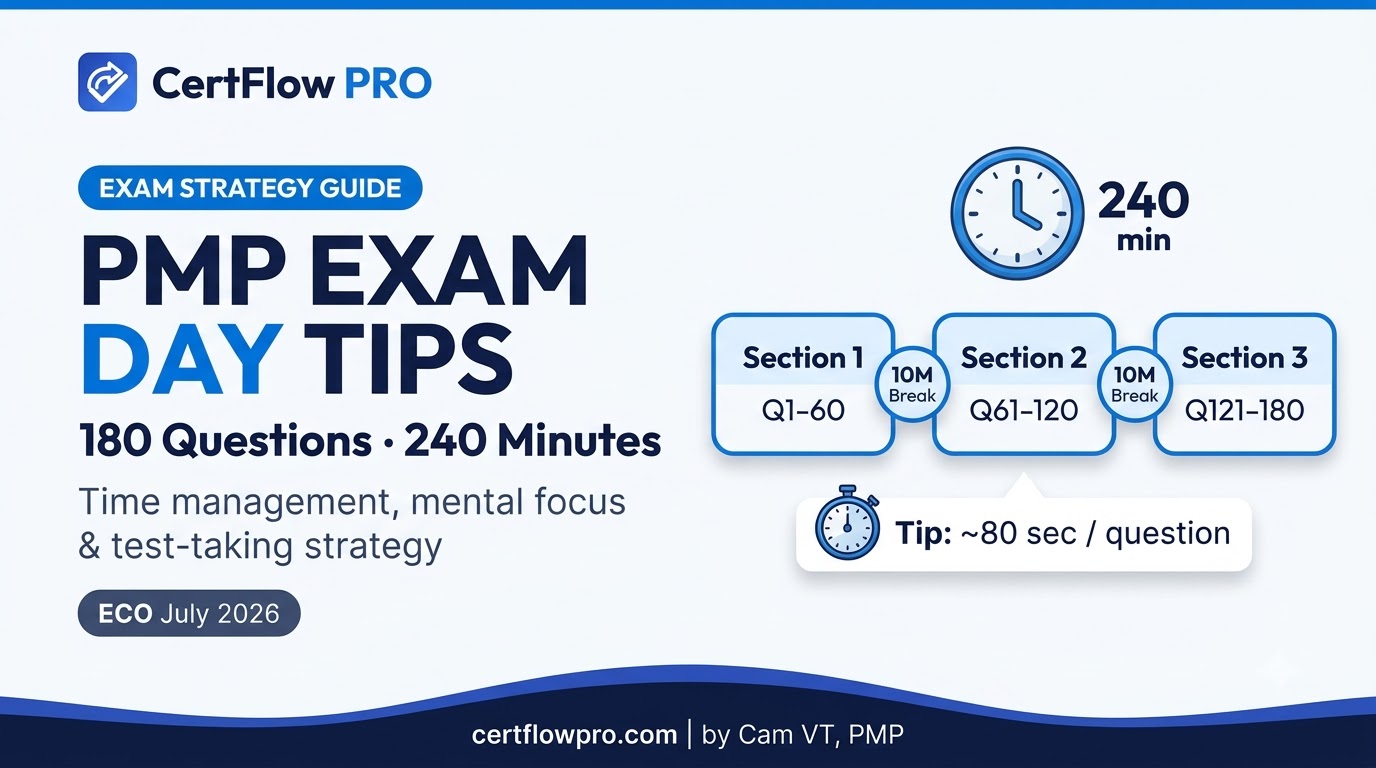
The PMP 2026 exam has 180 questions in 240 minutes — an average of 80 seconds per question, with no room to get stuck.
Two optional 10-minute breaks are available after question 60 and question 120; once you start a break, you cannot return to the previous section.
"Mark and move on" is the single most important skill in the exam room.
PMI mindset: always look for what an ideal PM would do — proactive, process-driven, team-protective.
Skipped questions count as wrong; always select your best guess, even if unsure.
Why exam-day strategy matters as much as content knowledge
Content knowledge and test-taking strategy are two separate skills. You can know all 26 tasks in the ECO 2026, understand PMBOK® Guide 8 thoroughly, and still score below your actual capability if you don't manage time and mental state in the exam room.
The PMP exam is not a pure knowledge test. Approximately 60% of questions fall under the adaptive/agile and hybrid approaches — meaning there is no "textbook-correct" answer, only an answer that is "correct given the context and PMI mindset." This type of question requires you to read the scenario carefully, identify the real issue, and select what an ideal PM would do — all within about 80 seconds.
Time pressure, mental fatigue after two hours of concentration, and uncertainty on difficult questions all directly affect decision quality. Exam-day strategy helps you maintain consistent performance from question 1 to question 180.
The PMP 2026 exam structure: what to know before you walk in
According to the PMP Examination Content Outline – July 2026, the current exam has these specifications:
Parameter | Value |
|---|---|
Total questions | 180 (including 10 unscored pretest items, distributed randomly) |
Time limit | 240 minutes |
Breaks | Two optional 10-minute breaks — after question 60 and question 120 |
Question types | Single response, multiple response, drag-and-drop, practicum |
Approach distribution | ~40% predictive, ~60% adaptive/agile and hybrid |
The most critical rule to internalize: once you start a break, you cannot return to the previous section. Each section is a one-way gate. Before taking any break, ensure you have reviewed all flagged questions in that section.
If you are testing via OnVUE (online proctoring at home), verify your system and environment at least 24 hours in advance. A technical issue right before exam time is an avoidable source of stress.
Time allocation strategy for 240 minutes
240 minutes ÷ 180 questions = an average of 80 seconds per question. Keep this number in mind as your benchmark throughout the exam.
The right pacing rhythm
The goal is not to spend exactly 80 seconds on every question. Straightforward questions may take 30-45 seconds; complex scenario questions may need 2-3 minutes. What matters is that each section stays within a safe time envelope:
Section | Questions | Target time | Break time |
|---|---|---|---|
Section 1 | 1–60 | ~75 minutes | 10 min (optional) |
Section 2 | 61–120 | ~75 minutes | 10 min (optional) |
Section 3 | 121–180 | ~70 minutes | None |
Check the clock after every 20 questions. If you have spent more than 30 minutes on the first 20 questions, you need to accelerate.
The "mark and move on" technique
This is the most important skill in the PMP exam room. When you encounter a question you're unsure about:
Select your best answer based on first instinct.
Flag (mark) the question for review.
Move to the next question immediately.
Never spend more than 2 minutes on a single question when there are many more ahead. A difficult question that takes 5 minutes doesn't just cost you time — it degrades the quality of your thinking for subsequent questions, because your brain stays partially "stuck" on it.
When you finish a section, return to flagged questions with a fresher perspective. Many questions that seemed difficult become clearer after working through 10-15 more.
Managing mental state as pressure builds
Psychological pressure in the PMP exam room typically appears in two forms: anxiety about time and uncertainty about answers. Both are manageable with advance preparation.
When the clock seems to be moving faster than expected: pause for five seconds, breathe, remind yourself that 80 seconds/question is an average, not a hard ceiling. Then continue. Panicking about time causes you to read questions less carefully and choose wrong answers at a higher rate.
When you encounter 3-4 difficult questions in a row: this is normal. Exams include difficulty clusters designed to differentiate performance levels. Flag them and keep moving. It does not mean you are failing.
Taking breaks effectively: when you take a break, step away from the screen entirely. Drink water, stand up, move gently. A properly used 10-minute break restores cognitive capacity far better than 10 minutes of staring at the screen.
When Section 3 begins: this is where most candidates experience their biggest score drop due to accumulated fatigue. Taking both breaks before Section 3 makes a measurable difference. This is why skipping breaks to "save time" is a false economy.
How to approach individual questions
Single-response questions
The most effective process for reading PMI scenario questions:
Read the question stem first, not the answer choices. The stem defines the problem; the choices are just options.
Identify the action keyword: "first" (initial step), "best" (optimal given the context), "most likely" (highest probability), "next" (immediate following action).
Identify the context: predictive, agile, or hybrid? What phase is the project in? What problem is the PM facing?
Only then read the answer choices and eliminate.
PMP questions typically have two choices that "sound reasonable" and two that are clearly weaker. Focus your analysis on distinguishing the two plausible choices: which one represents the more proactive and process-correct PM behavior?
Multiple-response questions
When a question says "Select 2" or "Select all that apply":
Never guess the number of correct answers — the question always states it explicitly.
Evaluate each choice independently against the question: correct or incorrect given this scenario? Do not compare choices against each other.
Multiple-response questions require all correct selections — there is no partial credit. When uncertain, use elimination to keep the most defensible options.
Multiple-response questions typically take 30-60 seconds longer than standard questions. Factor this into your time plan.
Common mistakes in the exam room and how to avoid them
Mistake | How it shows up | How to avoid it |
|---|---|---|
Skipping breaks | Wanting to "save" 10 minutes; Section 3 scores drop significantly compared to Section 1 | Always take both breaks; they are recovery time, not wasted time |
Getting stuck on hard questions | Spending 5-7 minutes on one question; rushing at the end of the section | Two-minute cap per question; flag and move on; return later |
Changing answers without cause | Switching from B to C on review just because "C suddenly seems fine" | Only change if you identify a specific reason: you misread a keyword on the first pass |
Leaving questions blank | Skipping questions when unsure | Blank answers count as wrong. Always select your best guess, even when uncertain. |
Choosing based on real-world experience | Selecting "what I would do at my company" instead of "what an ideal PM per PMI would do" | Always ask: "What does PMI want a PM to do here?" — usually: be proactive, follow process, protect the team |
3 scenario questions
Question 1. You are a PM leading a digital transformation project. At the end of sprint 3 of 6, your team has completed only 60% of the planned story points. The sponsor is asking for a status update. What should you do first?
A. Report the sprint results to the sponsor and ask for a schedule extension
B. Conduct a retrospective with the team to identify the root causes of the velocity gap
C. Immediately add resources to the team to recover the schedule
D. Revise the project plan to reflect a reduced scope
Question 2. During execution of a predictive infrastructure project, two senior engineers disagree on the technical solution for a critical component. The disagreement has been ongoing for three days, and it is starting to delay work. The PM should:
A. Make the technical decision to stop the delay
B. Escalate the issue to the functional manager of both engineers
C. Facilitate a structured discussion between both engineers to reach a technical consensus
D. Assign the component to a third engineer who was not part of the disagreement
Question 3. A key stakeholder submits a formal change request during project execution. The change would add a new feature that is outside the current approved scope. The project is currently on schedule and within budget. The PM should:
A. Reject the change request to protect the project baseline
B. Accept the change to maintain stakeholder satisfaction
C. Ask the team to incorporate the change informally to avoid the overhead of the change control process
D. Submit the change request through the integrated change control process for evaluation and decision
Answers and explanations
Question 1: Answer B. The first step is to understand the root cause — not to report or add resources immediately. PMI consistently prioritizes diagnosis before action. A retrospective helps the team determine why velocity was low: were stories larger than estimated, is there technical debt, or are there dependency issues? Option A (report and ask for extension) is reactive without analysis. Option C (add resources) may slow things down in the short term (Brooks's Law). Option D (reduce scope) is a major decision that requires complete information first.
Question 2: Answer C. The PM is not the technical decision-maker, but the PM is responsible for resolving team conflict. Facilitating the two engineers toward consensus is a core PM responsibility per PMBOK® Guide 8. Option A (PM decides) exceeds the PM's technical authority and doesn't build lasting consensus. Option B (escalate to functional manager) is a fallback when resolution isn't possible at PM level, not the first step. Option D (reassign) avoids the conflict rather than resolving it.
Question 3: Answer D. All scope changes must go through the integrated change control process — this is non-negotiable, even when the project appears to be doing well. Option A (reject outright) denies the stakeholder's right to submit a valid change request. Option B (accept immediately) bypasses change control entirely. Option C (absorb informally) is uncontrolled scope creep — the most common PMI exam trap.
Want to practice more scenario questions under timed conditions? Try 10 free PMP questions at CertFlow PRO — no account required.
Summary
PMP exam-day strategy doesn't replace knowledge — it ensures the knowledge you have translates into your actual score. Three pillars: pace correctly (80 seconds/question average, check every 20 questions), manage mental state (take breaks, mark and move on), and read questions with PMI mindset (identify action keywords, scenario context, eliminate). To build stronger reflexes for PMI's thinking framework, the 50 PMP Mindset Principles series is worth reading before exam day. And if you want a clear picture of what changed in the exam format, see the PMP 2026 exam structure guide.
Frequently asked questions (FAQ)
How long is the PMP exam and how many questions does it have?
The PMP exam under the ECO July 2026 format has 180 questions in 240 minutes. Ten of those questions are unscored pretest items distributed randomly throughout the exam — you won't know which ones they are, so treat every question as scored. There are two optional 10-minute breaks after question 60 and question 120.
Can you change your answer after flagging a question on the PMP exam?
Yes, you can return to and change flagged answers within the same section, until you click "Next Section" or start a break. Once you move past a section, you cannot go back. On whether to change: only switch your answer when you can identify a specific reason — for example, you realize you misread a keyword the first time. Research on test-taking generally shows that first instinct is more reliable than changes made on vague feeling.
Should you skip difficult questions on the PMP exam?
Don't skip — mark and move on. The distinction matters: you must select an answer before marking, because blank responses count as wrong. Choose your best guess, flag the question, and return when you have time. This approach prevents time running out and lets you revisit hard questions with a fresher mental state.
What is the passing score for the PMP exam?
PMI® does not publish a specific passing score. Results are reported in four performance levels — Above Target, Target, Below Target, and Needs Improvement — reported separately for each domain. There is no official "70%" or "75%" threshold; figures circulating in study communities are not confirmed by PMI. Aim for "Target" or "Above Target" across all three domains.
References
Project Management Institute. (2026). PMP® Examination Content Outline – July 2026. PMI. pmi.org
Project Management Institute. (2025). A Guide to the Project Management Body of Knowledge (PMBOK® Guide) – Eighth Edition. PMI.
Pearson VUE. (2026). PMP Exam Policies and Procedures. home.pearsonvue.com