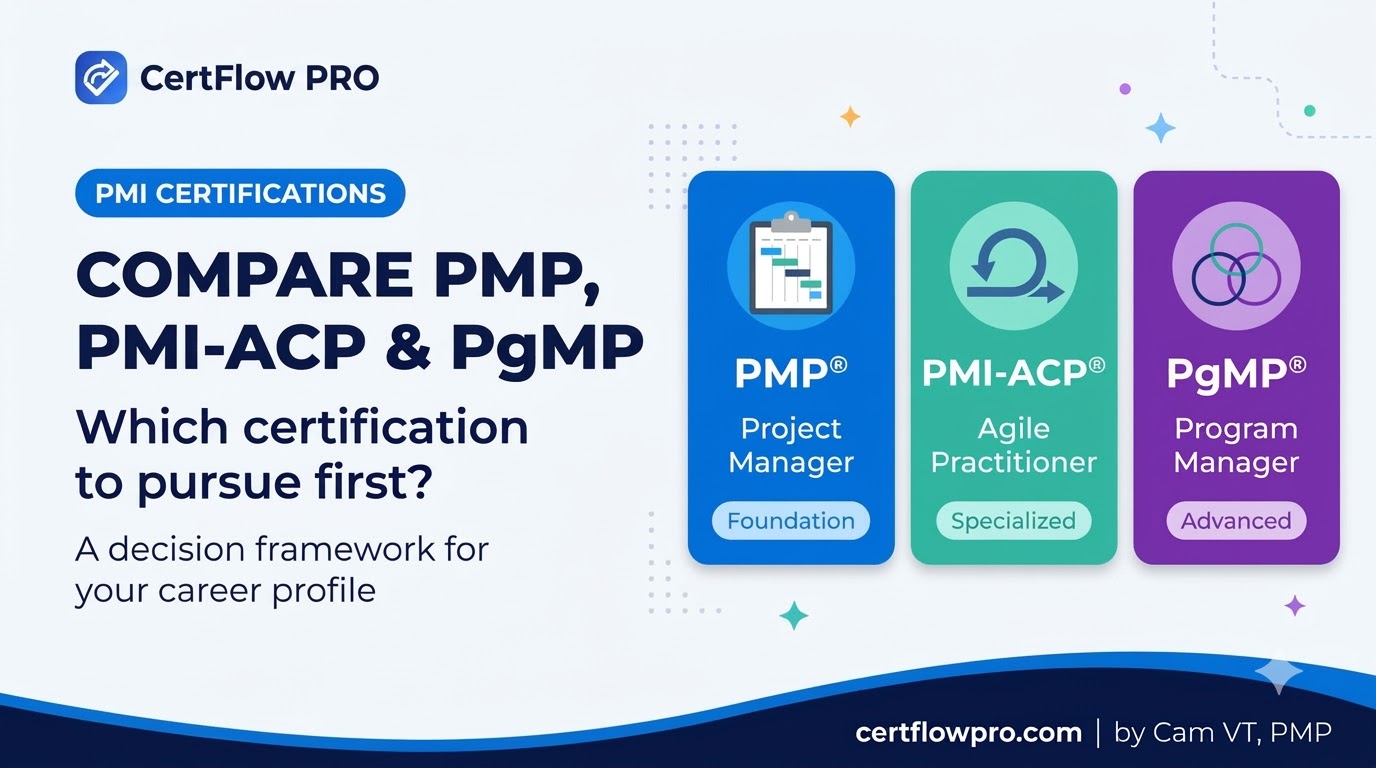
PMP, PMI-ACP or PgMP? Compare the 3 most popular PMI certifications to choose the right career path.
An IT project manager is scrolling LinkedIn when two job postings catch their eye — both from the same international company. One says "PMP preferred," the other says "PMI-ACP a plus." Their manager adds: "Why not just go for PgMP while you're at it?" After 30 minutes of searching and reading five different articles, the question still doesn't have a clear answer.
This guide compares PMP vs PMI-ACP vs PgMP so you can match the right credential to your career stage. All three are issued by PMI®, but they serve completely different audiences. PMP is the foundational credential for project managers across all types of projects. PMI-ACP validates practical Agile expertise. PgMP is for senior professionals managing multiple related projects at a strategic level. Knowing which one matches your current career profile saves you time, money, and misdirected effort.
This article compares all three across exam requirements, format, cost, and real-world market value — so you can make the right call.
Key takeaways
PMP is the most recognized PM credential globally and in Vietnam; it's the right starting point for most project managers.
PMI-ACP is for Agile practitioners — Scrum Masters, Agile coaches, or Agile PMs — who want a specialized international credential; it doesn't replace PMP.
PgMP is the most advanced of the three, requiring years of program management experience and a multi-phase assessment process.
Recommended sequence for most: PMP first, then PMI-ACP if Agile is your career focus, and PgMP when you're genuinely at the program management level.
Why people confuse these three certifications
All three carry the PMI logo, all require PDUs to maintain, and all appear on the same pmi.org page. The abbreviated names — PMP, PMI-ACP, PgMP — look similar enough that newcomers often assume they're different levels of the same certification path.
They're not. Each credential has its own eligibility board, its own requirements, and a completely different exam. PMP doesn't automatically lead to PMI-ACP, and PMI-ACP isn't a prerequisite for PgMP. Each credential answers a different career question.
PMP®, PMI-ACP®, and PgMP®: a 30-second overview
PMP® (Project Management Professional) is PMI's most comprehensive project management credential. The ECO July 2026 exam covers predictive, agile, and hybrid approaches — roughly 40% predictive and 60% adaptive/hybrid. PMP is widely required by employers globally, and it's the most commonly cited credential in PM job descriptions across industries in Vietnam.
PMI-ACP® (PMI Agile Certified Practitioner) validates hands-on Agile experience — Scrum, Kanban, Lean, XP, and other frameworks. The key differentiator from PMP: PMI-ACP requires actual agile project experience, not just theoretical knowledge. This certification is most valued in software companies with mature Agile cultures.
PgMP® (Program Management Professional) validates the ability to manage a program — coordinating multiple related projects to achieve a strategic organizational objective. This is a credential for senior professionals who have spent years in project management and are now operating at the program or portfolio level. PgMP holders represent a small global community.
Side-by-side comparison: requirements, exam, and career value
Criteria | PMP® | PMI-ACP® | PgMP® |
|---|---|---|---|
Primary audience | Project managers, all project types | Agile practitioners, Scrum Masters, Agile PMs | Senior PMs managing multiple related projects |
Experience requirements | 36 months PM experience (4-year degree) or 60 months (no degree) | 2,000h general project experience + 1,500h agile project experience | Years of program management experience — multi-phase assessment |
Required training | 35 contact hours in PM | 21 contact hours in agile practices | No fixed training hours requirement |
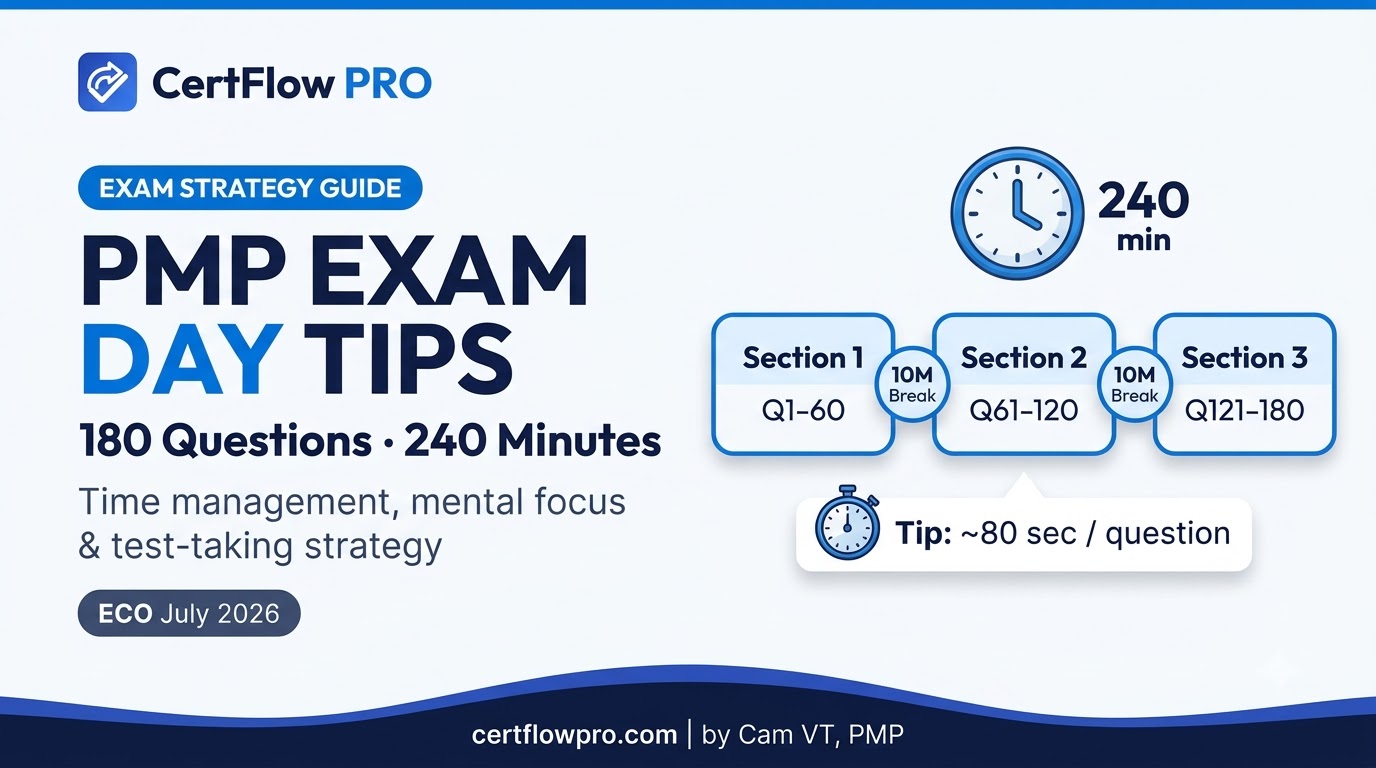
Exam format | 180 questions / 240 minutes (two optional 10-minute breaks) | ~120 questions / 3 hours | Multi-phase: application → panel review → exam (~170 questions / 4 hours) |
Fees (USD) | $393 (PMI member) / $575 (non-member) | ~$435/$495 | Significantly higher (~$800–$1,000) |
Relative difficulty | High — complex scenario questions, PMI mindset required | Moderate — requires deep knowledge of multiple Agile frameworks | Very high — panel review before exam access |
Vietnam market value | High — most widely required in PM job postings | Medium — growing in software/tech sector | Low (rare) — relevant only for senior program manager roles |
Maintenance (3-year cycle) | 60 PDUs | 30 PDUs (specific agile PDU requirement) | 60 PDUs (specific program mgmt PDU requirement) |
PMP® — the foundational credential for all project managers
PMP is the most comprehensive of the three because the exam covers all delivery approaches. Under ECO July 2026, approximately 60% of questions address agile or hybrid contexts — meaning even if you're working on traditional waterfall projects, you're expected to understand how agile teams operate and when to adapt your approach.
In Vietnam's job market, PMP remains the clearest signal of PM credibility across industries including IT, construction, banking, and consulting. The earning premium for PMP holders is well-documented. If you're deciding between certifications and unsure where to start, PMP consistently delivers the highest career ROI for project managers at the mid-career stage.
Eligibility requires 36 months of project leadership experience (4-year degree) and 35 contact hours of PM education. If you're unsure how to count your 35 contact hours, see our guide to what counts as 35 contact hours.
PMI-ACP® — for hands-on Agile practitioners
PMI-ACP isn't "PMP for Agile teams." It's a credential that validates you have actually worked in Agile environments — not just read the Scrum Guide. The requirement for documented agile project experience (verify exact hours at pmi.org) means someone who only knows Agile theory doesn't qualify, even with years of general PM experience.
PMI-ACP is best suited for Scrum Masters, Agile coaches, and PMs working in software teams with established Agile practices, who want an internationally recognized credential for their Agile expertise. It covers Scrum, Kanban, Lean, XP, and other approaches — making it genuinely broader than a single-framework certification like CSM.
One key point: PMI-ACP does not require PMP as a prerequisite. You can pursue PMI-ACP without PMP. However, if you're deciding between the two, PMP opens more doors in most markets because it validates a broader skillset. PMI-ACP is the stronger choice if you're certain your career will stay within Agile-focused roles long-term.
PgMP® — the advanced credential for program managers
PgMP operates at a different altitude. Program management means coordinating multiple related projects to achieve strategic objectives — not just handling several projects simultaneously. This is a role most PMs reach after 10 or more years of progressive experience, and the PgMP credential reflects that.
The most distinctive feature of PgMP is its multi-phase assessment. After submitting your application, you must pass a panel review — evaluated by experienced program managers who assess your real-world competency — before you're allowed to sit the exam. There's no purely academic preparation path for the panel review.
If you're in the early or middle stages of your PM career, PgMP isn't the immediate priority. Build toward it by securing PMP first, accumulating genuine program leadership experience, and revisiting PgMP when you're actively managing programs — not before.
Which certification should you pursue first? A decision framework
There's no single right answer for everyone. But three common profiles cover most situations:
Profile A — Active project manager, no international PM credential yet
Start with PMP. It covers all delivery approaches, is the most widely recognized, and delivers the clearest career ROI for project managers in most industries and markets.
Profile B — Scrum Master or Agile coach, no PMP, choosing between PMP and PMI-ACP
PMP first. PMI-ACP validates Agile depth, but PMP validates broader PM competency and unlocks more opportunities. Once you have PMP, PMI-ACP is a natural complement. Exception: if your employer explicitly values PMI-ACP over PMP and your career is firmly in Agile coaching, you can make a case for PMI-ACP first.
Profile C — Senior PM (8+ years) managing multiple related projects
PgMP — but only when you genuinely meet the experience requirements and your current role is program management in the PMI sense. If you don't yet have PMP, get it first; PgMP presupposes a strong project management foundation.
A useful rule of thumb: start with the credential that reflects what you're doing today, not what you aspire to in five years. The best certification is the one you can apply immediately and that speaks to what your current or target employer actually values.
Common mistakes when choosing a PMI certification
Pursuing PMI-ACP first because "the exam is shorter": fewer questions doesn't mean easier. PMI-ACP requires understanding multiple Agile frameworks in depth. And in most markets, PMP unlocks more opportunities than PMI-ACP for someone without any PM credential.
Applying for PgMP before genuinely meeting the requirements: managing multiple projects simultaneously is not the same as program management in PMI's definition. Program management requires strategic alignment of related projects toward a long-term organizational objective.
Treating PMI-ACP as a replacement for PMP: these credentials are complementary, not interchangeable. Many job descriptions list both because employers want both. PMI-ACP doesn't substitute for PMP's broader project management validation.
Delaying PMP until you're "more ready": PMP has clear experience requirements. If you meet them, the optimal time to prepare is while your project experience is fresh — not after you've been away from active PM work for years.
Summary
PMP®, PMI-ACP®, and PgMP® each answer a different career question: can I manage any type of project effectively? (PMP), am I a skilled Agile practitioner? (PMI-ACP), can I coordinate a strategic program? (PgMP). Matching the right credential to your current role and career trajectory means your investment delivers results — in the exam room and on the job market.
For most project managers, PMP is the right first step. If you want to gauge your current readiness, try 10 PMP scenario questions free — no registration required. For a full walkthrough of the PMP path from eligibility to exam, see our guide to what PMP is and how to start.
Frequently asked questions (FAQ)
What is the difference between PMP and PMI-ACP?
PMP validates broad project management competency across predictive, agile, and hybrid delivery. PMI-ACP specifically validates Agile practitioner skills — Scrum, Kanban, Lean, XP, and others — and requires documented agile project experience. Both can coexist; many experienced PMs hold both credentials.
Can I take PMI-ACP without having PMP first?
Yes. PMI-ACP has no PMP prerequisite. However, if you hold no international PM credential yet, PMP is usually the stronger strategic choice because it's recognized across more industries and roles. PMI-ACP makes more sense as a specialization credential once you have a PM foundation in place.
Is PgMP harder than PMP?
Overall, yes. PgMP requires significantly more experience, a panel review phase before the exam, and a longer, more complex assessment overall. The number of global PgMP holders is far smaller than PMP holders — a reflection of how selective the credential is by design.
How long does it take to prepare for PMP vs PMI-ACP?
PMP typically requires 3–6 months of focused study (50–150 hours of self-study) depending on your background. PMI-ACP often takes 2–4 months for someone with strong agile project experience. Candidates unfamiliar with multiple Agile frameworks may need additional time to cover Scrum, Kanban, Lean, XP, and SAFe together.
References
Project Management Institute. (2026). PMP® Examination Content Outline – July 2026. PMI. pmi.org
Project Management Institute. (2025). A Guide to the Project Management Body of Knowledge (PMBOK® Guide) – Eighth Edition. PMI.
Project Management Institute. (n.d.). PMI Agile Certified Practitioner (PMI-ACP®). PMI. pmi.org/certifications/agile-acp (accessed 10/2026)
Project Management Institute. (n.d.). Program Management Professional (PgMP®). PMI. pmi.org/certifications/program-management-pgmp (accessed 10/2026)