Not all risks are threats — some are opportunities. You'll learn to identify, analyze, and respond to project risks using proven PMI frameworks and tools.
"The last time anyone saw him... he forgot to identify risks." This is the slide I love most in every PMP course — accompanied by an image of a man disappearing into a desert. A bit dramatic, but not wrong.
Risk Management is the knowledge area expanded most significantly in ECO 2026 — moving from the Process domain to the Business Environment domain and growing from 2 enablers to 7. PMI is sending a clear message: 'PMs must understand risk at the strategic level, not just at the task-list level.'
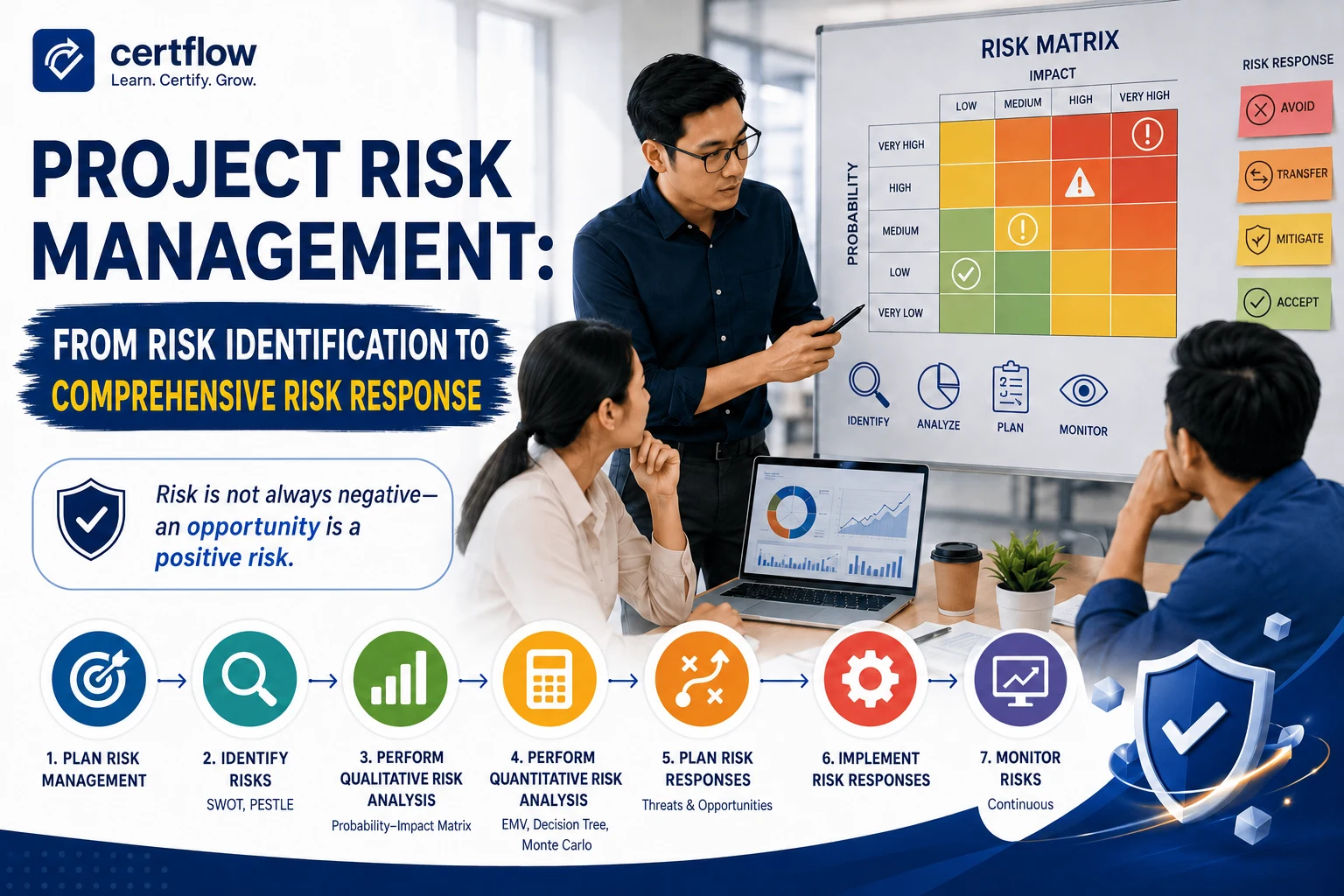
This article walks through all 7 processes of Risk Management — from planning, identification, qualitative and quantitative analysis, and response planning, through to ongoing risk monitoring.
What Is a Risk? — Not Just a Bad Thing
A risk is an uncertain event or condition that, if it occurs, will affect at least one project objective. The key point that many people overlook: risks can be positive (opportunities) or negative (threats).
Risk vs. Issue — A Critical Distinction
Risk | Issue |
An event that has not yet occurred — it lies in the future | An event that has already occurred — it is in the present |
Has a probability of occurring (0% < P < 100%) | Has already occurred — probability = 100% |
Recorded in the Risk Register | Recorded in the Issue Log |
Risk Trigger: A warning sign that a risk is about to occur or has occurred — transitioning from a risk to an issue.
Individual Risk vs. Overall Project Risk
Individual Project Risk | Overall Project Risk | |
Question | "What specific risks does this project have?" | "How risky is this project overall?" |
Scope | Specific risks within the project | The overall risk exposure of the entire project |
Recorded in | Risk Register | Risk Report |
Perspective | PM | Sponsor |
Known vs. Unknown Risks
- Known Risks (Known Unknowns): The team can identify them → analyze and develop a response plan → use Contingency Reserve
- Unknown Risks (Unknown Unknowns): Cannot be identified in advance → use Management Reserve
Risk Attitudes
- Risk Averse: Uncomfortable with uncertainty — avoids risk
- Risk Neutral: Neutral — evaluates objectively
- Risk Seeker: Views risk as a challenge — willing to accept higher risk for greater reward
- Risk Tolerant: Not overly concerned about risk
Plan Risk Management
Defines how to conduct risk management for the project — the level, type, and visibility of effort must be proportionate to the risk and importance of the project.
Three Key Concepts
- Risk Appetite: The amount and type of risk the organization is willing to accept in pursuit of its business objectives
- Risk Tolerance: The specific maximum level of risk the organization accepts for a given risk
- Risk Threshold: The point at which a risk becomes unacceptable
Risk Management Plan
A component of the project management plan, including: risk strategy, methodology, roles & responsibilities, funding, timing, risk categories (Risk Breakdown Structure), definitions of probability & impact, probability-impact matrix, reporting formats, and tracking.
Identify Risks — Find Them All, Continuously
Determines which risks may affect the project. Repeated throughout the project life cycle — new risks emerge continuously.
Identification Tools
For Overall Project Risk:
- SWOT: Strengths, Weaknesses, Opportunities, Threats
- PESTLE: Political, Economic, Social, Technological, Legal, Environmental
- TECOP: Technical, Environmental, Commercial, Operational, Political
- VUCA: Volatility, Uncertainty, Complexity, Ambiguity
For Individual Project Risk:
- WBS/RBS categories used as prompt lists
- Risk Checklists: Based on historical information from similar projects — fast but not exhaustive
- Document Analysis: Review the PM plan, contracts, assumptions, and constraints
- Assumptions Analysis: Examine assumptions — what risks arise from incorrect assumptions?
- Root Cause Analysis: Find the root cause → develop preventive action
- Risk Workshops: Facilitated brainstorming — requires a skilled facilitator to be effective
Outputs
- Risk Register: Identified risks, potential risk owners, potential risk responses. Updated through subsequent processes.
- Risk Report: Sources of overall risk, summary information, metrics, trends.
Perform Qualitative Risk Analysis — Prioritization
Not every risk requires the same level of attention. Qualitative analysis helps prioritize risks based on probability and impact.
Risk Data Quality Assessment
Before analyzing, assess the quality of risk data: Relevancy, Reliability, Integrity, Timeliness. Poor data → flawed analysis.
Probability and Impact Assessment
- Probability: The likelihood that the risk will occur (0% < P < 100%)
- Impact: The degree of effect if it occurs — can be measured on a scale: Very Low, Low, Moderate, High, Very High, or numerically
Probability-Impact Matrix
A matrix that combines probability × impact to rank risks. Risks in the upper-right corner (high probability + high impact) = highest priority. Risks in the lower-left corner = watchlist.
Risk Score = Probability × Impact — this number determines priority.
Other Parameters
- Urgency: A risk occurring soon → requires urgent attention
- Controllability: Can it be controlled?
- Detectability: Can it be detected early?
💡 Exam Tip: Qualitative = subjective, fast, used for ALL projects. Quantitative = objective, slower, used only for high-priority risks. When a question asks "The PM has just finished identifying risks — what is the next step?" → Qualitative Analysis (prioritize first).
Perform Quantitative Risk Analysis — Analysis by Numbers
Analyzes numerically — quantifying the combined effect of risks on project objectives. Not required for every project — used only when necessary and for high-priority risks.
Expected Monetary Value (EMV)
A statistical technique that calculates the expected monetary value:
EMV = Probability × Impact (in monetary terms)
Example: A risk with a 30% probability of occurring, with an impact of $100,000 if it does.
EMV = 0.30 × (-$100,000) = -$30,000
The total EMV of all risks = the basis for calculating the Contingency Reserve.
Decision Tree Analysis
A tree-shaped diagram that supports decision-making when multiple scenarios exist. Each branch has a probability and an outcome. Calculate the EMV for each branch and compare them.
Practical example: Organizing a tournament indoors or outdoors?
Venue | Weather | Guests | Ticket | Income | EMV |
Indoor | 40% Rain | 3,500 | $110 | $385,000 | $154,000 |
Indoor | 60% Sunshine | 4,000 | $110 | $440,000 | $264,000 |
Outdoor | 40% Rain | 2,000 | $105 | $210,000 | $84,000 |
Outdoor | 60% Sunshine | 5,000 | $105 | $525,000 | $315,000 |
Total EMV Indoor = $154K + $264K = $418K. Total EMV Outdoor = $84K + $315K = $399K. → Decision: Indoor (higher EMV).
Monte Carlo Simulation
Uses software to run thousands of "what-if" scenarios to forecast a probability distribution of project outcomes. Output is typically an S-curve showing the probability of completing within budget/schedule.
Sensitivity Analysis (Tornado Diagram)
Analyzes which risk has the greatest impact on project outcomes — holding all other risks at baseline and varying each one individually. Results are displayed as a Tornado Diagram — the risk with the longest bar has the greatest impact.
Plan Risk Responses — Response Strategies
Develops options, selects strategies, and agrees on actions to address individual risks and overall project risk.
Strategies for Threats (Negative Risks)
Strategy | Description | Example |
Avoid | Eliminate the threat entirely by changing the plan | Change technology to avoid a technical risk |
Transfer | Shift the impact to a third party — does NOT eliminate the risk | Purchase insurance, outsource, use a fixed-price contract |
Mitigate | Reduce probability and/or impact to an acceptable level | Build an early prototype to reduce technical risk |
Accept | Accept the risk — no proactive action taken | Passive: do nothing. Active: prepare a contingency plan. |
Strategies for Opportunities (Positive Risks)
Strategy | Description | Example |
Exploit | Ensure the opportunity definitely occurs | Assign the best team member to capitalize on the opportunity |
Share | Share ownership with a third party better positioned to capture it | Joint venture, partnership |
Enhance | Increase the probability and/or impact of the opportunity | Add resources to increase the chance of finishing early |
Accept | Accept — willing to take advantage if it occurs but not proactively pursuing it |
Escalate
When a risk is outside the project scope or exceeds the PM's authority → escalate to the appropriate level. An escalated risk is no longer monitored by the project team.
Contingency Plan, Fallback Plan, Residual & Secondary Risks
- Response Plan: The primary action to address a risk
- Contingency Plan: A backup plan — executed when a risk trigger occurs
- Fallback Plan: A retreat plan — used when the contingency plan is ineffective
- Residual Risk: Risk remaining AFTER implementing the response
- Secondary Risk: NEW risk arising AS A RESULT of implementing the response
💡 Pro Tip: In the PMP exam, threat responses follow this order of proactiveness: Avoid > Transfer > Mitigate > Accept. Opportunity responses: Exploit > Share > Enhance > Accept. When a question describes a PM wanting to completely eliminate a risk → Avoid. Transfer it to someone else → Transfer. Reduce it → Mitigate.
Monitor Risks — Continuous Oversight
Monitors implementation of risk response plans, tracks identified risks, identifies new risks, and evaluates the effectiveness of the risk management process.
Key Activities
- Determine the current level of overall project risk — is the strategy still valid?
- Track identified risks — are there signs they are about to occur?
- Monitor residual risks
- Review assumptions — are they still valid?
- Identify new individual risks
- Analyze contingency reserves — do they need adjustment?
Risk Audits
Measures the effectiveness of risk owners in implementing responses, AND the overall effectiveness of the risk management process. Can be part of a routine project review or a standalone meeting.
Reserve Analysis
Compares remaining contingency reserves against the remaining amount of risk — are the reserves sufficient? Continuous analysis from start to finish shows the project's "health."
Summary: The 7 Processes of Risk Management
Process | Purpose | Key Output |
1. Plan Risk Management | Define how to manage risk | Risk Management Plan |
2. Identify Risks | Find all risks | Risk Register, Risk Report |
3. Qualitative Analysis | Prioritize risks | Updated Risk Register (priority) |
4. Quantitative Analysis | Analyze numerically | Updated Risk Report (EMV, simulation) |
5. Plan Risk Responses | Develop response strategies | Updated Risk Register (responses) |
6. Implement Risk Responses | Execute response plans | Change requests |
7. Monitor Risks | Monitor and adjust | Work performance info, Change requests |
📍 Key cheat sheet to remember:
- Risk = uncertain future event; Issue = event that has already occurred
- Risks can be positive (opportunity) or negative (threat)
- Known risks → Contingency Reserve (PM controls)
- Unknown risks → Management Reserve (Management controls)
- Threats: Avoid > Transfer > Mitigate > Accept
- Opportunities: Exploit > Share > Enhance > Accept
- EMV = Probability × Impact
- Qualitative = subjective, for all projects / Quantitative = numeric, for high-priority risks
- Risk Score = Probability × Impact (Probability-Impact Matrix)
- Rule of Seven (from Quality) also applies to risk monitoring
- Residual risk: remaining after response / Secondary risk: arising from the response
- Response → Contingency → Fallback (3 tiers of response)
Risk Management is the most important knowledge area in ECO 2026 — with 7 full enablers in the Business Environment domain (26%). Understanding risk correctly not only helps you pass the PMP exam but changes how you manage projects in practice.
Practice scenario questions about risk identification, response strategies, and EMV calculations on CertFlow — this is a "win-win" topic: it earns exam points and builds real-world skills.
Frequently Asked Questions (FAQ)
What are the 4 risk response strategies for negative risks according to PMI?
For negative risks (threats): Avoid (eliminate the cause), Transfer (shift the risk to another party — purchase insurance, outsource), Mitigate (reduce probability or impact), Accept (accept it — passive or active with a contingency reserve). PMI does not have a "best" strategy — it depends on the nature of the risk and the project's capabilities.
How is EMV (Expected Monetary Value) calculated?
EMV = Probability × Impact. Example: a risk with a 30% probability and an impact of -$50,000 → EMV = 0.3 × (-50,000) = -$15,000. The total EMV of all risks is the basis for calculating the contingency reserve. EMV is also used in Decision Tree Analysis to compare alternatives.
What is the difference between Residual Risk and Secondary Risk?
Residual Risk: the portion of risk remaining after a risk response has been applied — it cannot be eliminated entirely. Secondary Risk: a new risk that arises as a direct result of the risk response itself — for example, outsourcing to a vendor to transfer risk but creating a vendor dependency risk in the process. Both must be tracked in the risk register.
Now that you understand project risk management, it's time to put it into practice with real exam questions.
Next article: Agile Mindset & Scrum: Everything PMP Requires You to Know
Project compliance management and risk classification according to PMBOK 8
Try Free PMP Practice Questions →
Official References: