The PMP exam since July 9, 2026 uses the new ECO: 170 scored questions, 240 minutes, Business Environment up to 26%, about 60% agile and hybrid, 26 tasks and two new question types. A detailed breakdown from PMI's own documents.
Since July 9, 2026, every PMP exam uses the new 2026 Exam Content Outline (ECO). If you're studying with materials written for the old exam, this guide shows exactly what changed: domain weights, the task list, question types, timing, and how to adjust your study plan.
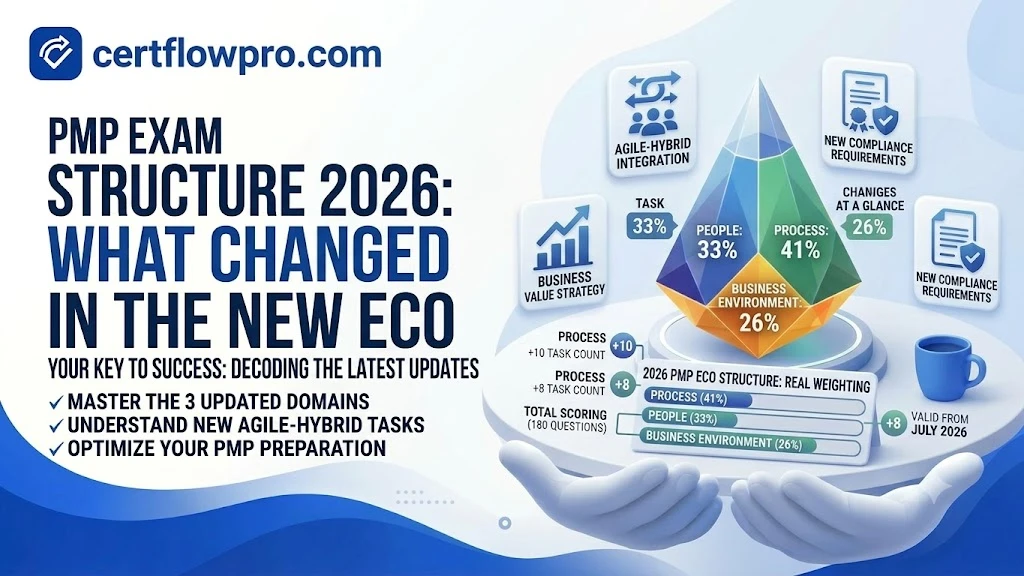
Quick summary: the 2026 PMP exam still has 180 questions but only 170 are scored, and the time rises to 240 minutes. Business Environment jumps from 8% to 26%, agile and hybrid make up about 60% of the exam, tasks drop from 35 to 26, and there are two new question types: case studies and graphic-based questions.
Old vs new PMP exam at a glance
Item | 2021 ECO (until July 8, 2026) | 2026 ECO (from July 9, 2026) |
|---|---|---|
Questions | 180 (175 scored + 5 pretest) | 180 (170 scored + 10 pretest) |
Time | 230 minutes | 240 minutes |
Breaks | Two, 10 minutes each | Two, 10 minutes each, within the 240 minutes |
People | 42% — 14 tasks | 33% — 8 tasks |
Process | 50% — 17 tasks | 41% — 10 tasks |
Business Environment | 8% — 4 tasks | 26% — 8 tasks |
Total tasks | 35 | 26 |
Predictive / agile + hybrid | ~50% / ~50% | ~40% / ~60% |
New question types | — | Case/scenario, graphic-based |
Experience window | Last 8 years | Last 10 years |
Why did PMI change the ECO?
PMI builds the ECO from a Job Task Analysis (JTA), carried out for this edition by Alpine Testing Solutions. According to the 2026 ECO, three things drove the update:
Trends missing from the old exam: the ECO names artificial intelligence (AI) and sustainability as trends fed into the JTA to assess their impact on project managers' work.
A broader definition of project success: the 2026 ECO aligns with PMI's Maximizing Project Success report, which reframes success beyond scope, schedule and budget to delivering value that was worth the effort and expense.
Mixed delivery approaches: practitioners use predictive, agile and hybrid approaches side by side, so the exam reflects all three across every domain.
How the ECO is structured: domains, tasks and enablers
Domain: a high-level knowledge area — People, Process, Business Environment.
Task: a core responsibility of the project manager within a domain.
Enabler: an illustrative example of the work in a task. PMI notes that enablers are not an exhaustive list.
According to PMI, every exam includes questions on all tasks in each domain, and the percentages are held at domain level. In other words, there's no task you can afford to skip.
Domain I: People (33%) — 8 tasks
Task | Focus (from the enablers) |
|---|---|
1. Develop a common vision | Build and maintain a shared vision with key stakeholders; find the root cause when the vision is misunderstood |
2. Manage conflicts | Identify sources and context of conflict, apply a resolution strategy, uphold ground rules |
3. Lead the project team | Set expectations, empower the team, represent its voice, choose an appropriate leadership style, define clear roles |
4. Engage stakeholders | Identify and analyze stakeholders, tailor communication, build trust and influence |
5. Align stakeholder expectations | Categorize stakeholders, identify expectations, facilitate alignment, mentoring |
6. Manage stakeholder expectations | Internal and external customer expectations; monitor satisfaction |
7. Help ensure knowledge transfer | Identify and gather critical knowledge; foster an environment for sharing it |
8. Plan and manage communication | Communication strategy, transparency, feedback loops, reporting aligned to sponsor expectations |
The servant leadership mindset lives squarely in task 3: empowering the team, solving problems and representing the team.
Domain II: Process (41%) — 10 tasks
Task | Focus (from the enablers) |
|---|---|
1. Develop an integrated project management plan and plan delivery | Assess complexity, recommend an approach (predictive/agile/hybrid), build and maintain the integrated plan, make data-driven decisions |
2. Develop and manage project scope | Define scope, obtain stakeholder agreement, break scope down |
3. Help ensure value-based delivery | Prioritize by value, deliver incrementally, measure benefits |
4. Plan and manage resources | Plan and optimize resources |
5. Plan and manage procurement | Procurement strategy, contract types, negotiation, supplier management |
6. Plan and manage finance | Financial needs, risk contingency, spend tracking, financial reporting, reserves |
7. Plan and optimize quality of products/deliverables | Quality requirements, regulatory compliance, cost of quality (CoQ) and sustainability, continuous improvement |
8. Plan and manage schedule | Schedule by chosen approach, estimating (including story points), baselining, variance analysis |
9. Evaluate project status | Project metrics, artifact management, progress assessment, status reporting |
10. Manage project closure | Closure criteria, transition readiness, lessons learned, retrospectives |
Domain III: Business Environment (26%) — 8 tasks
Task | Focus (from the enablers) |
|---|---|
1. Define and establish project governance | Structure, rules, ethics and policies through OPAs; success metrics; escalation paths and thresholds |
2. Plan and manage project compliance | Compliance requirements (security, safety, sustainability, regulatory), threats, consequences of noncompliance |
3. Manage and control changes | Change control process, communicating and implementing approved changes |
4. Remove impediments and manage issues | Evaluate, prioritize and remove impediments; recognize when a risk becomes an issue |
5. Plan and manage risk | Identify, analyze and respond to risks, including security and sustainability risks |
6. Continuous improvement | Use lessons learned, update OPAs |
7. Support organizational change | Assess organizational culture and the impact of organizational change on the project |
8. Evaluate external business environment changes | Track external changes (regulation, technology, geopolitics, markets) and their impact on scope/backlog |
The biggest changes to know
1. Business Environment triples
From 8% (about 14 scored questions) to 26% (about 44). Several topics that used to sit in Process or People now belong to Business Environment. Comparing task names across the two ECOs:
Topic | 2021 ECO | 2026 ECO |
|---|---|---|
Project governance | Process | Business Environment |
Change management | Process | Business Environment |
Risk management | Process | Business Environment |
Issue management | Process | Business Environment |
Removing team impediments | People | Business Environment |
Project value and benefits | Business Environment | Process (value-based delivery) |
Communication, stakeholder engagement, knowledge transfer | Process | People |
2. Agile and hybrid make up about 60%
The 2026 ECO states that about 40% of questions represent predictive approaches and the remaining 60% are split between agile and hybrid. These approaches appear across all three domains, not in any single domain or task. Expect agile questions about risk, finance or compliance, not just Scrum.
3. Tasks drop from 35 to 26
Many old tasks were consolidated. For example, the 2021 ECO's separate tasks on team ground rules, mentoring and training now appear as enablers inside broader tasks (Manage conflicts, Align stakeholder expectations). Fewer tasks doesn't mean less content — each task now covers more ground.
4. Finance becomes its own task
The 2021 ECO combined "budget and resources" in one task. The 2026 ECO splits it into Plan and manage resources and Plan and manage finance, with enablers such as risk contingency allocations, spend tracking and managing reserves. This mirrors the Finance domain in PMBOK 8.
5. Sustainability shows up across several tasks
"Sustainability" is named directly in the enablers of four tasks: information requirements during planning (Process 1), cost of quality (Process 7), compliance (Business Environment 2) and risk (Business Environment 5). PMI cites AI as a trend fed into the JTA, but it doesn't appear as a task or enabler of its own.
Question types on the 2026 PMP exam
Type | Description | Delivery |
|---|---|---|
Case/Scenario (new) | A detailed scenario (possibly with charts) followed by a series of questions | All modalities |
Graphic-based (new) | Interpret charts, diagrams or images to answer | All modalities |
Multiple-choice single response | One correct answer | All modalities |
Multiple response | More than one correct answer | All modalities |
Enhanced matching | Matching with images, drag and drop | Computer-based only |
Matching | Pair items across columns | Computer-based only |
Point and click | Click the correct area of an image | Computer-based only |
Pull-down list | Choose the answer from a drop-down | Computer-based only |
Timing, breaks and scoring
240 minutes for 180 questions, about 1 minute 20 seconds per question. The optional tutorial and end-of-exam survey don't count toward the 240 minutes.
The first break comes after the case-study section; the second comes about midway through the independent questions. Once you start a break, you can't go back to the previous section.
10 pretest questions are placed randomly, don't count toward your score, and aren't identified.
PMI doesn't publish a fixed passing score; the scoring model is reviewed periodically by scoring experts. You get a preliminary result when you finish and the official result within 10 business days.
Time management tip
Because the case study comes before the first break, read each scenario and its charts fully before answering — but set yourself a checkpoint so it doesn't eat into the time for the independent questions. Before each break, review every flagged question.
Delivery and retake policy
At a Pearson VUE test center (PMI's recommendation) or online proctored. Online testing requires a system test and a thorough check-in; the proctor may ask to see your ID after each break.
Once your application is approved you have 1 year and up to 3 attempts. After three unsuccessful attempts you must wait 1 year from the last one before reapplying.
Adjusting your study plan for the 2026 ECO
Use the 2026 ECO as your checklist. Go task by task and enabler by enabler and ask whether you could handle a scenario on it.
Give Business Environment real time: governance, compliance, change control, risk, organizational change and the external environment.
Study agile and hybrid across every topic, not just Scrum: agile risk, hybrid finance, compliance with incremental delivery.
Practice reading case studies and charts: burndown charts, EVM, stakeholder grids, risk heat maps.
Update your materials: PMBOK 8 and the Agile Practice Guide, 2nd edition, instead of PMBOK 6 and practice banks written for the 2021 ECO.
A detailed 12-week schedule is in the 2026 PMP self-study plan.
Conclusion
The 2026 ECO doesn't change the nature of the PMP exam — it's still scenario questions that test how you make decisions. But the emphasis has clearly shifted: from "managing the process correctly" to delivering value in a business context, with agile and hybrid as the default. Study to the new structure and nothing in the exam room will surprise you.
Want to see where you stand against the new exam? Try a free PMP practice test on CertFlow.
Frequently Asked Questions (FAQ)
How many questions are on the 2026 PMP exam?
180 questions: 170 scored and 10 unscored pretest questions, in 240 minutes with two 10-minute breaks.
What domains are in the 2026 ECO?
Three domains: People 33% (8 tasks), Process 41% (10 tasks) and Business Environment 26% (8 tasks), for 26 tasks in total.
How much of the new PMP exam is agile?
About 60% of questions are agile or hybrid and 40% are predictive. These approaches appear across all three domains.
When did the new PMP exam start?
On July 9, 2026. All exams scheduled on or after that date use the new exam.
What question types are new on the 2026 PMP exam?
Two new types: case/scenario (a detailed situation followed by several questions) and graphic-based (questions based on charts, diagrams or images).
Are practice exams written for the 2021 ECO still useful?
They still help you practice scenario thinking, but they don't reflect the new weights — Business Environment was only 8% rather than 26% — and they lack case studies and graphic questions. Prioritize banks updated for the 2026 ECO.
What is the PMP passing score?
PMI doesn't publish a fixed passing score. A common community benchmark is scoring consistently above 70% on quality question banks.
Try free PMP practice questions →
Official PMI sources: