The 35 Contact Hours requirement stops many PMP applicants cold. Learn exactly which PMI-recognized training sources count, and how to earn them safely.
If you're preparing to apply for the PMP exam, you'll inevitably encounter the 35 Contact Hours requirement. This is one of the key eligibility conditions that must be met before PMI will accept your application.
Yet many first-time PMP candidates find themselves confused at this step:
What are the 35 Contact Hours for PMP? Where can you study and have it recognized? Do you have to learn from PMI directly? Do online courses count?
This article will give you a clear understanding of the 35 Contact Hours PMP requirement, the recognized learning sources, and how to choose the right course — one that satisfies your eligibility and supports effective exam preparation.
What Are the 35 Contact Hours for PMP?
35 Contact Hours PMP refers to a minimum of 35 hours of formal project management education that candidates must have completed when applying for the PMP exam.
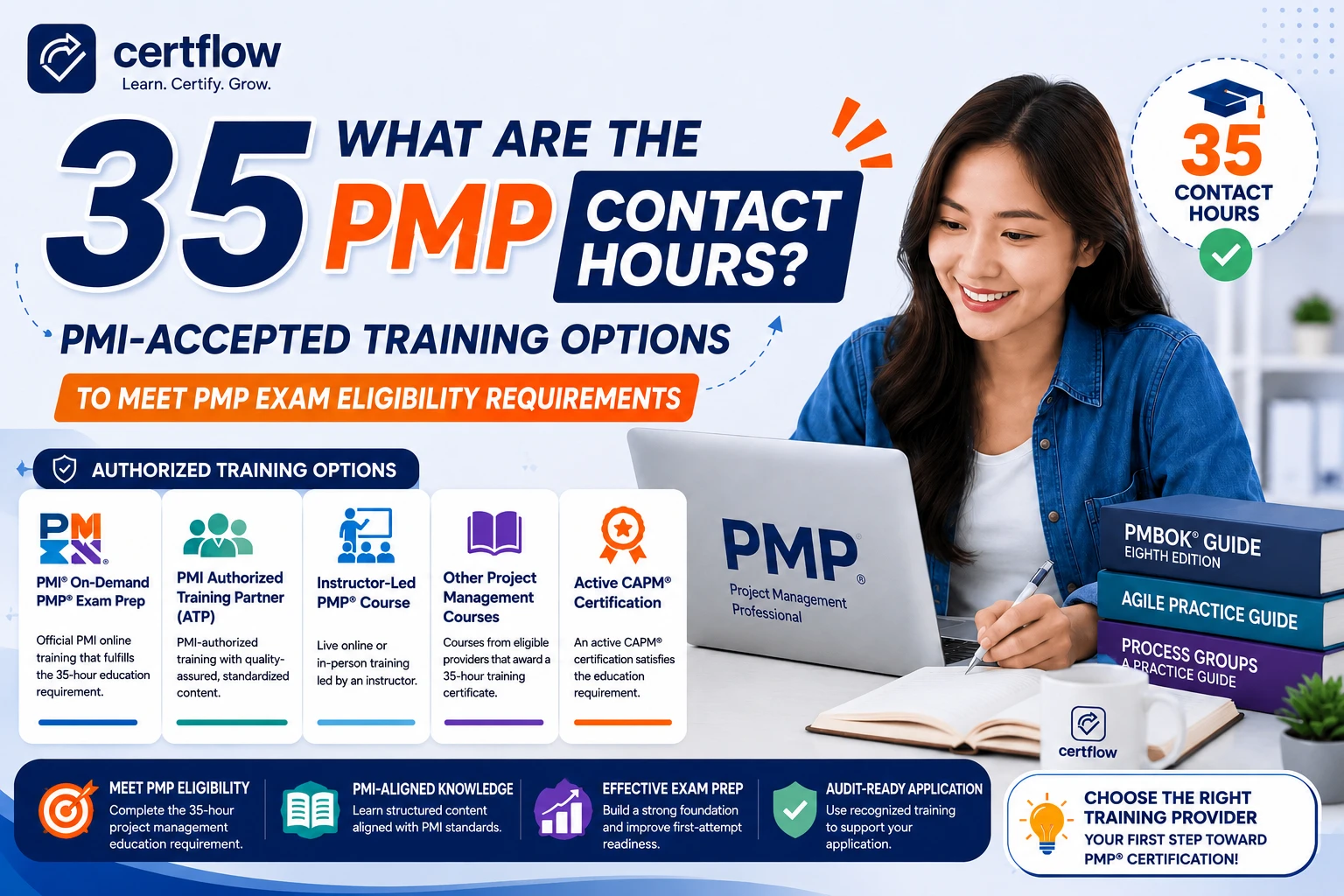
According to PMI, to be eligible for the PMP exam, candidates must have project management experience and 35 hours of project management training. This requirement can be fulfilled by 35 hours of project management education, a valid CAPM certification, a PMP Exam Prep Course, or an Instructor-Led PMP Course.
Simply put, 35 Contact Hours serve as evidence that you have participated in a formal project management learning program before sitting for the PMP exam.
Why Are the 35 Contact Hours Important?
The 35 Contact Hours are more than just a box to check on your application. They are a foundational step that helps you develop the project management mindset required by PMI standards.
Through a 35-hour course, you will typically cover topics such as:
The role of the Project Manager
Stakeholder management
Scope, schedule, and cost management
Risk management and change management
Agile, hybrid, and predictive approaches
The mindset needed for PMP scenario-based questions
Choosing the right learning source means you won't just earn a certificate to submit — you'll also build a solid foundation for your PMP exam preparation.
Recognized Learning Sources for the 35 Contact Hours PMP
1. PMI Authorized On-demand PMP Exam Prep
The safest and most authoritative learning source is the PMI Authorized On-demand PMP Exam Prep course offered directly by PMI.
This is a self-paced online course, suitable for those who want to study on their own schedule. PMI describes this course as self-paced, aligned to the PMP Exam Content Outline, and meeting the 35 training hours required to apply for the PMP exam.
This course is ideal if you want to:
Learn directly from PMI
Have a clearly recognized, authoritative learning source
Study at your own pace
Minimize risk when declaring 35 Contact Hours in your PMP application
If you want the safest option and don't want to spend time verifying a provider's credibility, this is a very strong choice.
2. Courses from PMI Authorized Training Partners (PMI ATP)
The next most widely recognized learning source is courses from PMI Authorized Training Partners, commonly referred to as PMI ATP.
According to PMI, Authorized Training Partners use official PMI training content, meet certification requirements, and are delivered by trusted providers.
PMI also states clearly that Authorized Training Partners use curricula developed by PMI, satisfy the 35-hour training requirement for PMP eligibility, and align with PMP exam content.
Courses from PMI ATP are a good fit for those who want to:
Learn with an instructor
Follow a structured schedule
Ask questions during the learning process
Study via online live sessions or in-person classes
Receive a completion certificate to keep on file
For first-time PMP candidates, PMI ATP courses are often easier to follow than fully self-directed study, since you get a clear learning path, an instructor, and organized materials.
3. Instructor-Led PMP Courses
An Instructor-Led PMP Course is a course with a live instructor, available either in person or online.
PMI lists Instructor-Led PMP Courses as one of the options that can satisfy the training requirement when applying for the PMP exam.
When selecting this type of course, verify the following carefully:
Criteria | What to Check |
|---|---|
Number of hours | Does it meet the 35-hour minimum? |
Certificate | Is a completion certificate issued? |
Content | Does it cover project management? |
Provider | Is the provider information clear and verifiable? |
Format | Is it online live or in-person? |
Materials | Is it aligned to the PMP Exam Content Outline? |
If the course is delivered by a PMI ATP, the level of assurance is high. If the provider is not an ATP, verify the certification details and course content carefully.
4. Project Management Courses from Other Qualified Providers
You are not required to source all 35 hours from a single provider.
According to PMI, the 35 hours of education may come from any qualified course or provider, and no single specific source is mandatory. The format can be a live class — either in-person or virtual with an instructor — or on-demand.
This means that certain project management courses from other training organizations may also qualify, as long as they meet the requirements.
However, to minimize risk, look for courses that clearly provide:
A clearly stated course name
Project management content
A total of at least 35 hours
A certificate of completion
A course completion date
A clearly identified provider name
Information that can be declared in your PMP application
If your application is audited, you will need documentation proving you completed the course. Don't choose a course solely because it's cheap if it doesn't come with a clear completion certificate.
5. A Valid CAPM Certification
If you already hold a valid CAPM certification, you can use it to satisfy the training requirement when applying for the PMP exam.
On the PMP eligibility page, PMI states that the 35-hour training requirement can be met with a CAPM certification.
This is the right option for those who have already earned their CAPM and are ready to advance to PMP.
Which Learning Source Is the Safest Choice?
If your goal is to satisfy PMP eligibility clearly and with minimal risk, consider prioritizing in this order:
Priority | Learning Source | Assurance Level |
|---|---|---|
1 | PMI Authorized On-demand PMP Exam Prep | Very high |
2 | PMI Authorized Training Partner | Very high |
3 | Instructor-Led PMP Course with clear certification | High |
4 | Project management course from another provider | Needs careful verification |
5 | Valid CAPM certification | Suitable if you already hold CAPM |
For first-time candidates, the easiest options to explain and document are PMI Authorized On-demand PMP Exam Prep or a course from a PMI Authorized Training Partner.
How to Check Whether a Course Qualifies for the 35 Contact Hours
Before enrolling in any course, ask yourself these 6 questions:
Does the course explicitly state 35 Contact Hours or 35 training hours?
Does it issue a certificate of completion after finishing?
Is the content focused on project management?
Does it cover predictive, Agile, or hybrid approaches?
Does the provider have clear information that can be declared in your application?
If audited, can you provide proof of completion?
If the answers to any of these questions are unclear, consider choosing a different course.
Should You Take a Cheap Course Just to Get the 35 Contact Hours?
A lower-cost course isn't automatically a bad one. However, with PMP, the most important thing is whether that course is eligible to declare in your application.
If a cheap course doesn't clearly state the number of training hours, doesn't provide a completion certificate, or doesn't demonstrate project management content, you may run into problems when submitting your application or during an audit.
On the other hand, a good course should help you achieve both goals:
A 35 Contact Hours certificate to submit with your PMP application
Foundational knowledge to begin effective exam preparation
So don't choose based on price alone. Choose based on credibility, content, and your ability to document completion.
Conclusion
35 Contact Hours PMP is one of the key eligibility requirements for applying to the PMP exam. It is a formal project management education requirement that allows PMI to confirm you have a learning foundation before entering the examination.
The recognized learning sources to consider include:
PMI Authorized On-demand PMP Exam Prep
PMI Authorized Training Partner
Instructor-Led PMP Course
Project management courses from other qualified providers
A valid CAPM certification
If you're just starting out and want the most straightforward path, prioritize a course directly from PMI or a PMI Authorized Training Partner. These are the clearest, most easily documented options for satisfying the 35 Contact Hours PMP requirement.
Frequently Asked Questions (FAQ)
Are 35 contact hours the same as PDUs?
Not exactly. Contact hours (also called Education hours) refer to PM training completed in the past — used to meet the eligibility requirement to apply for the PMP exam. PDUs (Professional Development Units) are continuing education hours earned after you hold a PMP certification — required to renew the certification every 3 years (60 PDUs needed). 35 contact hours equal 35 PDUs in quantity, but they serve different purposes.
Which online courses are recognized for the 35 contact hours PMP?
PMI recognizes: (1) Courses from PMI Authorized Training Partners (ATP) — guaranteed valid. (2) University courses in Project Management. (3) PMI chapter courses and workshops. (4) Many online platforms such as Coursera, LinkedIn Learning, and Udemy if the course covers Project Management skills. Key point: the course must cover PM knowledge areas — not just any business course.
Can the 35 contact hours come from multiple sources?
Yes — PMI does not require all hours to come from a single source. For example: 20 hours from an online course + 10 hours from PMI chapter workshops + 5 hours from in-house company PM training. You just need a total of 35 hours and documentation (a certificate or attendance record) for each source. Keep your documents ready in case of an audit.
Now that you understand the 35 contact hours PMP requirement, it's time to put it into practice with real exam questions.
Try Free PMP Practice Questions →
Official References: