What PMP certification is, who should take it, 2026 eligibility, fees, the new exam format since July 9, 2026, and the steps to get certified, for beginners.
Last updated: October 1, 2026 — checked against PMI's PMP certification page, the PMI Certification Handbook (June 2026) and the 2026 PMP Examination Content Outline on pmi.org.
If you work in project management, IT, construction, finance or manufacturing — or you want to grow into a Project Manager role — you've almost certainly heard of the PMP certification. This guide explains what PMP is, who should take it, the eligibility requirements, costs, the new exam format in effect since July 9, 2026, and the steps to get certified — all on one page.
What is PMP certification?
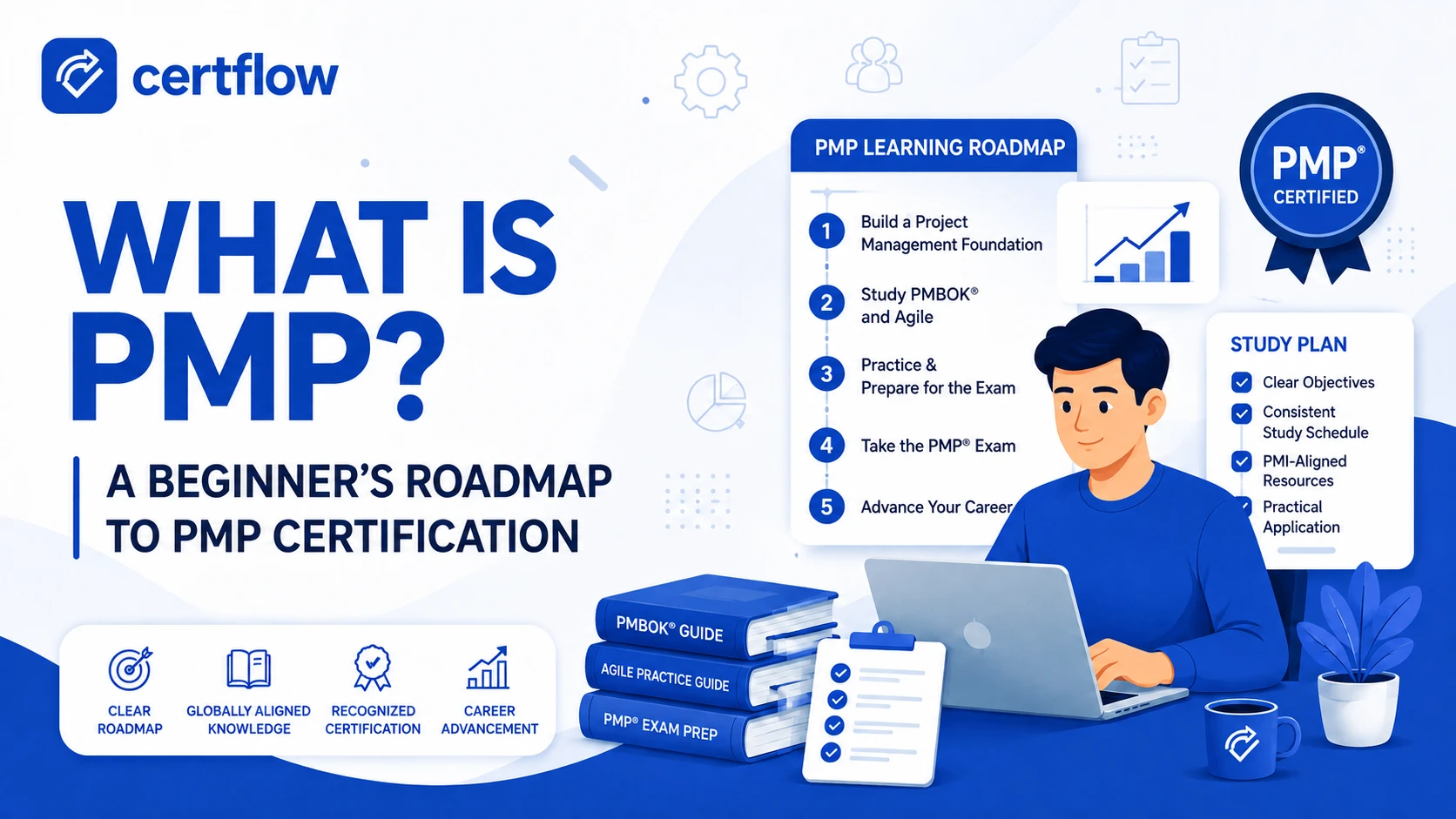
PMP (Project Management Professional) is the project management certification issued by the Project Management Institute (PMI). It shows that you have experience leading projects and the knowledge to manage them across three approaches: predictive (traditional), agile and hybrid.
PMP isn't limited to IT. It's used in construction, finance, manufacturing, healthcare, education, consulting and many other fields, because the project management practice it tests doesn't depend on the industry.
PMP at a glance (2026)
Item | Details |
|---|---|
Issued by | PMI (Project Management Institute) |
Eligibility | 24–60 months of project leadership experience (depending on education) within the last 10 years + 35 training hours or CAPM |
Exam | 180 questions (170 scored + 10 pretest), 240 minutes, two 10-minute breaks |
Content | People 33%, Process 41%, Business Environment 26%; about 40% predictive, 60% agile and hybrid |
Exam fee | 393 USD (PMI member) / 575 USD (non-member) — list prices; regional pricing may apply |
Delivery | Pearson VUE test center or online proctored |
Languages | English plus up to 15 translated languages |
Eligibility period | 1 year from application approval, up to 3 attempts |
Maintenance | 60 PDUs every 3-year cycle + renewal fee |
Why does the PMP certification matter?
PMP isn't just a line on your resume. Its real value is how it changes the way you see a project: instead of just "getting tasks done", you look at business objectives, stakeholders, risk, scope, schedule, cost, quality, the team and the value the project ultimately delivers.
For Project Managers, Team Leads, Tech Leads, Business Analysts and Scrum Masters, PMP helps you:
- Understand what a project manager's role really involves
- Work with stakeholders more professionally
- Make better decisions in complex situations
- Manage risk and change systematically
- Stand out for project management roles, especially with international clients
- Speak the same project management "language" as colleagues worldwide
Who should pursue the PMP?
Role | Why PMP helps |
|---|---|
Project Manager | Standardizes your knowledge and sharpens your project management capability |
Team Lead / Tech Lead | Builds understanding of schedule, risk, stakeholder and team management |
Business Analyst | Deepens understanding of project context and stakeholder coordination |
Scrum Master / Agile Coach | Adds predictive and hybrid thinking alongside agile |
Developers moving into management | Builds the foundation for a PM role |
Business owners / Founders | Improves how projects are organized and controlled |
PMP isn't the right fit if you've never led a project, because PMI requires real experience. In that case PMI points candidates to the CAPM (Certified Associate in Project Management) — and an active CAPM also replaces the 35 training hours when you later qualify for the PMP.
2026 PMP eligibility requirements
You need experience leading projects (the Project Manager title isn't required) within the last 10 years, plus 35 hours of project management training or an active CAPM.
Education | Project leadership experience | Training |
|---|---|---|
High school diploma | 60 months | 35 hours or CAPM |
Associate's degree, higher certificate or advanced vocational qualification | 48 months (new tier in 2026) | 35 hours or CAPM |
Bachelor's degree or higher | 36 months | 35 hours or CAPM |
Degree from a PMI GAC-accredited program | 24 months | GAC coursework can count toward the 35 hours |
Note: months spent on parallel projects count only once. From December 1, 2026, instructor-led classes count toward the 35 hours only if delivered by a PMI Authorized Training Partner or an eligible accredited higher-education program; self-paced courses from any provider still count. Details: 35 Contact Hours for PMP explained.
The 2026 PMP exam format
Since July 9, 2026, every PMP exam uses the new 2026 Exam Content Outline (ECO):
- 180 questions: 170 scored and 10 unscored pretest questions.
- 240 minutes, including two 10-minute breaks. After each break you can't return to the previous section.
- Three domains: People 33%, Process 41%, Business Environment 26% (up sharply from 8% on the old exam).
- Approaches: about 40% predictive, 60% agile and hybrid.
- Question types: single- and multiple-response multiple choice, drag-and-drop, matching, plus two new types: case studies and graphic-based questions.
PMI doesn't publish a fixed passing score. You get a preliminary result as soon as you finish, and PMI confirms the official result within 10 business days.
How much does the PMP cost?
Item | Cost (USD) |
|---|---|
Exam fee — PMI member | 284 |
Exam fee — non-member | 575 |
PMI membership | 109/year |
35 training hours | From a discounted self-paced Udemy course up to USD 699–799 for PMI's official course |
These are list prices on pmi.org; PMI applies regional pricing, so log in to your PMI account to see your exact price. At list prices, joining before you pay (109 + 284 = 393 USD) costs less than paying as a non-member (575 USD), and you also get free downloads of PMBOK 8 and the Agile Practice Guide. Second and third attempts within the 1-year period require a re-examination fee.
Is the PMP exam hard?
PMP isn't easy, but it's very achievable with the right approach. The difficulty isn't memorizing definitions; it's situational questions that put you in the project manager's seat and ask "what should you do next?"
- The project is behind schedule — what should the PM do?
- A stakeholder disagrees with the plan — how should the PM handle it?
- There's conflict on the team — how should the PM step in?
- The client requests a scope change — how should the PM respond?
- A risk has become an issue — what's the next step?
To answer well you need the PMI mindset: communicate proactively, analyze root causes before acting, don't blame, respect the process, support and empower the team, and stay focused on value. In agile contexts, prioritize collaboration, transparency and continuous improvement. The 2026 exam adds long case studies, so reading scenarios carefully matters more than ever.
Steps to earn your PMP
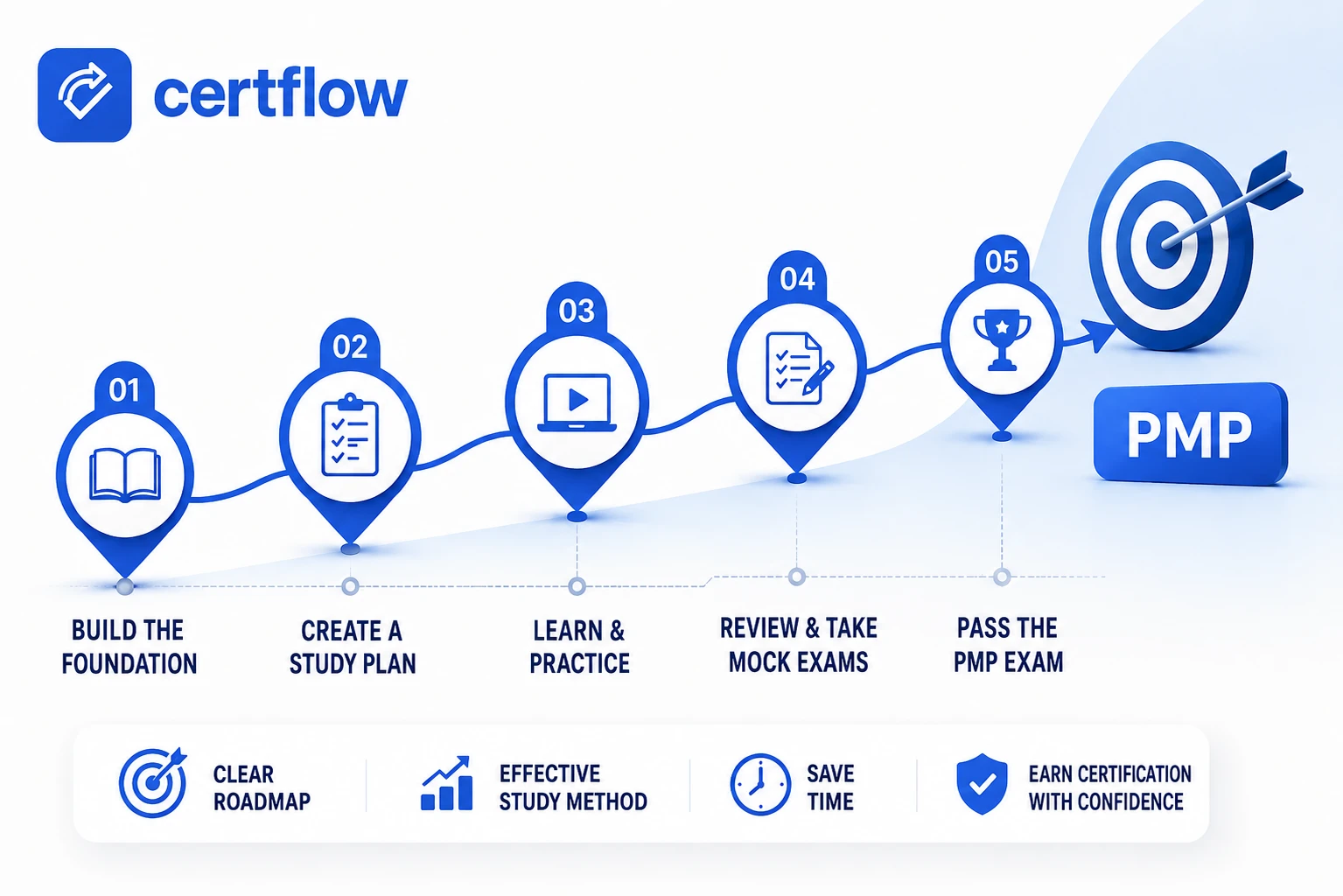
1. Check your eligibility against the table above.
2. Earn 35 training hours (or use an active CAPM).
3. Apply on PMI.org — see how to complete the PMP application.
4. Handle the audit if selected — see how to handle a PMP audit.
5. Study the 2026 ECO with PMBOK 8 and the second edition of the Agile Practice Guide — see PMBOK 8 vs PMBOK 7.
6. Practice until you score consistently above 70% on quality question banks.
7. Pay, schedule with Pearson VUE and take the exam.
8. Maintain the credential with 60 PDUs every 3 years.
Working professionals typically need 3–4 months to prepare. A detailed 12-week schedule, recommended materials and exam-day tips are in the 2026 PMP self-study plan.
Common mistakes beginners make
- Memorizing theory without practicing how to apply it to scenarios.
- Starting practice exams too early, before building a foundation.
- Not analyzing wrong answers — that's where the real learning happens.
- Underestimating agile and hybrid, which make up about 60% of the exam.
- Studying outdated materials (PMBOK 6, the 2021 exam) instead of the 2026 ECO.
Maintaining your PMP
The PMP credential runs on a 3-year cycle. To renew, you earn 60 PDUs (Professional Development Units) each cycle and pay the renewal fee. PDUs can come from courses, webinars, reading, working as a project practitioner or sharing knowledge. If you don't earn enough PDUs, your certification lapses.
Conclusion
PMP is a highly valuable certification for anyone aiming to grow into a Project Manager, Program Manager, Delivery Manager or leadership role. More than an exam, preparing for it builds a professional project management mindset: working with stakeholders, managing risk, supporting your team, handling change and focusing on the real value a project delivers.
Start by checking your eligibility, then take a free PMP practice test on CertFlow to see where you stand.
Frequently Asked Questions (FAQ)
What is PMP?
PMP (Project Management Professional) is a project management certification issued by the Project Management Institute (PMI). It shows you have experience leading projects and the knowledge to manage them across predictive, agile and hybrid approaches.
What are the PMP eligibility requirements?
You need 36 months of project leadership experience with a bachelor's degree (48 months with an associate's degree, 60 months with a high school diploma, or 24 months with a GAC-accredited degree) within the last 10 years, plus 35 hours of project management training or an active CAPM.
How much does the PMP exam cost?
The list price is USD 284 for PMI members and USD 575 for non-members; membership costs USD 109 a year. PMI applies regional pricing, so check the price shown when you log in to your PMI account.
How many questions are on the PMP exam?
Since July 9, 2026, the PMP exam has 180 questions (170 scored and 10 pretest), with 240 minutes and two 10-minute breaks.
Which languages is the PMP exam offered in?
The PMP exam is available in English and up to 15 translated languages. Check the PMI Certification Handbook for the current list.
How long is the PMP certification valid?
The PMP runs on a 3-year cycle. To keep it, you need 60 PDUs per cycle plus the renewal fee.
What if I don't have project management experience yet?
If you don't yet have enough project leadership experience, start with PMI's CAPM certification. An active CAPM also replaces the 35-hour training requirement when you later qualify for the PMP.
Now that you know what PMP certification is, it's time to start your journey.
Next article: 2026 PMP self-study plan
Try free PMP practice questions →
Official PMI sources: