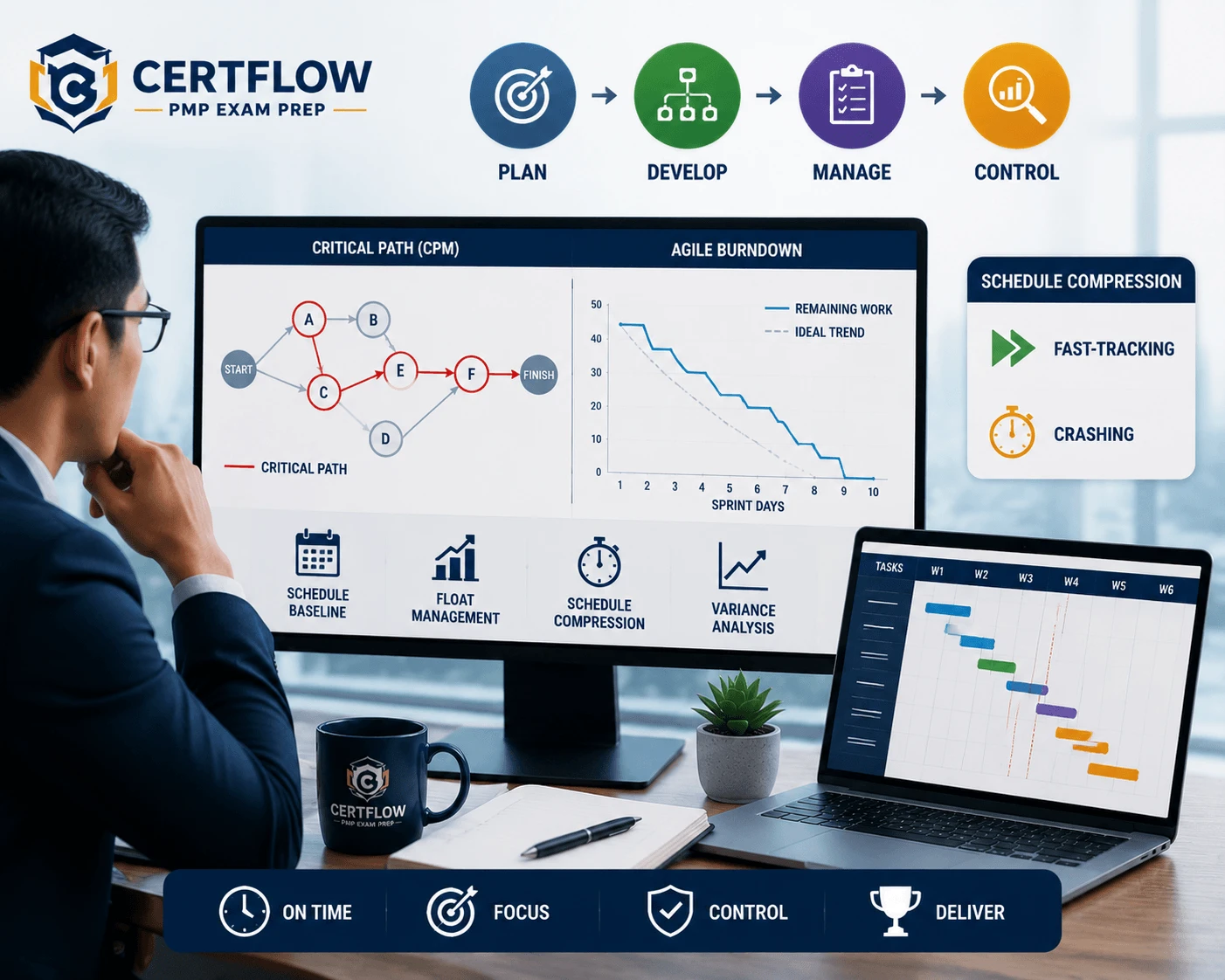
Whether you're using CPM or sprint planning, PMBOK 8 expects you to master both approaches and blend them in hybrid environments.
1. Why is the schedule the most fragile constraint?
Budget can be supplemented. Scope can be cut. But time? A day that has passed can never be recovered. That is why schedule management is especially critical — and PMBOK 8 dedicates an entire Performance Domain to it.
PMBOK® 8, Section 2.3: "Project scheduling provides a plan that represents how and when the project will deliver the products, services, and results defined in the project scope. The schedule serves as a tool for communication, managing stakeholder expectations, and provides a basis for performance reporting."
The schedule is also where every other problem surfaces — resource shortages → schedule delays, scope creep → schedule delays, risks occurring → schedule delays. Managing the schedule well means managing the entire project well.
2. Four steps to develop a schedule according to PMBOK 8
PMBOK 8 (Section 2.3.2.2) defines 4 clear steps:
Step | Activity | Output |
|---|---|---|
1. Define Activities | Decompose work packages → schedule activities | Activity list, activity attributes, milestone list |
2. Determine Sequence | Identify logical relationships (dependencies) between activities | Project schedule network diagram |
3. Estimate Effort & Duration | Estimate effort (labor units) and duration (work periods) | Duration estimates, basis of estimates |
4. Adjust | Apply CPM, compression, resource optimization, reserves | Schedule baseline, project schedule |
💡 PMBOK® 8: "Developing an acceptable project schedule is an iterative process. Schedule development may require review and revision of duration estimates, resource estimates, and schedule reserves to establish an approved schedule baseline."
3. Estimation — From analogous to story points
6 estimation techniques from PMBOK 8
Technique | Description | Accuracy | Approach |
|---|---|---|---|
Analogous | Based on similar previous projects | Low–Medium | Predictive & Adaptive |
Parametric | Statistical relationship (e.g., 1 developer = 5 stories/sprint) | Medium–High | Predictive |
Bottom-up | Estimate each activity individually, then aggregate | Highest | Predictive |
Three-point (PERT) | (O + 4ML + P) / 6 | Medium–High | Predictive |
Relative sizing | Story points, T-shirt sizing, Planning Poker | Medium | Adaptive |
Expert judgment | SME opinion | Variable | Both |
💡 PMBOK 8 emphasizes benchmarks and historical data: "Project files from previous projects such as scope, cost, schedules, performance measurement baselines" are the most valuable organizational process assets for estimation.
Effort vs. Duration — A clear distinction
Effort | Duration | |
|---|---|---|
Definition | Number of labor units needed to complete the work (hours, person-days) | Number of work periods from start to finish |
Example | Task requires 40 person-hours of effort | With 2 people → duration = 20 hours (2.5 days) |
Changes when | Scope changes | Resources change (adding/removing people) |
4. Dependencies and float — The DNA of the schedule
4 types of dependencies — PMBOK 8
Type | Description | Example | Modifiable? |
|---|---|---|---|
Mandatory (Hard logic) | Required by technical or legal logic | Lay the foundation before building walls | No |
Discretionary (Soft logic) | Best practice or team preference | Design review before coding | Yes (when needed) |
External | Depends on parties outside the project | Vendor delivers equipment, government permit | No (outside your control) |
Internal | Depends on another team or group within the organization | Database team finishes → API team begins | Possibly negotiable |
Precedence Diagramming Method (PDM) — 4 relationship types
Relationship | Meaning | Example |
|---|---|---|
Finish-to-Start (FS) | A finishes → B starts | Coding finishes → Testing starts (most common) |
Finish-to-Finish (FF) | A finishes → B finishes | Documentation is complete when coding is complete |
Start-to-Start (SS) | A starts → B starts | Leveling and pouring begin at the same time |
Start-to-Finish (SF) | A starts → B ends | Very rare — new system starts → old system ends |
Lead and Lag
Lead = overlap between activities (e.g., testing begins 2 days before coding is complete). Lag = waiting time between activities (e.g., after pouring concrete you must wait 3 days before continuing = 3-day lag). Lead accelerates the schedule. Lag slows down the schedule.
Float (Slack)
Total Float = the amount of time an activity can be delayed without affecting the project end date. Free Float = the amount of time an activity can be delayed without affecting the start date of its successor. Activities on the critical path have Total Float = 0.
5. Critical Path Method — The backbone of the predictive schedule
PMBOK 8: "The critical path method is used to estimate the minimum project duration and determine the amount of schedule flexibility on the logical network paths within the schedule model."
Critical Path = the longest sequence of activities through the network diagram = the shortest time to complete the project. Any delay on the critical path = delay to the entire project.
Critical Chain Method
PMBOK 8 also mentions the Critical Chain Method — similar to CPM but incorporating resource constraints and using buffers (project buffer, feeding buffer) instead of float. Particularly useful when resource conflicts are common.
6. Schedule Compression — When you need to go faster
When the schedule needs to be shortened without reducing scope — PMBOK 8 provides 2 techniques:
Fast-Tracking | Crashing | |
|---|---|---|
Technique | Run activities in parallel that were originally sequential | Add resources to shorten duration |
Cost | Usually no direct increase | ALWAYS increases cost |
Risk | Increases risk (rework if predecessor changes) | Less risk but cost impact |
Applies to | Activities with discretionary dependencies | Activities on the critical path |
Example | Begin testing before coding is 100% complete | Add developers, authorize overtime, hire additional contractors |
Limitation | Only applies when activities CAN overlap | Diminishing returns — adding people does not always speed things up (Brooks's Law) |
💡 PMP Tip: Fast-tracking = NO cost increase, MORE risk. Crashing = MORE cost, less risk. When a question asks "compress schedule with minimum additional cost" → fast-tracking. "Compress schedule by adding resources" → crashing. "Compress without increasing risk" → crashing (not fast-tracking).
7. Schedule in Adaptive — Velocity, burndown, and flow
Agile Release Planning
PMBOK 8: "Relationship among product vision, release planning, and iteration planning" — 3 layers of planning in agile: Product Vision (the entire product), Release Plan (a group of iterations that form a release), Iteration Plan (sprint-level detailed plan).
Velocity-Based Planning
Velocity = story points completed per sprint. After 3–5 sprints, velocity stabilizes → use it to forecast: Remaining story points ÷ Average velocity = Sprints remaining.
Burndown and Burnup Charts
Iteration Burndown = remaining work in the sprint. Ideal: a declining curve that reaches 0. Release Burnup = cumulative completed work across releases. Ideal: a rising curve that reaches the target.
Flow-Based Scheduling
PMBOK 8: "Focuses on optimizing the flow of work through a system. Maximizing flow of deliverables based on resource capacity. Minimizing time and resource waste." Kanban boards, WIP limits, and Theory of Constraints — not timebox-based like Scrum but continuous flow.
8. Baseline, monitor, and analyze variance
Baseline a Project Schedule
PMBOK 8: "The schedule baseline is the approved version of a schedule model that can be changed using formal change control procedures."
Predictive: Schedule baseline approved through CCB. Changes → formal change request + impact analysis. Adaptive: Baseline per iteration — "defined at the beginning of each iteration and aligned with the prioritized requirements." Flexible, rolling wave.
Analyze Schedule Variance
Metric | Formula | Meaning | Favorable value |
|---|---|---|---|
SV (Schedule Variance) | EV - PV | Ahead or behind schedule? | SV > 0 = ahead |
SPI (Schedule Performance Index) | EV / PV | % of planned work completed | SPI > 1.0 = ahead |
⚠️ PMBOK 8 note: "A schedule variance may show a correlation with project team member dissatisfaction. This correlation can assist in addressing a root cause that may not have been obvious." — Schedule metrics don't just measure progress; they can reveal deeper issues.
Coordinate with Other Projects
The PM must coordinate: shared resources between projects (availability conflicts), inter-project dependencies (deliverables from another project), organizational operations (resource competition with BAU work), and portfolio-level constraints (budget allocation timing).
9. PMP Exam Tips
📍Tip 1 — Critical Path = zero float: Activities on the critical path have Total Float = 0. Delay any activity on the CP = delay the project. When a question asks "which activity's delay will impact the project end date?" → an activity on the critical path.
📍Tip 2 — Fast-tracking vs Crashing: Fast-tracking = parallel (no cost, more risk). Crashing = add resources (more cost, less risk). "Minimum cost" → fast-track. "Minimum risk" → crash. Crashing is only effective on CRITICAL PATH activities.
📍Tip 3 — PERT formula: (O + 4ML + P) / 6 = Expected duration. Standard deviation = (P - O) / 6. Exam questions typically provide O, ML, and P and ask for the expected duration or range.
📍Tip 4 — Resource Leveling vs Smoothing: Leveling = CAN extend the schedule (changes the critical path). Smoothing = does NOT extend it (only uses float). "Deadline cannot change" → smoothing.
10. Ten scenario-based practice questions
Question 1
Your project network has 4 paths: A-B-C (15 days), A-D-E (20 days), A-F-G (18 days), A-H-I (20 days). Activities D-E and H-I both have zero float.
How many critical paths does this project have?
A. 1 — the longest path (A-D-E at 20 days).
B. 2 — both 20-day paths (A-D-E and A-H-I) are critical paths.
C. 4 — all paths are critical.
D. 0 — critical path can only be determined with resource assignments.
Question 2
Your project is 2 weeks behind schedule. The sponsor demands you finish on the original date. The critical path includes activities that can be done in parallel with some risk of rework.
What should you try FIRST?
A. Crash the schedule by adding overtime and contractors.
B. Fast-track by running the parallelizable critical path activities concurrently to recover time without additional cost.
C. Request a schedule extension from the sponsor.
D. Reduce scope to meet the deadline.
Question 3
Your team estimates a task using three-point estimating: Optimistic = 10 days, Most Likely = 15 days, Pessimistic = 26 days.
What is the PERT expected duration?
A. 15 days
B. 16 days
C. 17 days
D. 18 days
Question 4
Your agile team has completed 5 sprints with velocities of: 18, 22, 20, 21, 19 story points. The remaining backlog has 120 story points.
How many sprints are needed to complete the backlog?
A. 5 sprints
B. 6 sprints
C. 7 sprints
D. Cannot be determined without more data
Question 5
A critical path activity has a mandatory Finish-to-Start dependency with its successor. The successor must begin immediately after the predecessor finishes. The PM asks you to start the successor 2 days before the predecessor finishes to save time.
Is this possible?
A. Yes — add a 2-day lead to the FS relationship.
B. No — mandatory dependencies cannot be modified. The activities cannot overlap because the dependency is hard logic.
C. Yes — change to a Start-to-Start relationship.
D. Yes — fast-track by running them in parallel.
Question 6
Your project has SPI = 0.85 at month 4 of a 12-month project. The sponsor asks: "Will we finish on time?"
What is your BEST response?
A. "No — SPI below 1.0 means we will definitely be late."
B. "Currently, we've completed 85% of the work we planned by this point. If this trend continues, we'll likely be late. I recommend analyzing the root causes, developing recovery options, and presenting them to you for a decision."
C. "Yes — we still have 8 months to recover."
D. "I need to calculate EAC before answering."
Question 7
Your construction project must coordinate with a road widening project managed by a different organization. Your project needs the widened road completed before heavy equipment can be delivered to your site.
What type of dependency is this, and what should you do?
A. Internal mandatory — add buffer and monitor.
B. External dependency — outside your control. Add it to the risk register, monitor the other project's progress, establish communication with their PM, and develop contingency plans.
C. Discretionary — you can reroute equipment via another road.
D. Internal discretionary — coordinate with the other team.
Question 8
Your team of 3 developers has been crashing the schedule by adding 2 more developers for 4 weeks. After 2 weeks, velocity has actually DECREASED. The new developers need significant onboarding.
What phenomenon explains this?
A. The new developers are underperforming — replace them.
B. Brooks's Law — adding people to a late project makes it later. New members need onboarding and create communication overhead. Short-term productivity loss is expected before any gain.
C. The team needs better tools to handle the larger size.
D. The original developers are slowing down due to frustration.
Question 9
Your project uses a hybrid approach: predictive for infrastructure and adaptive for software. The infrastructure schedule shows the data center ready by March 15. The software team plans their Sprint 8 deployment for March 1, requiring the data center.
What is the schedule risk, and how should you address it?
A. No risk — software can deploy to a temporary environment.
B. The software deployment depends on infrastructure completion (external dependency within the project). Add a 2-week buffer, monitor infrastructure progress, and have the software team prepare a fallback deployment plan.
C. Ask the infrastructure team to accelerate by 2 weeks.
D. Delay the software sprint to align with infrastructure.
Question 10
During sprint planning, the team estimates a user story at 8 story points. The PM says: "That seems high. Similar stories were 5 points in previous projects. Make it 5."
Is the PM's action appropriate?
A. Yes — the PM should use historical data to calibrate estimates.
B. No — in agile, the team doing the work provides the estimates. The PM can share historical data as input but should NOT override the team's estimate. Historical context is different from current context.
C. Yes — PMs are responsible for schedule accuracy.
D. The PM should escalate to the PO for a final decision.
11. Answer Key
Question 1:
Answer: B — Critical path = longest path(s) with zero float. Both A-D-E and A-H-I are 20 days with zero float. Having 2 critical paths increases risk — delay on EITHER path delays the project. PM should monitor both closely.
Question 2:
Answer: B — Fast-tracking first because it doesn't increase cost. The activities CAN be parallelized (discretionary dependency). If fast-tracking isn't sufficient, THEN consider crashing. Scope reduction (D) and extension (C) change project parameters — try compression first.
Question 3:
Answer: B — PERT = (O + 4ML + P) / 6 = (10 + 4×15 + 26) / 6 = (10 + 60 + 26) / 6 = 96/6 = 16 days. Standard deviation = (P-O)/6 = (26-10)/6 = 2.67 days.
Question 4:
Answer: B — Average velocity = (18+22+20+21+19)/5 = 100/5 = 20 points/sprint. Remaining = 120 points. 120/20 = 6 sprints. Velocity-based forecasting is the primary schedule tool in agile.
Question 5:
Answer: B — PMBOK 8: "Mandatory dependencies involve a relationship that is inherently in the nature of the work being done" — they CANNOT be changed. Only discretionary dependencies can be modified for fast-tracking. Attempting to overlap mandatory dependencies creates unacceptable risk.
Question 6:
Answer: B — SPI = 0.85 means 85% of planned work is done — behind schedule. But PM should analyze WHY (root cause), develop options (fast-track, crash, scope trade-offs), and present transparently. Simply saying "no" (A) doesn't help. Assuming recovery (C) ignores the trend. EAC (D) is for cost, not schedule.
Question 7:
Answer: B — External dependency: another organization's project. PM cannot control it but must manage it: risk register, communication, contingency. Rerouting (C) may be a contingency but the dependency itself is external and real.
Question 8:
Answer: B — Brooks's Law (from The Mythical Man-Month). Communication channels increase with n(n-1)/2 — from 3 channels (3 people) to 10 channels (5 people). New members need onboarding from existing team, reducing everyone's productivity temporarily. Crashing has diminishing returns.
Question 9:
Answer: B — This is an inter-stream dependency in a hybrid project. Software Sprint 8 (March 1) depends on infrastructure (March 15) — a 2-week gap. PM should: recognize the dependency, buffer appropriately, monitor progress, and plan contingency. Simply delaying (D) wastes software team capacity.
Question 10:
Answer: B — PMBOK 8 emphasizes team empowerment. In agile, the development team estimates because they understand current context (technical debt, team composition, complexity). The PM can share benchmarks as DATA but not override the estimate. Different sprints have different contexts — historical data is a guide, not a mandate.
12. Conclusion
Schedule management connects everything: scope determines WHAT, schedule determines WHEN, resources determine WHO — and all three must be synchronized.
Three takeaways:
1. Critical Path = heartbeat of the schedule — Knowing the critical path means knowing when the project will end. Every delay on the CP = project delay. Every compression effort must target CP activities. A PM who doesn't know the critical path is blind to the schedule.
2. Estimate collaboratively, track relentlessly — The team estimates (the PM does not dictate). Historical data informs (it does not replace). Velocity stabilizes after 3–5 sprints. SV/SPI tells you where you are. Variance analysis tells you what to do. Measure continuously — don't wait for milestone reviews.
3. Compression has a cost — choose the right technique — Fast-tracking = free but risky (rework). Crashing = effective but costly (more resources). Resource Leveling = equitable but may extend the schedule. Resource Smoothing = safe but limited (only uses float). Each technique has trade-offs — the PM must choose the right one for the right situation.
PMBOK® 8, Section 2.3.1: "The detailed project schedule should be flexible throughout the project to adjust for the knowledge gained, increased understanding of the risks and external influences, and value-added activities. Revising and maintaining the project schedule to sustain a realistic schedule should continue throughout the project."
Frequently Asked Questions (FAQ)
How does a hybrid project manage its schedule when it has both predictive phases and agile sprints?
The common approach: use a Gantt chart at a high level (milestones and phases), while inside each agile phase the team uses sprint planning and burndown charts. The schedule baseline applies to hard milestone dates; sprint scope remains flexible. Communication is key: stakeholders who need a Gantt get one, while the agile team works from a backlog and burndown.
How are the Schedule Performance Index (SPI) and burndown charts used together?
In a hybrid context: SPI from EVM measures overall schedule health using the predictive approach. The burndown chart measures sprint-level delivery progress. If SPI < 1 but the burndown shows the team is on track, the team may be re-prioritizing the backlog correctly — deeper analysis is needed. SPI should not be used in isolation for agile teams.
How does Agile Release Planning differ from Sprint Planning?
Release Planning: determines which features will be included in a release, estimates velocity, and sets the release date and content — typically plans 3–6 sprints ahead. Sprint Planning: the detailed plan for one specific sprint — the team commits to stories, breaks down tasks, and estimates hours. Release = strategy; Sprint = tactics. Both are necessary in agile.
Now that you understand schedule management — it's time to practice with real exam questions.
Next article: Project Status Assessment: Metrics & Reporting according to PMBOK 8
Schedule Management: Critical Path & Schedule Control for PMP
Building an Integrated Project Management Plan according to PMBOK 8
Try Free PMP Practice Questions →
Official References: