PMBOK 8 treats quality as both product and process. You'll learn quality planning, assurance, control, and continuous improvement with PDCA.
1. Quality According to PMBOK 8 — Broader Than You Think
Many PMs think of quality as "testing" or "zero defects." PMBOK 8 defines it much more broadly:
PMBOK® 8, Section 3.5: "Quality is the degree to which a set of inherent characteristics of a project deliverable or process helps to meet or exceed the project's target objectives. Embedding quality includes the ability to satisfy customers and stakeholders' stated or implied needs at or above target levels of efficiency."
Two important keywords: "stated or implied needs" — quality must address both what stakeholders SAY they need and what they IMPLICITLY expect. And "processes AND deliverables" — quality is not just about the final product, but also about how you create it.
PMBOK 8 elevates quality to the third foundational principle: "Embed Quality Into Processes and Deliverables" — it is not a standalone activity, but must be INTEGRATED into everything.
2. Seven Dimensions of Quality According to PMBOK 8
Dimension | Evaluation Question | Example |
|---|---|---|
Performance | Does the deliverable function as intended? | App loads in under 3 seconds |
Conformity | Does it meet specifications and is it fit for use? | All acceptance criteria are met |
Resilience | Can it withstand unexpected failures and recover quickly? | System uptime 99.9% |
Satisfaction | Do users give positive feedback on usability and UX? | NPS > 50 after go-live |
Uniformity | Is there consistency across outputs and workflows? | All reports share the same format and logic |
Efficiency | Is the output/input ratio optimized? | Less rework, high resource utilization |
Sustainability | Does it meet sustainability standards? | Carbon footprint reduced by 20% |
🌟 PMBOK 8 emphasizes: "Quality as a feature" — quality is an attribute of scope, not a separate concern. A bridge must be structurally sound, an app must be fast, a system must be secure — these are quality attributes, and they belong to scope.
3. The 7-Enabler Quality Management Framework
Group | Enabler | Core Question |
|---|---|---|
Planning | Gather quality requirements | What quality level do stakeholders expect? |
Planning | Plan quality processes and tools | What tools will ensure quality? |
Execution | Execute quality management plan | Is quality assurance operating effectively? |
Compliance | Help ensure regulatory compliance | Are mandatory regulations being met? |
Financial | Manage CoQ and sustainability | How much are we investing in quality and sustainability? |
Monitoring | Conduct ongoing quality reviews | Is quality meeting standards? |
Improvement | Implement continuous improvement | Are processes getting better over time? |
4. Gather Quality Requirements and Plan Quality Processes
Gather Quality Requirements
Quality requirements include: Functional requirements (what the system must do), Nonfunctional requirements (performance, security, availability, usability), Acceptance criteria (conditions a deliverable must satisfy), Definition of Done (DoD) — PMBOK 8: "checklist of all criteria required so that a deliverable can be considered ready for customer use."
🌟 Sources of quality requirements: stakeholder interviews, industry standards (ISO, CMMI, IEEE), regulatory requirements (FDA, SOX, GDPR), organizational quality policies (OPA), benchmarking against competitors, and customer talks and tests (a new tool in PMBOK 8).
Plan Quality Processes and Tools
PMBOK 8 Manage Quality Assurance (Section 2.1.6.5): "Ensuring processes are performed in a manner consistent with stakeholder expectations, involving the implementation of planned and systematic activities defined in the quality management plan."
The Quality Management Plan defines: applicable quality standards, quality metrics (how to measure), quality assurance activities (process audits, reviews), quality control activities (inspection, testing), roles and responsibilities for quality, and tools and techniques.
Quality Assurance (QA) | Quality Control (QC) |
|---|---|
Focuses on processes — how we do the work | Focuses on deliverables — the products we create |
Prevention-oriented — prevents defects before they occur | Detection-oriented — finds defects after they are created |
Process audits, reviews, continuous improvement | Inspection, testing, control charts, statistical sampling |
Applied throughout the project | Applied when deliverables are produced |
"Doing things right" | "Making sure things are right" |
💡 PMP Tip: Quality ASSURANCE = process-focused, prevention. Quality CONTROL = product-focused, detection. When a question says "the PM wants to prevent defects" → QA. "The PM wants to find defects" → QC. PMI prioritizes prevention (QA) over inspection (QC).
5. Cost of Quality (CoQ) — Prevention Is Cheaper Than the Cure
PMBOK 8 provides a detailed model for Cost of Quality — the total cost incurred throughout the product lifecycle to ensure quality.
Cost of Conformance (money spent TO achieve quality) | Cost of Nonconformance (money lost DUE TO lack of quality) | |
|---|---|---|
Type | Prevention + Appraisal | Internal Failure + External Failure |
Prevention | Training, document processes, equipment, "time to do it right" | — |
Appraisal | Testing, destructive testing, inspections | — |
Internal Failure | — | Rework, scrap (found BEFORE the customer receives the product) |
External Failure | — | Liabilities, warranty, lost business (found AFTER the customer receives the product) |
PMBOK® 8: "The optimal CoQ is one that reflects the appropriate balance for investing in the cost of prevention and appraisal to AVOID failure costs." — Investing in prevention and appraisal (conformance) is always cheaper than bearing failure costs (nonconformance).
External failure costs are the most expensive — warranty claims, lawsuits, lost reputation, lost customers. That is why PMBOK 8 stresses: embed quality from the start; do not wait until the end to inspect.
6. Execute the Quality Plan, Audits, and Reviews
Quality Audits
PMBOK 8: "A quality audit is usually conducted by a team external to the project. Objectives include: identifying good practices, identifying nonconformities and gaps, sharing good practices across projects, proactively offering assistance to raise productivity."
Quality audits also confirm implementation of approved change requests — ensuring that changes have actually been carried out correctly.
Quality Control Tools — PMBOK 8
Tool | Purpose | When to Use |
|---|---|---|
Control Charts | Determine whether a process is stable and predictable. Upper/Lower Control Limits. | Repetitive activities, manufacturing, service delivery |
Inspection | Examine deliverables for conformance to standards | All deliverables prior to acceptance |
Cause-and-Effect (Fishbone) | Trace an effect back to its root cause | When you need to find the root cause of a quality problem |
Histogram | Show frequency distribution of data | Analyze defect patterns, performance distribution |
Scatter Diagram | Show relationship between 2 variables | Correlation analysis (e.g., hours worked vs. defects) |
Statistical Sampling | Test a subset of a population | Large quantities, when destructive testing is impractical |
Testing | Verify a deliverable meets requirements | UAT, integration testing, performance testing |
Quality in Adaptive Environments — Definition of Done
PMBOK 8: "DoD is a checklist of all criteria required so that a deliverable can be considered ready for customer use." DoD replaces formal inspection processes in agile. If an increment does not meet the DoD, it cannot be released. DoD serves as the automatic quality gate for each sprint.
7. Regulatory Compliance and Sustainability
Help Ensure Regulatory Compliance
The PM must ensure: identify applicable regulations early (FDA, SOX, GDPR, building codes, environmental regulations), integrate compliance into the quality plan (not as an afterthought), track compliance throughout the project (audits, documentation), and engage regulatory subject matter experts when needed.
PMBOK 8 notes: a company expanding shipping services must meet "governmental shipping specifications for each target market." But a quality-driven approach goes further: "high-value customers have stricter standards than regulatory bodies — by addressing these higher standards, the company exceeds expectations."
Sustainability in Quality
PMBOK 8 lists Sustainability as the seventh dimension of quality. Sustainability in quality includes: sustainable materials selection, energy-efficient processes, waste reduction, carbon footprint measurement, social impact assessment, and lifecycle thinking (quality is not only about what is delivered, but also about how the product is eventually disposed of).
8. Continuous Improvement — PDCA and Beyond
PMBOK® 8: "Adopting a continuous improvement mindset optimizes processes, boosts efficiency, and enhances maturity growth for the whole organization, leading to better project outcomes and overall organizational success."
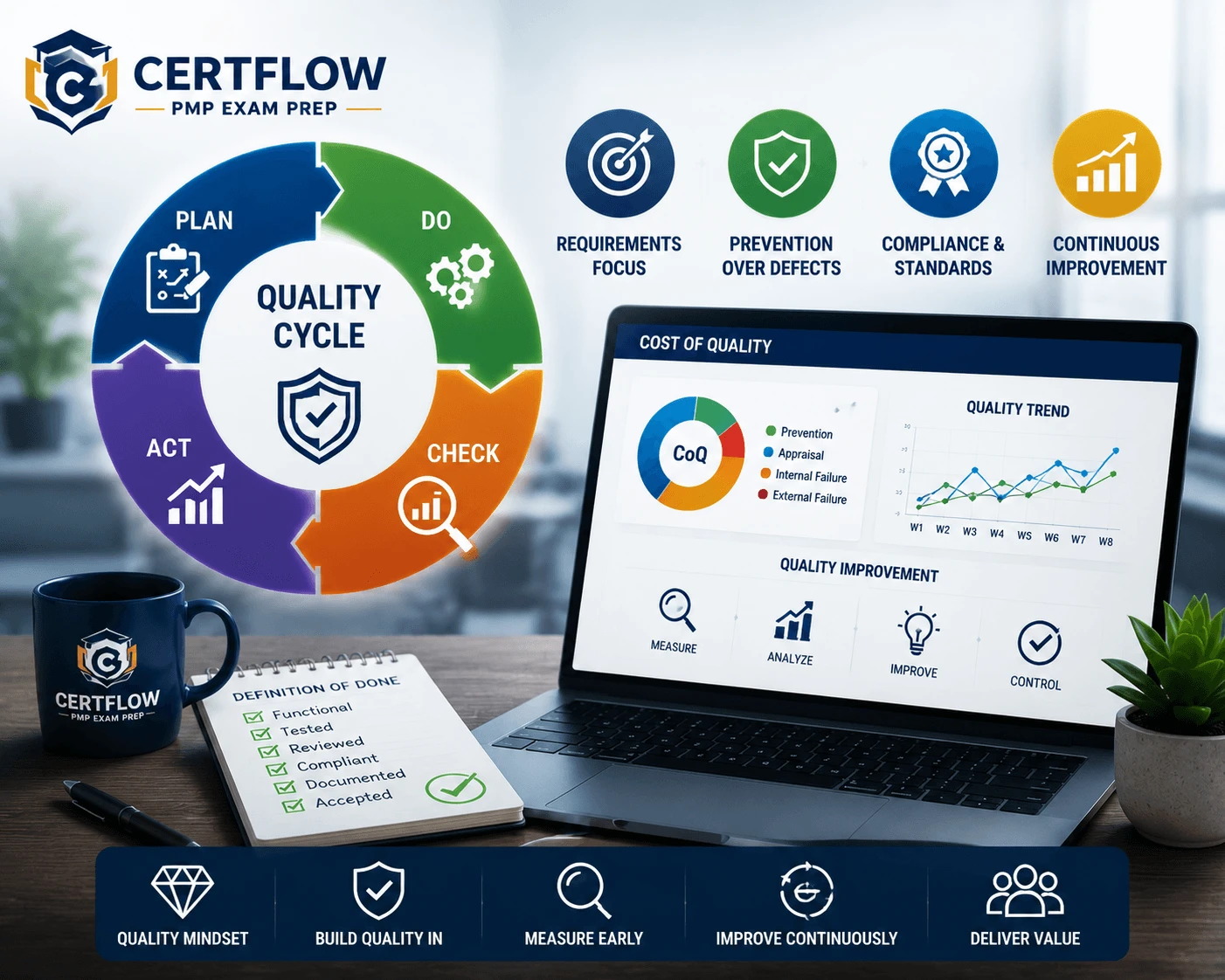
PDCA Cycle (Plan-Do-Check-Act)
- Plan — Identify the improvement opportunity, analyze root cause, develop a plan
- Do — Implement the plan on a small scale (pilot)
- Check — Measure results and compare them against expected outcomes
- Act — If successful, standardize. If not, learn from it and cycle again.
Continuous Improvement Frameworks from PMBOK 8
Framework | Focus | Best Suited For |
|---|---|---|
PDCA | Iterative improvement cycle | All project types, general improvement |
Lean | Eliminate waste, maximize value flow | Manufacturing, operations, service delivery |
Six Sigma | Reduce variation, achieve near-zero defects | High-volume, statistical process control |
Total Quality Management | Organization-wide quality culture | Enterprise-level transformation |
Kaizen | Small, incremental daily improvements | Team-level, daily practices |
Theory of Constraints | Identify and improve the bottleneck | Process optimization, throughput |
In Adaptive environments: Retrospectives are the primary continuous improvement mechanism. PMBOK 8: "Regularly occurring workshop to explore work and results to improve both process and product." Every sprint ends with a retrospective — meaning every sprint is an opportunity to improve.
9. PMP Exam Tips
📍Tip 1 — Prevention > Inspection: PMI always prioritizes "preventing defects" (QA) over "finding defects" (QC). When a question offers a choice between "invest in better processes" vs. "add more testing" — choose processes.
📍Tip 2 — Quality IS Scope: Nonfunctional requirements (performance, security, usability) belong to scope. "The app works but is slow" = a scope gap, not merely a quality issue.
📍Tip 3 — CoQ: External failure is the most expensive: When asked "which quality cost is highest?" — external failure (warranty, lawsuits, lost customers) > internal failure (rework) > appraisal (testing) > prevention (training). Invest early to save the most.
📍Tip 4 — Control Charts: within limits = stable: A process within control limits is stable (normal variation). Outside control limits = unstable (investigate). Control limits are not the same as specification limits — control limits are statistical; specification limits are requirements-based.
10. Ten Situational Practice Questions
Question 1
Your software meets all functional requirements but users report it takes 12 seconds to load the main dashboard. No performance requirement was documented.
What type of quality issue is this?
A. This is not a quality issue — all requirements were met.
B. This is a nonfunctional requirement gap — performance is a quality attribute that should have been captured in scope as an acceptance criterion.
C. This is a user training issue — users need to understand system limitations.
D. This is a testing failure — QC should have caught the performance issue.
Answer: B — PMBOK 8: "Quality is an integral attribute of scope and can include both functional AND nonfunctional requirements." Performance is a nonfunctional quality requirement. The gap is in requirements elicitation, not testing — the requirement was never captured.
Question 2
Your organization spends $50K on developer training and $30K on code reviews (prevention), $20K on testing (appraisal), $40K on rework (internal failure), and $100K on warranty claims (external failure). Total CoQ = $240K.
Where should the PM focus investment to reduce total CoQ?
A. Reduce testing costs — $20K is significant.
B. Reduce rework by adding more testing.
C. Increase investment in prevention (training, code reviews, better processes) to reduce both internal and external failure costs, which represent 58% of total CoQ.
D. Negotiate lower warranty costs with the service team.
Answer: C — PMBOK 8: "The optimal CoQ reflects the appropriate balance for investing in prevention and appraisal to AVOID failure costs." Failure costs ($140K) are 58% of total CoQ — reducing these through better prevention is the highest ROI. Reducing testing (A) may increase failures.
Question 3
A control chart shows a process with 7 consecutive data points above the mean but all within control limits.
What does this indicate?
A. The process is stable — all points are within control limits.
B. The process shows a trend or shift that should be investigated even though points are within limits — the "Rule of Seven" suggests a non-random pattern.
C. The control limits need to be recalculated.
D. The data is coincidental — no action needed.
Answer: B — The "Rule of Seven" states that 7 consecutive points on one side of the mean indicate a non-random pattern (assignable cause), even if within control limits. The process is trending and should be investigated before it goes out of control. This is a leading indicator.
Question 4
Your pharmaceutical project must comply with FDA 21 CFR Part 11 regulations for electronic records. The team wants to skip formal documentation to move faster — the regulations slow them down significantly.
What should you do?
A. Allow the team to skip documentation for speed and add it later.
B. Explain that regulatory compliance is non-negotiable, but work with the team to find more efficient ways to meet compliance requirements without unnecessary overhead.
C. Escalate to the sponsor for a waiver.
D. Switch to agile to reduce documentation burden.
Answer: B — Regulatory compliance cannot be skipped or deferred. PMBOK 8: quality-driven approach means meeting legal requirements AND finding efficient ways to do so. The PM should help find streamlined compliance processes, not bypass regulations (A) or assume agile eliminates compliance needs (D).
Question 5
Your agile team delivered a sprint increment that the PO accepted. However, QA found that automated test coverage was only 30% — below the team's Definition of Done requirement of 80%.
What should happen?
A. Accept the increment since the PO approved it.
B. The increment does NOT meet the Definition of Done and should not be considered "done." The team must increase test coverage to 80% before the increment can be released.
C. Update the DoD to 30% to match the team's capacity.
D. Add test coverage as a separate task in the next sprint.
Answer: B — PMBOK 8: DoD is "all criteria required so that a deliverable can be considered ready for customer use." If DoD says 80% coverage, anything less is not "done." PO acceptance doesn't override DoD. Lowering DoD (C) undermines quality. Deferring to next sprint (D) accumulates technical debt.
Question 6
After 3 sprints, your team's defect rate has remained at 15% — above the 5% target. The team's response has been "we'll test more carefully." The defect rate hasn't improved.
What approach should you recommend?
A. Add more QA resources to catch defects.
B. Conduct root cause analysis on the defects, then implement process improvements (better requirements, code reviews, pair programming) to PREVENT defects rather than just detecting them more.
C. Extend sprint duration to allow more testing time.
D. Set a zero-defect target to motivate the team.
Answer: B — "Test more carefully" = detection (QC). The defect rate isn't improving because the ROOT CAUSE isn't addressed. PMBOK 8 emphasizes prevention over inspection. Root cause analysis + process improvement (QA) will reduce defects at the source. More testing (A) catches more defects but doesn't prevent them.
Question 7
During a quality audit, the auditor finds that the team follows processes consistently and deliverables meet specs. However, customer satisfaction scores remain low. The auditor reports: "Process compliance is excellent."
What does this reveal?
A. Quality is good — the auditor confirmed process compliance.
B. The processes are being followed but may not be the RIGHT processes for achieving customer satisfaction. Quality must address both "doing things right" (conformance) AND "doing the right things" (fitness for use/customer satisfaction).
C. Customer satisfaction is a marketing issue, not a quality issue.
D. The quality metrics need updating to include satisfaction.
Answer: B — PMBOK 8: quality includes "satisfaction — do deliverables elicit valuable feedback from customers including usability and UX?" Process conformance alone doesn't guarantee customer satisfaction. The PM should evaluate whether processes are producing the RIGHT outcomes, not just any outcomes efficiently. D is partially correct but B is the root issue.
Question 8
Your construction project uses sustainable materials that cost 20% more than conventional alternatives. The sponsor questions the additional cost.
How should you justify the sustainability investment as a quality decision?
A. It's a regulatory requirement — no choice.
B. Present the lifecycle cost analysis: sustainable materials last longer (lower maintenance), meet emerging regulations (avoid future compliance costs), align with organizational values (brand value), and reduce environmental impact (triple bottom line).
C. Absorb the cost difference from contingency reserve.
D. Switch to conventional materials to stay within budget.
Answer: B — PMBOK 8: quality includes sustainability as the 7th dimension. Sustainability is a quality investment, not just a cost. Lifecycle analysis shows total value — initial cost is higher but total cost of ownership may be lower. This aligns with PMBOK 8's triple bottom line: people, planet, profit.
Question 9
Your team has been running retrospectives every sprint for 6 months but team members say nothing ever changes. The same issues keep recurring. Retrospective attendance has dropped.
What is the MOST likely root cause?
A. The team is tired of retrospectives — reduce frequency.
B. The retrospective format is stale — try different techniques.
C. Action items from retrospectives are not being implemented — the continuous improvement LOOP is broken. Retrospectives identify issues but no follow-through converts them into actual process changes.
D. The Scrum Master should facilitate better.
Answer: C — PDCA cycle: Plan (identify), Do (implement), Check (verify), Act (standardize). If only "Plan" happens (identify issues) but "Do" never follows (implement changes), improvement stops. The PM must ensure retrospective action items become concrete changes to DoD, working agreements, or processes — not just a list.
Question 10
Your vendor delivers components that meet all contractual specifications. When integrated into your system, performance degrades. The vendor says: "We met our specs — integration is your problem."
What quality management lesson does this illustrate?
A. The vendor is correct — integration quality is the buyer's responsibility.
B. Quality must be defined HOLISTICALLY — acceptance criteria should include integration testing and system-level performance, not just component specs. The gap is in how quality requirements were specified in the contract.
C. Add additional testing after vendor delivery.
D. Replace the vendor with one who tests integration.
Answer: B — PMBOK 8's Adopt a Holistic View: quality is about the WHOLE system, not just components in isolation. The contract should have included integration performance requirements as acceptance criteria. "Quality as a feature" means ALL quality attributes — including how components work together — must be specified in scope.
11. Summary
Quality management according to PMBOK 8 is not a standalone activity — it is a mindset embedded in everything a PM does.
Three key takeaways:
1. Prevention > Detection > Correction — Investing in training, process design, and code reviews (prevention) is always cheaper than testing (detection), and both are cheaper than rework and warranty claims (correction). The Cost of Quality model makes it clear: external failure costs are the most expensive. Invest early, save later.
2. Quality = Scope = Value — Quality is not something you "add on" after scope is defined. Nonfunctional requirements (performance, security, usability, sustainability) ARE scope. PMBOK 8 states clearly: "quality is an integral attribute of scope." Missing quality requirements = a scope gap, not merely a quality gap.
3. Continuous improvement is a mindset, not an event — PDCA, Lean, Six Sigma, Retrospectives — all are tools toward the same goal: getting a little better every day. But tools are meaningless if action items are never executed. Close the improvement loop: identify → implement → verify → standardize.
PMBOK® 8, Section 3.5: "Foundational to embedding target quality thresholds is continuous improvement and waste elimination. These practices enable project teams to refine their processes, optimize resource utilization, and deliver outcomes that meet or exceed target objectives."
Frequently Asked Questions (FAQ)
How does PMBOK 8 approach quality management compared to PMBOK 6?
PMBOK 6 had 3 processes: Plan Quality, Manage Quality (QA), and Control Quality (QC). PMBOK 8 integrates quality into the project performance domains and emphasizes a continuous improvement culture over checklist compliance. Retrospectives in agile and lessons learned in predictive are both quality improvement mechanisms.
What does the Definition of Done (DoD) have to do with quality management in agile?
DoD is the quality criteria a user story must meet before it is considered "done" — coded, tested, reviewed, documented, deployed to staging. DoD is the QC mechanism in agile: if an increment does not pass the DoD, it cannot be demoed or accepted into a release. The team defines their own DoD and adheres to it rigorously.
What is Cost of Poor Quality (COPQ) and why does it matter?
COPQ = costs incurred when quality is not achieved = internal failures (rework, scrap) + external failures (warranty, returns, reputation damage). COPQ is typically 5–10 times the cost of prevention. PMBOK 8 reminds PMs: invest in prevention and quality planning upfront — that cost is far lower than fixing defects after release.
Now that you understand project quality management — it's time to put that knowledge to the test with real exam questions.
Next article: Schedule Management: CPM & Agile Planning According to PMBOK 8
Project quality management: QA, QC & Cost of Quality for PMP
Continuous improvement: Lessons Learned, OPAs & PDCA according to PMBOK 8
Try Free PMP Practice Questions →
Official References: