Sprint Review and Sprint Retrospective are often confused — who attends, what's the purpose, what's the output? Full comparison table with 3 PMP questions.
Here is a situation I have seen more than once on real projects: a client manager shows up at what the Scrum Master called a "retrospective" and says they want to hear honest feedback from the team. The room goes quiet. That awkward silence happens because Sprint Review vs Sprint Retrospective is not just a naming difference — the two events serve completely different purposes, with different audiences, different outputs, and different questions they answer. Mixing them up is not just a process violation; it breaks the psychological safety that makes both events work.
On the PMP exam, these two events appear together in scenario questions that test whether you know who belongs in the room and what comes out at the end. This article compares them side by side, grounded in the Scrum Guide 2020, so the distinction becomes instinct rather than memorized trivia.
Key takeaways
Sprint Review: inspect the product (Increment) with stakeholders → output is an updated Product Backlog.
Sprint Retrospective: inspect how the team worked → output is at least one improvement added to the next Sprint Backlog.
Stakeholders attend Sprint Review, not Sprint Retrospective.
Sprint Review happens before Sprint Retrospective — Review is the second-to-last event, Retrospective is the last event in the Sprint.
Both are mandatory — Scrum has no optional events.
Why people confuse them — and why it matters for PMP
Both events happen near the end of the Sprint. Both involve the word "review" in common parlance. Both have the Scrum Master present. And in many organizations, the line between them has been blurred by habit — teams that invite a client to "join the retro" or skip the formal Retrospective in favor of an informal chat after the demo.
The PMP Examination Content Outline – July 2026 states that approximately 60% of exam questions involve Agile or Hybrid approaches. Questions about which stakeholders attend which event — and what the correct output is — appear frequently in both the People domain (Task 3: Lead the project team) and the Process domain (Task 1: Plan and manage delivery).
PMI expects answers grounded in the Scrum Guide 2020, not in whatever informal practice your current workplace uses. That is worth saying plainly: the "right" answer on the exam may differ from what you do at your company.
Sprint Review
Purpose
The Sprint Review exists to inspect the Increment that was produced during the Sprint and to adapt the Product Backlog based on what was learned. The Scrum Guide 2020 describes it as a "working session" — not a demo, not a status meeting, not an approval gate. Stakeholders and the Scrum Team work together to figure out what is valuable and what should come next.
One useful question to hold in mind: "Does what we built still make sense given what we now know?" That is what Sprint Review answers.
Who attends
The full Scrum Team — Product Owner, Scrum Master, and Developers — plus any stakeholders the Product Owner invites. The PO decides who is invited and this can change Sprint to Sprint based on who has relevant feedback to give or receive. There is no fixed list. Stakeholders might include customers, end users, senior management, or representatives from other business units.
Timebox and output
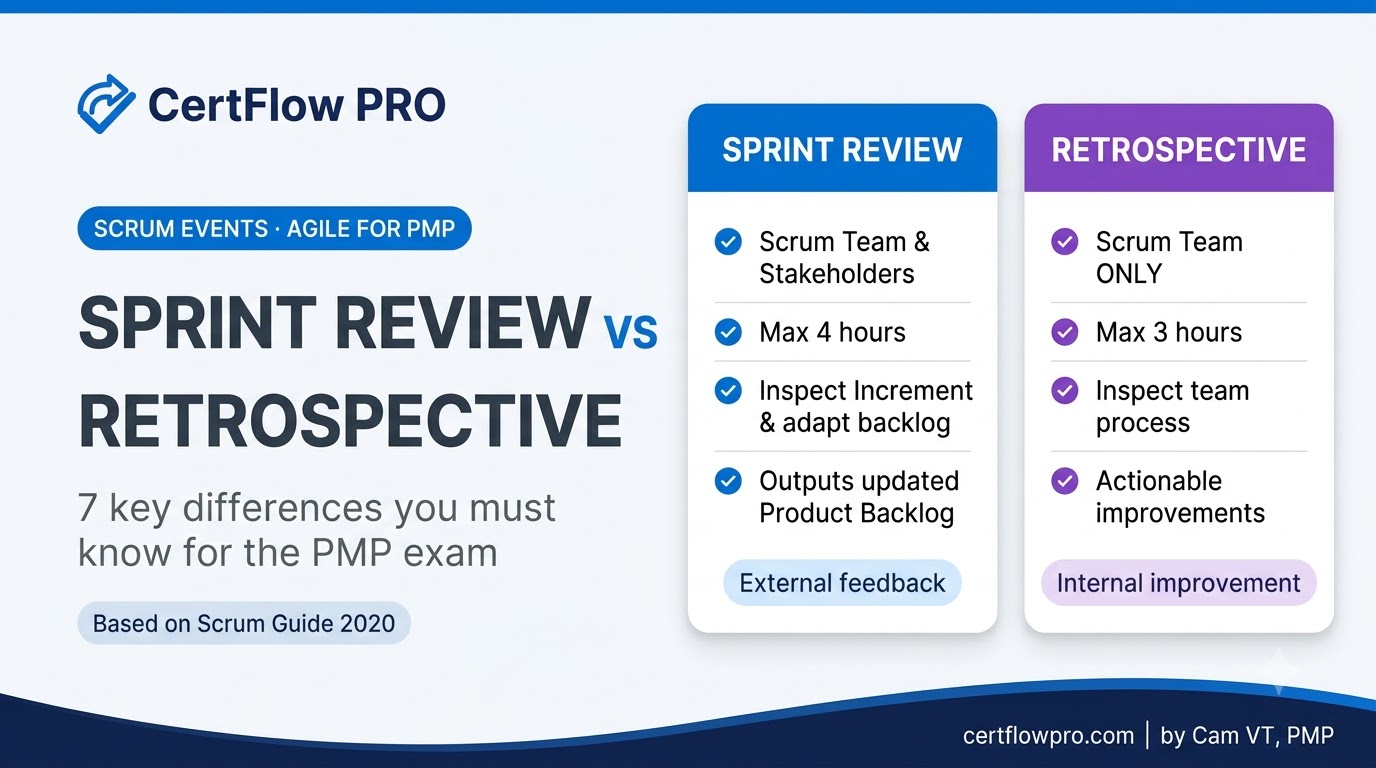
Maximum timebox: 4 hours for a one-month Sprint (shorter for shorter Sprints). The primary output is an updated Product Backlog — new items added, priorities adjusted, outdated items removed — based on the discussion. Sprint Review does not produce a sign-off document, a Sprint report, or a formal acceptance record. The Increment either meets the Definition of Done or it does not; no additional approval layer is needed.
Sprint Retrospective
Purpose
The Sprint Retrospective exists for the Scrum Team to inspect how it worked during the Sprint — the people, interactions, processes, and tools — and to create a concrete plan for improvement. It is the team's primary mechanism for self-management and continuous improvement.
The question Sprint Retrospective answers: "How did we work together, and what can we do differently?"
Who attends
Scrum Team only: Product Owner, Scrum Master, and Developers. No external stakeholders. This is intentional. The Retrospective is a space where the team needs to speak candidly about what impeded their work — including organizational constraints, unclear requirements from stakeholders, or tension within the team. Having outsiders present changes the dynamic in ways that undermine candor, which is the entire point of the event.
Timebox and output
Maximum timebox: 3 hours for a one-month Sprint. The primary output is at least one actionable improvement that the team adds to the next Sprint Backlog. The Scrum Guide 2020 is explicit that the improvement should be specific enough to act on — "communicate better" is not an improvement item; "start each Daily Scrum with a one-sentence blocker round and timebox the whole event to 12 minutes" is.
Seven-point comparison
Criterion | Sprint Review | Sprint Retrospective |
|---|---|---|
Primary purpose | Inspect Increment; adapt Product Backlog | Inspect how the team works; plan process improvements |
Who attends | Scrum Team + stakeholders (invited by PO) | Scrum Team only (PO + SM + Developers) |
What is inspected | The product (Increment) | The team's working process (people, tools, interactions) |
Timebox (one-month Sprint) | Maximum 4 hours | Maximum 3 hours |
Primary output | Revised/updated Product Backlog | At least 1 improvement added to next Sprint Backlog |
Order within Sprint | Second-to-last event | Last event |
Typical facilitator | Product Owner (presents outcomes, invites stakeholders) | Scrum Master (creates psychological safety, facilitates) |
Sprint Review and Retrospective in Hybrid projects
In Hybrid environments, organizations often keep both events but adapt the structure to fit existing governance. A few things to know for the PMP exam:
Aspect | Pure Scrum | Common Hybrid adaptation |
|---|---|---|
Sprint Review | Collaborative session; PO decides who attends | May align with steering committee review; inspect Increment purpose stays the same |
Sprint Retrospective | Scrum Team only; improvement goes into next Sprint Backlog | May expand into formal lessons-learned log for the broader project record |
Key exam principle | Events are distinct; never merge them | Even in Hybrid context, PMI expects you to know which stakeholders belong in which event |
A common PMP question type: a Hybrid project holds an end-of-iteration session with the client present. Is this Sprint Review or Retrospective? Answer: Sprint Review — the presence of external stakeholders is the deciding factor. Retrospective is always internal to the Scrum Team.
Common exam mistakes
Confusing who attends: Stakeholders attend Sprint Review, not Retrospective. This is the most frequent source of wrong answers. If a scenario question describes a Retrospective and one of the options includes inviting or accommodating a stakeholder, that option is wrong.
Confusing the order: Sprint Review comes before Sprint Retrospective. If a question asks "which event is last in the Sprint?" — Retrospective. If it asks "what happens immediately before the Retrospective?" — Sprint Review.
Confusing the outputs: Sprint Review does not produce a Sprint report or acceptance document — the output is an updated Product Backlog. Retrospective does not produce meeting minutes — the output is an improvement item in the Sprint Backlog.
Treating Sprint Review as an approval gate: Sprint Review is a collaborative working session, not a pass/fail check. An Increment that meets the Definition of Done is Done — no further approval is needed from stakeholders.
Treating Sprint Retrospective as optional: Scrum has no optional events. Skipping the Retrospective violates Scrum and removes the team's formal continuous improvement mechanism.
PMP mindset: how PMI thinks about these events
When reading a scenario question, ask two things immediately: (1) Is this about the product or about how the team works? — Product → Review; Process → Retrospective. (2) Are there stakeholders outside the Scrum Team? — Yes → Review; No → Retrospective.
Signal words to watch for on the exam:
→ Sprint Review: "stakeholder feedback," "demo the increment," "customer input," "adjust product backlog," "business value"
→ Sprint Retrospective: "improve how the team works," "process improvement," "team dynamics," "impediment," "self-assessment," "continuous improvement"
If a question uses the word "retrospective" but describes a scenario involving clients and external stakeholders, the correct answer usually involves moving that content into a Sprint Review — not accommodating the stakeholders inside the Retrospective.
Three scenario questions
Question 1. At the end of Sprint 4, the Product Owner invites the client's Head of Marketing to join a Scrum event to provide feedback on the new features delivered. During this event, the client requests two additional features and asks to remove one item from the existing plan. The Product Owner notes the changes. Which Scrum event is this, and what should happen next?
A. Sprint Retrospective; the Scrum Master should document the client's requests as team improvements for the next Sprint.
B. Sprint Review; the Product Owner should update the Product Backlog based on the feedback and reprioritize as needed.
C. Sprint Review; the Developers should immediately start working on the two new features in the same Sprint.
D. Sprint Planning; the team should commit to the two new features and remove the requested item before starting the Sprint.
Question 2. During a Sprint Retrospective, a senior manager from the client organization shows up and says they want to hear what the team thinks went wrong this Sprint. The Scrum Master needs to decide how to respond. What should the Scrum Master do?
A. Welcome the manager and allow them to participate since executive transparency is important for trust.
B. Allow the manager to listen but not speak, to maintain some level of team privacy.
C. Politely explain that the Sprint Retrospective is an internal Scrum Team event and offer to share a summary afterward if appropriate.
D. Cancel the Retrospective and reschedule it for a time when the manager cannot attend.
Question 3. A hybrid project team runs two-week Sprints. At the end of Sprint 6, the team holds a session where they identify that their Definition of Done needs to be stricter and that Daily Scrums have been running over 30 minutes. They agree to add specific testing steps to the DoD and enforce a 15-minute timebox for Daily Scrums starting next Sprint. What Scrum event is this, and is the outcome correct?
A. Sprint Review; the outcome is incorrect because the Product Backlog was not updated.
B. Sprint Retrospective; the outcome is correct — updating DoD and adding improvement items to the next Sprint Backlog is exactly what this event produces.
C. Sprint Review; the outcome is correct because stakeholders approved the Definition of Done changes.
D. Sprint Retrospective; the outcome is incorrect because DoD can only be changed by the Product Owner.
Answers and explanations
Question 1: B. The presence of the client's Head of Marketing — an external stakeholder — identifies this as a Sprint Review, not a Retrospective (eliminating A). The correct output of Sprint Review is an updated Product Backlog: the PO notes feedback and adjusts priorities accordingly. Developers do not start new features mid-Sprint (C violates Sprint integrity). Sprint Planning (D) opens a Sprint, not closes one. Option B is correct per Scrum Guide 2020: PO collects stakeholder input → updates Product Backlog → reprioritizes for the next Sprint.
Question 2: C. Sprint Retrospective is for the Scrum Team only. Allowing or welcoming an external manager (A or B) violates the Scrum Guide and destroys the psychological safety that makes Retrospectives productive. Canceling (D) is an overreaction and still fails the team. Option C is correct: the Scrum Master, acting as a servant leader, politely protects the team's internal space and offers an alternative way to address the manager's need. This is the PMI-aligned behavior — protecting the team while remaining respectful of stakeholders.
Question 3: B. No external stakeholders are present; the team is inspecting its own working process (Definition of Done, Daily Scrum timebox) — this is Sprint Retrospective. The output is correct: updating the DoD and adding the improvement to the next Sprint Backlog are exactly what the Scrum Guide 2020 describes as the Retrospective's purpose. The DoD is not set unilaterally by the PO (D is wrong) — the Scrum Team refines it together, which is a natural Retrospective activity.
Want to practice more Agile scenario questions with a timer? Try 10 free PMP questions at CertFlow PRO.
Summary
Sprint Review and Sprint Retrospective answer two fundamentally different questions: Review asks about the product; Retrospective asks about the team. Review opens the room to stakeholders; Retrospective is an internal conversation. Review produces an updated Product Backlog; Retrospective produces a specific improvement plan. Add to that the ordering — Review before Retrospective — and you have everything you need to answer most Scrum events questions on the PMP exam.
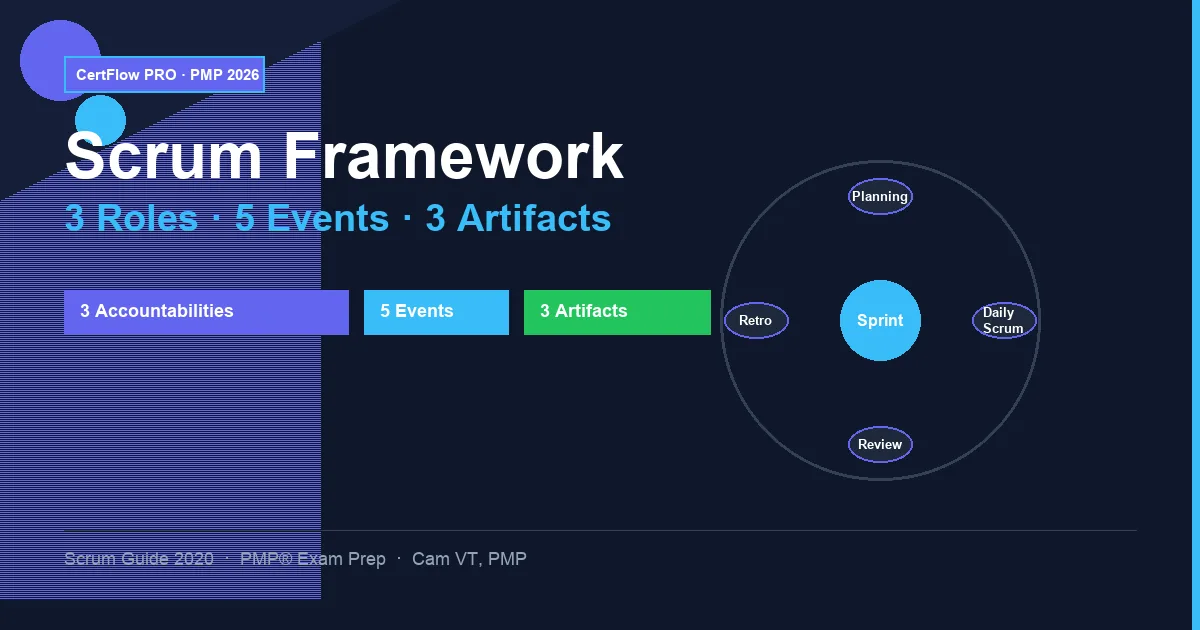
To see how Sprint Review and Sprint Retrospective fit within the full Scrum cycle, read Scrum Framework: 3 Roles, 5 Events, 3 Artifacts. For the mindset behind Scrum, see Agile Mindset and Scrum Mindset for PMP.
Frequently Asked Questions
Can stakeholders attend a Sprint Retrospective?
No — according to the Scrum Guide 2020, Sprint Retrospective is for the Scrum Team only: Product Owner, Scrum Master, and Developers. External stakeholders do not attend. If an organization wants stakeholders to receive retrospective insights, it can share a summary after the event; the Retrospective itself remains internal. This is not a suggestion — it is how Scrum defines the event.
What is the output of a Sprint Review?
The primary output is an updated Product Backlog — new items added, priorities revised, outdated items removed — based on the collaborative discussion between the Scrum Team and invited stakeholders. Sprint Review does not produce a Sprint report, a sign-off form, or an acceptance record. The Scrum Guide 2020 calls it a "working session" specifically to signal that the output is a revised understanding of what to build next, not a document.
Which comes first — Sprint Review or Sprint Retrospective?
Sprint Review comes first, Sprint Retrospective comes second. The order within a Sprint according to the Scrum Guide 2020 is: Sprint Planning → (Sprint work with recurring Daily Scrums) → Sprint Review → Sprint Retrospective. The Retrospective is the final event of the Sprint. This ordering is deliberate: the team first reflects on the product with stakeholders, then reflects on its own process internally.
What happens if a team skips the Sprint Retrospective?
Scrum has no optional events — skipping the Retrospective is a violation of Scrum. Practically, it means the team loses its formal mechanism for continuous process improvement. On the PMP exam, if a question asks how a Scrum team should handle persistent impediments or recurring quality issues, the correct answer almost always involves running an effective Retrospective — not adding ad hoc meetings or escalating to management first.
References
Schwaber, K., & Sutherland, J. (2020). The Scrum Guide. Scrum.org. scrumguides.org (accessed: 09 October 2026)
Project Management Institute. (2026). PMP® Examination Content Outline – July 2026. PMI. pmi.org
Project Management Institute. (2025). A Guide to the Project Management Body of Knowledge (PMBOK® Guide) – Eighth Edition. PMI.
Project Management Institute. (2017). Agile Practice Guide. PMI.