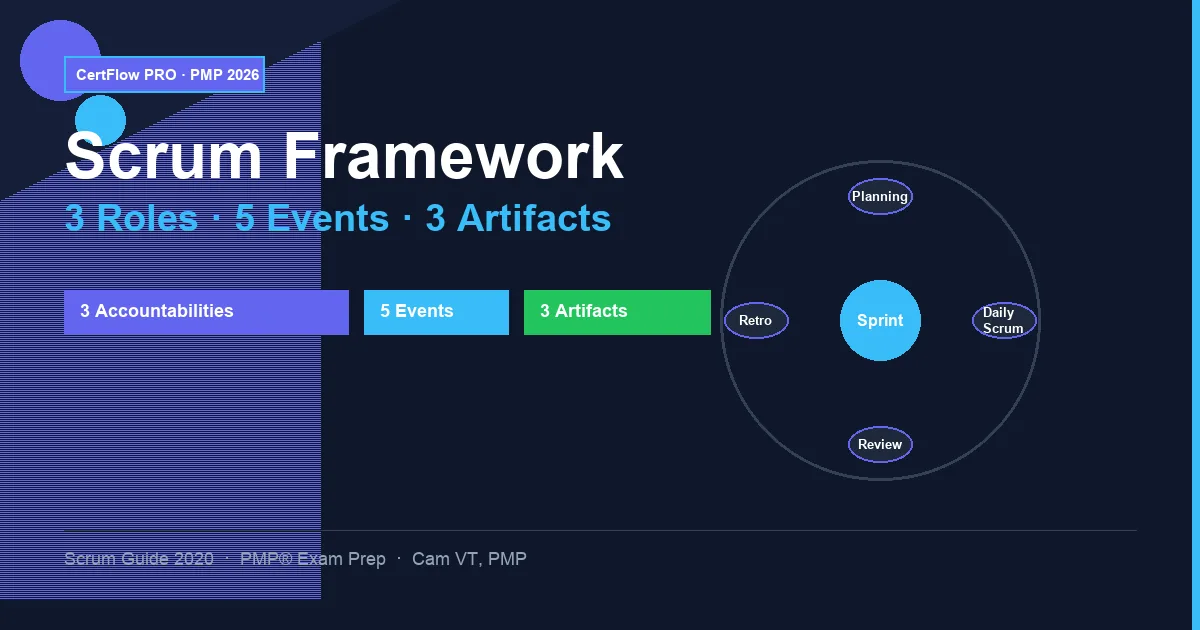
A clear breakdown of how Scrum works: 3 accountabilities, 5 events, 3 artifacts and 5 values — aligned with the Scrum Guide 2020.
The first time I led an Agile project, the team spent the first two weeks arguing about who should run the Daily Scrum and whether the Scrum Master could tell Developers what to build. Nobody was wrong — we just hadn't read the rulebook. The Scrum framework explained in the Scrum Guide 2020 is surprisingly lean: 3 accountabilities, 5 events, 3 artifacts. The value comes from understanding what each piece is actually for.
Scrum is a lightweight framework that helps teams deliver value through short, repeatable cycles called Sprints. It is not a methodology with prescribed steps. Scrum provides a minimal structure — 3 accountabilities, 5 events, and 3 artifacts — and leaves execution details to the team. This simplicity is intentional: Scrum is designed to surface problems quickly, not to solve them by itself.
This guide walks through the Scrum framework as defined in the Scrum Guide 2020 — the Tier 2 authoritative source for the PMP® exam — with 3 scenario questions in exam format.
Key takeaways
Scrum has three core layers: 3 accountabilities, 5 events, and 3 artifacts — each artifact paired with a commitment.
Scrum Team is self-managing. There is no Project Manager in pure Scrum. PMP candidates must understand this to answer role-based questions correctly.
Sprint is the container event — all 4 other events happen inside a Sprint.
The Scrum Guide 2020 replaced "roles" with "accountabilities." Exam questions may use either term.
Definition of Done is the commitment of the Increment, not of individual user stories.
Why Scrum matters for the PMP exam
According to the PMP® Examination Content Outline – July 2026, approximately 60% of exam questions involve Agile or Hybrid approaches. Scrum is the most widely referenced Agile framework in PMP scenario questions — particularly in People Domain tasks about team leadership and Process Domain tasks about adaptive planning.
Two areas where candidates consistently lose points: who has authority over the backlog, and what the Scrum Master does when there is conflict. Both have precise answers in the Scrum Guide, and PMI® expects the textbook answer — not what your organization actually does.
What Scrum is — and what it is not
Scrum is not a complete step-by-step process. The Scrum Guide uses the word "framework" deliberately: it provides minimal structure and lets teams decide how to work within it. This is why Scrum does not include user stories, story points, velocity, burndown charts, or a Definition of Ready. Those are complementary practices many teams add to Scrum — but they are not Scrum.
Scrum is built on empiricism: decisions based on observation and evidence, not upfront planning. The three pillars make empiricism work.
3 Pillars and 5 Scrum Values
3 Pillars: Transparency, Inspection, Adaptation
Transparency means everyone can see the true state of the work — the Product Backlog is visible, the Definition of Done is shared, and progress toward the Sprint Goal is not hidden. Without transparency, inspection becomes guesswork.
Inspection means regularly examining artifacts and progress toward goals to detect problems. The Daily Scrum, Sprint Review, and Sprint Retrospective are all inspection events.
Adaptation means adjusting when inspection reveals a problem — immediately, not at the next phase gate. If the team cannot adapt, inspection has no value.
5 Scrum Values
The three pillars only function when the Scrum Team lives by five values: Commitment to the Sprint Goal, Focus on Sprint work, Openness about obstacles and progress, Respect for each other as capable professionals, and Courage to raise problems and change direction when needed. Without these values, Scrum becomes a set of empty meetings.
3 Accountabilities: who is responsible for what?
The Scrum Guide 2020 uses "accountabilities" instead of "roles" to emphasize that these are responsibilities, not job titles. One person may hold multiple accountabilities in an organization, but within a single Scrum Team each accountability must be clearly assigned.
Product Owner
The Product Owner is accountable for maximizing the value of the product. The PO is not the end user, not the customer, and not a project sponsor — the PO is the decision-maker for the Product Backlog. Specifically:
Develops and communicates the Product Goal
Creates, orders, and clarifies Product Backlog items
Ensures the Product Backlog is transparent and understood
A common exam trap: the Product Owner is the only person with authority to reorder the Product Backlog. Stakeholders who want to influence prioritization must work through the PO — they cannot modify it directly.
Scrum Master
The Scrum Master is accountable for the Scrum Team's effectiveness by helping everyone understand and practice Scrum. The Scrum Master does not manage people, does not own the plan, and does not make decisions about what the team builds.
The Scrum Master serves three groups:
Scrum Team: coaching, removing impediments, creating conditions for self-management
Product Owner: helping with Product Backlog management and stakeholder communication
Organization: leading Scrum adoption, removing structural impediments
When conflict arises in the team, the Scrum Master facilitates — does not arbitrate or dictate. This servant-leader behavior is a frequent exam topic.
Developers
Developers are the people who create the Increment each Sprint. "Developer" does not mean software engineer — anyone who contributes to building the product is a Developer in Scrum. Their accountabilities:
Create the Sprint Backlog (the plan for the Sprint)
Maintain quality according to the Definition of Done
Adapt their plan daily based on Daily Scrum outcomes
Manage their own work — no one assigns tasks to Developers
The Scrum Team should be small enough to stay agile and large enough to deliver meaningful work within a Sprint. The Scrum Guide 2020 no longer specifies a maximum team size, though 10 or fewer is the general guideline.
5 Events: Sprint is the container
Scrum has 5 events. The critical thing to remember: Sprint is the container — the other 4 events all occur inside a Sprint. Sprint is not an additional event layered on top; it is the timeframe that holds everything else.
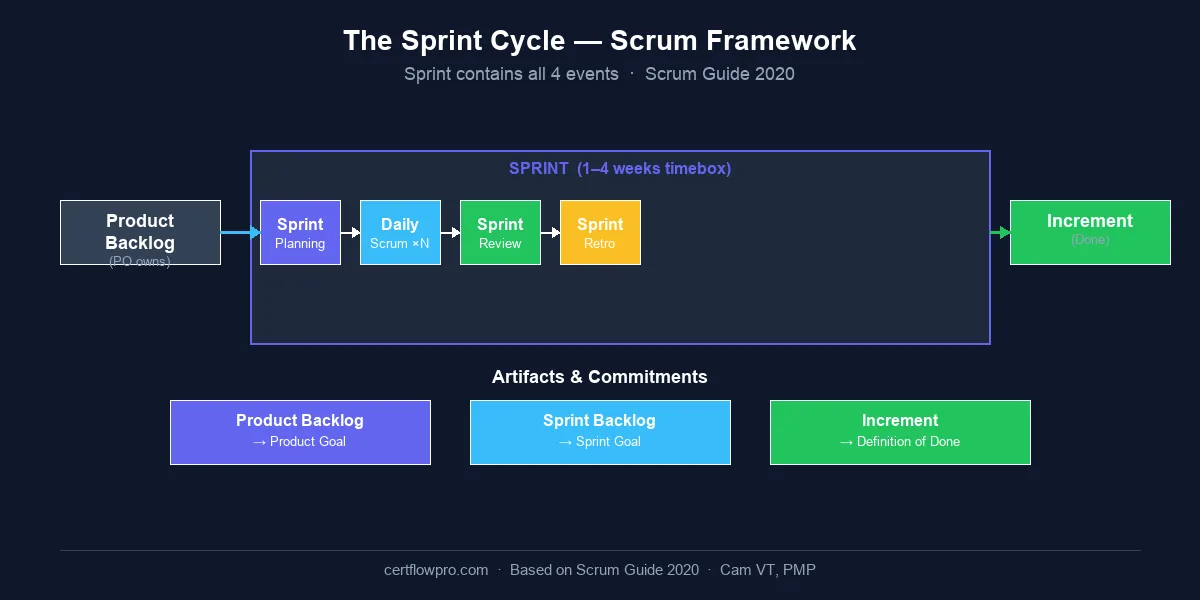
Sprint
A Sprint is a fixed-length timebox of one month or less, typically one to two weeks. Sprints are consecutive — a new Sprint starts immediately when the previous one ends. Each Sprint has a single Sprint Goal; the Goal does not change during the Sprint, though Sprint Backlog contents can be negotiated with the PO if needed.
Only the Product Owner can cancel a Sprint, and only when the Sprint Goal has become obsolete.
Sprint Planning
Sprint Planning opens the Sprint with the whole Scrum Team addressing three questions:
Why is this Sprint valuable? → Define the Sprint Goal
What can be Done this Sprint? → Select Product Backlog items
How will the chosen work get done? → Developers plan the work in detail
Timebox: up to 8 hours for a one-month Sprint; proportionally less for shorter Sprints.
Daily Scrum
The Daily Scrum is a 15-minute event for Developers, held at the same time and place each day. Its purpose is to inspect progress toward the Sprint Goal and adapt the Sprint Backlog for the coming day. This is not a status report to the Scrum Master — it is a planning event run by and for Developers.
The classic "three questions" format (yesterday / today / impediments) is one approach, not a requirement. Developers choose their own structure.
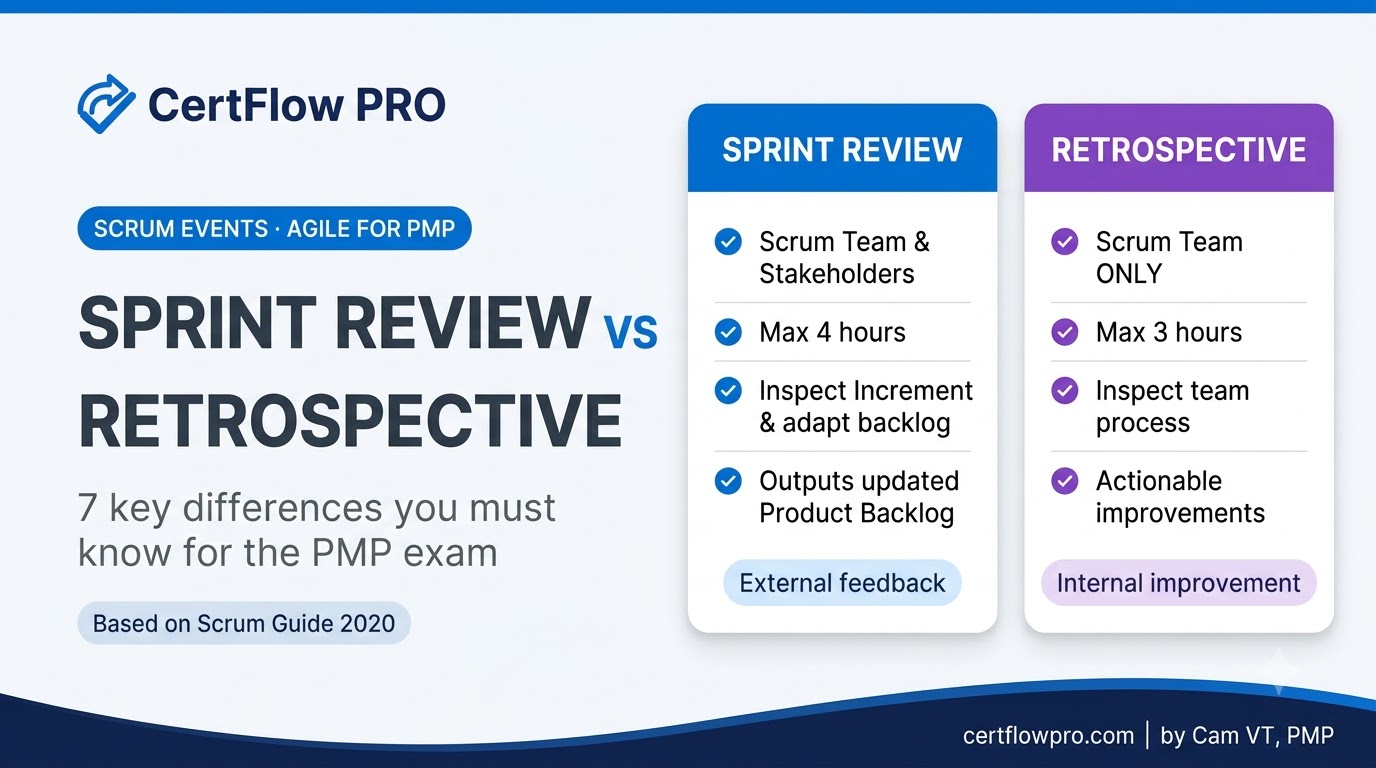
Sprint Review
The Sprint Review closes the Sprint and gives the Scrum Team and stakeholders an opportunity to inspect the Increment and adapt the Product Backlog. This is a collaborative working session — not a formal demo with a pass/fail outcome. The PO may update the Product Backlog based on what is learned. Timebox: up to 4 hours for a one-month Sprint.
Sprint Retrospective
The Sprint Retrospective is the final event inside a Sprint. The Scrum Team examines how it worked — people, interactions, processes, tools, and Definition of Done — and identifies at least one concrete improvement to act on in the next Sprint. This is self-governance: the team improves its own way of working without outside direction. Timebox: up to 3 hours for a one-month Sprint.
3 Artifacts and Commitments
Each artifact has a paired commitment — a significant addition in the Scrum Guide 2020 that many older resources miss.
Product Backlog and Product Goal
The Product Backlog is the single ordered list of everything that might improve the product. The Product Owner owns it. Backlog items are continuously refined — clarified, estimated, and broken down — through an ongoing activity called Product Backlog Refinement.
The Product Goal is the long-term objective for the product and the commitment of the Product Backlog. Each Sprint should bring the Scrum Team closer to the Product Goal.
Sprint Backlog and Sprint Goal
The Sprint Backlog consists of the Sprint Goal, the selected Product Backlog items, and the detailed plan for delivering the Increment. It belongs to the Developers and is updated throughout the Sprint as the team learns more. Stakeholders cannot add items to the Sprint Backlog during a Sprint.
The Sprint Goal is the single objective that gives the Sprint its purpose and is the commitment of the Sprint Backlog. If the Sprint Goal becomes obsolete, the PO may cancel the Sprint.
Increment and Definition of Done
An Increment is a concrete, usable result that meets the Definition of Done. A Sprint can produce multiple Increments. Every Increment must be usable when the Sprint ends — the PO decides whether to release it, but the Increment must be releasable.
The Definition of Done (DoD) is the quality standard an Increment must meet to be considered "Done." DoD is not the same as acceptance criteria: DoD applies to all Increment work (e.g., code reviewed, unit tests passing, deployed to staging), while acceptance criteria define specific conditions for individual backlog items. If a backlog item does not meet DoD, it cannot become part of the Increment — it returns to the Product Backlog.
Comparing Scrum, Predictive, and Kanban
Aspect | Predictive (Waterfall) | Scrum | Kanban |
|---|---|---|---|
Planning approach | Full upfront plan (project plan) | Sprint-by-Sprint, continuous refinement | Pull-based, no fixed timeboxes |
Unit of work | Work packages (WBS) | Sprints (1–4 weeks), Backlog Items | Work items, no time boundaries |
Scope changes | Through change control process | Not within Sprint; PO may adjust between Sprints | Flexible — items added or removed anytime |
PM role | Project Manager owns the plan and team | No PM; Scrum Master does not manage people | No prescribed roles |
Progress measure | % complete vs. baseline | Done Increments + Sprint Goal achieved | Throughput, cycle time, WIP limits |
Best for | Stable, well-defined requirements | Complex, frequently changing requirements | Continuous flow, support and maintenance |
Common mistakes and easily confused concepts
Scrum Master = Project Manager: False. The Scrum Master does not manage people, does not own the schedule, and does not report status upward. Scrum Master is a servant-leader, not an authority figure.
PO decides HOW the work is done: False. PO decides WHAT goes into the backlog and in what order. Developers decide HOW. PO interference in technical decisions during a Sprint is an anti-pattern.
Daily Scrum = status report to Scrum Master: False. Daily Scrum is for and by Developers. The Scrum Master may attend to observe, but is not receiving a report.
Sprint Review = formal acceptance gate: Incorrect. Sprint Review is a collaborative session for Scrum Team and stakeholders to inspect the Increment and discuss the way forward — not a mechanism to pass or fail a Sprint.
Definition of Done = acceptance criteria: Different things. DoD is a quality standard for the entire Increment. Acceptance criteria define specific conditions for a single backlog item.
PMP exam tip: how PMI thinks about Scrum
The key principle: PMI expects Scrum knowledge from the Scrum Guide 2020, not from your workplace. When a question asks about Scrum, ask yourself: "Whose accountability is this according to the Scrum Guide?"
Signal phrases that indicate the right Scrum answer:
PO priorities backlog → only the PO has this authority
Impediment / obstacle → Scrum Master removes it; Developers do not handle it alone or escalate immediately
Team disagrees → Scrum Master facilitates, does not decide
Stakeholder wants to add a requirement → it goes to the Product Backlog; PO decides priority; it cannot enter a running Sprint
Sprint did not complete all items → Sprint ends on schedule; Retrospective to improve; incomplete items return to Product Backlog
3 scenario questions
Question 1. You are a Scrum Master on a software team. During Sprint Review, a senior stakeholder insists that a new feature must be added to the current Sprint because it is "critical for the business." The Developers say they have no capacity and the Sprint Goal does not include this feature. What should you do first?
A. Tell the stakeholder that the feature will be added to the Sprint Backlog immediately to maintain the relationship.
B. Facilitate a discussion between the stakeholder and the Product Owner so the PO can decide whether to add it to the Product Backlog and reprioritize.
C. Ask the Developers to work overtime to accommodate the new request within the current Sprint.
D. Escalate the issue to the project sponsor for a final decision.
Question 2. Your Scrum Team has been running Sprints for three months. At the end of Sprint 6, the Developers announce that three backlog items were not completed because of unexpected technical complexity. The Product Owner is upset and wants to know who is responsible. As the Scrum Master, what is the most appropriate response?
A. Identify the Developer who underestimated the items and document it as a performance issue.
B. Remind the Product Owner that the Scrum Team is self-managing and complexity cannot always be predicted; use the Sprint Retrospective to improve estimation practices.
C. Commit that the team will complete those items in the next Sprint regardless of other priorities.
D. Recommend switching to a Waterfall approach for the remaining work to ensure predictability.
Question 3. A Scrum Team is delivering a cloud migration project using a hybrid approach. The organization's compliance team requires a formal quality gate and written sign-off before each release. During Sprint Review, the Increment meets all internal Definition of Done criteria, but the compliance sign-off takes three additional weeks. What should the team do?
A. Skip the compliance process to maintain the Scrum cadence and release immediately after Sprint Review.
B. Update the Definition of Done to include the compliance sign-off step, then plan Sprints accordingly so that releases account for the review timeline.
C. Create a separate "compliance Sprint" after each regular Sprint to handle the sign-off process.
D. Ask the Product Owner to remove compliance requirements from the backlog since they slow down delivery.
Answers and explanations
Question 1: B. The Product Owner is the only person with authority over Product Backlog prioritization. Adding directly to the Sprint Backlog (A) violates the Sprint Goal and Scrum's principle of protecting the team during a Sprint. Demanding overtime (C) ignores the Developers' self-management and Sprint Goal commitment. Escalating to the sponsor (D) is not the Scrum Master's role. Option B is correct because the Scrum Master facilitates — directing the stakeholder to work with the PO — consistent with servant leadership.
Question 2: B. Scrum Teams carry collective accountability — there is no individual blame model as in traditional projects. Documenting individual performance (A) is a Scrum anti-pattern. Unconditional commitment for next Sprint (C) creates artificial pressure without addressing root cause. Switching to Waterfall (D) avoids the real problem. Sprint Retrospective (B) is the correct Scrum mechanism for the team to self-improve — that is exactly what it is designed for.
Question 3: B. This is a classic hybrid scenario. Skipping compliance (A) is not a realistic or ethical option. A "compliance Sprint" (C) is an anti-pattern — it fragments the Scrum cadence and creates a hardening Sprint, a form of technical debt in process. Removing compliance from the backlog (D) would violate regulatory requirements. The correct answer (B) is to update the Definition of Done to reflect organizational constraints. This is how Hybrid works: retain the Scrum structure while adapting it to real-world requirements.
Want to practice more Agile scenario questions under timed exam conditions? Try 10 free PMP questions at CertFlow PRO.
Summary
Scrum's structure is not complicated: 3 accountabilities, 5 events, 3 artifacts with commitments. Its value comes from understanding the intent behind each piece. The Product Owner represents business value, Developers produce the Increment, and the Scrum Master protects the process. The Sprint creates a short feedback loop that allows inspection and adaptation — a fundamentally different operating model than predictive planning.
For the PMP exam, Scrum appears in team leadership, adaptive planning, and hybrid delivery contexts. Understanding "Scrum by the book" is what lets you recognize the correct answer regardless of how the question is framed.
For the mindset behind Agile and why Scrum is designed the way it is, read Agile Mindset and Scrum Mindset for PMP. For release planning and Sprint planning in practice, see Adaptive Planning: from Daily to Product Vision.
Frequently asked questions (FAQ)
What is the difference between a Scrum Master and a Project Manager?
A Project Manager in predictive delivery manages the plan, resources, and schedule for the entire project. A Scrum Master does not manage people, does not own a schedule, and does not make prioritization decisions. The Scrum Master is a servant-leader: protecting the team from interruptions, removing impediments, and coaching the team to self-manage effectively.
Can the Sprint Backlog change during a Sprint?
The Sprint Goal does not change. The Sprint Backlog content can be updated — Developers may add, remove, or adjust work as they learn more during the Sprint, as long as the Sprint Goal remains intact. Stakeholders cannot add requirements directly to a running Sprint Backlog.
How long should a Sprint be?
The Scrum Guide 2020 defines a Sprint as one month or less. There is no prescribed minimum. One to two weeks is most common in practice. Shorter Sprints surface problems earlier and reduce risk; longer Sprints may suit work that requires more time to produce something reviewable.
What happens when a Sprint ends with incomplete items?
Incomplete items return to the Product Backlog — they do not automatically carry over to the next Sprint. The PO re-evaluates their priority. The Sprint ends on schedule regardless of completion. The team uses the Sprint Retrospective to understand what caused the shortfall and improve estimation and planning for future Sprints.
References
Schwaber, K., & Sutherland, J. (2020). The Scrum Guide. Scrum.org. scrumguides.org (accessed: 08/10/2026)
Project Management Institute. (2026). PMP® Examination Content Outline – July 2026. PMI. pmi.org
Project Management Institute. (2025). A Guide to the Project Management Body of Knowledge (PMBOK® Guide) – Eighth Edition. PMI.
Project Management Institute. (2017). Agile Practice Guide. PMI.