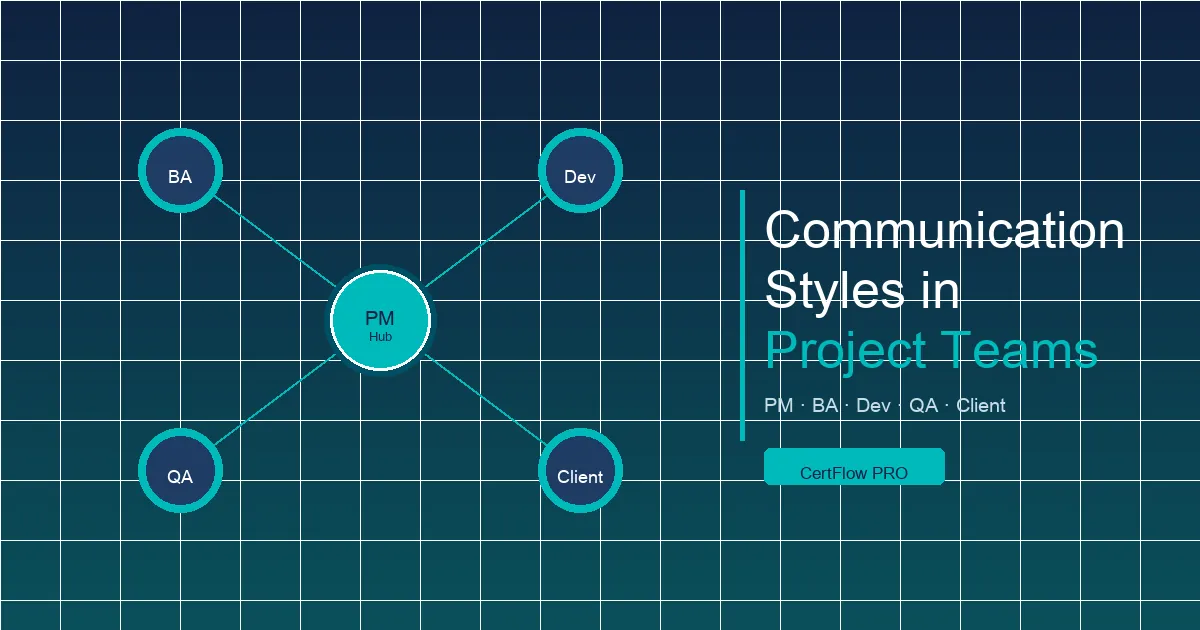
PMs don't communicate the same way with BA, Dev, QA, and clients — here's a practical guide to adapting your communication style to each role.
Early in my career as a PM, I once received the same feedback from three different people in the same week: the BA said I wasn't explaining business context clearly enough, the developer said I kept changing scope without explaining why, and the client said they weren't getting meaningful updates. My delivery of information was technically correct — but I was communicating the same way to everyone, and it wasn't working for anyone.
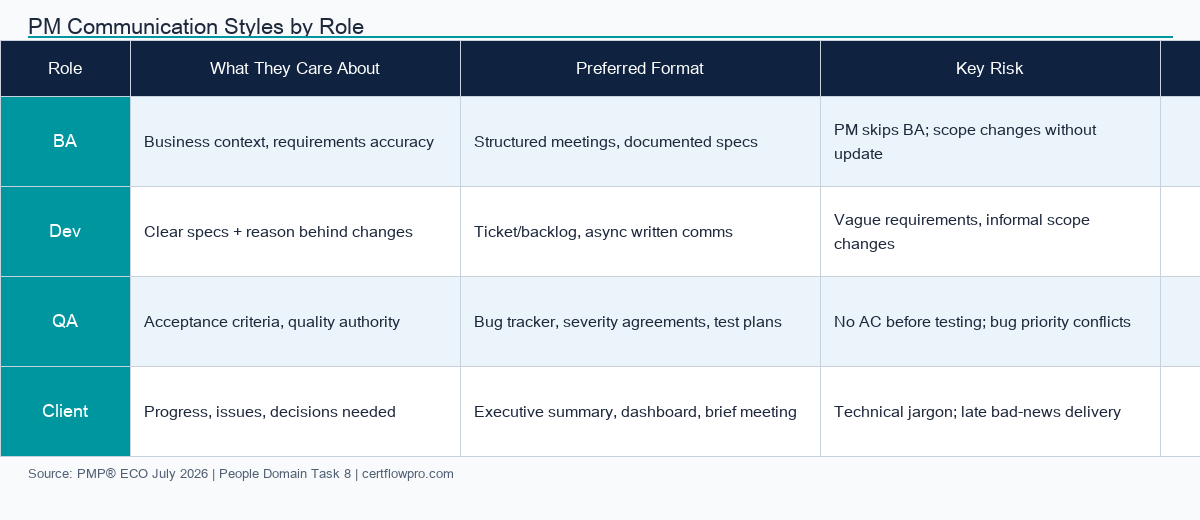
Communication styles in project teams vary by role — and a PM who adapts to each audience communicates far more effectively than one who uses the same approach for everyone. Business analysts need full business context to avoid requirements drift. Developers need to understand why something is changing, not just what is changing. QA needs clear acceptance criteria and authority over quality decisions. Clients and sponsors need transparent, structured updates — not raw technical data. According to the PMP® Examination Content Outline (ECO July 2026), People Domain (33% of the exam) tests your ability to plan and manage communication effectively across these different relationships.
This article walks through what each role needs from a PM, where communication typically breaks down, how it plays out differently in Predictive, Agile, and Hybrid environments, and how to apply PMI mindset in scenario-based exam questions.
Key takeaways
BAs need business context, not just feature requests — without it, requirements drift is almost guaranteed.
Developers need to understand why a change is happening, not just receive new instructions.
QA is not a gatekeeper — late-stage bug discoveries usually trace back to unclear requirements at the start.
With clients and sponsors, controlled transparency builds more trust than detailed reports.
PMI frames the PM as an information coordinator, not a filter or a gatekeeper — everyone gets the right information at the right time.
Why each project role processes information differently
Every role on a project team filters incoming information through the lens of their own responsibilities and risks. BAs worry about requirements being misunderstood. Developers worry about technical debt and scope expanding without explanation. QA worries about quality being sacrificed under deadline pressure. Clients worry about whether the product will actually deliver the ROI they expected.
When a PM communicates the same way to all of them — same level of detail, same format, same framing — it often creates understanding gaps. Not because the information is wrong, but because it doesn't address what each person actually needs to process and act on. PMBOK® Guide 8 emphasizes that communication effectiveness depends on matching content, channel, and audience — a core enabler of People Domain Task 8: Plan and manage communication.
For a deep dive into communication models (sender-receiver, push/pull/interactive) and the channel formula, see our article on project communication management.
Communicating with the Business Analyst (BA)
The BA's job is to bridge business needs and technical implementation. The PM-BA relationship is often underestimated — both roles are management-layer, not execution — but misalignment here is one of the most common sources of late-stage rework.
What BAs need from PMs
BAs need full business context, not just feature descriptions. When a PM hands over a requirement without explaining why the client needs this feature, or how it ranks relative to other requirements, the BA fills that gap with their own assumptions. Those assumptions compound into requirements drift.
BAs also need to know when scope changes are officially approved and who has decision-making authority when stakeholder priorities conflict. A common mistake: the PM receives client feedback and routes it directly to the developer, skipping the BA. The result is that the BA continues analyzing the old requirements while development has already changed direction.
When requirements are unclear: asking the right questions
When a BA flags that a requirement is unclear, the wrong PM response is "just ask the client." The right response is to work with the BA to identify exactly what is unclear before approaching the client. Vague questions get vague answers. Structured questions — "When user A does action B, should the system respond with X or Y?" — get usable answers.
Effective PMs help BAs prepare questions before stakeholder meetings, identify who has decision authority when requirements conflict, and protect BAs from being pulled into meetings that are outside their scope.
Communicating with Developers
Developers are technical executors. They need enough information to make good decisions within their scope — not more, not less. Too little information leads to assumptions; too much creates noise and context switching.
What developers need from PMs
Developers need clear requirements with acceptance criteria, a prioritized task list when competing work exists, and protection from informal scope creep. What they don't need is hourly progress check-ins or scope change requests arriving through chat from multiple people simultaneously.
One frequently overlooked point: developers perform better when they understand the business reason behind a requirement, not just the requirement itself. When they understand context, they can suggest better technical approaches and catch requirements that contradict existing system logic — preventing rework. PMs who withhold context to "save developers' time" often create larger rework cycles downstream.
Communicating scope changes to developers
How a PM frames a scope change determines most of the developer's reaction. Every scope change communication should include three components: (1) the reason (business decision or technical constraint?), (2) the specific impact (which tasks are affected, does the estimate change?), and (3) the approval process (who approved this change, through what channel?).
Missing any one of these, developers either push back or implement incorrectly. In Agile, scope changes flow through the Product Owner and are added to the backlog with explicit priority — the PM's job is to ensure that mechanism works, not to short-circuit it by going directly to the developer.
Communicating with QA/Testers
QA is often perceived as the project's "no" department — the people who slow things down. This is a costly misperception. QA is the last line of defense before the product reaches users. PMs who treat QA as an ally build better products; PMs who treat QA as an obstacle simply push quality risk downstream, where the cost of fixing issues is significantly higher.
The quality mindset of QA
QA needs clear acceptance criteria before testing begins, not after. When PMs or BAs don't provide sufficient testing criteria, QA is forced to define them independently — and most "unreasonable" bug reports trace back to this gap. Effective PMs ask QA at the start of each sprint: "What would make you reject this user story?"
QA also needs risk prioritization. Not all bugs carry equal weight. PMs and QA leads should align on a severity matrix — critical, major, minor — and agree in advance on who has authority to approve release when known minor defects remain open.
When a bug threatens the timeline
This is where many PMs make their most costly communication mistake. When QA reports a critical bug close to the release date and the developer says "it's a quick fix," the PM should not unilaterally decide to patch and release. That decision belongs to whoever holds risk acceptance authority — typically the sponsor or Product Owner — and the PM's job is to present both options with specific consequences: release on schedule with risk X, or delay Y days for a proper fix.
PMI mindset here is clear: surface the risk transparently, do not absorb it silently to preserve the deadline. See our article on conflict resolution techniques for managing disagreements between Dev and QA on bug severity.
Communicating with Clients and Sponsors
Clients and sponsors don't need — and often don't want — every technical detail. They need to know whether the project is on track, who is handling issues when they arise, and which decisions require their input. Skilled PMs manage information in both directions: filtering what matters for upward reporting, and translating executive direction into actionable guidance for the team.
Status reporting and delivering bad news
Delivering bad news correctly is the most important communication skill a PM uses with clients and sponsors. The principle: report early, report clearly, and always include options. "We've identified issue X, caused by Y. We're addressing it with Z. Estimated impact is A, and we need your decision on B by date C."
PMs who delay bad news to avoid negative reactions typically receive a much stronger reaction when the situation surfaces later — along with permanent damage to trust. Clients and sponsors can handle problems. What they rarely forgive is being kept in the dark.
Managing expectations continuously
Expectations shift as projects progress — especially once clients see a first prototype and realize the gap between what they thought they requested and what they actually wanted. PMs need to build regular expectation checkpoints throughout the project, not just at the end, and make clear that changes to scope, timeline, or budget are the consequence of decisions that were mutually agreed upon.
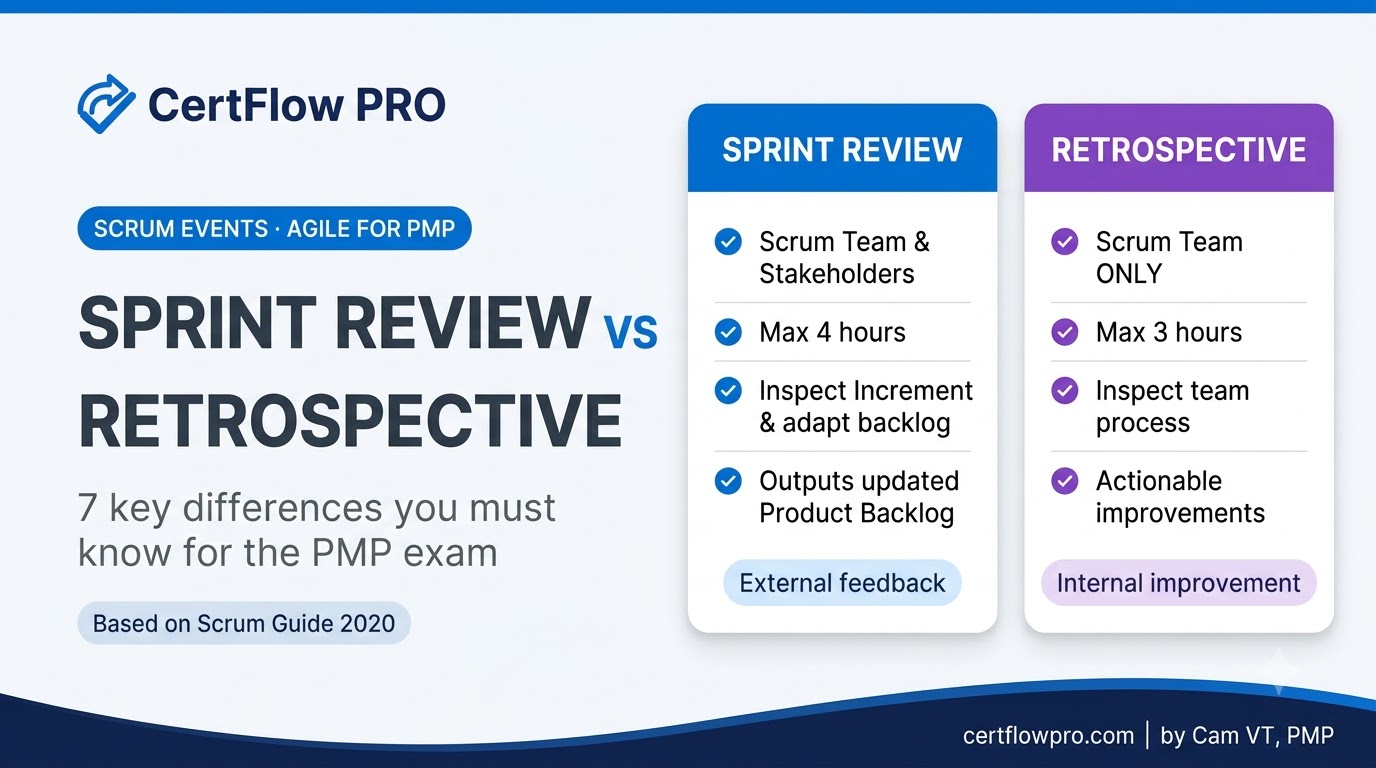
In Agile, the sprint review is this expectation checkpoint. In Predictive, phase gate reviews serve the same function. In both cases, client confirmation must be active — not passive acknowledgment of a status update. See our guide on 6-step stakeholder engagement strategy for a structured approach.
Communication style comparison: Predictive, Agile, and Hybrid
Dimension | Predictive | Agile | Hybrid |
|---|---|---|---|
Client communication frequency | Milestone/phase gate driven; formal status reports on a fixed schedule | After every sprint (1–2 weeks); sprint review is the primary mechanism | Sprint reviews for Agile workstreams; formal reports for Predictive components |
BA communication | Requirements frozen before execution; PM actively protects scope baseline | BA (often Product Owner) engaged continuously; backlog refinement is ongoing | Core requirements fixed, details flexible; BA participates in both planning cycles |
Developer communication | Via work packages and WBS; changes require formal change requests | Daily standup; scope changes route through Product Owner, not directly from PM | Agile sprint cadence for development; formal change control for system integration |
QA communication | Distinct testing phase; bug reports by severity, fixes prioritized by PM/QA | QA embedded in team, continuous testing during sprint; "definition of done" includes test pass | Continuous testing for Agile components; formal UAT for Predictive deliverables |
Reporting format | Formal: status reports, variance analysis, earned value | Visual and lightweight: burndown chart, velocity, retrospective output | Combined: sprint metrics dashboard + milestone status report |
Common communication errors and how to spot them
Communicating through too many channels simultaneously: PM emails the BA, chats with the developer, holds a meeting with QA — each channel carries slightly different information. Each person acts on their version. Fix: define the authoritative channel for each type of communication in the communication plan and enforce it.
Announcing changes without explaining impact: "Scope changed, please update" with no context will be received as a command, not information. Developers will either resist or implement incorrectly without understanding the full picture.
Reporting to clients in technical language: Telling a sponsor that "the API integration is experiencing latency issues due to database indexing" doesn't help them decide anything. "Feature X may load slowly for datasets above 1,000 records; we're fixing it and expect completion by date Y" does.
Assuming silence means understanding: Especially in many Asian work cultures, silence after an explanation does not mean agreement or comprehension. PMs should verify understanding with open questions — "How will you handle this part?" — rather than closed ones — "Does everyone understand?"
PMP exam tips: PMI mindset on communication
Tip: In PMP scenario questions about communication, watch for two common traps: (1) an answer that takes immediate action while skipping the communication step, and (2) an answer that escalates to senior management before the issue has been addressed at the PM level. PMI favors: confirm your understanding → listen to all perspectives → take action transparently → escalate only when the issue exceeds your authority.
Common PMP communication question patterns:
"What should you do FIRST?": The correct answer is almost always a step that gathers more information or confirms understanding before taking action.
Conflict between team roles: The PM doesn't pick sides. The PM creates conditions for the parties to resolve the issue — or uses collaborative techniques to find a mutually acceptable solution.
Client dissatisfied with progress: The correct answer is typically to meet with the client to understand specifically what they expected, then adjust communication — not to immediately accelerate the deliverable.
Team member reporting informally: The PM acknowledges the information but follows up through the official channel and ensures it gets documented.
For the formal framework underlying these decisions, see our guide to communication management planning in PMBOK 8.
3 Scenario questions
Question 1. You are a PM on a predictive software project. During a project meeting, a developer on your team says: "I'm tired of constant scope changes. I can't do my work properly when requirements keep shifting." The client is present at the meeting. What should you do FIRST?
A. Apologize to the developer and immediately tell the client to stop making changes.
B. Acknowledge the developer's concern, remind the team that scope changes follow the formal change control process, and schedule a follow-up conversation with the developer privately.
C. Defend the client's right to request changes and ask the developer to be more flexible.
D. Escalate the developer's behavior to their functional manager after the meeting.
Question 2. You are managing an Agile project. At the end of a sprint review, the client stakeholder says: "This doesn't look like what we discussed at the beginning of the sprint." The Product Owner and developers are present. What is the BEST response?
A. Ask the Product Owner to explain the user story acceptance criteria to the client immediately.
B. Thank the stakeholder for their feedback, ask them to describe specifically what they expected, and facilitate a discussion between the stakeholder, Product Owner, and developers.
C. Remind the client that all work was completed according to the approved user stories and therefore the sprint is complete.
D. Stop the sprint review and reschedule after the Product Owner updates the backlog.
Question 3. Near the release deadline, the QA lead reports a critical bug that could corrupt customer data. The developer estimates a 2-week fix. The sponsor wants to deliver on time. What should you do?
A. Agree with the sponsor and release on time; document the bug for a post-release patch.
B. Override the sponsor's preference and delay the release to fix the bug properly.
C. Present the sponsor with both options — release on time with the documented risk, or delay 2 weeks to fix — clearly outlining the consequences of each, and let the sponsor decide.
D. Ask the QA lead and developer to reach an agreement on severity before involving the sponsor.
Answers and explanations
Question 1: Answer B. PMI mindset prioritizes addressing the emotional tension before solving the underlying issue. Acknowledging the developer's concern (without dismissing it) and reinforcing the change control process is something the PM can do immediately without damaging the client relationship. The private follow-up gives the PM space to understand the root cause more fully. Answer A is wrong because the PM has no authority to unilaterally promise the client will stop making changes. C is wrong because taking sides publicly undermines team cohesion. D escalates prematurely when the issue hasn't yet been addressed at the PM level.
Question 2: Answer B. The PM's role is to create space for the stakeholder to express expectations more precisely, then connect them directly with the Product Owner — who owns the product backlog — and the development team. The PM does not explain on behalf of the Product Owner (A), does not defend completed work against legitimate feedback (C), and does not stop a session that exists precisely to collect this type of feedback (D).
Question 3: Answer C. The PM does not have unilateral authority to decide release versus delay when a critical data risk is involved — that decision belongs to the sponsor. The PM's responsibility is to present both options with specific, documented consequences, enabling the sponsor to make an informed decision. A is wrong because the PM cannot accept data corruption risk on behalf of the organization. B is wrong because overriding the sponsor violates project governance. D delays involving the sponsor when they need to be part of this decision now.
Want to practice more communication and leadership scenario questions under timed conditions? Try 10 free PMP questions.
Summary
Effective PMs don't use a single communication style — they adapt their language, detail level, and channel to each audience. BAs need business context; developers need reasons and process; QA needs clear criteria and quality authority; clients need controlled transparency and actively managed expectations.
In the PMP® exam, communication questions consistently test whether you understand that the PM's role is to coordinate information — not to filter, hide, or solve everything unilaterally — and whether you prioritize confirming understanding before taking action. This is also the skill that most separates experienced PMs from those who are technically skilled but operationally ineffective.
To master the formal framework behind these decisions, read our guide to communication management planning in PMBOK 8.
Frequently Asked Questions (FAQ)
What is the PMI mindset for project communication?
PMI frames the PM as an information coordinator, not a filter. The PM ensures the right people receive the right information at the right time — per the agreed communication plan — and actively confirms that the information was understood, not just delivered. When problems arise, the PM surfaces them transparently rather than absorbing them silently.
How should a PM deliver bad news to a client?
Report early — as soon as the issue is identified, not after it's resolved. Structure the message as: what happened, what caused it, estimated impact, what you're doing about it, and what decision you need from the client. Properly delivered bad news builds long-term trust; concealed bad news destroys it, regardless of how things turn out.
How is communication different in Agile vs Predictive projects?
In Agile, client communication happens continuously after every sprint — feedback is incorporated immediately into the backlog. In Predictive, communication is planned around phases and milestones; changes require formal change requests. Hybrid combines both: Agile cadence for development workstreams, Predictive reporting for integration and overall project status.
What causes miscommunication between BA and Dev?
The most common cause: BAs write requirements in business language without specific technical acceptance criteria, and developers implement based on their own interpretation. PMs reduce this by requiring BAs to define a clear "definition of done" for each user story before development starts, and by facilitating a shared requirements review between BA, Dev, and QA at the start of each sprint.
References
Project Management Institute. (2026). PMP® Examination Content Outline – July 2026. PMI. pmi.org
Project Management Institute. (2025). A Guide to the Project Management Body of Knowledge (PMBOK® Guide) – Eighth Edition. PMI.
Schwaber, K. & Sutherland, J. (2020). The Scrum Guide. Scrum.org. scrumguides.org
PMI. (2017). Agile Practice Guide. Project Management Institute. pmi.org