PMBOK 8 confirms: empowerment isn't abandonment. A 4-pillar guide to team autonomy while keeping projects on track.
Picture this: you hand your team full authority over the technical architecture, confirm the budget and deadline, then step back. Three weeks later, you discover the team has made design decisions that directly conflict with your organization's enterprise architecture standards — standards outlined in the project charter. The deliverable is unusable.
Project team empowerment PMBOK 8 defines: giving team members the authority, resources, and accountability to make decisions within their area of responsibility — not abandoning oversight, but structuring it differently. The project manager remains ultimately accountable to sponsors and stakeholders; what changes is how the PM creates an environment where the team can perform without asking permission for every small decision.
This article examines PMBOK® Guide 8's Build an Empowered Culture principle, then offers a 4-pillar practical framework — with 3 PMP® scenario questions to test your PMI® mindset.
Key Takeaways
Empowerment is not abandonment: clarity and accountability must accompany autonomy.
PMBOK 8 places "Build an Empowered Culture" among its 6 core principles — applicable to all delivery approaches, not just Agile.
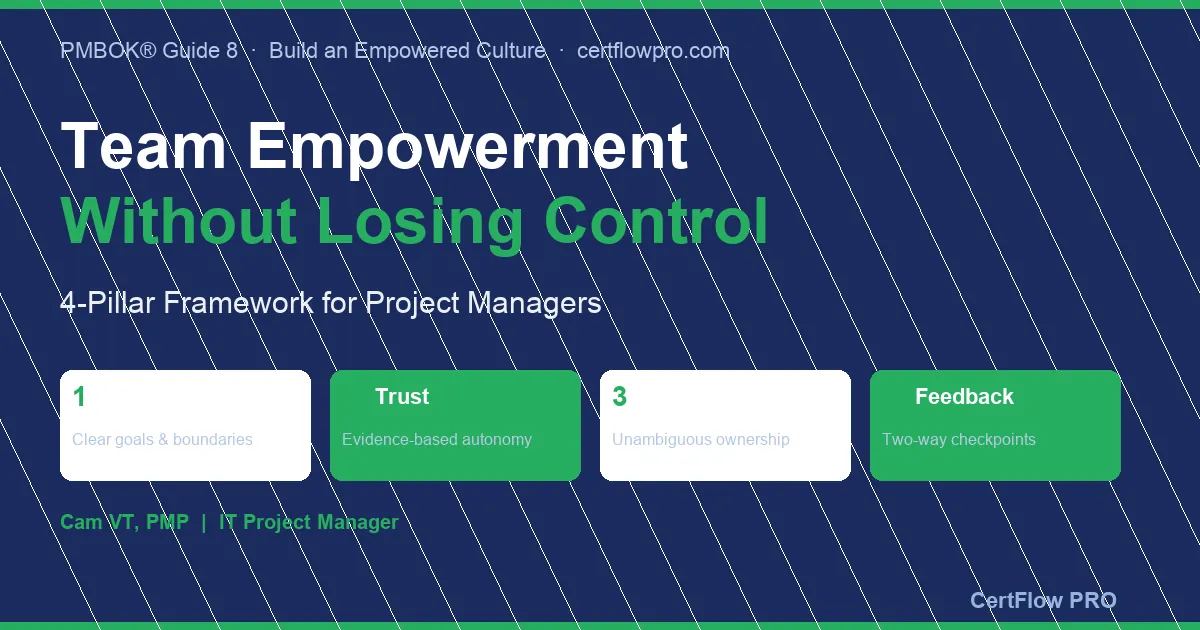
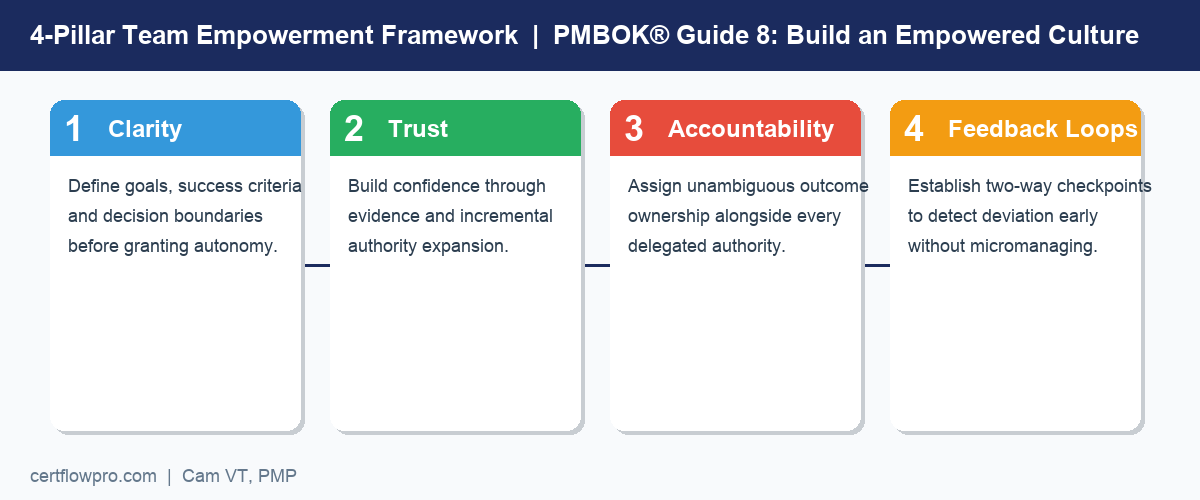
4 practical pillars: Clarity → Trust → Accountability → Feedback loops.
In PMP exam questions, when a team has a problem, the PMI answer usually involves talking directly with the team and removing impediments — not escalating immediately.
The Predictive / Agile / Hybrid comparison shows that control mechanisms differ, but the empowerment principle stays consistent.
Why team autonomy is not a risk
The instinctive response of many project managers to high-risk situations is tighter control. But research on large-scale software teams consistently shows the opposite: teams with higher autonomy detect problems earlier, because members don't wait for permission before acting on warning signs.
In the PMP 2026 exam context, roughly 60% of questions involve adaptive or hybrid approaches — where self-organizing teams are the default model. The exam will put you in scenarios that require distinguishing when PM intervention is warranted, and when intervention is itself the source of the problem.
PMI is explicit: the PM is not there to do the team's work. The PM's role is to facilitate, remove impediments, and shield the team from external disruptions. Team autonomy is the outcome of a PM who performs this role well — not a risk to be controlled.
Build an Empowered Culture in PMBOK 8
The PMBOK® Guide Eighth Edition (published November 2025) organizes project management knowledge around 6 principles rather than a process list. One of those principles is Build an Empowered Culture.
Under this principle, an empowering work environment has the following characteristics:
Team members are given authority commensurate with their responsibility — accountability is never assigned without accompanying authority.
Everyone has adequate information and resources to make decisions within their domain.
Mistakes are treated as learning opportunities, not as reasons to reduce autonomy.
Each member's contribution is recognized and connected to the project's shared goal.
Notably, this principle is not Agile-exclusive. A predictive construction project also needs a PM who can delegate technical decisions to engineers on site — rather than approving every detail from a remote office.
In PMBOK 8, this principle pairs with Be an Accountable Leader: the project leader is responsible for creating that environment, not simply delegating and stepping away.
4 pillars of empowerment without losing control
The following framework is drawn from IT project management practice and management research. The four pillars are not sequential — they operate simultaneously and reinforce each other.
Clarity — Clear goals and decision boundaries
Before delegating authority, the PM must ensure the team knows exactly: what success looks like, what the acceptance criteria are, and where their decision-making authority ends. Saying "you decide" with no further context is not empowerment — it is avoidance of responsibility.
In Agile, the sprint goal, Definition of Done, and acceptance criteria are clarity tools. The team has freedom within the sprint, but the output must meet the DoD before it counts as done. In predictive environments, the scope baseline, RACI chart, and project charter delineate who decides what.
A practical example: "The team decides on technical library choices. Any change affecting scope, budget, or organizational security standards must go through the change control process." This gives the team enough freedom to do their best work while the PM retains control at the points that genuinely matter.
Trust — Intentional, evidence-based trust
Trust in project management is not "trust and disappear" — it is confidence grounded in demonstrated capability, built incrementally over time.
Servant leadership — emphasized in both PMBOK 8 and ECO 2026 — requires PMs to develop trust through a repeating loop: delegate a manageable task → observe the result → expand the scope of authority gradually. When a new team member joins, the PM starts with observable smaller tasks and increases autonomy as confidence in their capability grows.
Psychological safety is a prerequisite for trust to function. If team members fear reporting mistakes because they anticipate punishment, they will hide problems — and the PM loses the most important information needed to steer the project. PMs build psychological safety by responding to a mistake with "What did we learn?" rather than "Who caused this?"
Accountability — Unambiguous ownership of outcomes
Empowerment without accountability is abandonment. Accountability here is not blame culture — it is a clear answer to the question: who owns the outcome of this decision?
The distinction between Responsible and Accountable in the RACI framework captures this precisely: Responsible is the person who does the work; Accountable is the person who signs off on the result. Empowering the team to execute (Responsible) does not remove the PM's ultimate Accountability to the sponsor for project outcomes.
In Agile, the team holds collective accountability for the sprint goal. There is no "that was developer X's mistake" — if the sprint goal is missed, the whole team examines the process in a retrospective. This is accountability in a learning sense, not a punitive one.
Feedback loops — Regular, two-way checkpoints
This is the PM's mechanism for "not losing control." Instead of controlling every task, the PM establishes regular checkpoints to detect deviations early — before they escalate into issues.
The daily standup in Agile is not a tool for the PM to monitor what each person is doing. Its purpose is for the team to surface and communicate blockers to each other, and for the PM to learn what impediments they need to remove. In predictive environments, weekly status meetings with earned value data serve the same function.
Feedback loops must run in both directions: the team reports progress to the PM, and the PM responds with concrete action on impediments. If the loop is one-directional — team reports, PM acknowledges but never acts — the team will stop reporting honestly within weeks.
Predictive, Agile, and Hybrid compared
Aspect | Predictive | Agile | Hybrid |
|---|---|---|---|
Authority structure | Hierarchical via WBS and RACI; PM approves major technical decisions | Self-organizing team; PO decides backlog priority; Scrum Master removes impediments | Predictive governance (stage gates) with agile execution per module or stream |
Control mechanism | Schedule baseline, earned value, integrated change control | Sprint review, retrospective, velocity, burndown | Stage gate metrics + sprint velocity; translate sprint data into milestone language for stakeholders |
PM role | Planner, coordinator, monitor — actively directs decisions | Servant leader, facilitator, impediment remover | Orchestrator: bridges sponsor/governance and agile team; translates agile output into milestone reporting |
Boundaries of autonomy | Defined by WBS, role assignments, and change control thresholds | Within sprint boundary and Definition of Done | By module or stream; technical execution is agile, governance reporting is predictive |
Empowerment risk | Ambiguity in authority if RACI is unclear | Lack of direction with new teams; drift without retrospectives | Tension between agile team's desire for autonomy and governance demand for predictability |
Common empowerment mistakes
Most empowerment failures trace back to missing one or more pillars in the framework above:
Empowerment as abandonment: assign the work, then disappear. The team has no clarity on boundaries, no feedback loop, and is left to guess — and the PM only discovers the problem when it is already serious.
Clarity comes after authority: delegate first, define boundaries later. The team has already made decisions based on wrong assumptions, and the PM must demand rework — eroding trust in both directions.
Authority without capability: assign responsibility to someone without the knowledge or tools to carry it out. This is a common failure when PMs transition to servant leadership — they empower without investing in team development.
Ambiguous accountability: everyone is "responsible," but no one is accountable for the outcome. When problems surface, there is no clear owner.
One-directional feedback loops: the PM receives reports but never takes action on impediments. The team stops reporting honestly after a short period.
PMP exam tips: PMI mindset on empowerment
Tip: In team-related scenario questions, the PMI answer typically prioritizes the PM removing obstacles over controlling or punishing. When you see these verbs in answer choices, pay close attention:
✅ Correct answers typically contain: "facilitate," "empower," "support," "remove obstacles," "coach," "hold a retrospective," "have a conversation with"
❌ Incorrect answers typically contain: "take over," "escalate immediately," "reassign," "monitor more closely," "override the team's decision," "control all decisions"
Three critical recognitions for the PMP exam:
When a team has an internal problem: the correct answer usually involves talking directly with the team member first — not escalating to the sponsor or functional manager right away.
When the team wants to change how they work: the PM supports and enables (servant leader), rather than blocking because "that's not how we do things here."
When a stakeholder demands the PM exert tighter control over the team: the PM explains the approach with data (velocity, quality metrics, burndown), rather than immediately complying and imposing micromanagement on the team.
3 scenario questions
Question 1.
A software development team working in an Agile environment has been given full autonomy to design the technical architecture of the new system. Three weeks into the project, the project manager notices the team has made design decisions that conflict with the enterprise architecture standards, which were outlined in the project charter. What should the project manager do first?
A. Immediately escalate the issue to the sponsor and request technical authority over the team's decisions going forward.
B. Facilitate a meeting with the team and the enterprise architecture team to review the standards and align the technical approach.
C. Allow the team to continue since they were given full autonomy to make technical decisions.
D. Reassign the lead architect and bring in an external expert who is familiar with the enterprise standards.
Question 2.
A project manager notices that the development team consistently delivers sprint goals on time but rarely flags risks or blockers during daily standups. The project manager suspects the team is hiding issues to avoid being micromanaged. What should the project manager do first?
A. Review all team members' individual task progress daily to identify hidden blockers themselves.
B. Escalate the concern to the team's functional managers to understand what is really happening.
C. Hold a retrospective to address team communication and create a more psychologically safe environment for raising concerns.
D. Add mandatory daily written status reports to increase visibility into each team member's blockers.
Question 3.
A project is using a hybrid approach. Business stakeholders require predictive milestone reporting, while the development team self-organizes using two-week sprints. The project manager is struggling to provide milestone updates without disrupting the team's agile cadence. Which approach best aligns with PMI principles?
A. Switch to a fully predictive approach to satisfy the stakeholders' reporting requirements.
B. Ask the development team to pause sprints during milestone review periods to allow comprehensive reporting.
C. Map sprint outcomes to the predictive milestone cadence, translating agile metrics into milestone-compatible language for stakeholders.
D. Inform stakeholders that self-organizing agile teams do not provide milestone reporting.
Answers and explanations
Question 1: B. When an empowered team crosses a clearly defined boundary (the project charter specifies compliance with enterprise architecture standards), the PM must act — but the correct action is to facilitate a conversation between the team and the relevant stakeholders to realign the technical direction. The root cause is a Clarity gap: the team did not fully understand the boundaries of their decision-making authority. — Option A escalates prematurely and revokes team authority instead of addressing the root cause. Option C ignores a clear boundary violation. Option D replaces personnel without solving the communication and clarity problem.
Question 2: C. When a team is not reporting honestly, the issue usually lies with psychological safety — not with reporting procedures. A retrospective provides a safe space for the team to surface what is not working, including feeling micromanaged. The PM facilitates rather than adding more control. — Option A increases micromanagement, which is counterproductive. Option B escalates through functional managers before engaging the team directly. Option D adds reporting overhead without addressing the underlying trust problem.
Question 3: C. In a hybrid project, the PM serves as an orchestrator — translating agile language (velocity, sprint burndown, sprint goal completion) into the language predictive stakeholders need (milestone status, deliverable readiness). This is not a compromise between two approaches; it is the core value a PM adds in a hybrid context. — Option A abandons the agile benefits the project has already chosen. Option B disrupts the team's cadence and defeats the purpose of the agile approach. Option D refuses accountability to stakeholders.
Want to practice more questions like these under timed conditions? Try 10 free PMP questions.
Summary
Empowering your team is not a choice between control and freedom — it is the discipline of designing an environment with all four pillars in place, so the team can perform at their best without the PM intervening in every small decision. PMBOK® Guide 8 places "Build an Empowered Culture" among its core principles for exactly this reason: it is not an optional skill, but a condition for any project to run effectively across all delivery approaches.
To go deeper on the leadership competencies behind team empowerment, explore the related articles on leading project teams in PMBOK 8 and conflict management techniques for project teams.
Frequently Asked Questions (FAQ)
What does "Build an Empowered Culture" mean in PMBOK 8?
"Build an Empowered Culture" is one of the 6 principles in PMBOK® Guide 8. It requires the project manager and organization to create an environment where team members have sufficient authority, information, and resources to make decisions within their areas of responsibility. This is not an Agile-only principle — it applies to predictive, adaptive, and hybrid delivery approaches.
How does empowerment differ from leaving the team unsupervised?
Empowerment comes with clarity about decision boundaries, clear accountability, and regular feedback loops. Abandonment means assigning work without any of those elements. In a PMP exam scenario, when a PM "gives full authority" and disappears — and the project drifts — that is a PM failure, not a team failure.
How does a PM maintain visibility without micromanaging in Agile?
The PM maintains visibility through existing Agile artifacts and ceremonies: daily standups surface blockers in real time; sprint reviews show actual output; velocity and burndown charts reveal progress relative to the sprint goal. The PM does not need to track each person's individual tasks — this data is already available and transparent to the whole team.
When should a PM intervene in an empowered team's decision?
PM intervention is appropriate when: (1) the team's decision violates a constraint explicitly defined in the project charter or scope baseline; (2) there is a risk to quality, compliance, or safety; (3) the impact extends beyond the team's defined authority (cross-team, cross-project). Even when intervening, the PMI approach is dialogue and facilitation — not unilateral override.
References
Project Management Institute. (2026). PMP® Examination Content Outline – July 2026. PMI. pmi.org
Project Management Institute. (2025). A Guide to the Project Management Body of Knowledge (PMBOK® Guide) – Eighth Edition. PMI.
Project Management Institute. (2017). Agile Practice Guide. PMI & Agile Alliance. pmi.org
Schwaber, K. & Sutherland, J. (2020). The Scrum Guide. scrumguides.org