Your project finished on time and on budget — but nobody uses the product. PMBOK 8 reframes success around value, not just deliverables.
The Problem: Why Do So Many "Successful" Projects Deliver No Value?
Imagine: you are managing a project to deploy a new CRM system. After 12 months, the project is delivered on time, within budget, and with all the required features. You hold a grand go-live ceremony. Three months later, you discover: the sales team is still using Excel. The CRM system is too complex — nobody wants to use it. The expected 30% increase in sales productivity? The actual figure: 0%.
Was this project a success or a failure?
By traditional standards (correct scope, on time, on budget) — this is a success. But according to PMBOK 8, this is a failure, because:
PMBOK® 8 — Focus on Value Principle
"Value per unit of investment is the ultimate indicator of project success."
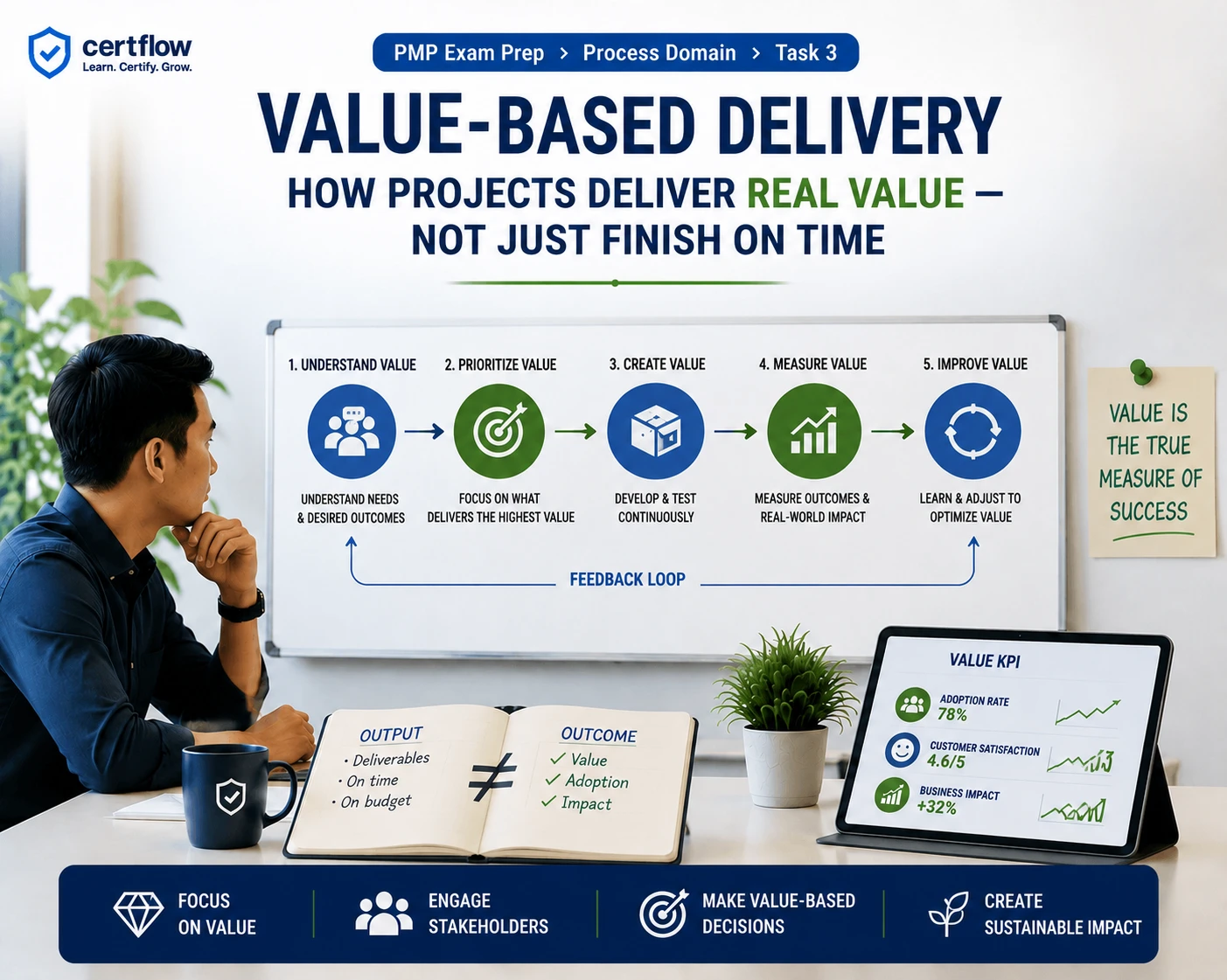
The CRM software is the output (the delivered product). But "a 30% increase in sales productivity" is the outcome (the business result) — and the outcome is what creates value. If the output does not lead to the outcome, the project has not delivered value.
This is precisely why PMBOK 8 places "Focus on Value" as one of its six foundational principles, and why the PMP Exam dedicates an entire task — Task 3 of the Process Domain — to "Value-Based Delivery."
What Is "Value" in a Project — Really?
Before diving into the how, we need to align on: what is value? PMBOK 8 defines value as the total worth of a project's outcomes and the net benefits to stakeholders — including financial contributions, social benefits, or the value that customers perceive from the project's results.
What matters is being able to distinguish between three layers of value:
The 3-Layer Value Model
Layer | Definition | Example (CRM Project) | Who is responsible? |
|---|---|---|---|
Output | The tangible product the project creates | The deployed CRM software | Project Team |
Outcome | The business result achieved through the output | Sales team increases calls by 30% per day through CRM | PM + Business Owner |
Benefit | The long-term value for the organization | Revenue grows 15% within 12 months | Sponsor + Program Mgr |
The PM is accountable for outputs (certainly) and outcomes (largely). Benefits typically materialize after the project closes — but the PM must design outputs in a way that enables outcomes and benefits to occur.
Returning to the CRM example: if the PM recognized that "outcome = the sales team changing their behavior," they would have added supporting deliverables to the scope: training programs, user guides, and a change management plan. Good output + Outcome design = Value delivery.
So how do you execute value-based delivery in practice? PMBOK 8 and the PMP ECO describe 6 steps that form a continuous cycle:
The Value-Based Delivery Cycle
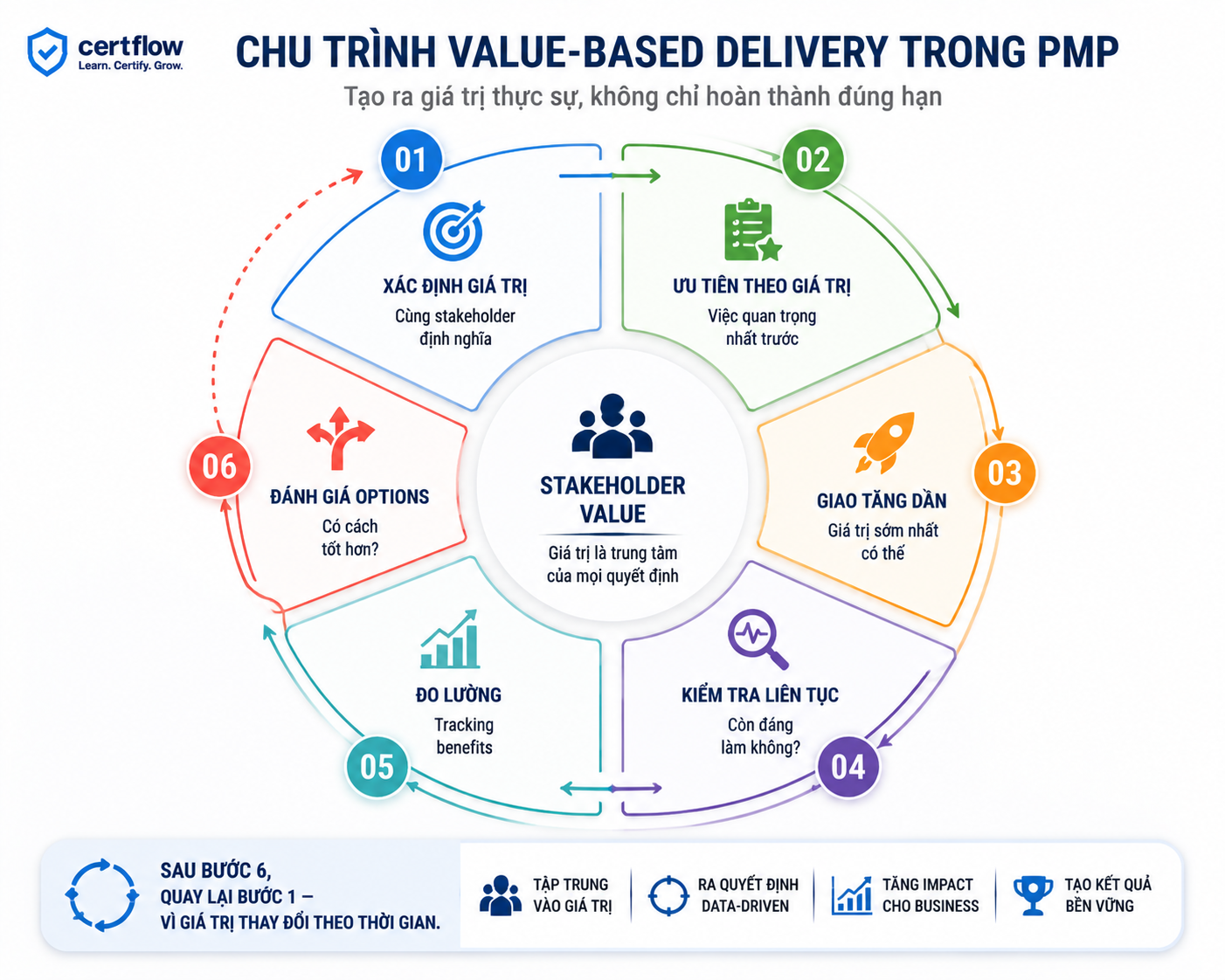
Let's explore each step in depth.
Step 1: Define Value Together with Stakeholders
Value is not something the PM defines alone — it must be co-created with stakeholders. The challenge is: each stakeholder sees "value" differently. The CFO cares about ROI. End users care about experience. The regulatory board cares about compliance. The community cares about social impact.
PMBOK 8 lists four primary types of value:
- Tangible/Financial — Revenue growth, cost reduction, ROI, NPV, market share. Measurable in numbers.
- Intangible — Customer satisfaction, brand reputation, employee morale, competitive advantage. Difficult to measure but very real.
- Social — Community benefits, access to education, health improvements, environmental impact.
- Strategic — Market positioning, innovation capability, organizational agility.
Key tools for defining value include: the Business Case (describes why the project exists), the Benefits Management Plan (when and how benefits will be realized), and the Value Breakdown Structure (VBS) — a new tool in PMBOK 8 that helps decompose value by deliverable.
The Golden Question for Stakeholders
"If this project is a perfect success, how will your life or work be different?" — This question shifts focus from features (output) to impact (outcome). It is the starting point for identifying genuine value.
Step 2: Prioritize Work by Value
Once you know where value lies, the next step is to sequence work so that the highest-value items are delivered first. This principle applies to both predictive approaches (prioritizing work packages in the WBS) and adaptive approaches (prioritizing user stories in the backlog).
The three most common prioritization models every PM needs to know:
3 Prioritization Models
MoSCoW
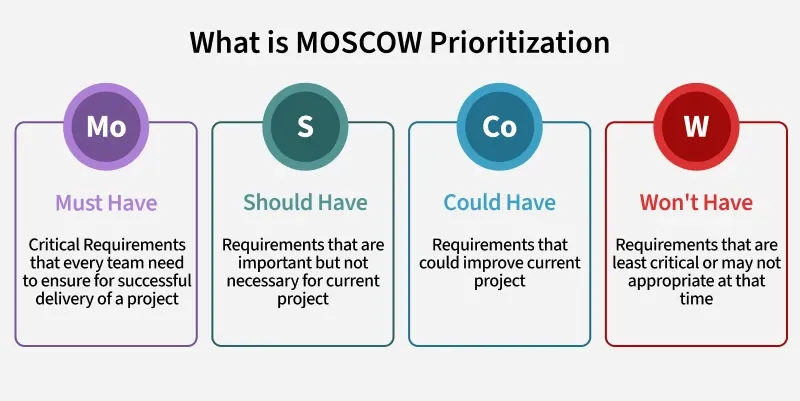
Clear categorization
Must have — without this, the project fails. Should have — important but a workaround exists. Could have — nice-to-have. Won't have (this time) — known but not included this iteration. Best for quick scope decisions.
WSJF

Weighted Shortest Job First
Formula: (Business Value + Time Criticality + Risk Reduction) ÷ Job Size. Prioritizes items with the highest value relative to the smallest effort. Widely used in SAFe® and agile environments.
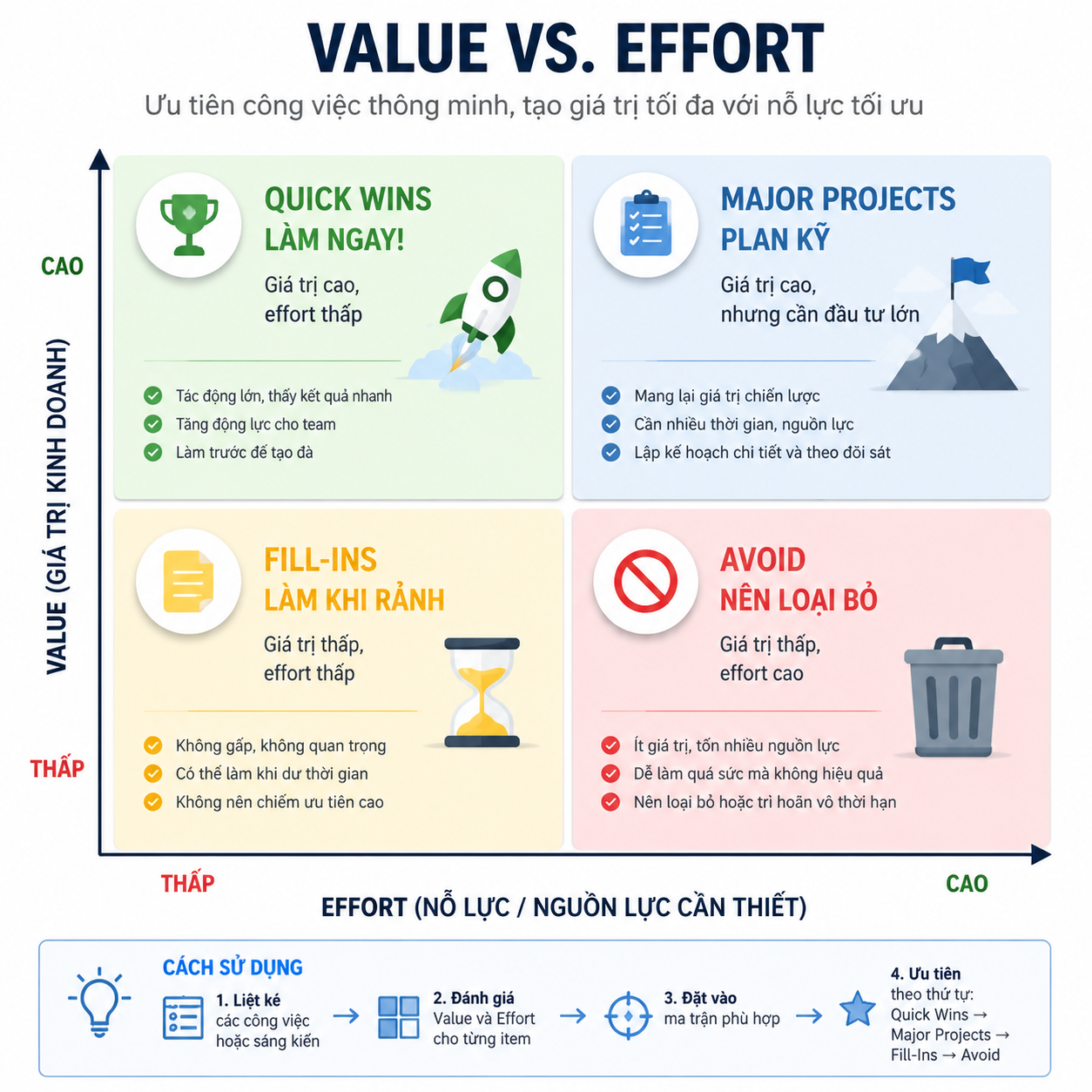
Value vs. Effort
2×2 Matrix
Visual and easy to apply in any context. Classifies each item along 2 axes: business value (high/low) and required effort (high/low).
The Value vs. Effort matrix is especially effective when the team needs to make fast decisions:
Value vs. Effort Matrix
Beyond these three models, two additional concepts are also important: the Kano Model helps classify features by their effect on satisfaction — Must-be (basic needs; their absence causes dissatisfaction), One-dimensional (more is better), and Attractive (exceeds expectations, creates delight). Cost of Delay measures the value lost each week if delivery is postponed — features with a high Cost of Delay should be prioritized first.
💡 PMP Exam Tip: When a question asks "how should the PM prioritize the backlog" — the correct answer is always based on business value, not technical complexity, team preference, or ease of implementation. In an agile context, "the product owner prioritizes based on value" is typically the correct answer.
Step 3: Deliver Value Incrementally, as Early as Possible
PMBOK 8 emphasizes: "Value can be realized throughout the project, at the end of the project, or following project completion." A skilled PM finds every opportunity to deliver value as early as possible — rather than waiting until the final day to "reveal" the product.
There are four delivery models, from least flexible to most flexible:
4 Delivery Cadence Models (PMBOK 8)
📦 Single Delivery
Everything delivered at project end. Example: building a house — only usable when complete
📦📦 Multiple Deliveries
Multiple components delivered at different times. Example: clinical trials Phase 1, 2, 3
🔄 Periodic Deliveries
Regular, fixed schedule. Example: software release every 2 weeks
♾️ Continuous Delivery
Ongoing. CI/CD — deploy as soon as a feature is ready
Minimum Viable Product (MVP) — Deliver Value Fastest
An MVP is the minimal version of a product — just enough features for customers to use and provide feedback. PMBOK 8 states clearly: when the market is unclear and customer preferences are unknown, "adopting an iterative approach with a clear MVP could provide rapid feedback."
Why does incremental delivery create more value than a big-bang approach?
- Earlier — Stakeholders receive value sooner, start benefiting earlier, and improve cash flow.
- Feedback loop — Each increment is a learning opportunity. A mistake in Sprint 3 can be corrected; a mistake at month 18 is too late.
- Reduced risk — Defects are discovered early, when the cost of change is still low.
- Motivation — The team sees a real product used by real users — not just a plan on paper.
- Flexibility — If the market shifts, you have already delivered the most important value. The rest can be adjusted.
Step 4: Continuously Check — Is the Project Still Worth Doing?
This is a question many PMs are reluctant to ask. But PMBOK 8 is very clear:
⚠️ PMBOK 8 Warning
"If misalignment persists or the project is unlikely to deliver the intended value, it may be best to terminate the effort." — Stopping a project when the value proposition no longer holds is a responsible decision, not a failure.
The value proposition can change for many reasons: a competitor launches a similar product (first-mover advantage is lost), new technology emerges (cheaper, faster solutions), costs exceed projections (ROI decreases), stakeholders shift priorities, new laws or regulations emerge, or the organization pivots its strategy.
Value Checkpoints
In predictive projects, use phase gates/quality gates — PMBOK 8 describes: "project's performance and progress are compared to business documents. A decision (go/no-go) is made." In adaptive projects, sprint reviews serve as natural checkpoints — stakeholders view working increments and provide direct feedback. Both approaches should be supplemented with periodic business case reviews (quarterly or at milestones) to compare actual vs. expected value.
Step 5: Establish a Benefits Measurement System
"If you can't measure it, you can't manage it." A benefits measurement system must be established before the project begins — not figured out after delivery.
Common Benefits Measurement Indicators
- ROI
- Return on Investment
- NPV
- Net Present Value
- IRR
- Internal Rate of Return
- PBP
- Payback Period
- BCR
- Benefit-Cost Ratio
- NPS
- Net Promoter Score
A complete measurement system must clearly define 6 elements: Baseline (where are we now?), Target (where do we want to be?), Metrics (what do we measure?), Frequency (how often do we measure?), Data source (where does data come from?), and Responsibility (who tracks it?).
Beyond financial metrics, PMBOK 8 also references Earned Value Management (EVM) — with CPI, SPI, EAC, ETC — as a tool for measuring "value received relative to investment." And as AI becomes increasingly prevalent, PMBOK 8 notes: predictive analytics can forecast the probability of benefit realization and suggest corrective actions.
⚠️ Key Point
PMBOK 8 warns: "Measuring only output of deliverables can encourage the team to focus on creating a large volume of deliverables rather than on deliverables that provide higher customer satisfaction." — Measure the right things (outcomes) rather than simply measuring many things (outputs).
Step 6: Evaluate Delivery Options
The PM does not just execute a plan — the PM must continuously ask: "Is there a better, faster, or cheaper way to deliver value?"
Delivery options to evaluate include: Build vs. Buy vs. Partner (build it yourself, purchase an existing solution, or collaborate?), Phased delivery (deliver everything at the end vs. phase-by-phase — which phase delivers the highest value first?), MVP then iterate (minimum version first, then expand), Pivot (change direction when data shows the current approach is suboptimal), and Scope trade-offs (reduce lower-priority scope to focus on high-value items).
When evaluating options, the PM needs to analyze multiple dimensions: time-to-first-value (when will stakeholders receive their first value?), total cost of ownership (including long-term maintenance), alignment with organizational needs, risk profile, and stakeholder satisfaction. Don't choose based on a single dimension — the "cheapest" option is not necessarily the "most valuable" option.
Summary: A Mindset Shift for the PM
Value-Based Delivery is not a process or a tool — it is a mindset. PMI increasingly expects PMs to act as business partners, not merely task executors.
Three questions that value-driven PMs always ask:
- "What outcome does this deliverable create?" — If you can't answer that, it may be waste.
- "Is there a way to deliver value sooner?" — Every week of delay is value lost (Cost of Delay).
- "Is this project still worth doing?" — The courage to ask this question is the hallmark of accountable leadership.
PMBOK® 8 — Focus on Value
"A focus on value aims to maximize the return on project investments for the customer, performing organization, and/or other stakeholders. This effort involves delivering the required functionality and quality by optimizing workflows with acceptable risk exposure, using minimal necessary resources, and avoiding unnecessary rework and other types of waste."
On the PMP exam, the best answer for scenarios related to Task 3 is typically the one where the PM proactively evaluates business value, proposes delivery options, and helps stakeholders make value-based decisions — rather than simply following the original plan.
💡 Remember: projects exist to create value. Everything else — scope, schedule, budget, quality — are instruments in service of that goal.
Frequently Asked Questions (FAQ)
What is the Value Delivery System in PMBOK 8?
The Value Delivery System is a framework that describes how organizations create value through portfolios, programs, and projects. PMBOK 8 introduces this concept to remind PMs that a project does not exist in isolation — it is part of a system that creates business value for the organization. PMs need to understand how their project contributes to the business strategy.
How do outcomes and outputs differ, and why does it matter?
Outputs (deliverables): the tangible products the project creates — applications, documents, infrastructure. Outcomes: the real-world results and changes that occur from using those outputs — increased revenue, reduced processing time, improved user experience. PMBOK 8 emphasizes that PMs must focus on outcomes, not just outputs — because stakeholders need outcomes, not just deliverables.
How do you measure the business value of an IT project?
Common methods include: ROI (Return on Investment), NPV (Net Present Value), IRR (Internal Rate of Return), Payback Period. For agile projects, you can measure incremental value after each sprint: user adoption rate, feature utilization, customer satisfaction scores. The PM should work with business stakeholders to define success metrics before the project begins.
Now that you understand Value-Based Delivery — it's time to practice with real exam questions.
Next article: Project Resource Planning according to PMBOK 8
Try Free PMP Practice Questions →
Official References: