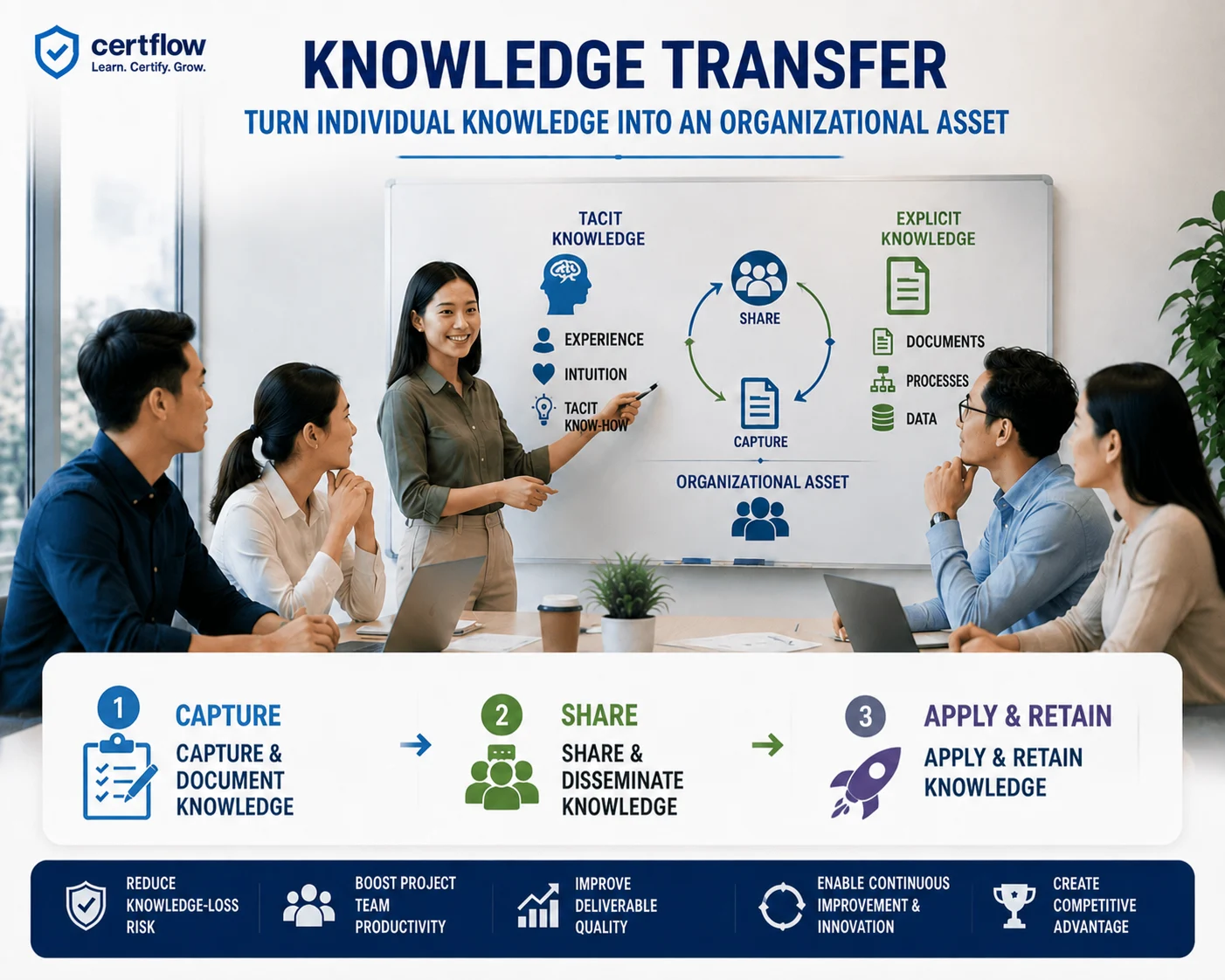
When a key team member leaves, knowledge walks out with them. PMBOK 8 makes knowledge transfer your responsibility as PM — here's how to do it right.
1. Why Knowledge Transfer Is the Most Important "Insurance" for Your Project
Imagine this scenario: you are managing a bank system migration project. The developer lead — the only person who understands the data mapping logic between the old and new systems — announces they are leaving in 4 weeks. No documentation exists to describe this logic. Nobody else on the team understands it. Four weeks to transfer 8 years of accumulated knowledge.
This isn't a hypothetical scenario — it happens every day in organizations everywhere. The consequences: months of delays, budget overruns, quality issues, and sometimes even project cancellation.
PMBOK 8 dedicates an entire process — Manage Project Knowledge — to this issue, because knowledge is the most valuable yet most easily lost asset on any project.
PMBOK® 8, Section 2.1.6.6: "Managing knowledge involves more than just documenting explicit knowledge for sharing. Codified explicit knowledge lacks context and is open to different interpretations. Tacit knowledge has further context but is difficult to codify."
2. Tacit vs. Explicit Knowledge — Two Types, Two Management Approaches
This is the most important distinction in knowledge management — and the foundation for everything that follows.
Explicit Knowledge | Tacit Knowledge | |
|---|---|---|
PMBOK 8 Definition | "Formal and systematic; can be codified using words, pictures, or numbers" | "Embedded in a person's mind, highly personal, difficult to articulate" |
Characteristics | Codifiable, structured, easily communicated | Personal, experience-based, challenging to transfer |
Examples | SOPs, technical docs, lessons learned register, templates, checklists | "Vendor X typically delays 2 weeks — you need extra buffer." This knowledge doesn't appear in any document. |
Shared through | Databases, documents, manuals, web searches | Conversations, interactions, mentoring, shadowing |
Limitations | "Lacks context, open to different interpretations" | "Difficult to formalize and communicate" |
PMBOK® 8: "Tacit knowledge resides in the minds of individual experts or in social groups and is often shared through conversations and interactions. An important objective of knowledge management is converting tacit knowledge into explicit knowledge when possible."
Many PMs only manage explicit knowledge (writing documents, updating wikis). But tacit knowledge — insights, experience, gut feelings, knowing who actually makes decisions in the organization — is often far more valuable. Great PMs manage both.
AI and Knowledge — What's New in PMBOK 8
PMBOK® 8: "The latest AI technologies, such as interview bots, add new, strong capabilities in capturing and sharing both tacit and explicit knowledge." However: "Significant risks are associated with the use of AI, including unintentionally exposing sensitive information and experiencing AI hallucinations. Projects should have responsible AI policies to manage the related knowledge."
3. The ECO 3-Step Knowledge Transfer Framework
Step | Enabler | Core Question | Timing |
|---|---|---|---|
1 | Identify critical knowledge | What knowledge cannot be lost? | Project start + during personnel changes |
2 | Gather knowledge | How do you capture both explicit and tacit knowledge? | Continuously — not just at project end |
3 | Foster environment | Why don't people share? How do you change that? | From day one |
4. Step 1: Identify Critical Knowledge
Not all knowledge needs to be transferred — the PM must identify which knowledge is critical to project success.
4 Types of Critical Knowledge
Type | Description | Example | Risk if Lost |
|---|---|---|---|
Domain / Industry | Understanding of the industry, regulations, and market | Compliance requirements in healthcare, building codes | Violations, fines, rework |
Technical | Deep technical expertise, architecture, legacy systems | Only one developer understands how the legacy API works | Project stall, quality issues |
Organizational | Internal processes, culture, stakeholder dynamics | "Who really approves decisions? Where does informal power lie?" | Political mistakes, stakeholder mismanagement |
Project-Specific | Decisions made, the reasoning behind them, and workarounds applied | "Why did we choose microservices over a monolith?" | Repeat mistakes, wrong architectural decisions |
Single Point of Failure (SPOF)
When critical knowledge exists only in ONE person's head — that is the greatest risk. PMBOK 8 links knowledge management to risk management: if that person leaves, the project suffers severely.
Ways to identify SPOFs: Knowledge mapping — list the knowledge required for each work package, who owns it, and whether there is a backup. Risk register — review risks related to "key person leaves." Retrospectives — let the team self-identify knowledge gaps. "Bus factor" — if this person were hit by a bus (or won the lottery and quit), could the project continue?
PMP Exam Tip: When an exam question describes a "critical team member is leaving" scenario, the best answer always involves proactive knowledge transfer (pair with others, document critical knowledge, mentor handoff) — NOT "try to retain them" or "find a replacement with same skills."
5. Step 2: Gather Knowledge — Tools for Each Type
PMBOK 8 provides two distinct sets of tools for the two types of knowledge. This distinction matters because using the wrong tool for the wrong type of knowledge will be ineffective.
Information Management — For Explicit Knowledge
PMBOK 8: "Information management tools are effective for sharing simple, unambiguous, codified explicit knowledge."
Lessons Learned Register — Capture CONTINUOUSLY — not just at project end. PMBOK 8: "Lessons learned are incorporated during the ongoing processes, not only at the end of the project."
PMIS — Document management systems, wikis, knowledge bases.
Methods for codifying — Templates, checklists, SOPs, runbooks, architecture decision records.
Information gathering — Web searches, published articles, industry reports.
PMBOK® 8 Enhancement tip: "Tools that connect people to information can be enhanced by adding an element of interaction (e.g., including a 'contact me' function so users can get in touch with the originators of the lessons)." — Knowledge lives when someone explains it, not when it's just text on a page.
Knowledge Management — For Tacit Knowledge
PMBOK 8: "Knowledge management tools connect people so they can work together to create new knowledge, share tacit knowledge, and integrate the knowledge of diverse team members."
Tool | Description | When to Use |
|---|---|---|
Retrospectives | "Workshop to explore work and results to improve both process and product." Conducted frequently. | At the end of each sprint/iteration — at minimum |
Storytelling | New in PMBOK 8: "Powerful tool for conveying lessons learned through narratives. Makes information relatable and memorable." | When transferring context-rich experience |
After-Action Reviews | "Structured process: what happened, why, how to improve." Originating from U.S. Army. | After major events (go-live, major incident, milestone) |
Communities of Practice | Groups of experts sharing domain knowledge. "May generate insights that lead to improved processes." | Cross-project, ongoing knowledge sharing |
Knowledge fairs/cafés | Informal events for experts to share, ask questions, and network. | Quarterly or when cross-pollination is needed |
Work shadowing | Observing an expert at work, learning through observation. | Onboarding, succession planning |
Training with interaction | Not just reading documents — learning through interaction and hands-on practice. | When transferring hands-on skills |
AI Interview Bots | New in PMBOK 8: AI interviews experts, converting tacit knowledge into explicit knowledge. | When capturing knowledge at scale. Requires responsible AI policies. |
6. Step 3: Foster an Environment That Encourages Sharing
This is the most critical enabler — tools and processes are meaningless if the culture doesn't encourage sharing.
Why People DON'T Share
Barrier | Mindset | Solution |
|---|---|---|
Fear of losing "power" | "Knowledge = power. Sharing = losing your advantage" | Reward sharing behavior and recognize those who share the most |
No time | "The deadline is tight — documentation is a luxury" | Build documentation time into sprints/schedule; run documentation sprints |
No perceived value | "I write wiki pages nobody reads" | Demonstrate value — show how past lessons saved time/money |
Lack of trust | "If I share my mistakes, I'll be judged" | Psychological safety — celebrate learning from failures |
No mechanism | "I don't know where to share or who to share with" | Clear channels, easy-to-use platforms, communities of practice |
4 Ways a PM Fosters a Sharing Environment
PMBOK® 8: "Tacit knowledge can be shared within a project by fostering a collaborative and trust-filled environment. Creating opportunities for knowledge transfer through open communication, mentoring relationships, and team-building activities."
1. Psychological Safety — People only share when they feel safe. PM modeling desired behaviors: share your own mistakes first, celebrate lessons from failures, and ensure no one is blamed for acknowledging gaps.
2. Face-to-face & Interactions — PMBOK 8: "Encouraging face-to-face interactions and hosting regular brainstorming sessions can help make implicit knowledge more accessible." Colocation, pair programming, mob programming, cross-functional workshops — all create opportunities for tacit knowledge to flow naturally.
3. Recognition — Recognize and reward those who share knowledge. Integrate knowledge sharing into the team charter and performance criteria. "Knowledge contribution" should be valued as much as "code contribution."
4. Built-in Rituals — Retrospectives every sprint. Lunch-and-learn sessions. Pair rotations — rotate working pairs to spread knowledge. Onboarding buddies — pair new members with experienced colleagues. Documentation sprints — set aside dedicated time for documentation.
7. Knowledge Transfer at Project Close
PMBOK 8 (Section 2.1.6.9) lists knowledge transfer as a mandatory activity when closing a project:
Predictive: Manage knowledge sharing and transfer. Identify and document lessons learned. Archive project information for future organizational use. Transfer products/services to production/operations. Collect suggestions for improving organizational policies.
Adaptive: Facilitate knowledge-sharing sessions. Hold final retrospective. Document key decisions, architecture rationale, and technical debt.
The Most Common Mistake: "We'll write our lessons learned when the project is done." PMBOK 8 warns: "Determining how and when lessons learned and retrospectives will be conducted throughout the project helps support knowledge management." — Waiting until the end means losing most of the knowledge, because people have either forgotten or already left.
8. PMP Exam Tips for Knowledge Management
📍 Tip 1 — Key person leaving: When the exam describes a "critical team member is leaving" scenario, the correct answer is always proactive knowledge transfer (pair with others, document, mentor). NOT "retain them" (outside the PM's control), "find a replacement" (doesn't preserve knowledge), or "ask them to finish all work before leaving" (unrealistic).
📍 Tip 2 — Lessons learned are continuous: When the question asks "when should lessons learned be captured?" — the answer is THROUGHOUT the project, NOT "at the end." PMBOK 8 states clearly: "incorporated during ongoing processes, not only at the end."
📍 Tip 3 — Tacit knowledge beats documentation alone: When the exam describes "a team member discovered a workaround" — the best answer usually includes BOTH interactive sharing (demo, workshop) AND documentation. Documentation alone = lost context. Verbal sharing alone = nothing preserved.
📍 Tip 4 — Environment beats tools: When the question asks "why doesn't the team share knowledge?" — the answer usually points to environment/culture (lack of trust, no time allocated, no incentive) — NOT "wrong tools" or "not enough documentation."
9. Ten Situational Multiple-Choice Questions
Question 1
Your project's lead database architect, the only person who understands complex data migration logic, will leave in 4 weeks. No documentation exists for this critical area.
What should you do FIRST?
A. Request HR to make a counteroffer.
B. Immediately begin knowledge transfer: pair the architect with others for hands-on sessions, have them document the logic, record video walkthroughs, and ensure at least two people can perform the work.
C. Start recruiting a replacement with similar experience.
D. Ask the architect to complete all migration work before leaving.
Question 2
Your agile team runs retrospectives every sprint, but the same issues keep recurring. The lessons learned register has 47 entries but nobody reads it.
What is the ROOT CAUSE?
A. The team lacks discipline — enforce mandatory reading.
B. The retrospective format is stale — try different techniques.
C. Knowledge is captured but not integrated into processes. Transform retrospective action items into concrete changes to DoD, working agreements, or sprint practices.
D. Cancel retrospectives and replace with monthly workshops.
Question 3
A senior developer in India discovered an innovative workaround for a recurring integration issue. He mentioned it casually in a standup, but teams in the US, Germany, and Brazil don't seem to have noticed.
How should you ensure this knowledge is transferred?
A. Ask the developer to document the workaround on the wiki.
B. Send an email highlighting the workaround.
C. Organize a live demo session where the developer demonstrates the workaround, followed by Q&A, then document it on the wiki with a "contact me" link for follow-up.
D. Add the workaround to the coding standards.
Question 4
A new team member joins midway. They're technically skilled but have no context about past decisions or stakeholder dynamics. After a week reading comprehensive documentation, they say they feel "overwhelmed and lost."
What is the MOST effective onboarding approach?
A. Give them more time — they'll absorb the docs eventually.
B. Assign them a small, well-defined task to build confidence.
C. Pair them with an experienced team member (buddy system) who shares tacit knowledge through daily collaboration, explains the "why" behind decisions, and introduces them to stakeholders.
D. Schedule presentations where each team member explains their area.
Question 5
Three similar projects run simultaneously in your organization. Each team independently solves similar technical challenges, sometimes arriving at different solutions. No cross-project knowledge sharing exists.
What should you recommend?
A. Consolidate under one PM for consistency.
B. Create a standardized technical approach all must follow.
C. Establish a Community of Practice where technical leads regularly share solutions, challenges, and best practices — enabling organic knowledge transfer without forcing standardization.
D. Create a shared Slack channel for updates.
Question 6
You're using AI tools to capture project knowledge through automated expert interviews. A team member raises concerns that the AI extracted and stored a client's proprietary process information without authorization.
What should you do?
A. Remove the specific client information and continue using the tool.
B. Immediately pause the AI tool, assess the data exposure scope, consult legal/compliance, implement responsible AI policies, and only resume with proper safeguards.
C. Reassure the team the tool is organizationally approved and data is stored securely.
D. Switch to manual knowledge capture and discontinue AI tools.
Question 7
Your development team created extensive technical documentation for the operations team who will support the product post-launch. Operations says they don't understand it because it's "written by developers, for developers."
What is the BEST approach?
A. Ask developers to rewrite in simpler language.
B. Hire a technical writer to translate.
C. Organize collaborative sessions where developers walk operations through the system hands-on, then co-create operations-focused documentation (runbooks, troubleshooting guides) reflecting operations' actual needs.
D. Schedule formal presentations of the system architecture.
Question 8
During a retrospective, a team member admits they made a significant architectural mistake three sprints ago but didn't speak up because they were afraid of blame. Other members are frustrated because weeks of work may need refactoring.
What does this reveal about the knowledge transfer environment?
A. The team needs code review gates to catch mistakes earlier.
B. Thank the member for honesty, acknowledge frustration, then address BOTH the technical issue AND the psychological safety gap — if team members fear sharing mistakes, critical knowledge won't transfer and problems compound silently.
C. Focus on fixing the technical issue first; discuss culture later.
D. Implement a blameless post-incident review process.
Question 9
Your 2-year project has had several team composition changes. New members frequently ask: "Why did we choose this approach?" and "What alternatives were considered?" The original decision-makers have all left. Documentation shows WHAT was decided but not WHY.
What knowledge management failure occurred?
A. The previous PM should have written better meeting minutes.
B. Tacit knowledge (reasoning, context, alternatives) was never converted to explicit knowledge. For future projects, implement decision journals that capture context, alternatives, trade-offs, and rationale — plus mentoring overlaps during team transitions.
C. The organization should prevent team members from leaving without proper handoff.
D. This is inevitable in long projects — help the current team accept the existing approach.
Question 10
During project closing, the sponsor asks: "What did we learn that will help the organization?" Your team has a lessons learned register with 47 entries, but most are vague: "communication should be better" with no actionable insights.
What does this reveal, and what should you do?
A. Train the team on writing better lessons learned entries.
B. Filter to the top 5-10 most impactful lessons.
C. The gathering mechanism exists but quality was poor because deep reflection wasn't facilitated. Organize a structured final retrospective using After-Action Reviews or Storytelling to extract meaningful, actionable insights. For future projects, improve retrospective facilitation from the start.
D. This is normal — the real value was in the discussions, not documentation.
Answer Key
Question 1: Answer: B
— This is a classic SPOF scenario. The priority is capturing and transferring knowledge using multiple methods (pairing = tacit, documentation = explicit, video = both). Retention (A) is outside the PM's control. Replacement (C) doesn't preserve knowledge. Rushing work (D) doesn't build team capability.
Question 2: Answer: C
— PMBOK 8: "Codified explicit knowledge lacks context and is open to different interpretations." A register nobody reads = explicit knowledge failing to transfer. The fix: connect lessons to actionable process changes. "Lessons learned entries may be analyzed to identify common issues that can be addressed by changes to project procedures."
Question 3: Answer: C
— The workaround is TACIT knowledge. PMBOK 8: "Knowledge management tools connect people to share tacit knowledge." A live demo transfers context that documentation alone misses. The "contact me" function aligns with PMBOK 8's enhancement tip. Documentation alone (A, B) captures the explicit form but loses the WHY and WHEN.
Question 4: Answer: C
— PMBOK 8: "Tacit knowledge is often shared through conversations and interactions." Documentation "lacks context." A buddy system transfers tacit knowledge through daily interaction — the new member learns not just WHAT but WHY, not just WHO but HOW. Presentations (D) are one-directional. More reading (A) amplifies the problem.
Question 5: Answer: C
— PMBOK 8: "Communities of practice and subject matter experts may generate insights that lead to improved control processes." CoPs enable organic exchange without rigid standardization (B) that may not fit each project's context. Consolidation (A) is structural overreaction. A Slack channel (D) is a tool without structure for meaningful exchange.
Question 6: Answer: B
— PMBOK 8: "Significant risks are associated with AI, including unintentionally exposing sensitive information. Projects should have responsible AI policies." This is a data governance issue requiring immediate action. Simply removing data (A) doesn't fix the systemic risk. Reassurance (C) ignores a legitimate concern. Abandoning AI (D) is overreaction.
Question 7: Answer: C
— Developers' docs capture THEIR explicit knowledge but not the tacit context operations needs. PMBOK 8: "Encouraging face-to-face interactions helps make implicit knowledge more accessible." Co-creating ensures docs are written FOR the audience. Rewriting (A) still lacks operations context. Presentations (D) are one-directional.
Question 8: Answer: B
— PMBOK 8: knowledge sharing requires a "collaborative and TRUST-FILLED environment." Fear of blame is the #1 blocker — especially knowledge about mistakes, which is often the MOST valuable. The PM must validate honesty (modeling desired behavior), then address psychological safety systemically, then the technical problem. Blameless reviews (D) are good but the root issue is broader.
Question 9: Answer: B
— PMBOK 8: "An important objective of knowledge management is converting tacit knowledge into explicit knowledge when possible." The WHY behind decisions is tacit knowledge that left when people did. Meeting minutes (A) capture discussions but not structured reasoning. Retention policies (C) are impractical. Accepting knowledge loss (D) wastes organizational learning.
Question 10: Answer: C
— PMBOK 8 lists After-Action Reviews, Storytelling, and Retrospectives as separate tools for knowledge management — each extracts different types of insights. Vague entries = gathering technique was too superficial. Training alone (A) doesn't fix facilitation. Filtering (B) doesn't improve quality. Dismissing documentation value (D) fails the organization — OPA updates are a key output.
10. Conclusion
Knowledge Transfer is the final task in the People Domain — but its impact extends far beyond the current project. Three key takeaways:
1. Tacit knowledge is gold — explicit knowledge is the map to the gold — You need both. Documentation nobody reads is waste. Insights nobody records are lost the moment their owner walks out the door. PMs must use the RIGHT tool for the RIGHT type of knowledge: Information Management for explicit, Knowledge Management for tacit.
2. Continuously — not just at project end — "We'll write lessons learned when we're done" is the most common mistake. PMBOK 8 is clear: lessons learned must be captured CONTINUOUSLY. The best knowledge is captured while it's still fresh — waiting 6 months and trying to remember is too late.
3. Environment beats tools — Even the best wiki is useless if the team doesn't want to share. Psychological safety, recognition, built-in rituals (retrospectives, pair rotations, onboarding buddies), and leadership modeling — these are the foundation. When people FEEL safe and valued, knowledge flows naturally.
PMBOK® 8, Section 2.1.6.6: "Effective knowledge-sharing mechanisms foster a collaborative, evidence-based working environment throughout the project. Through these mechanisms, valuable insights are captured, shared, and utilized to enhance project outcomes and drive continuous improvement."
Frequently Asked Questions (FAQ)
How do explicit knowledge and tacit knowledge differ in a project context?
Explicit knowledge can be documented and shared easily — process docs, templates, lessons learned reports, runbooks. Tacit knowledge is "in the heads" of experienced practitioners — judgment calls, intuitions, relationship knowledge, hands-on know-how. Explicit knowledge is easy to transfer; tacit knowledge is much harder and requires mentoring, shadowing, and pair working to share.
How do you capture tacit knowledge before a team member leaves?
Techniques: (1) Knowledge interviews — structured conversations covering decisions, reasoning, and lessons. (2) Shadowing — a junior member works alongside the senior for 2–4 weeks before they leave. (3) Pair programming/working — transferring knowledge through hands-on work. (4) After-action reviews — debriefs after each significant event. (5) Community of Practice — create a forum for ongoing knowledge sharing.
How are Organizational Process Assets (OPA) updated after a project?
OPAs include: templates, processes, policies, procedures, historical databases, and the lessons learned repository. After a project, the PM should update: the lessons learned database (both successes and failures), estimate databases (actuals vs. planned), and updated templates reflecting improvements. PMBOK 8 treats OPA updates as a deliverable of project closure, not an optional activity.
Now that you understand knowledge transfer in projects, it's time to put it into practice with real exam questions.
Next article: Communication Planning in Projects According to PMBOK 8
Closing projects and updating lessons learned according to PMBOK 8
Continuous improvement with Lessons Learned and OPAs according to PMBOK 8
Try Free PMP Practice Questions →
Official References: