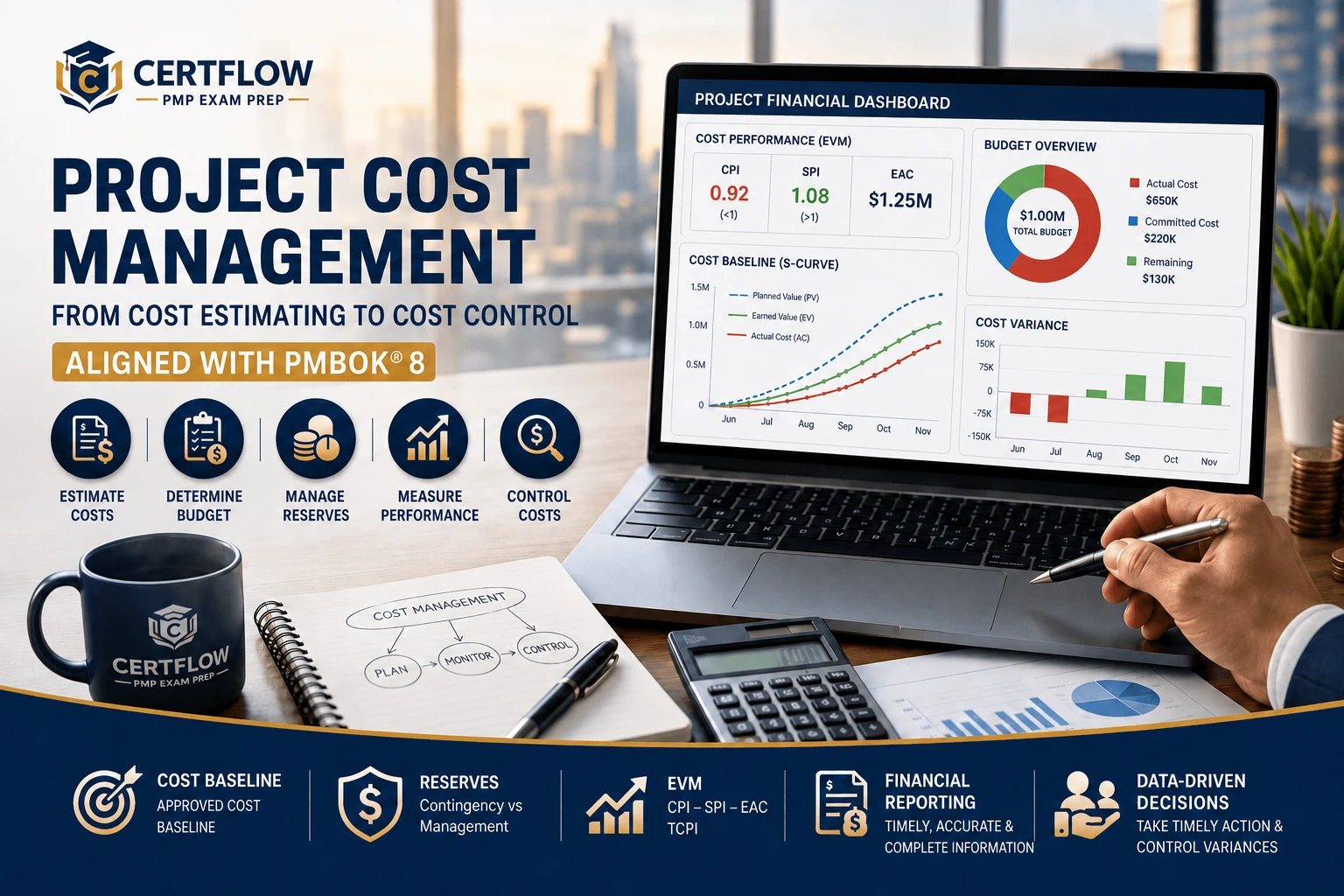
Quản lý tài chính trong PMBOK 8 không chỉ là EVM — mà là tư duy value-for-money trong toàn bộ vòng đời dự án. Bài này đi qua ước tính, baseline và kiểm soát chi phí.
1. Tại sao quản lý tài chính quyết định sống còn dự án?
Một PMO Director từng nói: "Dự án có thể chậm tiến độ và được tha thứ. Nhưng dự án vượt budget thì bị cancel." Đó không phải quá lời — trong hầu hết tổ chức, tiền là ràng buộc cứng nhất.
PMBOK 8 xác nhận rõ: tài chính dự án phục vụ 4 mục đích:
1. Evaluating performance — So sánh actual vs. plan
2. Tracking utilization — Resources, work completed, budget expended
3. Demonstrating accountability — Cho stakeholders và governance
4. Making informed decisions — Data-driven resource allocation
PMBOK® 8, Section 2.4: "All projects are investments, and the value proposition of any investment is sensitive to the amount being invested. Consequently, cost overruns or underruns can impact projects significantly."
2. Khái niệm nền tảng: Cost Baseline, Reserves, và Budget
Đây là phần phải nắm vững — cả cho thực tế lẫn PMP exam. PMBOK 8 phân biệt rõ ràng:
Khái niệm | Định nghĩa PMBOK 8 | Ai kiểm soát? |
|---|---|---|
Work Package Estimates | Chi phí ước tính cho từng work package | PM + Team |
Contingency Reserve | "Time or money allocated for known risks with active response strategies" (known-unknowns) | PM (thường) |
Cost Baseline | "Approved time-phased project budget, excluding management reserves" | PM, thay đổi qua CCB |
Management Reserve | "Time or money for unforeseen work within scope" (unknown-unknowns) | Senior Management |
Project Budget (BAC) | Cost Baseline + Management Reserve | Sponsor / Senior Mgmt |
Công thức xây dựng budget:
Work Package Estimates + Contingency Reserve = Cost Baseline.
Cost Baseline + Management Reserve = Project Budget (BAC).
PMBOK® 8 lưu ý: "Based on different organizational preferences, contingency reserve may be INSIDE the cost baseline (managed implicitly) or OUTSIDE the cost baseline (managed explicitly)." — Đề thi PMP có thể cho cả hai cách, nhưng truyền thống: contingency reserve nằm TRONG cost baseline.
CapEx vs. OpEx — Financial constraints
PMBOK 8 mới nhấn mạnh: CapEx (Capital Expenditures) = đầu tư dài hạn (mua equipment, build infrastructure). OpEx (Operational Expenditures) = chi phí vận hành (thuê services, salaries, maintenance). Nhiều tổ chức có budget riêng cho CapEx và OpEx — PM phải hiểu phân loại này để lập ngân sách đúng cách.
3. Framework 7 enablers quản lý tài chính
Nhóm | Enabler | Câu hỏi cốt lõi |
|---|---|---|
Planning | Analyze financial needs | Dự án cần bao nhiêu tiền, từ đâu? |
Planning | Quantify risk allocations | Dành bao nhiêu cho rủi ro? |
Tracking | Plan spend tracking | Theo dõi chi tiêu thế nào? |
Reporting | Plan financial reporting | Báo cáo tài chính cho ai, khi nào? |
Proactive | Anticipate future challenges | Rủi ro tài chính nào đang đến? |
Control | Monitor variations + governance | Biến động ở đâu, hành động gì? |
Control | Manage financial reserves | Reserves đang dùng thế nào? |
4. Phân tích nhu cầu tài chính và ước tính chi phí
Analyze Financial Needs
PM phải hiểu: nguồn funding (internal budgets, customer contracts, grants, crowdfunding), financial constraints (CapEx vs OpEx, fiscal year boundaries, currency restrictions), value definition (ROI, IRR, payback period, NPV, ROA), và alignment với organizational strategy.
PMBOK® 8: "Project management practitioners should have an understanding of how a project acquires its financial resources. Monies can be provided by several means including internal organizational budgets, customer contracts, grants, or customer-driven crowdfunding."
Estimate Costs — 6 kỹ thuật từ PMBOK 8
Technique | Mô tả | Accuracy | Khi nào dùng |
|---|---|---|---|
Analogous | Dựa trên dự án tương tự trước đó | -25% to +75% (ROM) | Sớm, ít data |
Parametric | Statistical relationship (VD: $/m²) | -10% to +25% | Có reliable parameters |
Bottom-up | Estimate từng work package, cộng lại | -5% to +10% | Scope rõ, cần chính xác |
Multipoint (PERT) | (O + 4ML + P) / 6 | Tùy range | Uncertainty cao |
Reserve analysis | Determine contingency + management reserves | N/A | Mọi dự án |
Cost of Quality | Prevention + appraisal + failure costs | N/A | Quality-sensitive projects |
5. Reserves — Contingency vs. Management
Đây là phần hay bị nhầm nhất trong PMP exam. Hãy phân biệt rõ:
Contingency Reserve | Management Reserve | |
|---|---|---|
Dành cho | Known risks (known-unknowns) — risks đã identified trong risk register | Unknown risks (unknown-unknowns) — unforeseen events |
Nằm trong | Cost baseline (thường) | NGOÀI cost baseline, trong project budget |
Ai dùng? | PM có quyền sử dụng | Senior management approval required |
Tính bằng | Risk analysis: EMV, simulation, % estimate | % of total project cost (thường 5-10%) |
Ví dụ | "Weather may delay 2 weeks — buffer $50K" | "Something unexpected we haven't thought of yet" |
💡Mẹo PMP: "PM uses contingency reserve without approval" = ĐÚNG. "PM uses management reserve without approval" = SAI (cần senior management approval). Khi đề thi mô tả "unforeseen event occurs" — đáp án thường liên quan đến management reserve, KHÔNG phải contingency reserve.
6. Earned Value Management — Bộ công cụ giám sát tài chính
EVM là framework quan trọng nhất cho financial monitoring — và là topic thi PMP nặng nhất trong Process Domain.
3 Giá trị cơ bản
Metric | Ý nghĩa | Cách tính |
|---|---|---|
PV (Planned Value) | Ngân sách approved cho công việc planned tại thời điểm đo | Từ cost baseline |
EV (Earned Value) | Giá trị công việc ĐÃ HOÀN THÀNH tại thời điểm đo | % complete × BAC |
AC (Actual Cost) | Chi phí THỰC TẾ đã tiêu cho công việc hoàn thành | Từ accounting records |
Variance Analysis — "Đang ở đâu so với plan?"
Metric | Công thức | Ý nghĩa | Giá trị tốt |
|---|---|---|---|
CV (Cost Variance) | EV - AC | Đang over hay under budget? | CV > 0 = under budget |
SV (Schedule Variance) | EV - PV | Đang ahead hay behind schedule? | SV > 0 = ahead |
CPI (Cost Performance Index) | EV / AC | Mỗi $1 chi ra, nhận $? giá trị | CPI > 1.0 = efficient |
SPI (Schedule Performance Index) | EV / PV | Tiến độ đạt bao nhiêu % kế hoạch? | SPI > 1.0 = ahead |
Forecasting — "Dự án sẽ tốn bao nhiêu khi hoàn thành?"
Metric | Công thức phổ biến | Ý nghĩa | Khi nào dùng |
|---|---|---|---|
EAC (Estimate at Completion) | BAC / CPI | Tổng chi phí dự kiến khi hoàn thành | Variance tiếp tục ở mức hiện tại |
ETC (Estimate to Complete) | EAC - AC | Còn cần bao nhiêu từ bây giờ? | Planning remaining work |
VAC (Variance at Completion) | BAC - EAC | Over/under tổng budget? | Báo cáo cho sponsor |
TCPI (To-Complete Performance Index) | (BAC - EV) / (BAC - AC) | CPI cần đạt từ giờ trở đi | Đánh giá khả thi |
PMBOK® 8: "EVM integrates the scope, schedule, and cost baselines to form the performance measurement baseline (PMB). EVM develops and monitors three key values for each work package: Planned Value (PV), Earned Value (EV), and Actual Cost (AC)."
7. Financial Reporting và Governance
Plan Spend Tracking
PM cần thiết lập hệ thống tracking ngay từ đầu: frequency (weekly cost reports, monthly EVM analysis, quarterly financial reviews), tools (PMIS, accounting integration, dashboards), thresholds (variance thresholds triggering escalation — VD: >10% CV = escalate), và processes (who inputs data, who reviews, who approves).
Plan Financial Reporting — Audience-specific
Audience | Cần thấy gì | Format |
|---|---|---|
Sponsor | Budget status, EAC, key variances, decisions needed | 1-page dashboard, RAG |
Steering Committee | Financial health, ROI tracking, risk exposure | Presentation + dashboard |
Team | Sprint/phase budget, resource costs | Detailed reports, burndown |
PMO | Portfolio-level financial rollup | Standardized templates |
External (Regulators/Auditors) | Compliance, financial records, audit trails | Formal documentation |
Monitor Variations and Governance
PMBOK 8 Monitor and Control Finances: "Continuously tracking expenditures, updating financial records, adjusting cost baseline and revenue forecasts, implementing corrective actions. Financial monitoring includes variance analysis — comparing actual costs against planned costs to identify and address deviations."
Khi variances vượt threshold: analyze root cause, develop corrective options (re-estimate, scope trade-offs, resource adjustment), present to governance (CCB, sponsor), implement approved changes, update baselines and forecasts.
Anticipate Future Finance Challenges
PM phải nhìn xa hơn hiện tại: exchange rate fluctuations (dự án đa quốc gia), inflation impacts (dự án dài hạn), funding availability (fiscal year boundaries, grant conditions), market price changes (materials, labor), regulatory changes (tax, compliance costs), và vendor financial stability (bankruptcy risk).
8. Predictive vs. Adaptive
Aspect | Predictive | Adaptive |
|---|---|---|
Budget | Detailed upfront, approved baseline | Release/iteration-level budgeting |
Cost tracking | EVM against cost baseline | Cost per sprint, velocity-based forecasting |
Reserves | Contingency + Management formally allocated | Often embedded in iteration planning, less formal |
Change impact | Formal change control with cost impact analysis | Scope trade-offs within fixed iteration budget |
Baseline | Fixed cost baseline (Scope + Schedule + Cost) | "Inverted triangle" — cost/time fixed, scope varies |
Forecasting | EAC, ETC, TCPI | Release burnup, cost per story point trend |
PMBOK® 8, Inverted Triangle: Trong adaptive, thường cost và time được FIX (sprint budget, sprint duration cố định), và SCOPE thay đổi liên tục dựa trên prioritization. Đây là ngược với predictive triangle truyền thống nơi scope fix, cost/time thay đổi.
9. Mẹo thi PMP
Mẹo 1 — EVM formulas: CPI = EV/AC (cost efficiency). SPI = EV/PV (schedule efficiency). EAC = BAC/CPI (forecast total cost). CPI > 1 = good. CPI < 1 = bad. Nhớ: EV luôn ở TỬ SỐ trong CPI và SPI.
📍Mẹo 2 — Contingency vs Management Reserve: Contingency = known risks, PM uses. Management = unknown risks, needs approval. Khi đề nói "an identified risk occurred" → use contingency. "An unforeseen event occurred" → request management reserve.
📍Mẹo 3 — Cost baseline ≠ Budget: Cost baseline = approved time-phased budget WITHOUT management reserve. Budget = Cost baseline + Management reserve. Đề thi thường hỏi "what is included in the cost baseline?" — management reserve luôn NGOÀI.
📍Mẹo 4 — TCPI interpretation: TCPI > 1 = phải làm hiệu quả HƠN mức hiện tại để hoàn thành đúng budget. TCPI > 1.2 thường coi là "không khả thi" — cần request additional funding hoặc reduce scope.
10. Mười câu hỏi trắc nghiệm tình huống
Question 1
Your project has BAC = $100,000. At month 6, you measure: PV = $50,000, EV = $40,000, AC = $60,000.
What is the project's cost and schedule status?
A. Over budget and behind schedule.
B. Under budget and ahead of schedule.
C. Over budget and ahead of schedule.
D. Under budget and behind schedule.
Question 2
Using the same data (BAC=$100K, EV=$40K, AC=$60K, CPI=0.67), the sponsor asks: "How much will this project cost when complete if current performance continues?"
What is the EAC?
A. $100,000
B. $120,000
C. $149,254
D. $160,000
Question 3
During project execution, a risk that was identified in the risk register occurs. The risk response was already planned and budgeted for. The response costs $15,000.
Which reserve should fund this?
A. Management reserve — because it's a risk event.
B. Contingency reserve — because it's a known risk with a planned response.
C. Additional funding from the sponsor.
D. The project's operating budget.
Question 4
An earthquake damages your construction site — an event nobody anticipated or listed in the risk register. Emergency repairs will cost $200,000.
What is the correct financial action?
A. Use contingency reserve since this is a project risk.
B. Request management reserve from senior management since this is an unforeseen event within project scope.
C. Submit a change request for additional funding.
D. Absorb the cost within the existing cost baseline.
Question 5
Your project CPI is 0.85 and SPI is 1.10. The sponsor asks for your assessment.
What is the correct interpretation?
A. The project is in good shape — ahead of schedule compensates for cost overrun.
B. The project is ahead of schedule but over budget. Each dollar spent is only producing $0.85 of value. If this trend continues, the project will exceed the budget by approximately 18%.
C. The project needs to be paused until the cost issue is resolved.
D. The CPI and SPI cancel each other out — the project is on track.
Question 6
Your 24-month infrastructure project is funded by a government grant. The grant conditions state funds must be used within the fiscal year they're allocated — unspent funds cannot be carried over. Your project spans 2 fiscal years.
What financial challenge should you anticipate?
A. The project may need to front-load spending to use Year 1 funds.
B. Cash flow must be carefully planned to match spending with fiscal year allocations — otherwise funds may be lost, creating a budget shortfall in later phases.
C. Request all funding upfront to avoid fiscal year issues.
D. This is an accounting issue, not a project management concern.
Question 7
Your project's TCPI (based on BAC) is 1.35. This means the remaining work must be performed at 135% efficiency to complete within the original budget.
What should you recommend?
A. Push the team to increase efficiency by 35%.
B. Acknowledge that achieving TCPI of 1.35 is extremely unlikely. Present the situation transparently to the sponsor with options: request additional funding, reduce scope to fit budget, or accept the overrun with a revised EAC.
C. Crash the schedule to reduce costs.
D. Use management reserve to cover the gap.
Question 8
Your agile project has a fixed budget of $500K for 10 sprints. After Sprint 5, you've spent $300K (60% of budget) but delivered only 40% of planned features. Velocity has been declining.
What should you do?
A. Continue and hope velocity improves — agile is flexible.
B. Analyze the burn rate trend, forecast remaining costs, and work with the PO to reprioritize the backlog — ensuring the highest-value features are delivered within the remaining $200K budget.
C. Request additional budget since the original estimate was wrong.
D. Reduce team size to cut costs.
Question 9
During monthly financial review, you notice that actual costs are 15% below the cost baseline. The sponsor is delighted: "Great job saving money!" However, your SPI is also 0.75.
What is the MOST likely explanation?
A. The team is finding efficiencies and saving money.
B. The project is behind schedule — the "savings" are actually unspent budget because work hasn't been done yet. When the delayed work is completed, costs will likely catch up or exceed the baseline.
C. The estimates were too high — the project will finish under budget.
D. Resources are being underutilized — reassign them to other projects.
Question 10
Your project has multiple vendors. Vendor A uses a Fixed-Price contract, Vendor B uses Cost-Reimbursable. The project is 20% over budget.
Which vendor is MOST likely contributing to the overrun?
A. Vendor A — Fixed-Price contracts always lead to change orders.
B. Vendor B — Cost-Reimbursable contracts transfer cost risk to the buyer. Without strong monitoring, the buyer bears all cost increases.
C. Both equally — all vendors contribute to overruns.
D. Neither — the overrun is likely from internal activities.
Đáp án
Question 1: Answer: A
— CV = EV - AC = $40K - $60K = -$20K (over budget). SV = EV - PV = $40K - $50K = -$10K (behind schedule). CPI = 40/60 = 0.67 (for every $1 spent, only $0.67 value). SPI = 40/50 = 0.80 (only 80% of planned work done).
Question 2: Answer: C
— EAC = BAC / CPI = $100,000 / 0.67 = $149,254. The project will cost ~$149K if current efficiency continues — a 49% overrun. This is the most common EAC formula for PMP exam.
Question 3: Answer: B
— PMBOK 8: "Contingency reserve is time or money allocated for KNOWN RISKS with active response strategies." Since this risk was identified and planned for, contingency reserve is appropriate. Management reserve is for UNKNOWN-unknowns.
Question 4: Answer: B
— PMBOK 8: "Management reserve is for unforeseen work within scope — unknown-unknowns." The earthquake was not identified (no contingency). It's within project scope (site repair needed to continue). Management reserve requires senior management approval — PM cannot use it unilaterally.
Question 5: Answer: B
— CPI = 0.85 means cost inefficiency (over budget). SPI = 1.10 means ahead of schedule. These are independent metrics — good schedule doesn't fix bad cost. EAC = BAC/0.85 = ~118% of budget. The PM should investigate cost overrun causes while maintaining schedule advantage.
Question 6: Answer: B
— PMBOK 8: "Funding that is allocated for a specific time period such as a fiscal year" is a financial constraint. The PM must plan spending patterns (S-curve) to align with fiscal year boundaries. This is exactly "anticipate future finance challenges."
Question 7: Answer: B
— TCPI > 1.2 is generally considered unrealistic. PMBOK 8 Be an Accountable Leader: transparency, willingness to share bad news early. The PM should present facts and options, not hope for a miracle (A) or use management reserve for performance issues (D).
Question 8: Answer: B
— In adaptive environments, PMBOK 8's "inverted triangle" concept: budget is FIXED, scope varies. The PM should analyze the trend, forecast accurately, and work with PO to maximize value within the remaining budget — not hope (A) or request more without analysis (C).
Question 9: Answer: B
— SPI = 0.75 means only 75% of planned work is done. Lower actual costs with behind-schedule performance usually means the money hasn't been spent because the work hasn't happened. This is a false positive — when delayed work catches up, costs will surge. The PM must explain this to the sponsor before they reallocate "savings."
Question 10: Answer: B
— PMBOK 8: under Cost-Reimbursable, "the buyer bears the cost risk." Without strict monitoring and controls, CR vendors have less incentive to control costs. FP vendors (A) absorb their own overruns — they don't impact the buyer's budget (unless change orders). The PM should review Vendor B's costs closely.
11. Tổng kết
Quản lý tài chính dự án không chỉ là "theo dõi chi tiêu" — mà là hệ thống cảnh báo sớm giúp PM ra quyết định trước khi quá muộn. Ba takeaways:
1. EVM là bạn thân nhất của PM — CPI, SPI, EAC, TCPI cho bạn biết dự án đang ở đâu, đang đi đâu, và cần làm gì. Dự án không có EVM giống như lái xe không có đồng hồ tốc độ — bạn chỉ biết mình overrun khi đã quá muộn. Nắm vững 12 formulas = nắm vững financial control.
2. Reserves có rules — đừng nhầm lẫn — Contingency cho known risks, PM dùng được. Management cho unknown risks, cần senior approval. Cost baseline không bao gồm management reserve. Nhầm lẫn ở đây = sai trong thực tế VÀ sai trong đề thi.
3. Nhìn xa, không chỉ nhìn hiện tại — PM giỏi anticipate: exchange rates, inflation, fiscal year boundaries, vendor financial stability. PMBOK 8 yêu cầu "proactive decision-making" — không phải reactive khi budget đã cháy.
PMBOK® 8, Section 2.4: "The Finance performance domain focuses not only on cost management but also on ensuring that the project delivers maximum value. This effort involves aligning with strategy, using clear indicators of project success such as ROI and IRR, and considering other dimensions like social impact, customer satisfaction, and innovation."
Câu Hỏi Thường Gặp (FAQ)
3 phương pháp ước tính chi phí phổ biến nhất trong PMP là gì?
Analogous estimating: dựa vào dự án tương tự trong quá khứ — nhanh nhưng kém chính xác. Parametric estimating: dùng công thức/model (cost per unit × số lượng) — chính xác hơn nếu có data tốt. Bottom-up estimating: ước tính từng work package rồi tổng hợp lên — chính xác nhất nhưng tốn thời gian nhất.
Trong agile project, làm thế nào để quản lý budget khi scope thay đổi liên tục?
Agile budget management: dùng fixed budget với variable scope (ngược với predictive: fixed scope, variable budget). Kỹ thuật: burn-down chart tracking spending vs planned, budget per sprint/iteration, và frequent financial reviews với stakeholder. Key: prioritize backlog theo business value để tối ưu ROI trong budget constraints.
Cost Performance Baseline khác với Project Budget như thế nào?
Cost Performance Baseline (hay Cost Baseline): approved budget theo time-phased — dùng để đo và kiểm soát cost performance qua EVM. Project Budget = Cost Baseline + Management Reserve. Management Reserve không nằm trong baseline, cần sponsor approval để dùng. Sự khác biệt này hay xuất hiện trong câu hỏi thi PMP.
Bạn đã nắm vững quản lý tài chính dự án — giờ là lúc luyện tập với câu hỏi thi thật.
Bài tiếp theo: Quản Lý Chất Lượng Dự Án theo PMBOK 8
Nguồn tham khảo chính thức:
Bạn đã sẵn sàng luyện tập chưa?
Thử CertFlow miễn phí — 10 câu hỏi, không cần đăng ký.
Bắt Đầu Miễn Phí