PMBOK 8 nhìn chất lượng không chỉ ở sản phẩm mà còn ở quy trình. Bài này đi qua quality planning, assurance, control và cải tiến liên tục theo tư duy PMBOK 8.
1. Quality theo PMBOK 8 — Rộng hơn bạn nghĩ
Nhiều PM hiểu quality là "testing" hoặc "không có defects." PMBOK 8 định nghĩa rộng hơn rất nhiều:
PMBOK® 8, Section 3.5: "Quality is the degree to which a set of inherent characteristics of a project deliverable or process helps to meet or exceed the project's target objectives. Embedding quality includes the ability to satisfy customers and stakeholders' stated or implied needs at or above target levels of efficiency."
Hai keywords quan trọng: "stated or implied needs" — quality phải đáp ứng cả những gì stakeholder NÓI và những gì họ NGẦM GIẢI ĐỊNH. Và "processes AND deliverables" — quality không chỉ về sản phẩm cuối, mà còn về cách bạn tạo ra sản phẩm đó.
PMBOK 8 nâng quality thành nguyên lý nền tảng thứ 3: "Embed Quality Into Processes and Deliverables" — không phải hoạt động riêng biệt mà phải TÍCH HỢP vào mọi thứ.
2. Bảy dimensions of quality theo PMBOK 8
Dimension | Câu hỏi đánh giá | Ví dụ |
|---|---|---|
Performance | Deliverable có hoạt động đúng ý định? | App load dưới 3 giây |
Conformity | Có phù hợp specifications và fit for use? | Đạt tất cả acceptance criteria |
Resilience | Có chịu được failures bất ngờ và recover nhanh? | System uptime 99.9% |
Satisfaction | Có feedback tốt từ users về usability và UX? | NPS > 50 sau go-live |
Uniformity | Có consistency across outputs/workflows? | Mọi reports có cùng format, cùng logic |
Efficiency | Có tối ưu output/input ratio? | Ít rework, resource utilization cao |
Sustainability | Có đáp ứng tiêu chuẩn bền vững? | Carbon footprint giảm 20% |
🌟 PMBOK 8 nhấn mạnh: "Quality as a feature" — quality là thuộc tính của scope, không phải thứ riêng biệt. Cầu phải chắc, app phải nhanh, hệ thống phải bảo mật — đây là quality attributes, và chúng thuộc về scope.
3. Framework 7 enablers quản lý chất lượng
Nhóm | Enabler | Câu hỏi cốt lõi |
|---|---|---|
Planning | Gather quality requirements | Stakeholder kỳ vọng quality ở mức nào? |
Planning | Plan quality processes and tools | Dùng tools gì để đảm bảo quality? |
Execution | Execute quality management plan | Quality assurance đang hoạt động không? |
Compliance | Help ensure regulatory compliance | Đáp ứng regulations bắt buộc? |
Financial | Manage CoQ and sustainability | Chi bao nhiêu cho quality, sustainability? |
Monitoring | Conduct ongoing quality reviews | Quality có đang meet standards? |
Improvement | Implement continuous improvement | Processes có đang tốt hơn theo thời gian? |
4. Gather quality requirements và plan quality processes
Gather Quality Requirements
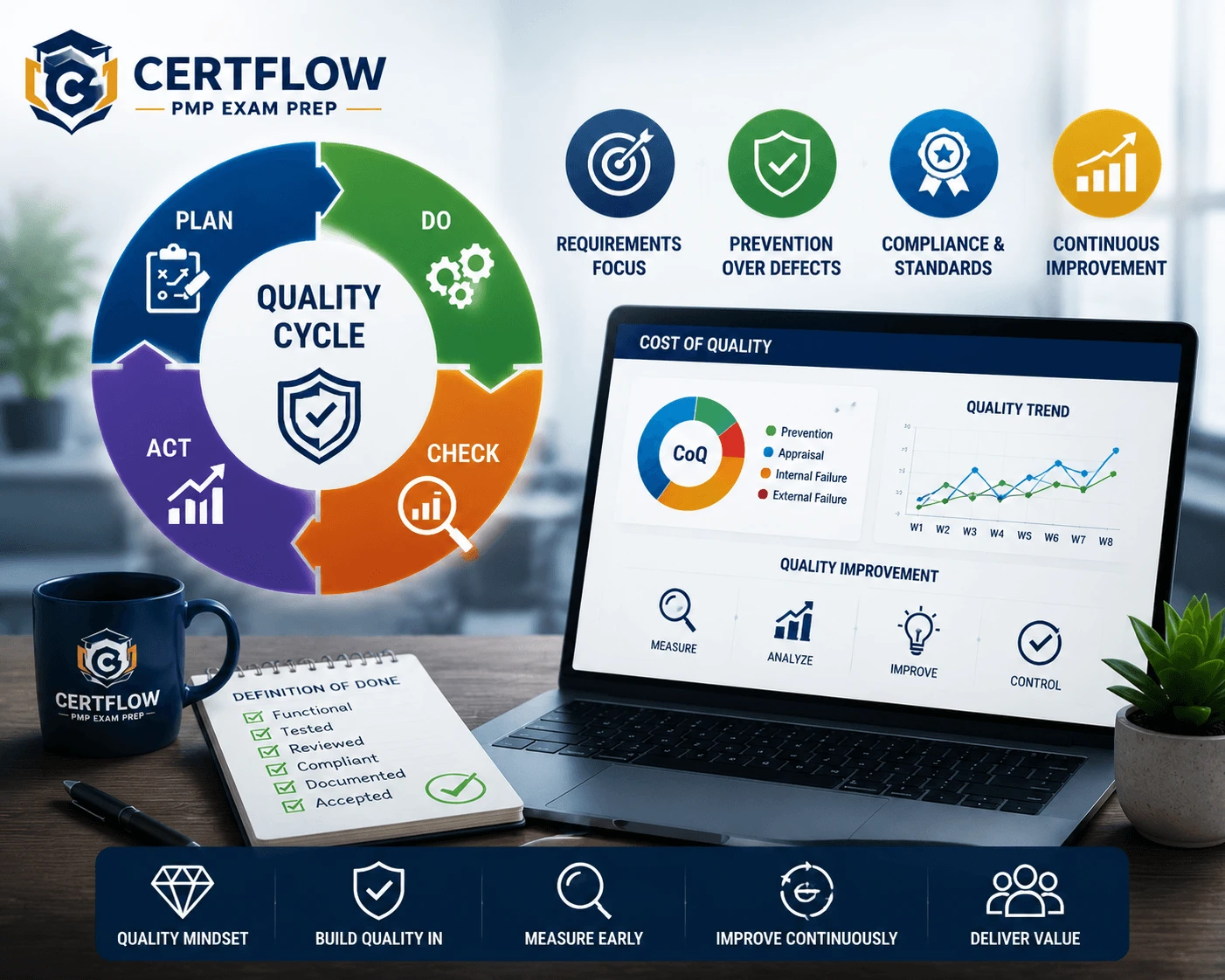
Quality requirements bao gồm: Functional requirements (hệ thống phải làm gì), Nonfunctional requirements (performance, security, availability, usability), Acceptance criteria (conditions deliverable phải đáp ứng), Definition of Done (DoD) — PMBOK 8: "checklist of all criteria required so that a deliverable can be considered ready for customer use."
🌟 Nguồn quality requirements: stakeholder interviews, industry standards (ISO, CMMI, IEEE), regulatory requirements (FDA, SOX, GDPR), organizational quality policies (OPA), benchmarking against competitors, và customer talks and tests (tool mới PMBOK 8).
Plan Quality Processes and Tools
PMBOK 8 Manage Quality Assurance (Section 2.1.6.5): "Ensuring processes are performed in a manner consistent with stakeholder expectations, involving the implementation of planned and systematic activities defined in the quality management plan."
Quality Management Plan xác định: quality standards applicable, quality metrics (how to measure), quality assurance activities (process audits, reviews), quality control activities (inspection, testing), roles and responsibilities for quality, và tools and techniques.
Quality Assurance (QA) | Quality Control (QC) |
|---|---|
Focus trên processes — cách chúng ta làm việc | Focus trên deliverables — sản phẩm chúng ta tạo ra |
Prevention-oriented — ngăn defects trước khi xảy ra | Detection-oriented — tìm defects sau khi tạo |
Process audits, reviews, continuous improvement | Inspection, testing, control charts, statistical sampling |
Áp dụng throughout project | Áp dụng khi deliverables được tạo |
"Doing things right" | "Making sure things are right" |
💡 Mẹo PMP: Quality ASSURANCE = process-focused, prevention. Quality CONTROL = product-focused, detection. Khi đề thi nói "the PM wants to prevent defects" → QA. "The PM wants to find defects" → QC. PMI ưu tiên prevention (QA) over inspection (QC).
5. Cost of Quality (CoQ) — Phòng bệnh rẻ hơn chữa bệnh
PMBOK 8 dành mô hình chi tiết cho Cost of Quality — tổng chi phí phát sinh trong suốt vòng đời sản phẩm để đảm bảo chất lượng.
Cost of Conformance (tiền chi ĐỂ đạt quality) | Cost of Nonconformance (tiền mất VÌ thiếu quality) | |
|---|---|---|
Loại | Prevention + Appraisal | Internal Failure + External Failure |
Prevention | Training, document processes, equipment, "time to do it right" | — |
Appraisal | Testing, destructive testing, inspections | — |
Internal Failure | — | Rework, scrap (tìm thấy TRƯỚC khi khách hàng nhận) |
External Failure | — | Liabilities, warranty, lost business (tìm thấy SAU khi khách hàng nhận) |
PMBOK® 8: "The optimal CoQ is one that reflects the appropriate balance for investing in the cost of prevention and appraisal to AVOID failure costs." — Đầu tư vào prevention và appraisal (conformance) luôn rẻ hơn gánh chịu failure costs (nonconformance).
External failure costs là đắt nhất — warranty claims, lawsuits, lost reputation, lost customers. Đó là lý do PMBOK 8 nhấn mạnh: embed quality from the start, đừng để đến cuối mới kiểm tra.
6. Execute quality plan, audits, và reviews
Quality Audits
PMBOK 8: "A quality audit is usually conducted by a team external to the project. Objectives include: identifying good practices, identifying nonconformities and gaps, sharing good practices across projects, proactively offering assistance to raise productivity."
Quality audits cũng confirm implementation of approved change requests — đảm bảo changes thực sự được thực hiện đúng.
Quality Control Tools — PMBOK 8
Tool | Mục đích | Khi nào dùng |
|---|---|---|
Control Charts | Xác định process có stable/predictable không. Upper/Lower Control Limits. | Repetitive activities, manufacturing, service delivery |
Inspection | Examine deliverables for conformance to standards | Mọi deliverable trước acceptance |
Cause-and-Effect (Fishbone) | Trace effect back to root cause | Khi cần find root cause of quality problem |
Histogram | Show frequency distribution of data | Analyze defect patterns, performance distribution |
Scatter Diagram | Show relationship between 2 variables | Correlation analysis (VD: hours worked vs defects) |
Statistical Sampling | Test subset of population | Large quantities, destructive testing impractical |
Testing | Verify deliverable meets requirements | UAT, integration testing, performance testing |
Quality trong Adaptive — Definition of Done
PMBOK 8: "DoD is a checklist of all criteria required so that a deliverable can be considered ready for customer use." DoD thay thế formal inspection processes trong agile. Nếu increment không meet DoD — nó không được release. DoD là quality gate tự động của mỗi sprint.
7. Regulatory compliance và sustainability
Help Ensure Regulatory Compliance
PM phải đảm bảo: identify applicable regulations sớm (FDA, SOX, GDPR, building codes, environmental regulations), integrate compliance vào quality plan (không phải afterthought), track compliance throughout project (audits, documentation), và engage regulatory SMEs khi cần.
PMBOK 8 nêu: một công ty mở rộng shipping services phải đáp ứng "governmental shipping specifications for each target market." Nhưng quality-driven approach đi xa hơn: "high-value customers have stricter standards than regulatory bodies — by addressing these higher standards, the company exceeds expectations."
Sustainability trong Quality
PMBOK 8 liệt kê Sustainability là dimension thứ 7 của quality. Sustainability trong quality bao gồm: sustainable materials selection, energy-efficient processes, waste reduction, carbon footprint measurement, social impact assessment, và lifecycle thinking (quality không chỉ khi deliver mà cả khi product bị dispose).
8. Continuous Improvement — PDCA và beyond
PMBOK® 8: "Adopting a continuous improvement mindset optimizes processes, boosts efficiency, and enhances maturity growth for the whole organization, leading to better project outcomes and overall organizational success."
PDCA Cycle (Plan-Do-Check-Act)
- Plan — Identify improvement opportunity, analyze root cause, develop plan
- Do — Implement the plan on small scale (pilot)
- Check — Measure results, compare with expected outcomes
- Act — If successful, standardize. If not, learn and cycle again.
Continuous Improvement Frameworks từ PMBOK 8
Framework | Focus | Phù hợp cho |
|---|---|---|
PDCA | Iterative improvement cycle | Mọi project, general improvement |
Lean | Eliminate waste, maximize value flow | Manufacturing, operations, service delivery |
Six Sigma | Reduce variation, achieve near-zero defects | High-volume, statistical process control |
Total Quality Management | Organization-wide quality culture | Enterprise-level transformation |
Kaizen | Small, incremental daily improvements | Team-level, daily practices |
Theory of Constraints | Identify and improve the bottleneck | Process optimization, throughput |
Trong Adaptive: Retrospectives là cơ chế continuous improvement chính. PMBOK 8: "Regularly occurring workshop to explore work and results to improve both process and product." Mỗi sprint kết thúc bằng retrospective = mỗi sprint là cơ hội cải tiến.
9. Mẹo thi PMP
📍Mẹo 1 — Prevention > Inspection: PMI luôn ưu tiên "prevent defects" (QA) hơn "find defects" (QC). Khi đề cho lựa chọn giữa "invest in better processes" vs "add more testing" — chọn processes.
📍Mẹo 2 — Quality IS scope: Nonfunctional requirements (performance, security, usability) thuộc về scope. "App works but is slow" = scope gap, không chỉ quality issue.
📍Mẹo 3 — CoQ: External failure là đắt nhất: Khi đề hỏi "which quality cost is highest?" — external failure (warranty, lawsuits, lost customers) > internal failure (rework) > appraisal (testing) > prevention (training). Invest early saves the most.
📍Mẹo 4 — Control charts: within limits = stable: Process within control limits = stable (normal variation). Outside control limits = unstable (investigate). Control limits ≠ specification limits — control limits are statistical, spec limits are requirements-based.
10. Mười câu hỏi trắc nghiệm tình huống
Question 1
Your software meets all functional requirements but users report it takes 12 seconds to load the main dashboard. No performance requirement was documented.
What type of quality issue is this?
A. This is not a quality issue — all requirements were met.
B. This is a nonfunctional requirement gap — performance is a quality attribute that should have been captured in scope as an acceptance criterion.
C. This is a user training issue — users need to understand system limitations.
D. This is a testing failure — QC should have caught the performance issue.
Answer: B — PMBOK 8: "Quality is an integral attribute of scope and can include both functional AND nonfunctional requirements." Performance is a nonfunctional quality requirement. The gap is in requirements elicitation, not testing — the requirement was never captured.
Question 2
Your organization spends $50K on developer training and $30K on code reviews (prevention), $20K on testing (appraisal), $40K on rework (internal failure), and $100K on warranty claims (external failure). Total CoQ = $240K.
Where should the PM focus investment to reduce total CoQ?
A. Reduce testing costs — $20K is significant.
B. Reduce rework by adding more testing.
C. Increase investment in prevention (training, code reviews, better processes) to reduce both internal and external failure costs, which represent 58% of total CoQ.
D. Negotiate lower warranty costs with the service team.
Answer: C — PMBOK 8: "The optimal CoQ reflects the appropriate balance for investing in prevention and appraisal to AVOID failure costs." Failure costs ($140K) are 58% of total CoQ — reducing these through better prevention is the highest ROI. Reducing testing (A) may increase failures.
Question 3
A control chart shows a process with 7 consecutive data points above the mean but all within control limits.
What does this indicate?
A. The process is stable — all points are within control limits.
B. The process shows a trend or shift that should be investigated even though points are within limits — the "Rule of Seven" suggests a non-random pattern.
C. The control limits need to be recalculated.
D. The data is coincidental — no action needed.
Answer: B — The "Rule of Seven" states that 7 consecutive points on one side of the mean indicate a non-random pattern (assignable cause), even if within control limits. The process is trending and should be investigated before it goes out of control. This is a leading indicator.
Question 4
Your pharmaceutical project must comply with FDA 21 CFR Part 11 regulations for electronic records. The team wants to skip formal documentation to move faster — the regulations slow them down significantly.
What should you do?
A. Allow the team to skip documentation for speed and add it later.
B. Explain that regulatory compliance is non-negotiable, but work with the team to find more efficient ways to meet compliance requirements without unnecessary overhead.
C. Escalate to the sponsor for a waiver.
D. Switch to agile to reduce documentation burden.
Answer: B — Regulatory compliance cannot be skipped or deferred. PMBOK 8: quality-driven approach means meeting legal requirements AND finding efficient ways to do so. The PM should help find streamlined compliance processes, not bypass regulations (A) or assume agile eliminates compliance needs (D).
Question 5
Your agile team delivered a sprint increment that the PO accepted. However, QA found that automated test coverage was only 30% — below the team's Definition of Done requirement of 80%.
What should happen?
A. Accept the increment since the PO approved it.
B. The increment does NOT meet the Definition of Done and should not be considered "done." The team must increase test coverage to 80% before the increment can be released.
C. Update the DoD to 30% to match the team's capacity.
D. Add test coverage as a separate task in the next sprint.
Answer: B — PMBOK 8: DoD is "all criteria required so that a deliverable can be considered ready for customer use." If DoD says 80% coverage, anything less is not "done." PO acceptance doesn't override DoD. Lowering DoD (C) undermines quality. Deferring to next sprint (D) accumulates technical debt.
Question 6
After 3 sprints, your team's defect rate has remained at 15% — above the 5% target. The team's response has been "we'll test more carefully." The defect rate hasn't improved.
What approach should you recommend?
A. Add more QA resources to catch defects.
B. Conduct root cause analysis on the defects, then implement process improvements (better requirements, code reviews, pair programming) to PREVENT defects rather than just detecting them more.
C. Extend sprint duration to allow more testing time.
D. Set a zero-defect target to motivate the team.
Answer: B — "Test more carefully" = detection (QC). The defect rate isn't improving because the ROOT CAUSE isn't addressed. PMBOK 8 emphasizes prevention over inspection. Root cause analysis + process improvement (QA) will reduce defects at the source. More testing (A) catches more defects but doesn't prevent them.
Question 7
During a quality audit, the auditor finds that the team follows processes consistently and deliverables meet specs. However, customer satisfaction scores remain low. The auditor reports: "Process compliance is excellent."
What does this reveal?
A. Quality is good — the auditor confirmed process compliance.
B. The processes are being followed but may not be the RIGHT processes for achieving customer satisfaction. Quality must address both "doing things right" (conformance) AND "doing the right things" (fitness for use/customer satisfaction).
C. Customer satisfaction is a marketing issue, not a quality issue.
D. The quality metrics need updating to include satisfaction.
Answer: B — PMBOK 8: quality includes "satisfaction — do deliverables elicit valuable feedback from customers including usability and UX?" Process conformance alone doesn't guarantee customer satisfaction. The PM should evaluate whether processes are producing the RIGHT outcomes, not just any outcomes efficiently. D is partially correct but B is the root issue.
Question 8
Your construction project uses sustainable materials that cost 20% more than conventional alternatives. The sponsor questions the additional cost.
How should you justify the sustainability investment as a quality decision?
A. It's a regulatory requirement — no choice.
B. Present the lifecycle cost analysis: sustainable materials last longer (lower maintenance), meet emerging regulations (avoid future compliance costs), align with organizational values (brand value), and reduce environmental impact (triple bottom line).
C. Absorb the cost difference from contingency reserve.
D. Switch to conventional materials to stay within budget.
Answer: B — PMBOK 8: quality includes sustainability as the 7th dimension. Sustainability is a quality investment, not just a cost. Lifecycle analysis shows total value — initial cost is higher but total cost of ownership may be lower. This aligns with PMBOK 8's triple bottom line: people, planet, profit.
Question 9
Your team has been running retrospectives every sprint for 6 months but team members say nothing ever changes. The same issues keep recurring. Retrospective attendance has dropped.
What is the MOST likely root cause?
A. The team is tired of retrospectives — reduce frequency.
B. The retrospective format is stale — try different techniques.
C. Action items from retrospectives are not being implemented — the continuous improvement LOOP is broken. Retrospectives identify issues but no follow-through converts them into actual process changes.
D. The Scrum Master should facilitate better.
Answer: C — PDCA cycle: Plan (identify), Do (implement), Check (verify), Act (standardize). If only "Plan" happens (identify issues) but "Do" never follows (implement changes), improvement stops. The PM must ensure retrospective action items become concrete changes to DoD, working agreements, or processes — not just a list.
Question 10
Your vendor delivers components that meet all contractual specifications. When integrated into your system, performance degrades. The vendor says: "We met our specs — integration is your problem."
What quality management lesson does this illustrate?
A. The vendor is correct — integration quality is the buyer's responsibility.
B. Quality must be defined HOLISTICALLY — acceptance criteria should include integration testing and system-level performance, not just component specs. The gap is in how quality requirements were specified in the contract.
C. Add additional testing after vendor delivery.
D. Replace the vendor with one who tests integration.
Answer: B — PMBOK 8's Adopt a Holistic View: quality is about the WHOLE system, not just components in isolation. The contract should have included integration performance requirements as acceptance criteria. "Quality as a feature" means ALL quality attributes — including how components work together — must be specified in scope.
11. Tổng kết
Quality management theo PMBOK 8 không phải hoạt động riêng biệt — mà là tư duy embedded vào mọi thứ PM làm.
Ba takeaways:
1. Prevention > Detection > Correction — Đầu tư vào training, process design, và code reviews (prevention) luôn rẻ hơn testing (detection), và cả hai rẻ hơn rework + warranty (correction). Cost of Quality model cho thấy rõ: external failure costs là đắt nhất. Invest early, save later.
2. Quality = Scope = Value — Quality không phải "thêm vào" sau khi scope đã xong. Nonfunctional requirements (performance, security, usability, sustainability) LÀ scope. PMBOK 8 nêu rõ: "quality is an integral attribute of scope." Thiếu quality requirements = scope gap, không phải quality gap.
3. Continuous improvement là mindset, không phải event — PDCA, Lean, Six Sigma, Retrospectives — tất cả đều là tools cho cùng một mục tiêu: mỗi ngày tốt hơn hôm qua một chút. Nhưng tools vô nghĩa nếu action items không được thực hiện. Close the improvement loop: identify → implement → verify → standardize.
PMBOK® 8, Section 3.5: "Foundational to embedding target quality thresholds is continuous improvement and waste elimination. These practices enable project teams to refine their processes, optimize resource utilization, and deliver outcomes that meet or exceed target objectives."
Câu Hỏi Thường Gặp (FAQ)
PMBOK 8 tiếp cận quality management như thế nào so với PMBOK 6?
PMBOK 6 có 3 processes: Plan Quality, Manage Quality (QA), Control Quality (QC). PMBOK 8 tích hợp quality vào project performance domains và nhấn mạnh continuous improvement culture hơn là checklist compliance. Retrospectives trong agile, lessons learned trong predictive đều là quality improvement mechanisms.
Definition of Done (DoD) trong agile có liên quan gì đến quality management?
DoD là quality criteria mà user story phải đạt trước khi coi là 'done' — coded, tested, reviewed, documented, deployed to staging. DoD chính là QC mechanism trong agile: không pass DoD thì không được demo và không accept vào release. Team tự định nghĩa DoD và nghiêm túc tuân thủ.
Cost of Poor Quality (COPQ) là gì và tại sao quan trọng?
COPQ = chi phí phát sinh khi không đạt chất lượng = internal failures (rework, scrap) + external failures (warranty, returns, reputation damage). COPQ thường gấp 5-10 lần cost of prevention. PMBOK 8 nhắc PM: invest vào prevention và quality planning upfront — cost này thấp hơn nhiều so với fixing defects sau khi release.
Bạn đã nắm vững quản lý chất lượng dự án — giờ là lúc luyện tập với câu hỏi thi thật.
Bài tiếp theo: Quản Lý Tiến Độ: CPM & Agile Planning theo PMBOK 8
Cải tiến liên tục: Lessons Learned, OPAs & PDCA theo PMBOK 8
Nguồn tham khảo chính thức:
Bạn đã sẵn sàng luyện tập chưa?
Thử CertFlow miễn phí — 10 câu hỏi, không cần đăng ký.
Bắt Đầu Miễn Phí