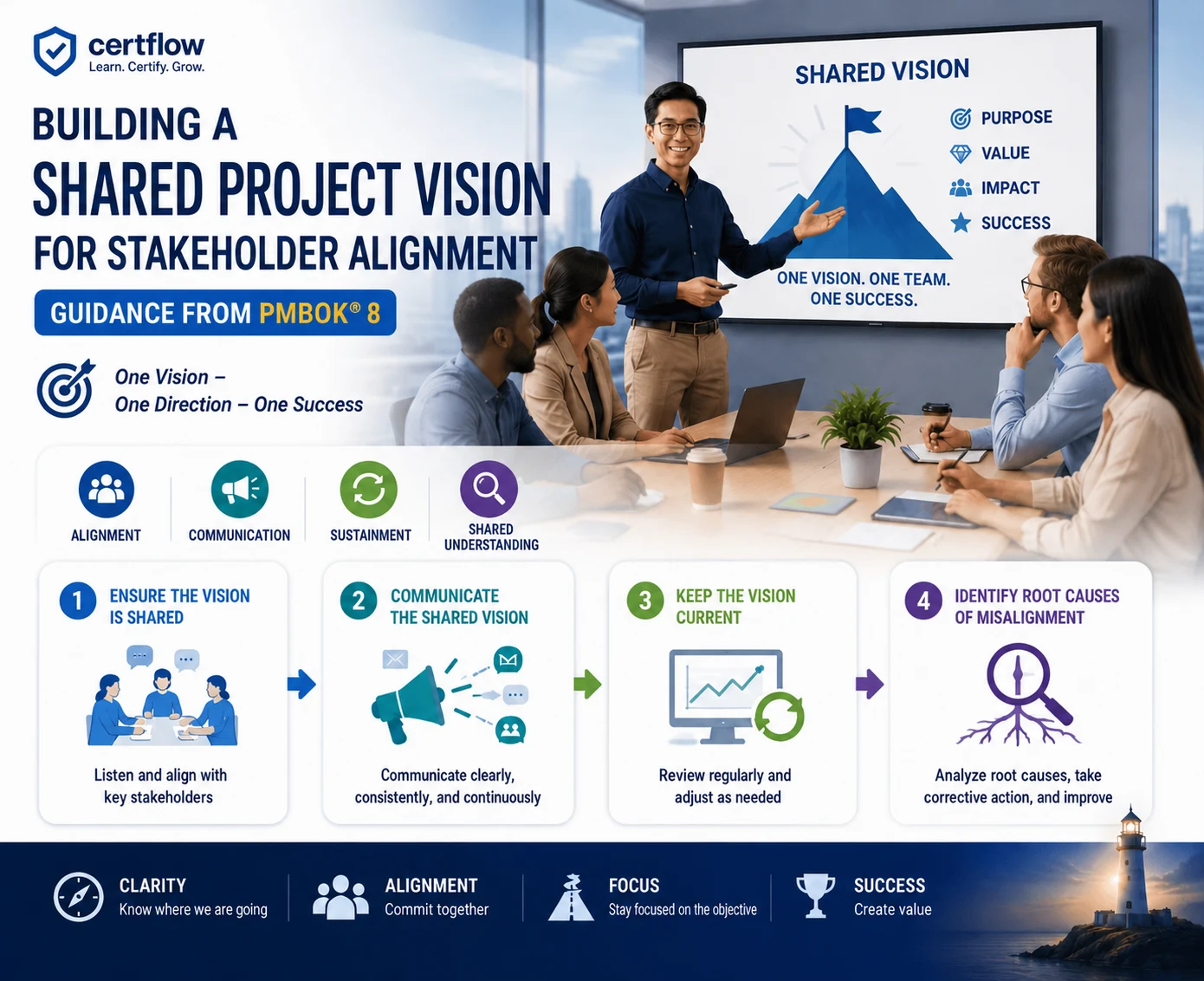
Without a shared vision, your project team loses direction. PMBOK® 8 People Domain shows you how to build alignment through a clear project vision statement.
1. A Real-World Story: The "Successful" Project That Left Everyone Unhappy
A logistics company launched a project to build a new warehouse management system. The CFO wanted to reduce operating costs by 20%. The VP of Operations wanted to double order processing speed. The IT Director wanted to modernize the entire technology stack. The sales team wanted real-time inventory visibility to give customers more accurate commitments.
Each stakeholder believed the project served their own goals. The PM dove into planning based on requirements gathered from all parties — without ever asking: "When all is said and done, what exactly are we building and why?"
Six months later, the project was delivered on time. But the CFO was dissatisfied because costs had not decreased as expected. Operations was disappointed because the system was optimized for reporting rather than processing speed. The IT Director was pleased with the technology but admitted it was over-engineered. The sales team still didn't have real-time visibility.
The root cause? No shared vision. Each stakeholder had their own "vision," and the project tried to satisfy all of them without converging them into a single direction.
This is precisely why the PMP ECO places "Develop a Common Vision" as the very first task in the People Domain — because without a shared vision, everything built afterward rests on an unstable foundation.
2. What a Common Vision Is — and What It Is Not
Before diving into the how, let's clearly distinguish a common vision from concepts that are often confused with it:
Concept | Definition | Example |
|---|---|---|
Vision | A picture of the desired state when the project succeeds — WHY the project exists | "Become the fastest-delivery logistics provider in the region within 18 months" |
Objectives | Specific, measurable targets — WHAT needs to be achieved | "Reduce order processing time from 48h to 12h" |
Scope | The work required to achieve the objectives — HOW to reach the goals | "Build a WMS system with 5 modules, deployed across 3 warehouses" |
Requirements | Detailed specifications — WHAT the product must have | "System supports barcode scanning, integrates with ERP" |
A common vision = a Vision that all key stakeholders understand, accept, and are committed to. "Common" (or "shared") is the most important keyword — a beautifully written vision statement posted on the wall that nobody believes or understands has no value.
PMBOK® 8, Section 2.6.2.4.1: "The vision and objectives are communicated throughout the project and are essential for understanding. This communication includes referencing the intended outcomes when the project team makes decisions and solves problems."
The vision acts as a decision filter: when conflicts arise over priorities, scope, or approach, the team can ask "Which decision better aligns with the project vision?" — and have a clear answer.
3. The 4-Step Framework for Building a Common Vision
The PMP ECO identifies 4 enablers for this task, forming a logical process:
Step | Enabler | Question answered | Timing |
|---|---|---|---|
1 | Ensure a shared vision with key stakeholders | Do stakeholders share the same understanding of the vision? | Initiating — when the project begins |
2 | Promote the shared vision | Does everyone know and remember the vision? | Continuously — at all times |
3 | Keep the vision current | Does the vision still reflect reality? | When the context changes |
4 | Identify root cause of misunderstanding | Why is there misunderstanding? What is the root cause? | When misalignment is detected |
⚠️ Note: these are not 4 sequential steps that are completed and done — they form a continuous cycle. You may be in step 2 (promote) and discover you need to return to step 1 (re-ensure) because a new stakeholder has joined. Or you may be in step 3 (update) and need step 4 (root cause) when the team reacts negatively to a change.
4. Step 1: Ensuring the Vision Is Shared with Key Stakeholders
This is the foundational step — and also the one that many PMs rush through most quickly. "Shared" does not mean the PM sends an email announcing the vision — it means stakeholders genuinely participate in the process of forming that vision.
Why "Shared" Is Different from "Informed"
Informed | Shared | |
|---|---|---|
Direction | One-way: PM → Stakeholders | Two-way: PM ↔ Stakeholders |
Participation | Passive: read, listen, acknowledge | Active: contribute, debate, commit |
Commitment | Low: "I know about it" | High: "I believe in it and I'm committed" |
Result | Compliance — doing it because they have to | Ownership — doing it because they want to |
How to Execute This Step
Gather inputs: Study the business case, project charter, and organizational strategy. PMBOK 8 notes: the project charter provides "understanding that facilitates efficient resource allocation" — and in adaptive environments, the charter may be "concise vision statements."
Facilitate a Vision Workshop: Invite key stakeholders to discuss three core questions: "Why does this project exist?", "What does success look like?", "What value will be created, and for whom?"
Confirm alignment: After the workshop, ask each stakeholder to paraphrase the vision in their own words. If the versions differ significantly — the vision is not yet truly "shared."
PMBOK® 8, Section 2.1.1: "A clearly articulated business case enables stakeholder alignment on priorities and constraints, and provides team members with a broader context that informs their work."
5. Step 2: Promoting the Common Vision
A vision only has value when everyone knows it, understands it, and remembers it. Think about it: if you asked any team member "What is this project trying to achieve?" — could they answer?
The PM must become a "storyteller" — continuously connecting day-to-day work to the larger vision.
Embed It in Every Activity
PMBOK 8 is clear: the vision and objectives need to be referenced when the team makes decisions and solves problems. In practice, this means: when assigning tasks, explain how each task contributes to the larger goal. When there is debate about priorities, return to the vision as the deciding criterion. When onboarding new team members, the vision is the first thing they need to understand — even before technical requirements.
Effective Promotion Channels
- Predictive: Kickoff meeting, phase reviews, milestone celebrations, steering committee presentations, project dashboards
- Adaptive: Sprint goals linked to vision, sprint review demos, product roadmap sessions, daily standups (when realignment is needed)
- Both: Information radiators (vision board displayed in the workspace), onboarding packages, town halls, newsletters
PMBOK® 8, Section 2.6.2.4.2: "Shared understanding can be achieved when the purpose of the project and the benefits that it will provide are held in common with the team. Shared understanding is closely related to project alignment, which helps ensure that the project's goals and activities are in line with the organization's mission and strategy."
6. Step 3: Keeping the Vision Current
The vision is not a document that gets written and filed away. In a world of constant change, the business context can shift significantly mid-project — and the vision needs to reflect the new reality.
When Should You Reassess the Vision?
The market changes significantly (new competitors, new regulations, new technology)
The Sponsor or key stakeholder changes (new person has different priorities)
The business case is no longer sound (ROI decreases, costs spiral out of control)
The project moves into a new phase with a different context
The organization's strategy pivots
PMBOK® 8, Section 3.4: "Desired outcomes should be clearly described, iteratively assessed, and updated throughout the project life cycle using quality gates, feedback loops, and regular reviews. The project team should adapt to changes and continuously evaluate alignment with the desired outputs, baselines, business case, and intended outcomes."
Updating Does Not Mean Constant Change
The PM must balance stability (the team needs a fixed "north star" to navigate toward) with adaptability (the vision must reflect reality). Every update must have a clear rationale, be agreed upon by key stakeholders, and be communicated broadly. Changing the vision without communicating it = creating more misunderstanding, not less.
And if the vision changes so fundamentally that the project no longer holds value — the PM must have the courage to propose: should we stop? PMBOK 8 states clearly: "If misalignment persists or the project is unlikely to deliver the intended value, it may be best to terminate the effort."
7. Step 4: Finding the Root Cause When the Vision Is Misunderstood
This enabler demands the deepest analytical skill. When the team or a stakeholder misunderstands the vision, the typical PM response is to repeat it — say it more clearly, send another email, schedule another explanation meeting. But if the problem is in how the message is being delivered, repeating it in the same way solves nothing.
The ECO requires PMs to "break down situations to identify the root cause" — to understand WHY the misunderstanding occurred, not just FIX the misunderstanding.
Root Cause Analysis Model
Root Cause | Telltale signs | Solution |
|---|---|---|
Vision is too abstract | Each person interprets it differently; nobody can give a concrete example | Make it concrete with measurable outcomes, user stories, or a "definition of success" |
Wrong communication channel | Team says "we never heard about it" even though the PM sent emails | Use interactive communication instead of push. Embed in meetings and standups |
Cultural differences | Multinational team — one group "gets it" but another doesn't | Adapt communication style, use visual aids, confirm understanding by asking people to paraphrase |
New stakeholder not onboarded | Person who joined mid-project missed the original context | Create an onboarding package for the vision; assign a "vision buddy" to explain 1-on-1 |
Vision not connected to daily work | Team says "the vision sounds great but has nothing to do with what I do" | Connect each task/story to the larger goal. Answer: "How does this task contribute to the vision?" |
Hidden conflicts of interest | Stakeholder says they "agree" but acts in opposition | Private 1-on-1 to understand unstated concerns; negotiate trade-offs transparently |
PMBOK® 8, Section 3.3: "Embracing a holistic perspective is crucial for managing project complexity, as it enables project managers to grasp the overall situation and the connections among different project components. This method aids in pinpointing the root causes of challenges and tackling them efficiently."
Analysis Tools
5 Whys:
Ask "Why?" five consecutive times to drill down from symptoms to root cause. Example: "Team misunderstands scope" → Why? → "They don't understand the priority" → Why? → "The vision doesn't clearly state which priority matters most" → Why? → "The Vision Workshop only included the PM and sponsor, not team leads" → Why? → "The PM assumed team leads would be briefed afterward" → Root cause: Key stakeholders were excluded from the vision-building process.
Fishbone Diagram (Ishikawa):
Categorize causes by branch: People (who misunderstood? why?), Process (does the communication process have gaps?), Communication (which channels were missed?), Culture (what cultural factors had an impact?), Timing (was the timing of communication appropriate?), Content (was the content clear?).
8. PMP Exam Tips on Common Vision
📍 Tip 1 — "What should the PM do FIRST?": When a question describes stakeholders with conflicting expectations — the correct answer is usually "facilitate a vision alignment workshop" or "bring stakeholders together to develop a shared understanding," NOT "escalate to sponsor" or "create the vision and communicate it."
📍 Tip 2 — New stakeholder joins: When the exam introduces a new stakeholder with a different vision — the correct answer is "engage them to understand their perspective, then facilitate reassessment with ALL key stakeholders." NOT "ask them to accept the existing vision" (too rigid) or "change the vision to match theirs" (too hasty).
📍 Tip 3 — Team misunderstands the vision: When the team acts in misalignment — the best answer always starts with "investigate the root cause of the misunderstanding," NOT "repeat the vision" or "send a clarifying email." PMI wants to see the PM analyze the cause, not just fix the symptom.
📍 Tip 4 — Vision in Agile: In an adaptive/agile context — the vision is typically expressed through a product vision statement, product roadmap, and sprint goals. The Product Owner owns the product vision; the PM facilitates alignment. If the question asks "who is responsible for the product vision in Scrum?" — the answer is the Product Owner.
9. Ten Scenario-Based Practice Questions
Question 1
You are assigned as PM for a new ERP implementation. During the first stakeholder meeting, the CFO expects the system to primarily reduce costs, the VP of Operations believes it should improve process efficiency, and the IT Director wants to modernize the technology stack. Each believes their priority should be the primary focus.
What should you do FIRST?
A. Escalate the conflicting expectations to the project sponsor for resolution.
B. Facilitate a vision alignment workshop to develop a shared understanding of the project's purpose and expected outcomes.
C. Document each stakeholder's expectations separately in the stakeholder register and proceed with planning.
D. Create a project charter based on the CFO's expectations since finance typically has the highest priority.
Question 2
Your software development project is at the 4-month mark. During a sprint review, you notice two sub-teams building features that conflict with each other. When you investigate, each team lead provides a different interpretation of the project's goals.
What is the BEST approach?
A. Assign a technical lead to standardize specifications across both teams.
B. Conduct a root cause analysis to understand why the teams have different interpretations of the project vision, then realign them.
C. Report the conflict to the sponsor and wait for direction.
D. Schedule additional code reviews to catch conflicting features earlier.
Question 3
Midway through a hospital construction project, the regional health authority changes its patient care guidelines, significantly impacting facility design requirements. The original vision was centered on building a traditional patient ward.
What should you do regarding the project vision?
A. Continue with the original vision since the project charter was already approved.
B. Submit a change request and let the change control board decide.
C. Work with key stakeholders to reassess and update the project vision to reflect the new guidelines, then communicate the updated vision broadly.
D. Add the new requirements to scope without changing the overall vision.
Question 4
You have just taken over a troubled agile project. The previous PM left abruptly. During your first retrospective, several team members say they don't understand why the project matters or how their work contributes to organizational goals. Morale is low and velocity has dropped 30%.
What is your FIRST priority?
A. Review the backlog and reprioritize items based on business value.
B. Rebuild and communicate a clear project vision that connects the team's daily work to organizational objectives.
C. Conduct one-on-one meetings to understand each team member's personal concerns.
D. Establish new team norms and a team charter.
Question 5
You are managing a distributed team across the US, India, and Germany. After distributing the project vision document, the India team reports that they find the vision "unclear and difficult to relate to." The US and Germany teams reported no issues.
What should you do?
A. Send the document again with a Japanese translation.
B. Ask the India team lead to explain the vision to the team in their own way.
C. Investigate the root cause — whether it's language, cultural context, or relevance — and adapt the communication approach accordingly.
D. Assume it's a language barrier and hire a professional translator.
Question 6
During a project status meeting, the sponsor says: "I think we should focus on delivering the minimum viable product as fast as possible." The lead developer argues: "We need to build a scalable architecture first, or we'll accumulate technical debt." The team looks to you for guidance.
How should you handle this in relation to the project vision?
A. Side with the sponsor since they have higher authority.
B. Side with the developer since technical debt will cost more long-term.
C. Facilitate a discussion to align both perspectives with the project vision and determine how to balance speed and sustainability.
D. Table the discussion and conduct a formal cost-benefit analysis.
Question 7
A new executive stakeholder joins your infrastructure project at the 6-month mark and says: "I wasn't part of the original vision discussions, and I have a completely different view of what success looks like."
What is the MOST appropriate response?
A. Politely explain the existing vision and ask the executive to align with it.
B. Immediately revise the vision to incorporate the executive's perspective.
C. Engage the executive in dialogue to understand their perspective, then facilitate a reassessment of the vision with all key stakeholders.
D. Document the executive's concerns in the issue log and continue.
Question 8
Your agile team's product owner informs you that recent customer research shows the target market has shifted significantly. The original vision of targeting millennials with social media campaigns may no longer be the most valuable approach.
What should you do?
A. Continue with the current vision through the planned sprints, then reassess.
B. Immediately pivot based on the product owner's recommendation.
C. Collaborate with the product owner and key stakeholders to evaluate the new data, and update the project vision if the evidence supports a change.
D. Add the new target market as a secondary objective while keeping the original vision.
Question 9
Over the last three sprint retrospectives, team members repeatedly say they feel their work "doesn't matter" and that they're "just checking boxes." Velocity has dropped 20%.
What is the MOST LIKELY root cause?
A. The team is burned out — implement shorter sprints.
B. The team has lost connection to the project vision — reconnect daily work to the project's purpose and value.
C. The team needs better tools — invest in automation.
D. The team lacks technical skills — arrange training.
Question 10
You manage a cross-functional project involving engineering, marketing, and customer success. Each team tracks different success metrics: code coverage, leads generated, and NPS respectively. Recently, the teams have been making decisions that optimize their own metrics but conflict with each other.
What is the BEST way to address this fragmentation?
A. Accept that different teams naturally have different metrics and focus on coordinating deliverables.
B. Ask all teams to adopt engineering's metrics since the project is primarily a tech initiative.
C. Facilitate a cross-functional alignment session to connect each team's metrics to the overarching project vision and define shared success criteria.
D. Create a dashboard tracking all metrics equally.
Answer Key:
Question 1: Answer: B
— The PM should first facilitate alignment among key stakeholders to develop a shared vision. PMBOK 8: "A clearly articulated business case enables stakeholder alignment on priorities and constraints." Escalating immediately is premature. Documenting separately doesn't resolve the misalignment. Favoring one stakeholder creates a Win-Lose dynamic.
Question 2: Answer: B
— The root problem is a misunderstanding of the project vision, not a technical issue. The ECO specifically requires PMs to "break down situations to identify the root cause of a misunderstanding of the vision." Code reviews and standardization treat symptoms. Waiting for the sponsor is too passive.
Question 3: Answer: C
— The ECO requires PMs to "keep the vision current." When external conditions change significantly, the vision must be reassessed collaboratively. PMBOK 8: outcomes should be "iteratively assessed and updated." Ignoring the change undermines project value. Adding scope without updating the vision creates misalignment.
Question 4: Answer: B
— The core issue is that the team lacks shared understanding of the project's purpose. PMBOK 8: "Shared understanding can be achieved when the purpose of the project and the benefits that it will provide are held in common with the team." While one-on-ones and norms are valuable, re-establishing the vision is the foundation — everything else flows from there.
Question 5: Answer: C
— The ECO requires PMs to "break down situations to identify the root cause of a misunderstanding." Simply translating assumes a linguistic problem — but it could be cultural (different values emphasis), contextual (different market realities), or structural (different communication preferences). PMBOK 8's Adopt a Holistic View principle encourages "pinpointing the root causes of challenges."
Question 6: Answer: C
— This is a vision alignment issue. The PM should refer back to the shared vision to guide the discussion. PMBOK 8's Be an Accountable Leader: "holding discussions to explore the root cause of the issue and identify acceptable adjustments." The vision serves as the north star — if it emphasizes rapid time-to-market, MVP makes sense; if long-term platform growth, architecture matters more.
Question 7: Answer: C
— A new executive IS a key stakeholder. Ignoring their input risks losing support. Immediately changing without consulting others violates the collaborative principle. The correct approach: engage AND reassess with all stakeholders. The ECO requires "help ensure a shared vision with key stakeholders" — continuously, not just once.
Question 8: Answer: C
— PMBOK 8: "In adaptive projects, the project team collaborates with the customer to determine which features are worth the investment." Changes to the vision should be evidence-based and collaboratively decided — not made unilaterally or delayed when data supports action. The ECO requires PMs to "keep the vision current."
Question 9: Answer: B
— When team members say their work "doesn't matter," this signals disconnection from the vision. PMBOK 8: "Vision and objectives are communicated throughout the project and are essential for understanding... referencing the intended outcomes when the project team makes decisions and solves problems." The ECO's "promote the shared vision" means continuously connecting daily work to purpose.
Question 10: Answer: C
— Different metrics are fine, but they must ladder up to a shared vision. PMBOK 8's Build an Empowered Culture: "full clarity on individual roles, responsibilities, team agreements, and guiding processes." A cross-functional session ensures each team understands how their work and metrics contribute to the common vision — not just their own silo.
10. Summary
A common vision is the first foundation of every successful project — and it is Task 1 in the People Domain for a reason. Three key takeaways:
- "Shared" means co-created, not announced — A vision that stakeholders did not participate in building will not have ownership. Workshops, dialogue, and collaborative definition create genuine commitment — emails and slides do not.
- Vision is a decision filter, not a poster on the wall — The real value of a vision shows up when the team faces conflicting priorities, scope creep, or a new stakeholder. "Which decision better aligns with the vision?" — that question resolves 80% of debates.
- When misunderstanding occurs, find the root cause — don't just repeat yourself — A misunderstood vision is a symptom. The root cause may be: the vision is too abstract, the wrong communication channel was used, cultural differences exist, or there are hidden conflicts of interest. The 5 Whys and Fishbone Diagram help uncover that root cause.
PMBOK® 8, Section 3.6: "Leadership is not exclusive to any specific role; in different moments of the project, a team member, stakeholder, or professional may take the leadership seat. Leadership is different from authority — leadership is about inspiring and motivating others through leading by example."
The PM does not need to be "great" to create a vision — the PM needs to listen, converge, and persistently communicate. The best common vision is not one the PM writes alone — it is one the entire team genuinely believes in.
Frequently Asked Questions (FAQ)
How does a Project Vision Statement differ from a Project Charter?
The Project Charter is a formal document signed by the Sponsor that authorizes the project and appoints the PM — it includes objectives, constraints, and high-level scope. A Project Vision Statement is simpler and focuses on the "why" and the "destination" — written in human language so the team can remember and connect with it. The vision answers WHY; the Charter answers WHAT.
How do you create a shared vision when the team has many different perspectives?
Effective techniques include: Vision Workshops — bring together key stakeholders and use facilitation tools such as dot voting and affinity mapping to find common ground. Start from: "What does project success look like in 1 year?" Capture all input, cluster by theme, and draft the vision statement from the most common themes.
What does PMBOK 8 emphasize about leadership and vision in the People Domain?
PMBOK 8 emphasizes that the PM is a servant leader — creating an environment where the team feels confident, creative, and aligned with the project goals. The vision must be communicated by the PM continuously, not just once at kickoff. In meetings, reviews, and retrospectives — the PM must keep connecting work back to the vision.
Now that you understand building a common project vision — it's time to practice with real exam questions.
Next article: Project Conflict Management: 5 Techniques & 6 Steps according to PMBOK 8
Project management fundamentals: PM role and project lifecycle
Stakeholder engagement: 6 strategic steps according to PMBOK 8
Try Free PMP Practice Questions →
Official References: