Stakeholder không được gắn kết đúng cách = scope creep và dự án thất bại. PMBOK 8 coi stakeholder engagement là competency cốt lõi của PM. Bài này đi qua 6 bước thực chiến.
1. Tại sao Engage Stakeholders là task chiến lược nhất?
Hãy hình dung: bạn đang triển khai dự án chuyển đổi số cho một bệnh viện. Hệ thống mới được phát triển tuyệt vời — nhanh, bảo mật, đầy đủ tính năng. Nhưng khi go-live, các bác sĩ từ chối sử dụng vì "không ai hỏi ý kiến chúng tôi trong quá trình thiết kế." Nhóm điều dưỡng phản đối vì workflow mới phức tạp hơn. Ban giám đốc bất ngờ vì chi phí training không nằm trong budget ban đầu.
Kết quả? Dự án bị delay 6 tháng, budget tăng 40%, và bạn mất uy tín.
Nguyên nhân gốc rễ: stakeholders không được gắn kết đúng cách, đúng lúc.
PMBOK® 8, Section 2.5: "Possessing the interpersonal and leadership skills to work effectively with stakeholders is just as important, if not more so" hơn kỹ năng kỹ thuật.
Đây là lý do ECO đặt "Engage Stakeholders" trong People Domain với 6 enablers — nhiều hơn hầu hết các task khác. Gắn kết stakeholder không phải "gửi báo cáo" — mà là nghệ thuật xây dựng mối quan hệ giúp dự án thành công.
2. Stakeholder là ai? Rộng hơn bạn nghĩ
PMBOK 8 định nghĩa: stakeholder bao gồm "the project sponsor, team members, and all the people impacted by — or who feel they may be impacted by — the project."
⚠️ Lưu ý: cảm nhận về tác động cũng đủ để trở thành stakeholder.
Internal Stakeholders | External Stakeholders |
|---|---|
Project Manager | Suppliers & Vendors |
Project Team | Customers |
Sponsor | End Users |
Governing Bodies | Regulatory Bodies |
PMO | Local Communities |
Steering Committees | Family members (ảnh hưởng gián tiếp) |
Cạm bẫy phổ biến: Chỉ focus vào stakeholder "quan trọng" (sponsor, client) mà bỏ qua stakeholder "ẩn" (regulatory bodies, communities, end users). PMBOK 8 nhấn mạnh phải bao gồm cả supporters, neutral parties, VÀ opponents.
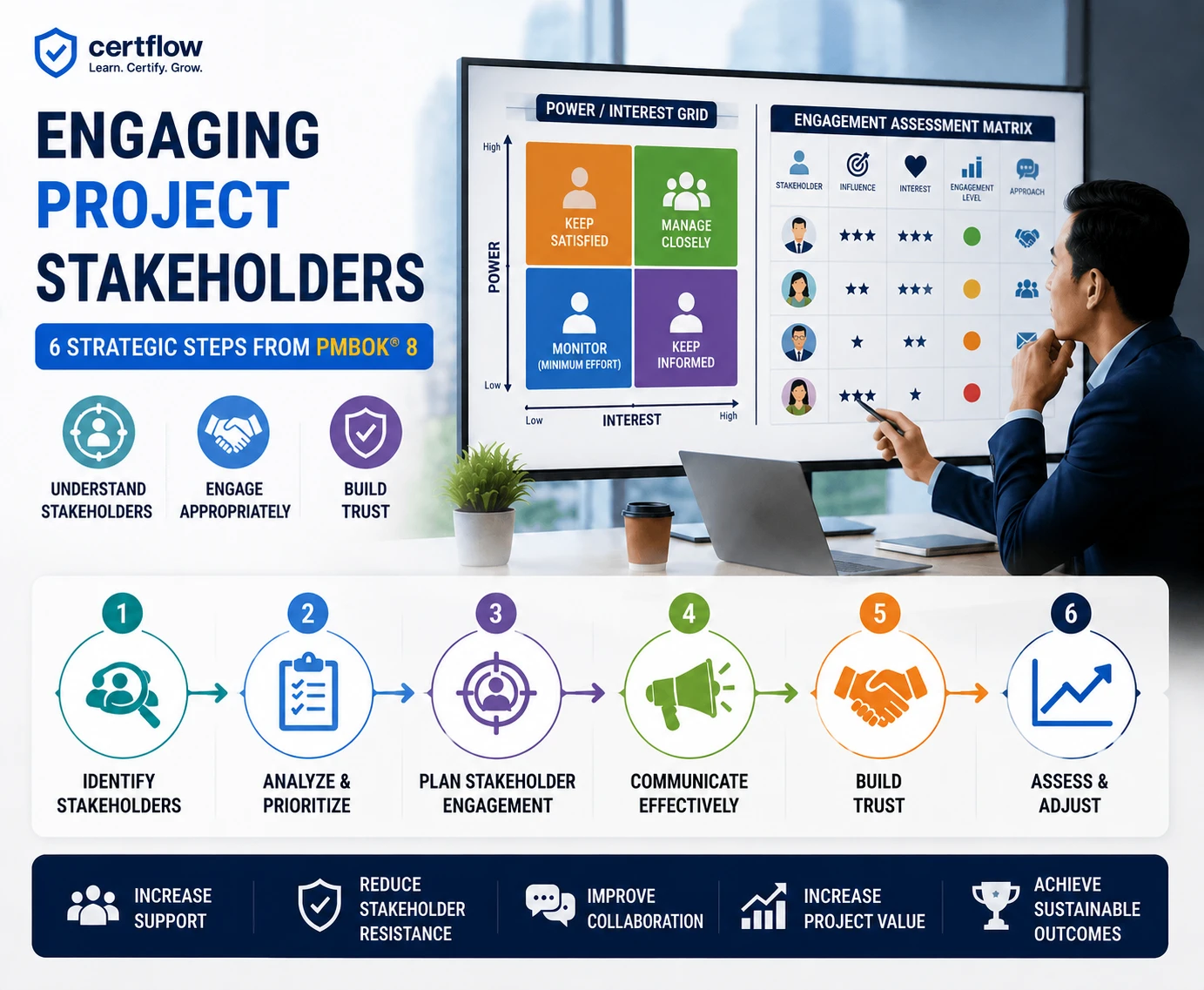
3. Framework 6 bước gắn kết stakeholder
Nhóm | Bước | Enabler | Câu hỏi cốt lõi |
|---|---|---|---|
Khám phá | 1 | Identify stakeholders | Ai bị ảnh hưởng bởi dự án? |
Khám phá | 2 | Analyze stakeholders | Họ có quyền lực, lợi ích, thái độ gì? |
Kết nối | 3 | Tailor communication | Giao tiếp với họ như thế nào cho hiệu quả? |
Thực thi | 4 | Execute engagement plan | Thực hiện kế hoạch gắn kết ra sao? |
Tối ưu | 5 | Optimize alignment | Nhu cầu, kỳ vọng và mục tiêu dự án có khớp? |
Niềm tin | 6 | Build trust and influence | Stakeholder có tin tưởng và ủng hộ dự án? |
Điểm quan trọng: đây là chu trình liên tục, không phải chuỗi tuần tự. Stakeholder mới có thể xuất hiện bất cứ lúc nào (quay lại bước 1). Kỳ vọng thay đổi theo thời gian (quay lại bước 5). Trust cần được duy trì liên tục (bước 6 không bao giờ "xong").
4. Bước 1-2: Nhận diện và phân tích stakeholder
Bước 1: Identify Stakeholders — Hoạt động liên tục
PMBOK 8 nhấn mạnh từ khóa "regularly": "Identifying project stakeholders regularly and analyzing relevant information regarding their interests, involvement, interdependencies, influence, and potential impact."
Nhận diện stakeholder không phải hoạt động một lần ở đầu dự án: "Continuous stakeholder identification can work as a risk management strategy as the project environment evolves."
Stakeholder Register — output chính — ghi nhận cho mỗi stakeholder: identification info (tên, vị trí, vai trò), assessment info (yêu cầu, kỳ vọng, ảnh hưởng tiềm năng), và classification (internal/external, power/interest, direction of influence).
Bước 2: Analyze Stakeholders — Hiểu sâu hơn "danh sách tên"
PMBOK 8 (Section 5) mô tả stakeholder analysis tạo ra danh sách với: positions, roles, "stakes", expectations, attitudes (mức độ support), và interest.
5 loại "Stakes" — lý do stakeholder quan tâm đến dự án:
Loại Stake | Ý nghĩa | Ví dụ |
|---|---|---|
Interest | Bị ảnh hưởng bởi quyết định dự án | End users sẽ dùng hệ thống hàng ngày |
Rights | Quyền lợi pháp lý hoặc đạo đức | Occupational health, environmental protection |
Ownership | Sở hữu tài sản hoặc tài nguyên liên quan | Department owner của legacy system |
Knowledge | Có kiến thức chuyên môn hữu ích | SME hiểu domain rules |
Contribution | Cung cấp funding, resources, hoặc advocacy | Sponsor cấp ngân sách |
Mẹo PMP: Khi phân tích stakeholder, đừng chỉ hỏi "họ muốn gì" — hãy hỏi "stake của họ thuộc loại nào?" Stakeholder có Rights (quyền pháp lý, VD: cơ quan quản lý) cần approach rất khác so với stakeholder có Knowledge (kiến thức chuyên môn, VD: SME).
5. Các mô hình phân loại stakeholder
PMBOK 8 cung cấp 4 mô hình phân loại — PM chọn mô hình phù hợp với độ phức tạp dự án:
Mô hình 1: Power/Interest Grid
Low Interest | High Interest | |
|---|---|---|
High Power | Keep Satisfied — Executives, regulators. Báo cáo ngắn gọn, chỉ escalate khi cần. | Manage Closely — Sponsor, key client. Gặp thường xuyên, involve trong quyết định lớn. |
Low Power | Monitor — Peripheral stakeholders. Kiểm tra định kỳ, minimal effort. | Keep Informed — End users, team. Muốn biết chi tiết nhưng ít ảnh hưởng quyết định. |
Mô hình 2: Salience Model
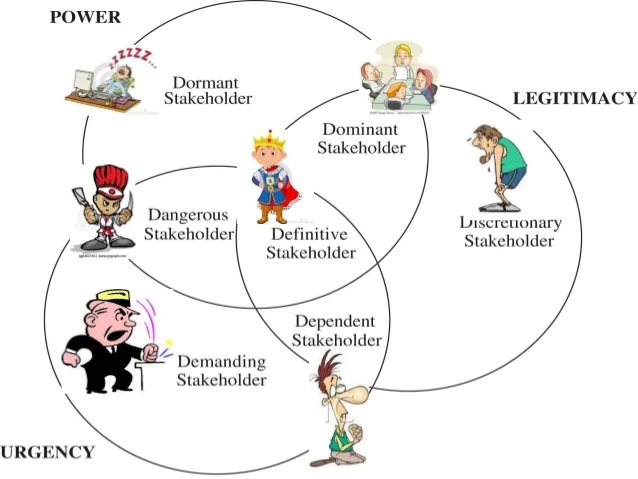
PMBOK 8: "Describes classes of stakeholders based on assessments of their power, urgency, and legitimacy (or proximity). Useful for large, complex communities of stakeholders or where there are complex networks of relationships." — Phù hợp khi Power/Interest Grid quá đơn giản.
Mô hình 3: Directions of Influence
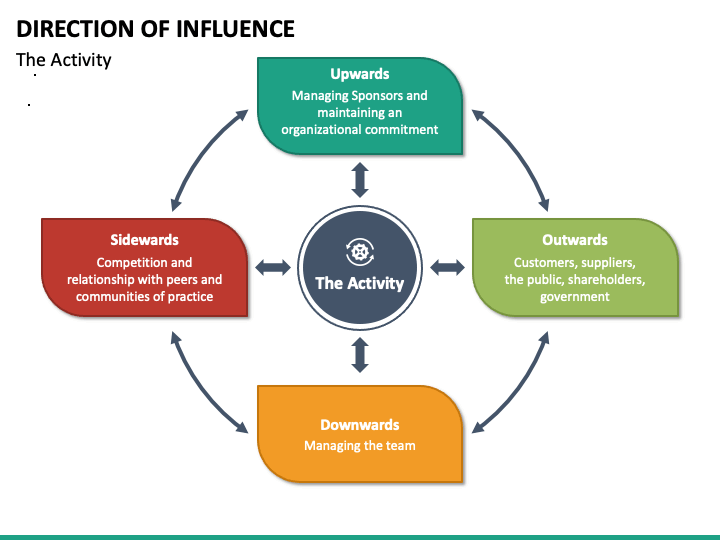
Upward (senior management, sponsor) — PM cần influence upward để secure resources. Downward (team, specialists) — PM cần empower và guide. Outward (suppliers, regulators, public) — PM cần manage expectations. Sideward (other PMs, middle managers) — PM cần negotiate shared resources.
Mô hình 4: Stakeholder Cube
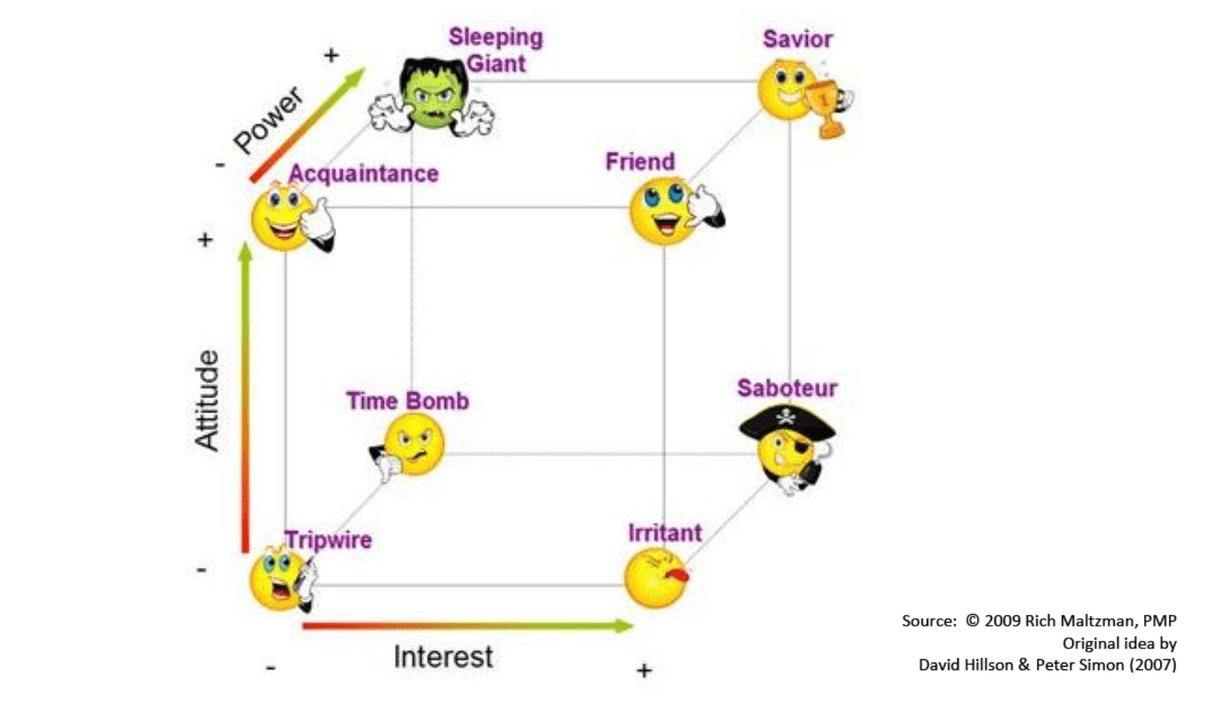
PMBOK 8: "Combines grid elements into a three-dimensional model... provides a model with multiple dimensions that improves the depiction of the stakeholder community as a multidimensional entity." — Dùng cho dự án rất phức tạp.
Stakeholder Engagement Assessment Matrix
Không chỉ phân loại — PM cần đánh giá gap giữa mức engagement hiện tại (C) và mong muốn (D):
Stakeholder | Unaware | Resistant | Neutral | Supportive | Leading |
|---|---|---|---|---|---|
CFO | C | D | |||
End Users | C | D | |||
IT Director | C | D | |||
Union Rep | C | D |
C = Current, D = Desired. Gap giữa C và D chính là focus area cho engagement plan. Lưu ý: không phải mọi stakeholder đều cần ở mức "Leading" — mục tiêu là đưa mỗi stakeholder đến mức engagement phù hợp.
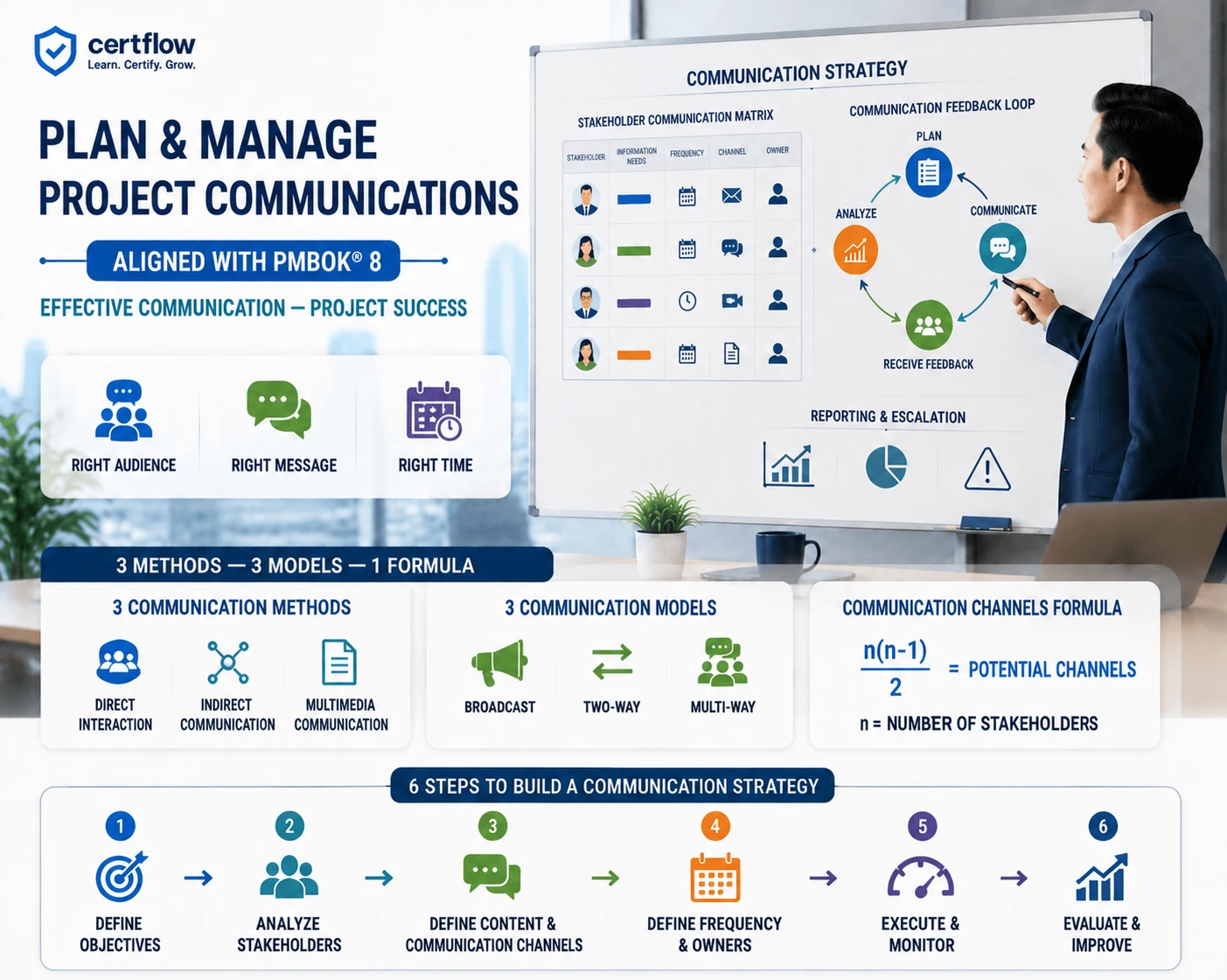
6. Bước 3: Điều chỉnh truyền thông theo nhu cầu
PMBOK 8:" The way of communicating should be tailored based on the needs and best fit for the stakeholders." Một báo cáo 20 trang phù hợp cho auditor nhưng giết chết sự chú ý của CEO.
3 Communication Methods
Method | Mô tả | Phù hợp cho |
|---|---|---|
Interactive | Real-time, 2+ chiều: meetings, calls, IM | Vấn đề phức tạp, quyết định quan trọng, xung đột |
Push | Gửi trực tiếp: email, reports, memos | Updates, thông báo, deliverable status |
Pull | Tự truy cập: portals, wikis, databases | Thông tin lớn, đối tượng rộng, reference materials |
3 loại "Intelligence" cần áp dụng
Political awareness — PMBOK 8: "Recognition of formal and informal power relationships and the willingness to operate within these structures." Hiểu ai thực sự có quyền lực — không chỉ theo org chart.
Cultural awareness — "Understanding of the differences among individuals, groups, and organizations and adapting the project's communication strategy in the context of these differences."
Communication styles assessment — "Often used with unsupportive stakeholders to identify gaps in engagement that require additional tailored communication."
7. Bước 4-5: Thực thi engagement plan và tối ưu alignment
Bước 4: Execute the Stakeholder Engagement Plan
PMBOK 8 Manage Stakeholder Engagement: "Communicating and working with stakeholders to meet their needs and expectations, address issues, and foster appropriate involvement. Key benefit: allows the PM to increase support and minimize resistance."
Trong adaptive environments, engagement xảy ra tự nhiên qua ceremonies: sprint planning (agree on goals), sprint reviews/demos (feedback on increment), retrospectives (process improvement), daily standups (visibility). Mỗi ceremony là một stakeholder engagement event.
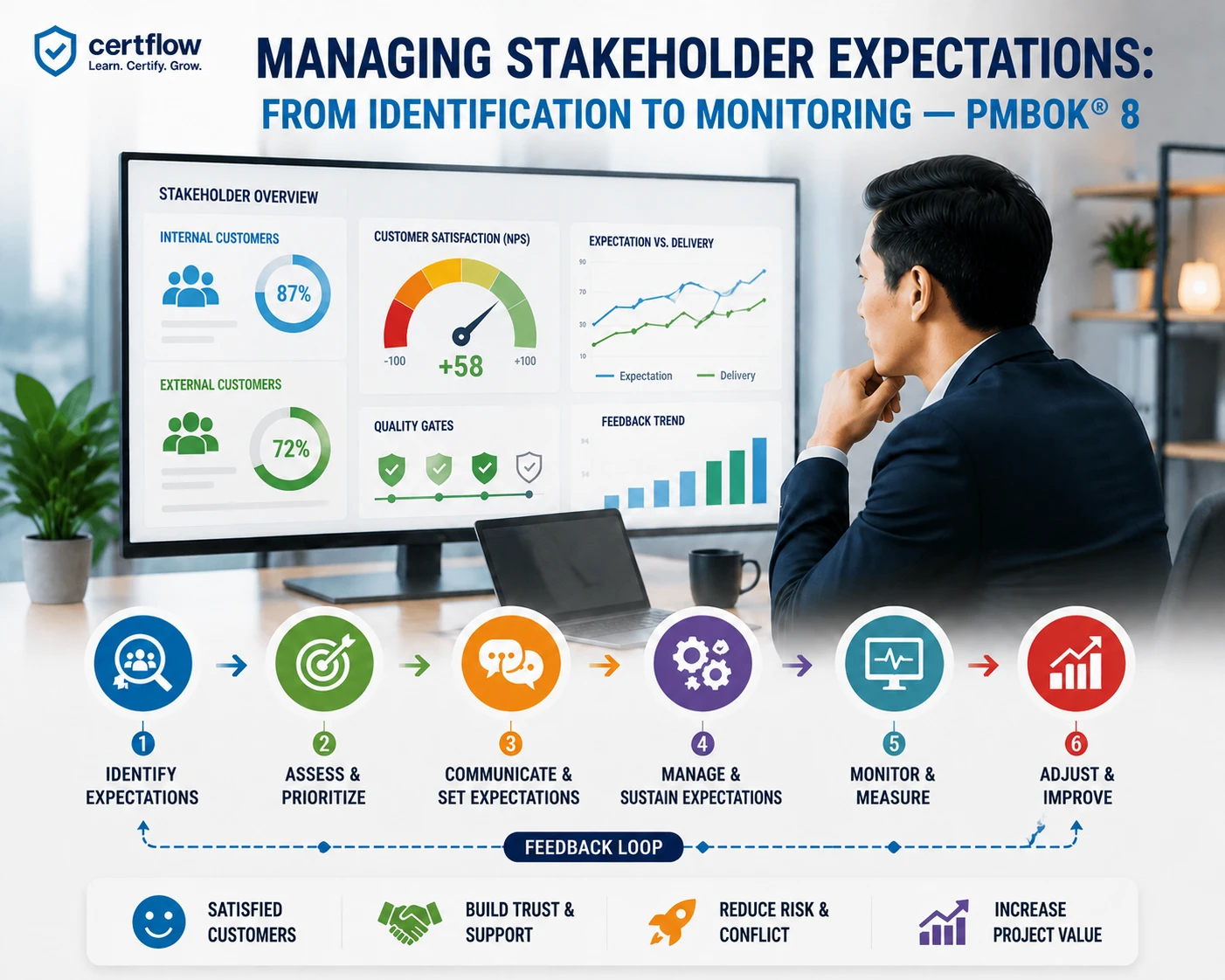
Bước 5: Optimize Alignment
PM phải liên tục kiểm tra sự phù hợp giữa: nhu cầu stakeholder ↔ kỳ vọng stakeholder ↔ mục tiêu dự án. Khi ba thứ này lệch nhau — dự án gặp vấn đề.
PMBOK 8 Monitor Stakeholder Engagement: "Assessing the effectiveness of engagement efforts, identifying necessary adjustments to improve relationships, and refining strategies."
Metrics đo alignment: NPS (Net Promoter Score — PMBOK 8 liệt kê cho Stakeholders Domain), stakeholder surveys, change request volume (nhiều CRs = signal misalignment), và feedback from sprint reviews.
8. Bước 6: Xây dựng niềm tin và gây ảnh hưởng
Đây là enabler nền tảng nhất — không có trust, mọi kế hoạch engagement đều thất bại.
5 yếu tố xây dựng Trust từ PMBOK 8
Yếu tố | Ý nghĩa thực tế |
|---|---|
Transparency | Minh bạch trong suy nghĩ, quyết định, thông tin. Không giấu tin xấu. |
Integrity | PMBOK 8: "Willingness to share bad news early, ensuring status reports provide accurate depiction." Đưa tin xấu sớm. |
Consistency | Nhất quán giữa lời nói và hành động. Promises phải được giữ. |
Competence | Thể hiện năng lực chuyên môn. Stakeholders trust PM biết họ đang làm gì. |
Respect | Tôn trọng quan điểm và quyền lợi mỗi bên. Lắng nghe thật sự. |
Influencing — 5 kỹ năng then chốt
PMBOK 8 liệt kê influencing là kỹ năng critical vì "project managers often have little or no direct authority over team members in a matrix environment." PM không có quyền ra lệnh — PM phải gây ảnh hưởng.
5 kỹ năng influencing từ PMBOK 8: Ability to be persuasive — trình bày rõ ràng giá trị và lợi ích. Clearly articulating points — nói rõ quan điểm, không vòng vo. High levels of active listening — lắng nghe thật sự, không chỉ chờ đến lượt nói. Awareness of various perspectives — nhìn từ nhiều góc. Gathering relevant info while maintaining trust — dùng facts, không dùng politics.
Quan trọng: Influencing ≠ Manipulating. Influencing giúp stakeholder thấy rõ sự thật để tự quyết định. Manipulating bóp méo thông tin để ép quyết định. Trong đề PMP, đáp án đúng luôn là transparent influencing.
Networking — Mạng lưới quan hệ
PMBOK 8: "Networking provides project managers with access to informal organizations to solve problems, influence actions of their stakeholders, and increase stakeholder support." Networking giúp PM hiểu stakeholder landscape, tìm allies, và giải quyết vấn đề nhanh qua kênh informal.
9. Mẹo thi PMP về Stakeholder Engagement
📍Mẹo 1 — "Regularly" là keyword: Stakeholder identification là hoạt động LIÊN TỤC, không phải một lần. Khi đề hỏi "a new stakeholder appears midway" — đáp án đúng luôn bắt đầu bằng "add to register, assess, develop engagement strategy," KHÔNG phải "inform them of existing plans."
📍Mẹo 2 — Sponsor engagement là #1: PMBOK 8: "Research shows that an active project sponsor is a critical success factor." Khi câu hỏi mô tả disengaged sponsor — đáp án đúng là proactively engage them, KHÔNG phải work around them hoặc escalate.
📍Mẹo 3 — Leading indicators: Khi đề mô tả stakeholder "stops attending meetings," "delays approvals," hoặc "becomes quiet" — đó là leading indicator of disengagement. PM phải PROACTIVELY investigate, không chờ formal complaint.
📍Mẹo 4 — Resistant stakeholder: Khi stakeholder resistant — đáp án tốt nhất là "understand their concerns first, then address with data and transparent communication." KHÔNG phải "get sponsor to force compliance" hoặc "ignore and move forward."
10. Mười câu hỏi trắc nghiệm tình huống
Question 1
During a community town hall for your infrastructure project, you discover that a local environmental group is planning to oppose the project due to wetland concerns. This group was not on your stakeholder register.
What should you do FIRST?
A. Ask legal to assess whether the group has standing to oppose.
B. Add the group to the stakeholder register, assess their power and interest, and develop an engagement strategy.
C. Inform the sponsor and wait for guidance.
D. Continue since the group is external and not in the project organization.
Question 2
Your stakeholder engagement assessment shows the VP of Marketing is "Resistant" but needs to be "Supportive." The VP believes the project will consume resources meant for their marketing campaign. You have data showing the project will actually increase marketing capabilities.
What is the BEST strategy?
A. Present the data in a one-on-one meeting showing how the project aligns with their marketing objectives.
B. Ask the sponsor to direct the VP to support the project.
C. Include the VP's team in the project for ownership.
D. Send regular status reports to keep the VP informed.
Question 3
You manage a project with stakeholders across three levels: C-suite (want dashboards), middle management (need resource details), and end users (want training schedules). Currently, everyone receives the same comprehensive weekly report.
How should you restructure communications?
A. Make the report shorter and more visual.
B. Set up a shared portal where everyone accesses all info.
C. Develop tailored communications for each group using appropriate method, format, and detail level.
D. Send the executive dashboard to everyone — it covers the most important info.
Question 4
During a sprint review, the product owner approves the increment, but two key end users seem disengaged — no questions, looking at phones. In previous reviews they were actively providing feedback.
What should you do?
A. Nothing — the PO approved, which is sufficient.
B. After the review, reach out privately to understand their disengagement and adjust engagement approach if needed.
C. Ask the PO to follow up with them.
D. Make next demo more detailed to re-engage them.
Question 5
A new regulation affects your construction project's environmental compliance. The regulatory body that issued it was not previously identified as a stakeholder. After adding them, how should you classify them?
Which classification is MOST appropriate?
A. High Power / Low Interest — Keep satisfied.
B. Low Power / High Interest — Keep informed.
C. High Power / High Interest — Manage closely with direct communication and proactive compliance.
D. Low Power / Low Interest — Monitor.
Question 6
The project sponsor says: "I don't have time for weekly meetings. Just email me when something goes wrong." However, you know disengaged sponsors create problems later when surprised by bad news.
How should you handle this?
A. Respect their preference and only communicate when issues arise.
B. Insist on weekly meetings because sponsors must be actively involved.
C. Propose a concise bi-weekly email summary with key metrics and decisions needed, plus clear escalation criteria for urgent issues.
D. Have the sponsor's assistant relay important updates.
Question 7
The HR Director initially supported your HR system project but has become increasingly silent — not responding to emails, not attending meetings. You hear informally they're concerned the new system will reduce their team's headcount.
What is the MOST effective approach?
A. Send a formal email requesting input and copy their manager.
B. Request a private meeting to openly discuss their concerns and collaboratively explore how the system could enhance their team's role.
C. Proceed without their input since you have sponsor approval.
D. Ask another HR team member to represent the Director's interests.
Question 8
Your vendor provides increasingly optimistic status reports, but deliverables are consistently late and below quality standards. When you raise concerns, the vendor's PM assures you "everything is on track."
How should you address this trust deficit?
A. Accept assurances to maintain a positive relationship.
B. Implement objective, data-based monitoring (milestone reviews, quality metrics, independent verification) while having a direct conversation about the gap between reports and reality.
C. Issue a formal non-compliance notice.
D. Replace the vendor.
Question 9
Your project has 50+ stakeholders across multiple departments. The Power/Interest grid feels too simplistic — some stakeholders have low formal power but can mobilize significant informal influence to block decisions.
What model should you adopt?
A. Continue with Power/Interest but add notes about informal influence.
B. Switch to the Salience Model, which assesses power, urgency, and legitimacy/proximity — providing more nuanced classification for complex communities.
C. Create individual engagement plans for all 50+ stakeholders.
D. Focus only on the top 10 most powerful stakeholders.
Question 10
You just joined as PM for an ongoing project. The previous PM had no stakeholder engagement plan, no register, and communicated ad hoc. Some stakeholders are disengaged, others frustrated, and the sponsor says "nobody tells me anything."
What should be your FIRST priority?
A. Create a comprehensive engagement plan with all processes before taking action.
B. Start sending weekly reports to all stakeholders immediately.
C. Conduct rapid stakeholder identification and analysis, assess engagement gaps, and begin targeted outreach to the most critical stakeholders (especially the sponsor) while developing a formal plan in parallel.
D. Hold a stakeholder kickoff to introduce yourself and reset expectations.
Đáp án
Question 1: Answer: B
— PMBOK 8: stakeholders include anyone "impacted by — or who feel they may be impacted by — the project." The environmental group qualifies. Continuous identification is a risk management strategy. Ignoring them (D) is dangerous. Waiting (C) is too passive.
Question 2: Answer: A
— The VP's resistance is based on a specific belief (resource competition). Address that belief directly with data in a private, interactive setting. PMBOK 8 emphasizes data-driven influencing. Using the sponsor (B) = Force = compliance, not support. Reports (D) are push communication — they inform but don't persuade.
Question 3: Answer: C
— PMBOK 8: "Project information should be adapted to provide information at an appropriate level, format, and detail for each type of stakeholder." One-size-fits-all fails most stakeholders. The PM must tailor — different content, different format, different channels.
Question 4: Answer: B
— A change in engagement behavior is a LEADING INDICATOR of misalignment. PMBOK 8: Monitor Stakeholder Engagement involves "assessing effectiveness and identifying necessary adjustments." PO approval alone doesn't ensure end-user alignment. The PM should proactively investigate.
Question 5: Answer: C
— A regulatory body with power to halt your project AND a new regulation directly affecting it = High Power + High Interest. PMBOK 8's stakeholder analysis includes "Rights (legal or moral)" as a stake type. Underestimating a regulator's interest (A) is a common and costly mistake.
Question 6: Answer: C
— PMBOK 8: communication should be "tailored based on the needs and best fit." The sponsor values brevity and hates meetings. But "only when wrong" leaves them uninformed. The PM should negotiate a middle ground: concise, periodic, with clear escalation. Influence through accommodation, not confrontation.
Question 7: Answer: B
— The Director's withdrawal signals a shift from Supportive to potentially Resistant — driven by a fear (job security). A private conversation builds trust and addresses the root cause. Formal escalation (A) damages trust. Proceeding without them (C) ignores a key stakeholder. A proxy (D) doesn't address the underlying concern.
Question 8: Answer: B
— Trust is built on transparency and data, not blind acceptance. The PM should address the gap directly AND establish objective verification. PMBOK 8 emphasizes data-driven decision-making. Formal notices (C) or replacement (D) may be needed later but are premature first steps.
Question 9: Answer: B
— PMBOK 8: Salience Model is "useful for large, complex communities of stakeholders or where there are complex networks of relationships." The third dimension (urgency/proximity) captures nuances the Power/Interest grid misses. Individual plans for 50+ (C) is impractical. Ignoring lower-power stakeholders (D) is how "hidden blockers" derail projects.
Question 10: Answer: C
— The situation demands both urgency AND structure. A comprehensive plan (A) takes too long when stakeholders are already frustrated. Blanket reports (B) don't address specific gaps. A kickoff (D) is useful but doesn't address the sponsor's specific frustration. Pragmatic approach: rapid assessment, immediate action on critical stakeholders, parallel plan development.
11. Tổng kết
Engage Stakeholders là task chiến lược nhất trong People Domain — vì stakeholder quyết định dự án sống hay chết, bất kể kỹ thuật tốt đến đâu. Ba takeaways chính:
- Nhận diện là hoạt động liên tục, không phải sự kiện — Stakeholders thay đổi, quyền lực thay đổi, lợi ích thay đổi. PM phải re-identify và re-assess liên tục. "Tôi đã identify stakeholders rồi" là mindset nguy hiểm — câu đúng là "tôi đang identify stakeholders."
- Tailor, don't broadcast — CEO không muốn đọc 20 trang. End users không cần thấy budget variance. Mỗi stakeholder cần thông tin phù hợp, qua kênh phù hợp, ở mức chi tiết phù hợp. One-size-fits-all communication là cách nhanh nhất để mất engagement.
- Trust là nền tảng, influence là phương tiện — Không có trust, mọi engagement plan đều thất bại. Trust được xây dựng bằng transparency, integrity, và consistency — không phải bằng lời hứa. Và influence là giúp stakeholder thấy rõ sự thật, không phải thao túng họ.
PMBOK® 8, Section 2.5: "Stakeholders permeate all aspects of projects. Stakeholders define and prioritize requirements and scope, participate in planning, determine acceptance criteria, use deliverables, and influence the realization of outcomes."
Câu Hỏi Thường Gặp (FAQ)
Stakeholder Register cần chứa thông tin gì?
Stakeholder Register ghi nhận: tên và thông tin liên hệ, role trong tổ chức và dự án, requirements và expectations, influence/power level, interest level, current engagement level (unaware/resistant/neutral/supportive/leading), và desired engagement level. Register phải được update thường xuyên — stakeholders thay đổi attitude theo thời gian dự án.
Power/Interest Grid và Salience Model khác nhau thế nào?
Power/Interest Grid: 2 chiều — power (ảnh hưởng) và interest (quan tâm). 4 quadrants: Manage closely (high power, high interest), Keep satisfied (high power, low interest), Keep informed (low power, high interest), Monitor (low power, low interest). Salience Model: 3 chiều — power, urgency, legitimacy. Phức tạp hơn, phù hợp cho dự án có nhiều stakeholders phức tạp.
Làm thế nào để chuyển stakeholder từ resistant sang supportive?
Approach: (1) Tìm hiểu nguyên nhân resistance — lo ngại về gì cụ thể? (2) Address concerns trực tiếp — facts, data, demonstrations. (3) Involve họ sớm trong decision-making — 'co-creation' thay vì 'tell & sell'. (4) Show quick wins có ích cho họ. (5) Build personal relationship — trust takes time. PMBOK 8 nhấn mạnh engage, không bypass resistant stakeholders.
Bạn đã nắm vững gắn kết stakeholder dự án — giờ là lúc luyện tập với câu hỏi thi thật.
Bài tiếp theo: Sắp Xếp Kỳ Vọng Stakeholder: Từ Phân Loại đến Đồng Thuận
Quản lý stakeholder: Power/Interest Grid và engagement plan theo PMP
Nguồn tham khảo chính thức:
Bạn đã sẵn sàng luyện tập chưa?
Thử CertFlow miễn phí — 10 câu hỏi, không cần đăng ký.
Bắt Đầu Miễn Phí