Poor stakeholder engagement leads to scope creep, missed requirements, and derailed projects. PMBOK® 8 gives you a 6-step framework to manage it effectively.
1. Why Is Engage Stakeholders the Most Strategic Task?
Imagine this: you are leading a digital transformation project for a hospital. The new system is brilliantly built — fast, secure, and feature-rich. But when you go live, the doctors refuse to use it because "nobody asked us during the design process." The nursing team pushes back because the new workflow is more complicated than the old one. The executive team is caught off guard because training costs weren't in the original budget.
The result? The project is delayed by 6 months, the budget balloons by 40%, and your credibility takes a serious hit.
The root cause: stakeholders were not engaged properly, at the right time.
PMBOK® 8, Section 2.5: "Possessing the interpersonal and leadership skills to work effectively with stakeholders is just as important, if not more so" than technical skills.
This is why the ECO places "Engage Stakeholders" in the People Domain with 6 enablers — more than most other tasks. Stakeholder engagement is not about "sending reports" — it is the art of building relationships that make projects succeed.
2. Who Is a Stakeholder? Broader Than You Think
PMBOK 8 defines stakeholders as including "the project sponsor, team members, and all the people impacted by — or who feel they may be impacted by — the project."
⚠️ Note: even the perception of being impacted is enough to qualify someone as a stakeholder.
Internal Stakeholders | External Stakeholders |
|---|---|
Project Manager | Suppliers & Vendors |
Project Team | Customers |
Sponsor | End Users |
Governing Bodies | Regulatory Bodies |
PMO | Local Communities |
Steering Committees | Family members (indirectly affected) |
Common pitfall: Focusing only on "important" stakeholders (sponsor, client) while overlooking "hidden" ones (regulatory bodies, communities, end users). PMBOK 8 stresses that you must include supporters, neutral parties, AND opponents.
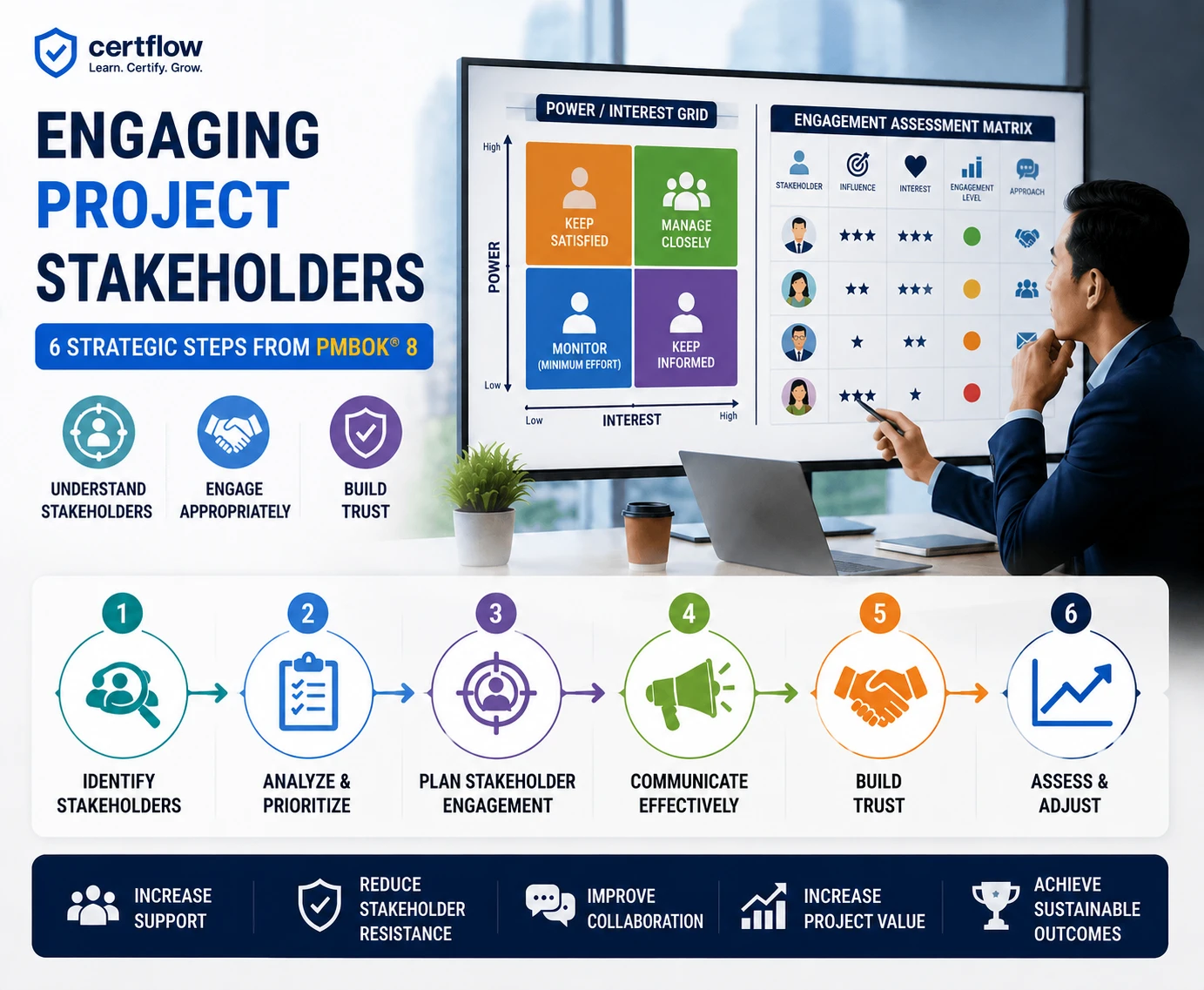
3. The 6-Step Stakeholder Engagement Framework
Group | Step | Enabler | Core Question |
|---|---|---|---|
Discover | 1 | Identify stakeholders | Who is affected by the project? |
Discover | 2 | Analyze stakeholders | What power, interests, and attitudes do they hold? |
Connect | 3 | Tailor communication | How do we communicate with them effectively? |
Execute | 4 | Execute engagement plan | How do we implement the engagement plan? |
Optimize | 5 | Optimize alignment | Do stakeholder needs, expectations, and project goals align? |
Trust | 6 | Build trust and influence | Do stakeholders trust and support the project? |
Key point: this is a continuous cycle, not a sequential checklist. New stakeholders can appear at any time (loop back to Step 1). Expectations shift over time (loop back to Step 5). Trust must be maintained continuously (Step 6 is never "done").
4. Steps 1–2: Identify and Analyze Stakeholders
Step 1: Identify Stakeholders — An Ongoing Activity
PMBOK 8 emphasizes the keyword "regularly": "Identifying project stakeholders regularly and analyzing relevant information regarding their interests, involvement, interdependencies, influence, and potential impact."
Stakeholder identification is not a one-time activity at the project's start: "Continuous stakeholder identification can work as a risk management strategy as the project environment evolves."
Stakeholder Register — the primary output — records for each stakeholder: identification information (name, position, role), assessment information (requirements, expectations, potential influence), and classification (internal/external, power/interest, direction of influence).
Step 2: Analyze Stakeholders — Going Deeper Than a Name List
PMBOK 8 (Section 5) describes stakeholder analysis as producing a list covering: positions, roles, "stakes", expectations, attitudes (level of support), and interests.
5 Types of "Stakes" — the reasons stakeholders care about the project:
Stake Type | Meaning | Example |
|---|---|---|
Interest | Affected by project decisions | End users who work with the system daily |
Rights | Legal or moral entitlements | Occupational health, environmental protection |
Ownership | Ownership of related assets or resources | Department owner of a legacy system |
Knowledge | Holds useful domain expertise | Subject matter expert who understands domain rules |
Contribution | Provides funding, resources, or advocacy | Sponsor who provides the budget |
PMP Tip: When analyzing stakeholders, don't only ask "what do they want?" — ask "what type of stake do they have?" A stakeholder with Rights (legal authority, e.g., a regulatory body) requires a very different approach from one with Knowledge (domain expertise, e.g., a subject matter expert).
5. Stakeholder Classification Models
PMBOK 8 provides 4 models for classifying stakeholders — PMs choose the model that matches the project's complexity:
Model 1: Power/Interest Grid
Low Interest | High Interest | |
|---|---|---|
High Power | Keep Satisfied — Executives, regulators. Provide concise reports; escalate only when necessary. | Manage Closely — Sponsor, key client. Meet frequently; involve in major decisions. |
Low Power | Monitor — Peripheral stakeholders. Check periodically; minimal effort required. | Keep Informed — End users, team. They want details but have limited influence over decisions. |
Model 2: Salience Model
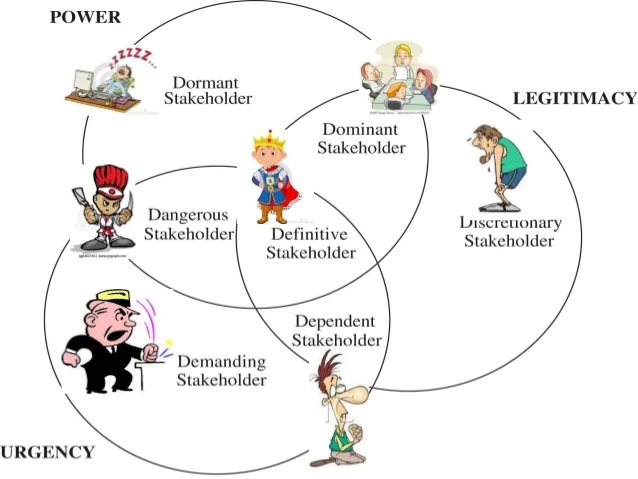
PMBOK 8: "Describes classes of stakeholders based on assessments of their power, urgency, and legitimacy (or proximity). Useful for large, complex communities of stakeholders or where there are complex networks of relationships." — Use this when the Power/Interest Grid is too simple.
Model 3: Directions of Influence
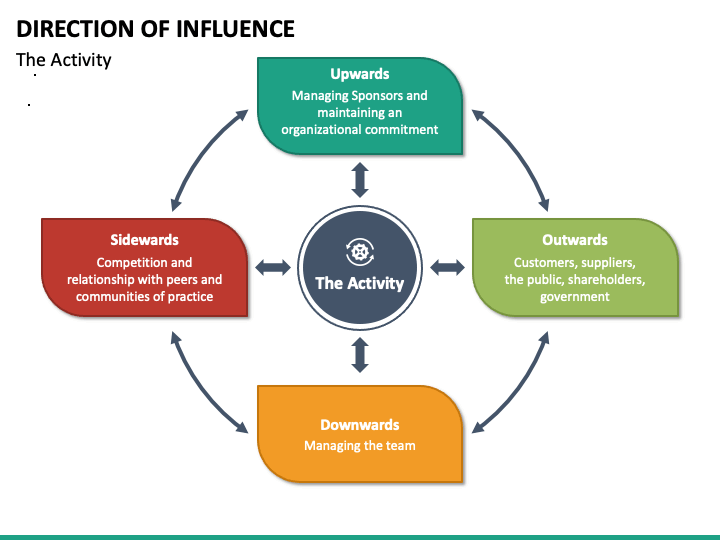
Upward (senior management, sponsor) — the PM must influence upward to secure resources. Downward (team, specialists) — the PM must empower and guide. Outward (suppliers, regulators, public) — the PM must manage expectations. Sideward (other PMs, middle managers) — the PM must negotiate for shared resources.
Model 4: Stakeholder Cube
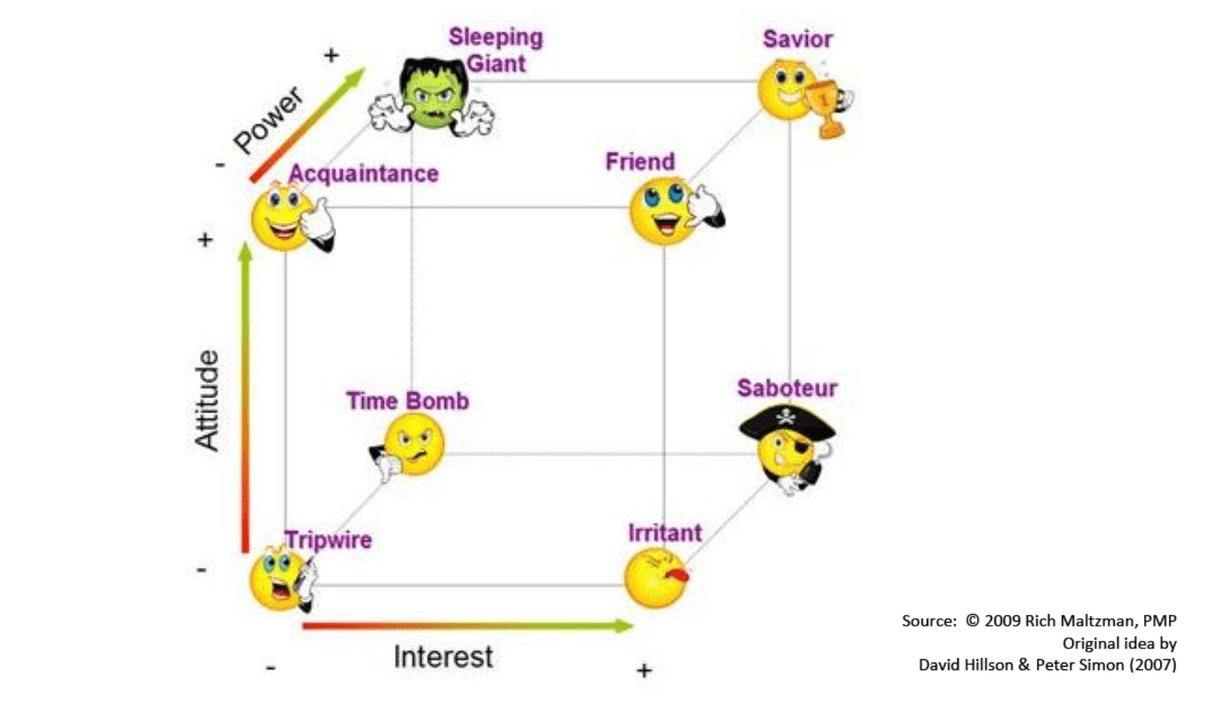
PMBOK 8: "Combines grid elements into a three-dimensional model... provides a model with multiple dimensions that improves the depiction of the stakeholder community as a multidimensional entity." — Use for highly complex projects.
Stakeholder Engagement Assessment Matrix
Beyond classification — PMs need to evaluate the gap between the current (C) and desired (D) engagement level:
Stakeholder | Unaware | Resistant | Neutral | Supportive | Leading |
|---|---|---|---|---|---|
CFO | C | D | |||
End Users | C | D | |||
IT Director | C | D | |||
Union Rep | C | D |
C = Current, D = Desired. The gap between C and D defines the focus areas for the engagement plan. Note: not every stakeholder needs to be at the "Leading" level — the goal is to bring each stakeholder to the engagement level that is appropriate for them.
6. Step 3: Tailor Communication to Stakeholder Needs
PMBOK 8:" The way of communicating should be tailored based on the needs and best fit for the stakeholders." A 20-page report is appropriate for an auditor but will lose a CEO's attention entirely.
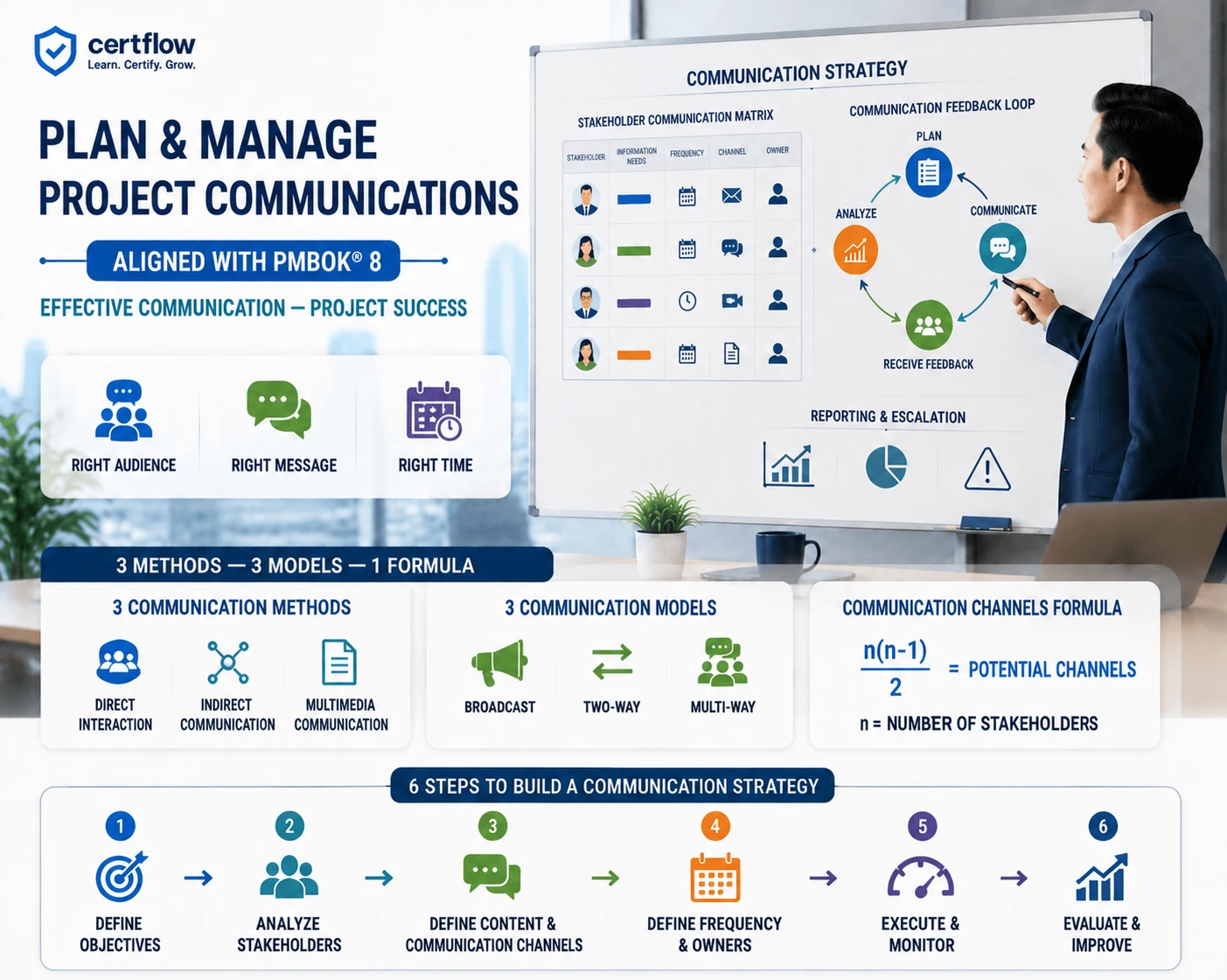
3 Communication Methods
Method | Description | Best For |
|---|---|---|
Interactive | Real-time, multi-directional: meetings, calls, instant messaging | Complex issues, critical decisions, conflict resolution |
Push | Sent directly: email, reports, memos | Updates, announcements, deliverable status |
Pull | Self-service access: portals, wikis, databases | High-volume information, broad audiences, reference materials |
3 Types of "Intelligence" to Apply
Political awareness — PMBOK 8: "Recognition of formal and informal power relationships and the willingness to operate within these structures." Understand who actually holds power — not just what the org chart says.
Cultural awareness — "Understanding of the differences among individuals, groups, and organizations and adapting the project's communication strategy in the context of these differences."
Communication styles assessment — "Often used with unsupportive stakeholders to identify gaps in engagement that require additional tailored communication."
7. Steps 4–5: Execute the Engagement Plan and Optimize Alignment
Step 4: Execute the Stakeholder Engagement Plan
PMBOK 8 Manage Stakeholder Engagement: "Communicating and working with stakeholders to meet their needs and expectations, address issues, and foster appropriate involvement. Key benefit: allows the PM to increase support and minimize resistance."
In adaptive environments, engagement happens naturally through ceremonies: sprint planning (agree on goals), sprint reviews/demos (feedback on increment), retrospectives (process improvement), daily standups (visibility). Each ceremony is a stakeholder engagement event.
Step 5: Optimize Alignment
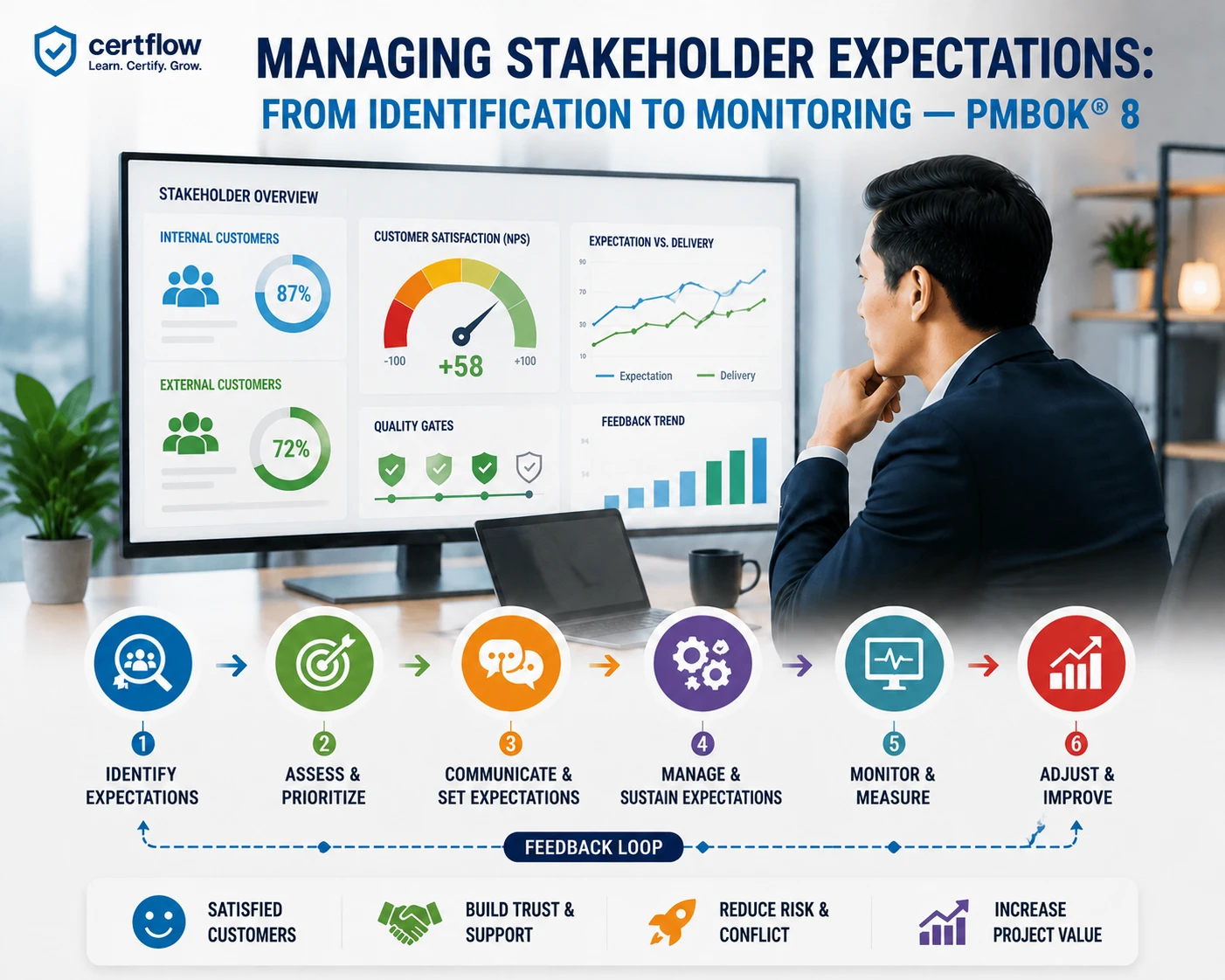
PMs must continuously check the alignment between: stakeholder needs ↔ stakeholder expectations ↔ project objectives. When these three diverge — the project is in trouble.
PMBOK 8 Monitor Stakeholder Engagement: "Assessing the effectiveness of engagement efforts, identifying necessary adjustments to improve relationships, and refining strategies."
Alignment metrics: NPS (Net Promoter Score — PMBOK 8 lists this for the Stakeholders Domain), stakeholder surveys, change request volume (high CRs = signal of misalignment), and feedback from sprint reviews.
8. Step 6: Build Trust and Influence
This is the most foundational enabler — without trust, every engagement plan will fail.
5 Trust-Building Elements from PMBOK 8
Element | What It Means in Practice |
|---|---|
Transparency | Be open about your thinking, decisions, and information. Never hide bad news. |
Integrity | PMBOK 8: "Willingness to share bad news early, ensuring status reports provide accurate depiction." Deliver bad news early. |
Consistency | Be consistent between words and actions. Keep promises. |
Competence | Demonstrate professional capability. Stakeholders trust a PM who clearly knows what they're doing. |
Respect | Honor each party's perspective and interests. Listen genuinely. |
Influencing — 5 Key Skills
PMBOK 8 identifies influencing as a critical skill because "project managers often have little or no direct authority over team members in a matrix environment." PMs cannot issue orders — they must influence.
5 influencing skills from PMBOK 8: Ability to be persuasive — clearly articulate value and benefits. Clearly articulating points — state your position clearly, without hedging. High levels of active listening — listen genuinely, not just waiting for your turn to speak. Awareness of various perspectives — see things from multiple angles. Gathering relevant information while maintaining trust — use facts, not politics.
Important: Influencing ≠ Manipulating. Influencing helps stakeholders see the truth clearly so they can make their own informed decisions. Manipulation distorts information to force a decision. On the PMP exam, the correct answer always involves transparent influencing.
Networking — Building Relationships
PMBOK 8: "Networking provides project managers with access to informal organizations to solve problems, influence actions of their stakeholders, and increase stakeholder support." Networking helps the PM understand the stakeholder landscape, find allies, and resolve issues quickly through informal channels.
9. PMP Exam Tips on Stakeholder Engagement
📍Tip 1 — "Regularly" is the keyword: Stakeholder identification is a CONTINUOUS activity, not a one-time event. When a question describes "a new stakeholder appearing midway" — the correct answer always starts with "add to register, assess, develop engagement strategy," NOT "inform them of existing plans."
📍Tip 2 — Sponsor engagement is #1: PMBOK 8: "Research shows that an active project sponsor is a critical success factor." When a question describes a disengaged sponsor — the correct answer is to proactively engage them, NOT to work around them or escalate to someone else.
📍Tip 3 — Leading indicators: When a question describes a stakeholder who "stops attending meetings," "delays approvals," or "goes quiet" — that is a leading indicator of disengagement. The PM must PROACTIVELY investigate, not wait for a formal complaint.
📍Tip 4 — Resistant stakeholder: When a stakeholder is resistant — the best answer is "understand their concerns first, then address them with data and transparent communication." NOT "get the sponsor to force compliance" or "ignore it and move forward."
10. Ten Scenario-Based Practice Questions
Question 1
During a community town hall for your infrastructure project, you discover that a local environmental group is planning to oppose the project due to wetland concerns. This group was not on your stakeholder register.
What should you do FIRST?
A. Ask legal to assess whether the group has standing to oppose.
B. Add the group to the stakeholder register, assess their power and interest, and develop an engagement strategy.
C. Inform the sponsor and wait for guidance.
D. Continue since the group is external and not in the project organization.
Question 2
Your stakeholder engagement assessment shows the VP of Marketing is "Resistant" but needs to be "Supportive." The VP believes the project will consume resources meant for their marketing campaign. You have data showing the project will actually increase marketing capabilities.
What is the BEST strategy?
A. Present the data in a one-on-one meeting showing how the project aligns with their marketing objectives.
B. Ask the sponsor to direct the VP to support the project.
C. Include the VP's team in the project for ownership.
D. Send regular status reports to keep the VP informed.
Question 3
You manage a project with stakeholders across three levels: C-suite (want dashboards), middle management (need resource details), and end users (want training schedules). Currently, everyone receives the same comprehensive weekly report.
How should you restructure communications?
A. Make the report shorter and more visual.
B. Set up a shared portal where everyone accesses all info.
C. Develop tailored communications for each group using appropriate method, format, and detail level.
D. Send the executive dashboard to everyone — it covers the most important info.
Question 4
During a sprint review, the product owner approves the increment, but two key end users seem disengaged — no questions, looking at phones. In previous reviews they were actively providing feedback.
What should you do?
A. Nothing — the PO approved, which is sufficient.
B. After the review, reach out privately to understand their disengagement and adjust engagement approach if needed.
C. Ask the PO to follow up with them.
D. Make next demo more detailed to re-engage them.
Question 5
A new regulation affects your construction project's environmental compliance. The regulatory body that issued it was not previously identified as a stakeholder. After adding them, how should you classify them?
Which classification is MOST appropriate?
A. High Power / Low Interest — Keep satisfied.
B. Low Power / High Interest — Keep informed.
C. High Power / High Interest — Manage closely with direct communication and proactive compliance.
D. Low Power / Low Interest — Monitor.
Question 6
The project sponsor says: "I don't have time for weekly meetings. Just email me when something goes wrong." However, you know disengaged sponsors create problems later when surprised by bad news.
How should you handle this?
A. Respect their preference and only communicate when issues arise.
B. Insist on weekly meetings because sponsors must be actively involved.
C. Propose a concise bi-weekly email summary with key metrics and decisions needed, plus clear escalation criteria for urgent issues.
D. Have the sponsor's assistant relay important updates.
Question 7
The HR Director initially supported your HR system project but has become increasingly silent — not responding to emails, not attending meetings. You hear informally they're concerned the new system will reduce their team's headcount.
What is the MOST effective approach?
A. Send a formal email requesting input and copy their manager.
B. Request a private meeting to openly discuss their concerns and collaboratively explore how the system could enhance their team's role.
C. Proceed without their input since you have sponsor approval.
D. Ask another HR team member to represent the Director's interests.
Question 8
Your vendor provides increasingly optimistic status reports, but deliverables are consistently late and below quality standards. When you raise concerns, the vendor's PM assures you "everything is on track."
How should you address this trust deficit?
A. Accept assurances to maintain a positive relationship.
B. Implement objective, data-based monitoring (milestone reviews, quality metrics, independent verification) while having a direct conversation about the gap between reports and reality.
C. Issue a formal non-compliance notice.
D. Replace the vendor.
Question 9
Your project has 50+ stakeholders across multiple departments. The Power/Interest grid feels too simplistic — some stakeholders have low formal power but can mobilize significant informal influence to block decisions.
What model should you adopt?
A. Continue with Power/Interest but add notes about informal influence.
B. Switch to the Salience Model, which assesses power, urgency, and legitimacy/proximity — providing more nuanced classification for complex communities.
C. Create individual engagement plans for all 50+ stakeholders.
D. Focus only on the top 10 most powerful stakeholders.
Question 10
You just joined as PM for an ongoing project. The previous PM had no stakeholder engagement plan, no register, and communicated ad hoc. Some stakeholders are disengaged, others frustrated, and the sponsor says "nobody tells me anything."
What should be your FIRST priority?
A. Create a comprehensive engagement plan with all processes before taking action.
B. Start sending weekly reports to all stakeholders immediately.
C. Conduct rapid stakeholder identification and analysis, assess engagement gaps, and begin targeted outreach to the most critical stakeholders (especially the sponsor) while developing a formal plan in parallel.
D. Hold a stakeholder kickoff to introduce yourself and reset expectations.
Answer Key
Question 1: Answer: B
— PMBOK 8: stakeholders include anyone "impacted by — or who feel they may be impacted by — the project." The environmental group qualifies. Continuous identification is a risk management strategy. Ignoring them (D) is dangerous. Waiting (C) is too passive.
Question 2: Answer: A
— The VP's resistance is based on a specific belief (resource competition). Address that belief directly with data in a private, interactive setting. PMBOK 8 emphasizes data-driven influencing. Using the sponsor (B) = Force = compliance, not support. Reports (D) are push communication — they inform but don't persuade.
Question 3: Answer: C
— PMBOK 8: "Project information should be adapted to provide information at an appropriate level, format, and detail for each type of stakeholder." One-size-fits-all fails most stakeholders. The PM must tailor — different content, different format, different channels.
Question 4: Answer: B
— A change in engagement behavior is a LEADING INDICATOR of misalignment. PMBOK 8: Monitor Stakeholder Engagement involves "assessing effectiveness and identifying necessary adjustments." PO approval alone doesn't ensure end-user alignment. The PM should proactively investigate.
Question 5: Answer: C
— A regulatory body with power to halt your project AND a new regulation directly affecting it = High Power + High Interest. PMBOK 8's stakeholder analysis includes "Rights (legal or moral)" as a stake type. Underestimating a regulator's interest (A) is a common and costly mistake.
Question 6: Answer: C
— PMBOK 8: communication should be "tailored based on the needs and best fit." The sponsor values brevity and dislikes meetings. But "only when wrong" leaves them uninformed. The PM should negotiate a middle ground: concise, periodic, with clear escalation. Influence through accommodation, not confrontation.
Question 7: Answer: B
— The Director's withdrawal signals a shift from Supportive to potentially Resistant — driven by a fear (job security). A private conversation builds trust and addresses the root cause. Formal escalation (A) damages trust. Proceeding without them (C) ignores a key stakeholder. A proxy (D) doesn't address the underlying concern.
Question 8: Answer: B
— Trust is built on transparency and data, not blind acceptance. The PM should address the gap directly AND establish objective verification. PMBOK 8 emphasizes data-driven decision-making. Formal notices (C) or replacement (D) may be needed later but are premature first steps.
Question 9: Answer: B
— PMBOK 8: Salience Model is "useful for large, complex communities of stakeholders or where there are complex networks of relationships." The third dimension (urgency/proximity) captures nuances the Power/Interest grid misses. Individual plans for 50+ (C) is impractical. Ignoring lower-power stakeholders (D) is how "hidden blockers" derail projects.
Question 10: Answer: C
— The situation demands both urgency AND structure. A comprehensive plan (A) takes too long when stakeholders are already frustrated. Blanket reports (B) don't address specific gaps. A kickoff (D) is useful but doesn't address the sponsor's specific frustration. The pragmatic approach: rapid assessment, immediate action on critical stakeholders, parallel plan development.
11. Conclusion
Engage Stakeholders is the most strategic task in the People Domain — because stakeholders determine whether a project lives or dies, regardless of how strong the technical execution is. Three key takeaways:
- Identification is an ongoing activity, not a one-time event — Stakeholders change, power dynamics shift, interests evolve. PMs must continuously re-identify and re-assess. "I already identified my stakeholders" is a dangerous mindset — the right mindset is "I am always identifying my stakeholders."
- Tailor, don't broadcast — CEOs don't want to read 20 pages. End users don't need to see budget variance. Each stakeholder needs the right information, through the right channel, at the right level of detail. One-size-fits-all communication is the fastest way to lose engagement.
- Trust is the foundation; influence is the tool — Without trust, every engagement plan will fail. Trust is built through transparency, integrity, and consistency — not through promises. And influence means helping stakeholders see the truth clearly, not manipulating them into a decision.
PMBOK® 8, Section 2.5: "Stakeholders permeate all aspects of projects. Stakeholders define and prioritize requirements and scope, participate in planning, determine acceptance criteria, use deliverables, and influence the realization of outcomes."
Frequently Asked Questions (FAQ)
What information should a Stakeholder Register contain?
The Stakeholder Register records: name and contact information, role in the organization and on the project, requirements and expectations, influence/power level, interest level, current engagement level (unaware/resistant/neutral/supportive/leading), and desired engagement level. The register must be updated regularly — stakeholders' attitudes shift throughout the project lifecycle.
How do the Power/Interest Grid and Salience Model differ?
Power/Interest Grid: two dimensions — power (influence) and interest (concern). Four quadrants: Manage closely (high power, high interest), Keep satisfied (high power, low interest), Keep informed (low power, high interest), Monitor (low power, low interest). Salience Model: three dimensions — power, urgency, and legitimacy. More nuanced, better suited for projects with large or complex stakeholder communities.
How do you move a stakeholder from resistant to supportive?
Approach: (1) Understand the root cause of resistance — what specifically are they worried about? (2) Address concerns directly with facts, data, and demonstrations. (3) Involve them early in decision-making — "co-creation" rather than "tell and sell." (4) Show quick wins that benefit them directly. (5) Build the personal relationship — trust takes time. PMBOK 8 emphasizes engaging resistant stakeholders, not bypassing them.
Now that you understand stakeholder engagement — it's time to practice with real exam questions.
Next article: Aligning Stakeholder Expectations: From Classification to Consensus
Stakeholder management: Power/Interest Grid and engagement plan per PMP
Try Free PMP Practice Questions →
Official References: