Balancing a full-time job and PMP prep is tough — but doable with the right plan. Discover study methods and resources that work for busy professionals.
Last updated: October 1, 2026 — checked against the PMI Certification Handbook (June 2026) and the 2026 PMP Examination Content Outline on pmi.org.
PMP (Project Management Professional) is the project management certification issued by the Project Management Institute (PMI). The good news: you can absolutely self-study for the PMP and pass without an expensive bootcamp, as long as you follow the right roadmap. This guide walks you through every step, from checking your eligibility to walking into the exam room — updated for the new PMP exam in effect since July 9, 2026.
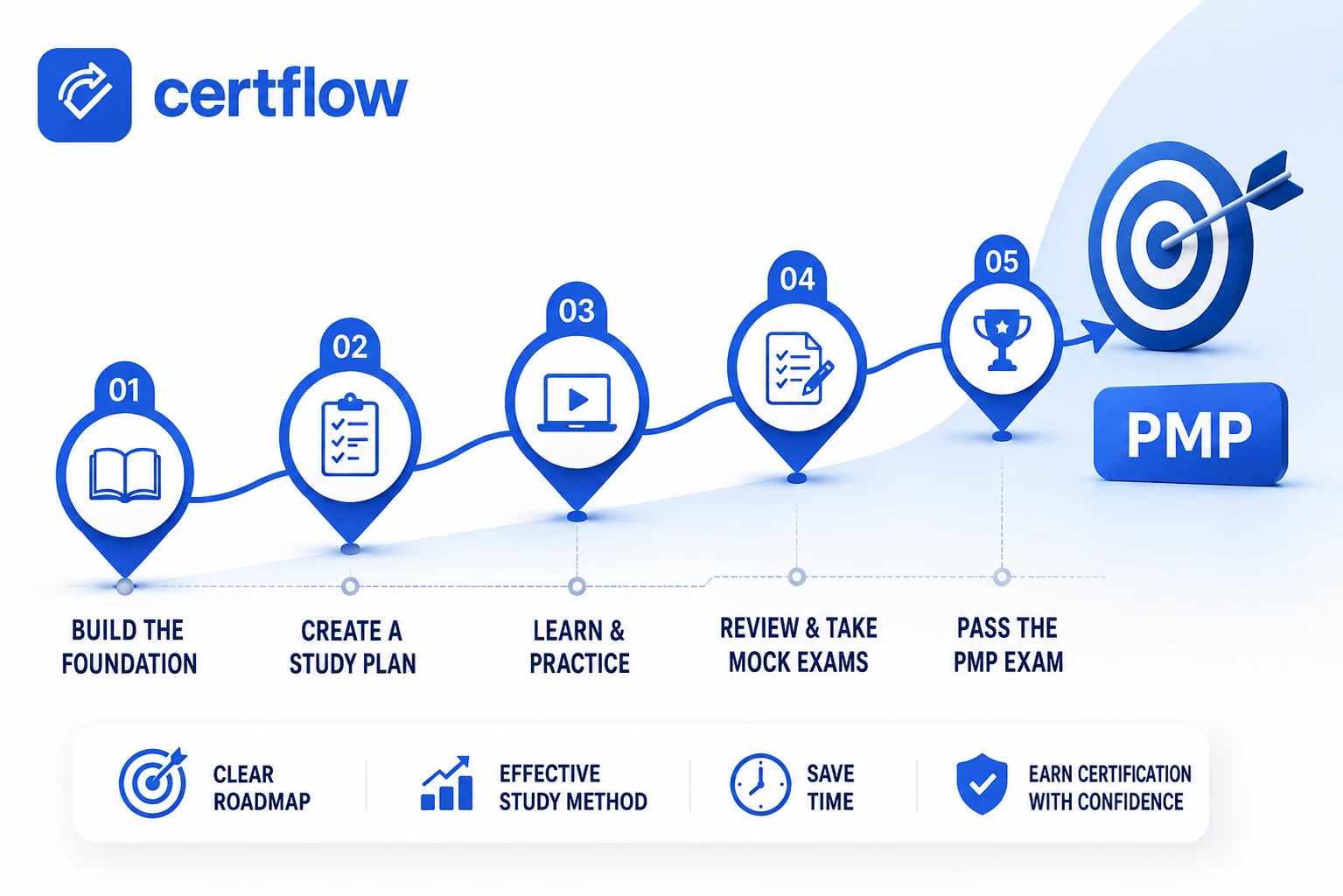
The 2026 PMP self-study plan in 7 steps
1. Check your PMP eligibility
2. Earn your 35 training hours
3. Submit your application on PMI.org
4. Study the 2026 ECO
5. Practice until you consistently score above 70%
6. Pay and schedule your exam with Pearson VUE
7. Take the exam with a calm, clear head
What's new in the 2026 PMP exam?
Since July 9, 2026, every PMP exam uses the new 2026 Exam Content Outline (ECO). If you started with older materials, here is what changed:
Item | Old exam (2021 ECO) | New exam (2026 ECO) |
|---|---|---|
Questions | 180 | 180 (170 scored + 10 unscored pretest) |
Time | 230 minutes | 240 minutes, including two 10-minute breaks |
People | 42% | 33% |
Process | 50% | 41% |
Business Environment | 8% | 26% |
Approach mix | ~50% predictive, ~50% agile/hybrid | ~40% predictive, ~60% agile and hybrid |
New question types | — | Case study/scenario and graphic-based questions |
Experience window | Last 8 years | Last 10 years |
The three changes that matter most for your study plan: Business Environment jumps from 8% to 26% (strategy, value, compliance, governance), agile and hybrid now make up about 60%, and the new case-study section rewards careful reading of long scenarios. For the background on the reference books, see PMBOK 8 vs PMBOK 7.
Step 1: Check your PMP eligibility
PMI requires two things: experience leading projects (depending on your education) and 35 hours of project management training. All experience must fall within the last 10 years, and overlapping months count only once.
Education | Project leadership experience | Training |
|---|---|---|
High school diploma | 60 months (5 years) | 35 hours or an active CAPM |
Associate's degree, higher certificate or advanced vocational qualification | 48 months (4 years) — new tier in 2026 | 35 hours or an active CAPM |
Bachelor's degree or higher | 36 months (3 years) | 35 hours or an active CAPM |
Degree from a PMI GAC-accredited program | 24 months (2 years) | GAC coursework can count toward the 35 hours |
Important points
You don't need the job title "Project Manager." PMI requires that you have led projects: owning, coordinating or directing the work as a team lead, tech lead or department head all can count. Look at your work through the lens of projects, not titles.
Experience doesn't need to be continuous, but months spent on parallel projects are counted only once.
If you hold an active CAPM, you don't need to document the 35 training hours.
Step 2: Earn your 35 training hours
PMI requires at least 35 hours of commercial project management training aligned with the ECO.
Popular options
Udemy (self-paced): the most budget-friendly choice for self-studiers. The courses by Andrew Ramdayal (TIA Education) and Joseph Phillips are the most widely used. Before buying, confirm the description says it is updated for the 2026 exam / 2026 ECO and issues a 35-hour certificate. Wait for one of Udemy's frequent sales.
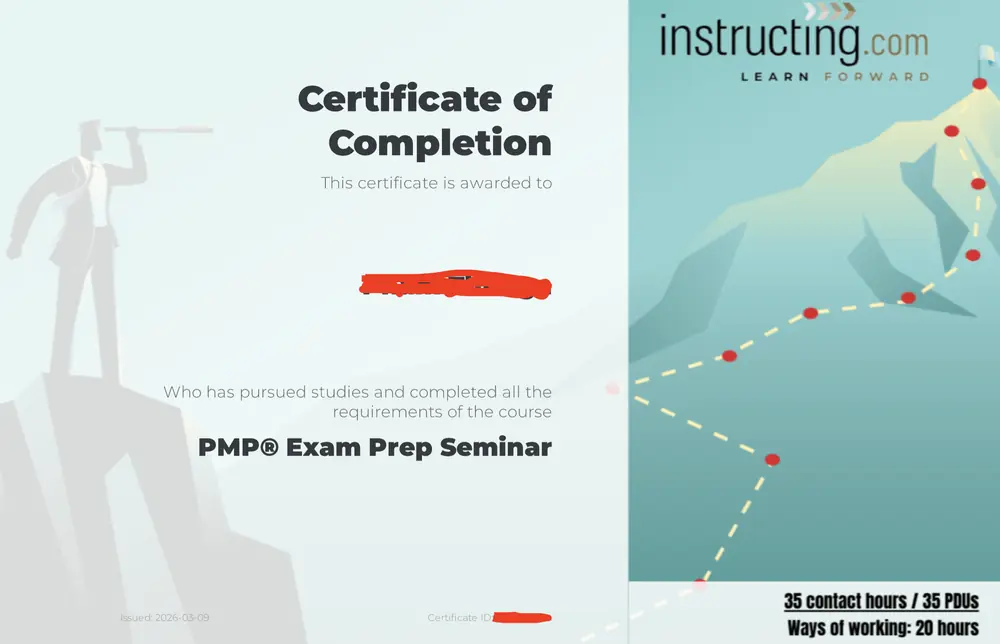
On Udemy you must complete 100% of the lectures to receive a Certificate of Completion. Go to "My Learning" → open the course → "Certificate" and download the PDF showing your hours. Keep it safe for your application and in case of an audit.
More on each accepted source: 35 Contact Hours for PMP explained.
Step 3: Submit your application on PMI.org
This step just takes patience and honesty. I've written a dedicated step-by-step guide with a sample project description: How to complete the PMP application.
A few things to know up front:
You only pay the exam fee after your application is accepted.
PMI selects some applications for a random audit. The audit is now fully online: you upload your evidence through myPMI ("Access Audit Package"), and your references sign electronically via a DocuSign email. You have 90 days to submit, and PMI processes audits in about 5–7 business days.
If you're audited, your 1-year eligibility period starts the day you're told the audit was successful.
There's no need to fear an audit if your information is accurate. See: How to handle a PMP audit.
Step 4: Study the 2026 ECO
The most important thing to understand: the PMP exam isn't based on a single book. It's built on the 2026 Exam Content Outline (ECO), with three domains: People (33%), Process (41%) and Business Environment (26%). About 40% of questions are predictive and the remaining 60% are agile and hybrid.
Recommended study materials
Your 35-hour course — the backbone of your theory study.
The 2026 PMP Examination Content Outline — free on pmi.org. Use it as a checklist: go task by task and ask whether you truly understand it.
PMBOK® Guide – Eighth Edition — six principles, seven performance domains, and reintroduced process guidance. Free PDF for PMI members.
Agile Practice Guide – Second Edition — the new edition created with Agile Alliance and connected to PMBOK 8. Essential since agile and hybrid make up about 60% of the exam. Free for PMI members.
CertFlow's key knowledge series — concise summaries of frequently tested topics.
How to study effectively
1. Work through your 35-hour course once, taking notes organized by the three ECO domains.
2. Don't memorize by rote. Most PMP questions are situational — "what should you do NEXT?" Train the PMI mindset: be proactive, engage stakeholders, respect the process, don't blame, and find the root cause before acting.
3. For agile, master servant leadership: the PM supports the team, removes impediments and empowers self-organization.
4. Give Business Environment dedicated time: business cases, benefits realization, compliance, governance and organizational change. Its weight has tripled.
5. Keep notes on commonly confused concepts: contract types, EVM, Scrum roles and conflict resolution approaches.
Step 5: Practice PMP questions
Practice questions decide whether you pass. Understanding theory is one thing; picking the best answer in a scenario is another.
Quality question sources
CertFlow practice exams — explanations for every question, real exam timing, and a readiness signal that tells you when to book.
PMI Study Hall — PMI's official question bank. Essentials (USD 59) includes 2 full 180-question exams; Plus (USD 79) includes 3. Each plan covers 3 months and includes a Pearson VUE-style exam mode.
PMI's PMP Practice Exam — USD 99 for one full 180-question exam in three timed sections, with unlimited retakes.
How to practice the right way
Start with topic-based sets, then move to full mock exams under real conditions: 180 questions, 240 minutes, two breaks.
The review matters more than the score. For every wrong answer (and every lucky guess), read the explanation until you understand why the right answer is right and the others are wrong.
Aim to score consistently above 70% on quality question banks before you book. PMI doesn't publish a fixed passing score, so 70% is a widely used community benchmark, not an official number.
Keep an error log of question types you keep missing and review it before exam day.
Practice case studies and graphic-based questions — both are new in the 2026 exam.
Watch the keywords (next, best, first, most likely). PMP questions often have two plausible answers but only one best answer. See the 50 PMI mindset principles.
A 12-week PMP study schedule for working professionals
This schedule assumes roughly 1–2 hours on weekdays and longer sessions at weekends.
Week | Focus |
|---|---|
1 | Check eligibility, read the 2026 ECO, buy your 35-hour course |
2–3 | 35-hour course: foundations and the People domain |
4–5 | 35-hour course: the Process domain (predictive) |
6 | Agile, Scrum and hybrid + Agile Practice Guide, 2nd edition |
7 | Business Environment; finish the course, download the certificate, submit your PMI application |
8–9 | Topic-based practice questions and an error log |
10 | Full mock exam #1, mock test and mistake analysis; book your exam |
11 | Full mock exam #2, mock test weak areas, case-study practice |
12 | Final mock, mock test, mindset review, rest before exam day |
Step 6: Pay and schedule your exam
Once your application is approved, you have 1 year to take the exam and up to 3 attempts in that period. The second and third attempts require a re-examination fee.
PMP exam costs
Item | Cost (USD) |
|---|---|
Exam fee — PMI member | 284 |
Exam fee — non-member | 575 |
PMI membership | 109/year |
Reschedule/cancel within 30 days of the exam | 70 |
These are the list prices on pmi.org. PMI applies regional pricing, so log in to your PMI account to see the exact price for you. Membership only pays off if you join before paying the exam fee. At list prices, 109 + 284 = 393 USD versus 575 USD, and you also get free downloads of PMBOK 8 and the Agile Practice Guide.
Note: if you reschedule or cancel within 48 hours of your appointment, or don't show up, you forfeit the entire exam fee.
Test center or online?
After paying, you schedule through Pearson VUE and choose one of two formats:
Pearson VUE test center: PMI recommends in-person testing, and so do I — it avoids internet outages, technical glitches and unintended rule violations.
Online proctored at home: you must run a system test beforehand and go through a thorough check-in; the proctor may ask to see your ID again after each break.
The PMP exam is offered in English and up to 15 translated languages. Plan to practice in the language you'll actually test in.
Tip: book your exam early to create a deadline, but leave enough time to complete at least 2–3 full mock exams.
Step 7: Exam day
Before the exam
Get a full night's sleep. Last-minute cramming does more harm than good.
Bring valid ID — your name must match exactly the name registered with PMI.
Online: clear your desk completely, test your camera, microphone and connection, and run the system check early.
Test center: arrive about 30 minutes early and store personal belongings in a locker.
During the exam
You have 240 minutes for 180 questions — about 1 minute 20 seconds per question. If a question is hard, mark it for review and move on.
The first break comes after the case-study section; the second comes about midway through the independent questions. Once you start a break, you cannot return to the previous section, so review all flagged questions before you take it.
The tutorial and survey don't count toward the 240 minutes.
Stay calm through a run of hard questions. Difficulty is mixed, and 10 pretest questions don't count.
After you submit
You receive a preliminary result as soon as you finish. PMI confirms the official result within 10 business days. When you see "Congratulations", you're about to become a PMP!
To keep the credential, you'll need 60 PDUs every 3-year cycle plus the renewal fee.
Summary
1. Check eligibility: 36/48/60 months of experience in the last 10 years + 35 training hours (or CAPM).
2. Earn 35 hours: self-paced courses still count after Dec 1, 2026; instructor-led classes must come from a PMI ATP.
3. Apply: be honest and keep evidence ready in case of an audit.
4. Study: follow the 2026 ECO, PMBOK 8 and the Agile Practice Guide, 2nd edition.
5. Practice: review every mistake, stay above 70%, get comfortable with case studies.
6. Book: consider PMI membership before paying, prefer a test center.
7. Test: sleep well, manage your time, review before every break.
Self-studying for the PMP is entirely achievable with the right roadmap and enough practice. Start practicing exam-style questions today on CertFlow and know exactly when you're ready.
Good luck — pass on your first try!
Frequently Asked Questions (FAQ)
How many questions are on the 2026 PMP exam, and how long is it?
Since July 9, 2026, the PMP exam has 180 questions: 170 scored and 10 unscored pretest questions. You have 240 minutes, which includes two 10-minute breaks.
How long does it take to self-study for the PMP?
Most working professionals need 3–4 months, roughly 150–200 study hours if they already have a project management background, and more if they're new to it. This is a community estimate; PMI doesn't publish an official figure. Study quality and mistake analysis matter more than total hours.
Will Udemy courses still count for the 35 hours after December 1, 2026?
Yes. According to PMI, self-paced courses from any organization remain eligible. The new rule from December 1, 2026 only applies to instructor-led classes, which must be delivered by a PMI Authorized Training Partner or an eligible accredited higher-education program. Keep your completion certificate showing the hours.
Which languages is the PMP exam available in?
The PMP exam is available in English and in up to 15 translated languages, including Spanish, French, German, Japanese, Korean and Chinese. Check the PMI Certification Handbook for the current list before you book.
What happens if I fail the PMP exam?
You can take the exam up to 3 times within the 1-year eligibility period after your application is approved, with a fee for the second and third attempts. If you fail all three, you must wait 1 year from your last attempt before reapplying.
What practice score should I reach before booking?
PMI doesn't publish a fixed passing score. A common benchmark is scoring consistently above 70% on quality banks such as PMI Study Hall, while understanding why you missed the rest.
Now that you have your 2026 PMP self-study plan, it's time to practice with real exam-style questions.
Next article: How to complete the PMP application
Try free PMP practice questions →
Official PMI sources: