PMBOK 8 keeps PMBOK 7's foundation but simplifies it: 6 principles, 7 performance domains, Focus Areas, 40 processes, new appendices. What it means for the PMP.
Last updated: October 1, 2026 — checked against the PMBOK® Guide page on pmi.org, PMI's PMBOK 8 launch announcement (November 13, 2025), PMI's PMBOK 7 materials and the 2026 PMP Examination Content Outline.
If you're studying for the PMP, the first question is usually: what's actually different between PMBOK 8 and PMBOK 7? The short answer:
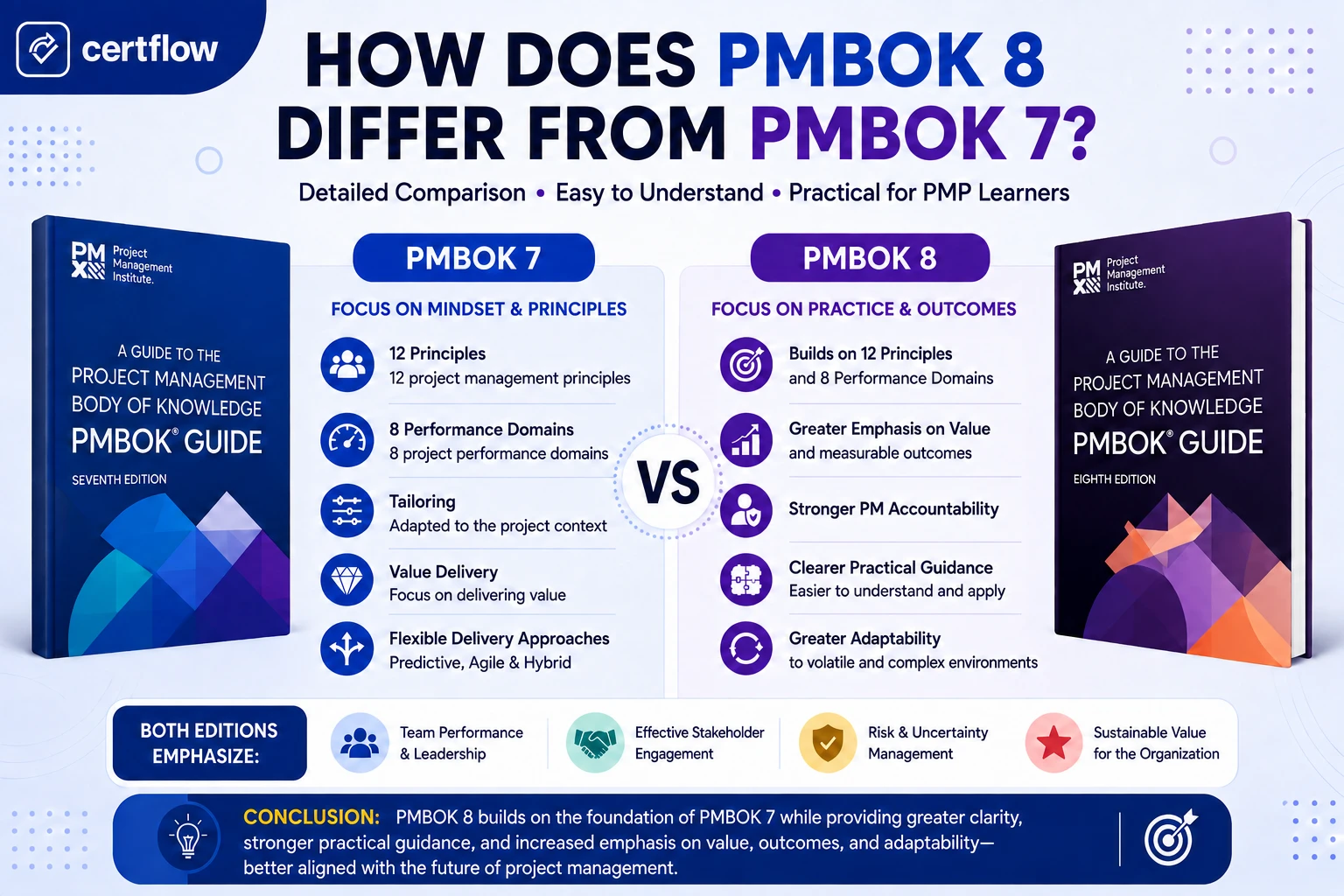
PMBOK 8 (released November 2025) keeps PMBOK 7's foundation of principles and performance domains but simplifies it: 12 principles become 6, the domains are restructured into 7, process groups return as Focus Areas with 40 non-prescriptive processes, and new appendices cover PMOs, AI and procurement.
This article walks through each change, separates what PMI has officially published from commentary, and explains what it means for the new PMP exam in effect since July 9, 2026.
PMBOK 7 vs PMBOK 8 at a glance
Criterion | PMBOK 7 | PMBOK 8 |
|---|---|---|
Released | August 2021 | November 2025 |
Principles | 12 | 6 |
Performance domains | 8: Stakeholder, Team, Development Approach & Life Cycle, Planning, Project Work, Delivery, Measurement, Uncertainty | 7: Governance, Scope, Schedule, Finance, Stakeholders, Resources, Risk |
Process groups | Removed from the book, only referenced | Back as Focus Areas |
Processes and ITTOs | Not fully included | 40 non-prescriptive processes with inputs, tools & techniques and outputs |
Tailoring | A dedicated section | Still central to how processes are applied |
Procurement | Part of the Project Work domain | Its own appendix |
AI, PMO | No dedicated coverage | Dedicated appendices |
Research basis | Community surveys and feedback | Input from thousands of practitioners and more than 48,000 data points |
Why did PMI update the PMBOK Guide?
PMBOK 7 (2021) was a big shift: from process-based guidance (PMBOK 6's 49 processes) to principles and performance domains. After four years in use, many practitioners found it hard to turn PMBOK 7 into concrete day-to-day practice.
According to PMI, PMBOK 8 retains the principles and performance domains foundation of the Seventh Edition but simplifies and clarifies them, and reintroduces process guidance "in an evolved, non-prescriptive way". It was built on input from thousands of project professionals and more than 48,000 data points. The draft was open for PMI member comments from December 20, 2024 to January 19, 2025.
Change 1: From 12 principles to 6
This is the most talked-about change. PMBOK 7 had 12 principles:
Stewardship · Team · Stakeholders · Value · Systems Thinking · Leadership · Tailoring · Quality · Complexity · Risk · Adaptability and Resiliency · Change
PMBOK 8 has six. PMI summarizes them as: "adopt a holistic view, focus on value, embed quality, lead accountably, integrate sustainability, and build empowered teams". Their full names in the book:
- Adopt a Holistic View
- Focus on Value
- Embed Quality Into Processes and Deliverables
- Be an Accountable Leader
- Integrate Sustainability Within All Project Areas
- Build an Empowered Culture
Sustainability is the clearest addition: in PMBOK 7 it was only touched on under Stewardship, while in PMBOK 8 it's a principle in its own right.
Where did the 12 old principles go?
PMI hasn't published an official mapping from 12 principles to 6. The table below is the author's own cross-reference to help you carry PMBOK 7 knowledge into PMBOK 8:
PMBOK 8 principle | Closest PMBOK 7 principles |
|---|---|
Adopt a Holistic View | Systems Thinking, Complexity, Stakeholders |
Focus on Value | Value |
Embed Quality | Quality |
Be an Accountable Leader | Leadership, Stewardship |
Integrate Sustainability | Stewardship (partly); largely new |
Build an Empowered Culture | Team, Adaptability and Resiliency, Change |
Principles such as Tailoring and Risk haven't disappeared: they show up in how processes are applied and in the Risk domain.
Change 2: Process groups return as Focus Areas
PMBOK 7 removed the five process groups and ITTOs from the book, keeping only references. PMBOK 8 brings them back as Focus Areas, in PMI's words "to accommodate diverse delivery approaches".
The Focus Areas correspond to the familiar process groups: Initiating, Planning, Executing, Monitoring & Controlling and Closing. What differs from PMBOK 6 is how they're used: Focus Areas aren't a rigid sequence. On predictive projects they sit close to the traditional process group structure; on agile projects the same goals can be met through lighter practices.
Note: Initiating and Planning are process groups/Focus Areas, not project phases — a very common mix-up in study materials.
Change 3: 7 performance domains and 40 processes
PMBOK 8 has seven performance domains: Governance, Scope, Schedule, Finance, Stakeholders, Resources and Risk. This isn't an edit of PMBOK 7's eight domains; it's a new structure that sits closer to the traditional knowledge areas practitioners are used to.
Within these domains are 40 processes, which PMI describes as process guidance "presented in an evolved, non-prescriptive way". Each process has inputs, tools & techniques and outputs — for example, Plan Scope Management lists the project charter, project management plan and project documents as inputs. You choose the processes that fit your project rather than using all of them.
Two points to get right:
- Finance doesn't "replace Cost" from PMBOK 7, because PMBOK 7 had no Cost domain. Cost was a knowledge area (Project Cost Management) in PMBOK 6. PMBOK 8's Finance domain covers the project's financial side within the new structure.
- Governance is a notable new domain. It lines up with the 2026 ECO's much heavier Business Environment domain, which includes the task "define and establish project governance".
Change 4: New appendices on PMOs, AI and procurement
According to PMI, PMBOK 8 includes dedicated appendices on the Project Management Office (PMO), Artificial Intelligence (AI) and Procurement.
- AI: the first time the PMBOK Guide gives AI dedicated coverage, including responsible use and ethical concerns.
- Procurement: in PMBOK 7, procurement was just part of the Project Work domain. PMBOK 8 gives it its own appendix.
- PMO: guidance on the role and setup of a project management office.
How does PMBOK 8 affect the 2026 PMP exam?
The PMP exam is built on the Exam Content Outline (ECO), not on a single book. The 2026 ECO itself says the exam "is not written according to any single text" and that there are "noticeable differences" between the ECO and the PMBOK Guide.
Still, PMBOK 8 matters a great deal:
- The 2026 ECO uses PMBOK 8's new definition of a project: "a temporary initiative in a unique context undertaken to create value".
- PMI's list of the 10 references most cited by exam question writers includes the PMBOK® Guide and the Agile Practice Guide (both free for members). That page now links to PMBOK 8 and the second edition of the Agile Practice Guide. PMBOK 7 is no longer on the list.
- The 2026 ECO weights People at 33%, Process at 41% and Business Environment at 26%, and about 60% of questions are agile or hybrid.
In short: the PMP doesn't test whether you can recite PMBOK definitions; it tests how you make decisions in scenarios. PMBOK 8 is a core reference, but not the only one.
Should you read PMBOK 7 or PMBOK 8?
If you're just starting PMP prep
- The 2026 ECO — your main checklist.
- PMBOK 8 — read the six principles and seven domains, then the processes by domain.
- Agile Practice Guide, 2nd edition — essential, since agile and hybrid make up about 60% of the exam.
- Situational practice questions — to turn knowledge into decision-making.
You don't need to read PMBOK 7; PMBOK 8 carries its foundation forward. Process Groups: A Practice Guide (49 processes) is still sold but no longer featured on pmi.org; read it only if you want to go deeper into traditional predictive practice.
If you already hold the PMP
You don't need to start over. Reading PMBOK 8's introduction and summary of changes to understand the six principles and seven domains is enough. The PMP credential runs on a 3-year cycle; to keep it, you need 60 PDUs per cycle plus the renewal fee. Reading and applying PMBOK 8 is a good way to earn PDUs.
How to get PMBOK 8
PMI members can download the PDF free from pmi.org. The print edition combines the PMBOK Guide and The Standard for Project Management in roughly 408 pages.
Conclusion
PMBOK 8 isn't a revolution; it's a refinement of PMBOK 7: six leaner principles, seven performance domains closer to real practice, processes back in a non-prescriptive form, and new appendices on AI, PMOs and procurement. PMBOK 7 changed how we think; PMBOK 8 makes that thinking easier to apply.
Frequently Asked Questions (FAQ)
How many principles does PMBOK 8 have?
PMBOK 8 has six principles, down from twelve in PMBOK 7: Adopt a Holistic View, Focus on Value, Embed Quality, Be an Accountable Leader, Integrate Sustainability and Build an Empowered Culture.
How many performance domains does PMBOK 8 have?
PMBOK 8 has seven performance domains: Governance, Scope, Schedule, Finance, Stakeholders, Resources and Risk. PMBOK 7 had eight domains with entirely different names.
Are PMBOK 8's Focus Areas the same as process groups?
Focus Areas are how PMBOK 8 brings process groups back, with familiar names such as Initiating and Planning. The difference is that they're applied flexibly across predictive, agile and hybrid approaches rather than as a rigid sequence.
How many processes are in PMBOK 8?
PMBOK 8 has 40 processes across its seven performance domains, compared with 49 in PMBOK 6. They're non-prescriptive: you choose the ones that fit your project.
Is the 2026 PMP exam based on PMBOK 8?
The PMP exam is based on the 2026 ECO, not on a single book. However, the ECO uses PMBOK 8's definition of a project, and the PMBOK Guide and Agile Practice Guide are among the references exam writers cite most.
Do I need to read PMBOK 7 before PMBOK 8?
No. PMBOK 8 keeps PMBOK 7's foundation, and PMBOK 7 is no longer on PMI's PMP reference list. New candidates should go straight to PMBOK 8 and the second edition of the Agile Practice Guide.
Now that you know how PMBOK 8 differs from PMBOK 7, it's time to practice with real exam-style questions.
Next article: 2026 PMP self-study plan
Introduction to project management: what every PM needs to know
Try free PMP practice questions →
Official PMI sources: