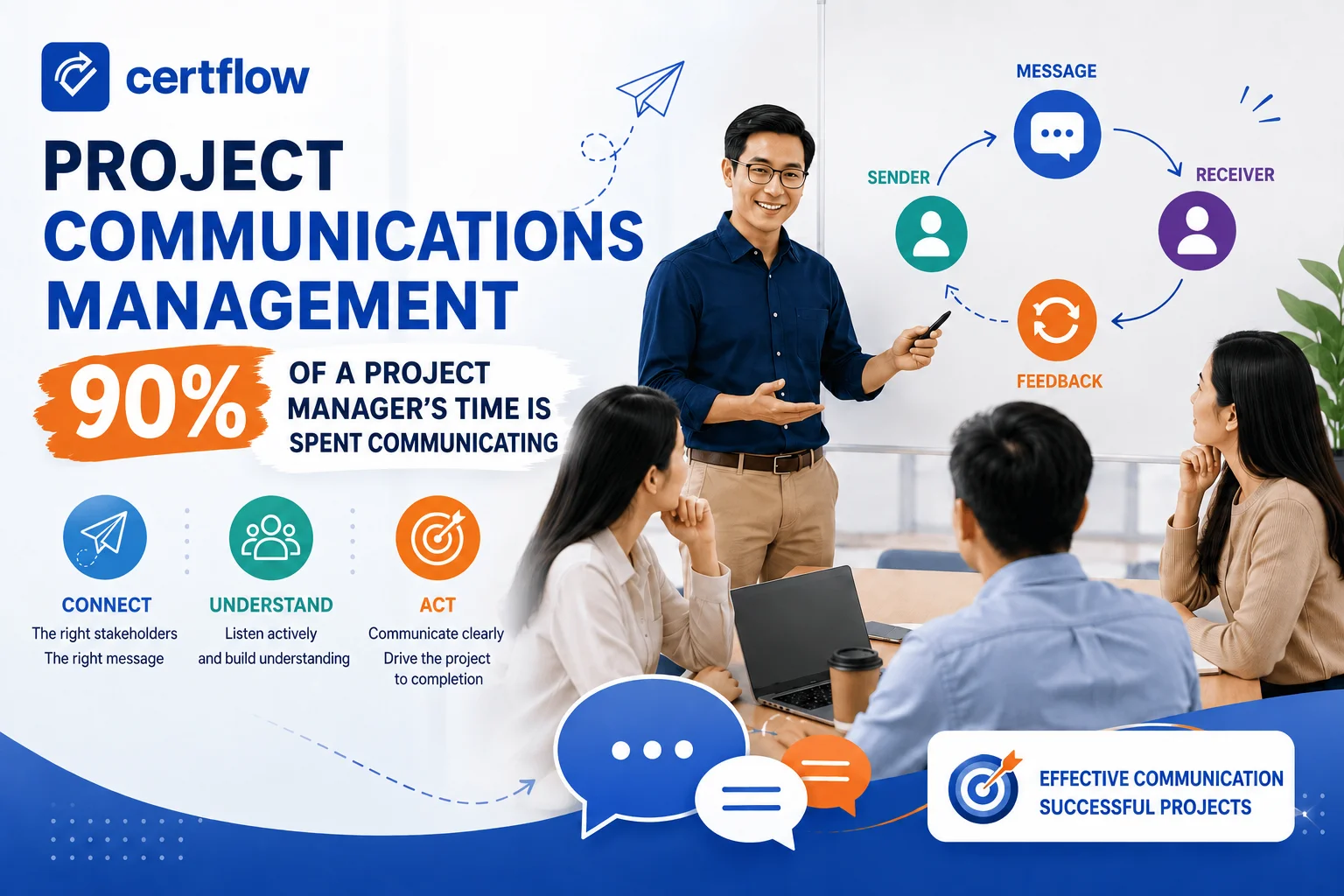
You spend 90% of your time communicating as a PM. Learn to build a Communication Plan, choose the right channels, and report project status effectively.
I once witnessed a classic scenario:
A technician received an email from the business team: "System error, please help."
The technician replied: "Send me the log file."
Two days later, the business analyst pasted 20 pages of logs directly into an email.
The technician replied: "I can't work with a paste like this."
The result? The analyst CC'd both managers, escalating it into a major incident — when at its core, it was just two people speaking two different languages.
A small story, but it perfectly reflects reality: project quality = communication quality. PMs spend up to 90% of their time communicating — when communication breaks down, everything else suffers.
This article walks through the entire project communication management process: from planning, understanding communication models, selecting the right communication methods, to monitoring and continuously improving communication.
What Is Communication in a Project Context?
Communication is the exchange of information — whether intentional or not. The information exchanged can be ideas, instructions, or emotions. Yes — emotions too. A frown in a meeting is communication, even if you say nothing at all.
The basic model: Sender → Message → Receiver → Feedback. Simple as it sounds, "noise" can appear at any point in this chain and distort the information.
Types of Communication
Communication in a project is classified along several dimensions:
By direction:
- Upward: With sponsors, senior management
- Downward: With team members, specialists
- Outward: With suppliers, customers
- Sideward: With peer PMs, parallel departments
By format:
Verbal | Written | |
Formal | Speeches, presentations, mass communication | Contracts, legal notices, project reports |
Informal | Meetings, discussions, phone calls | Emails, memos, messages |
📍 PMP Exam Tip: When a question mentions communication with a client or sponsor → formal. Contracts, project documents, reports → always formal written. Meetings — no matter how important the content — are still informal verbal. This is a small detail that the exam tests frequently.
Plan Communication Management — Communication Can't Be Ad Hoc
Communicating to the wrong audience, at the wrong time, in the wrong format — is worse than not communicating at all. That's why a clear plan is essential.
What, Why, When?
- What: Identify each stakeholder's communication needs and the appropriate approach.
- Why: Effective stakeholder engagement requires the right information delivered at the right time.
- When: As early as possible. Review periodically throughout the project — especially when the stakeholder community changes or a new phase begins.
Communication Requirement Analysis
For each stakeholder, you need to answer the following questions:
- What information do they need? Not everyone needs to know everything.
- What format? Report, email, meeting, dashboard?
- How frequently? Daily, weekly, per milestone?
- Who prepares it? PM, BA, team lead?
- Where is it stored? SharePoint, Google Drive, PMIS?
A useful framework from Japan is Horenso: Ho (Report/Present) + Ren (Relay/Update) + So (Consult/Discuss). These three activities cover the majority of project communication.
Communication Technology
Select communication technology based on 5 factors:
- Urgency: How urgent — urgent messages need fast channels
- Sensitivity: How sensitive — confidential information needs secure channels
- Environment: The setting — distributed teams vs. co-located
- Availability: Accessibility — can all stakeholders use the tool?
- Easy to use: Ease of use — overly complex tools won't get adopted
Communications Management Plan
The output of all this analysis is captured in the Communications Management Plan. This plan can be formal or informal, detailed or high-level — depending on the project's needs. It typically includes a matrix showing: which stakeholder — needs what information — in what format — how frequently — via which channel — owned by whom.
Communication Model — Understanding How Information Travels
This is theoretical but highly practical — and the PMP exam tests it frequently.
The Sender-Receiver Model
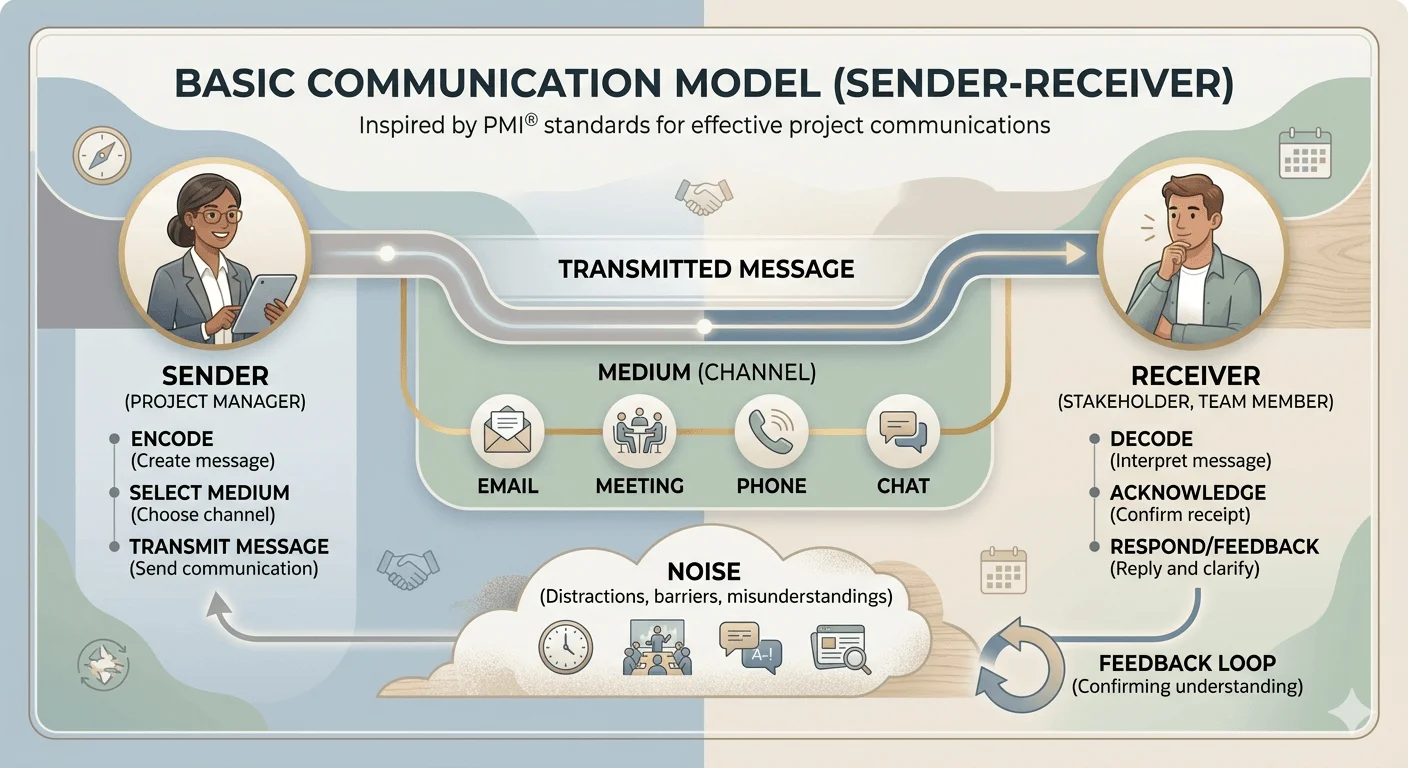
The complete communication process:
- Sender encodes the message — converts ideas into words, text, or images
- Transmits through a medium (channel) — email, phone, face-to-face
- Receiver decodes the message — interprets it in their own way
- Receiver encodes feedback and sends it back to the Sender
- Noise can appear at any step
Noise: The Silent Saboteur
Communication blockers can come from many sources:
- Ambient noise, physical distance
- Unclear message encoding (unclear speech, incoherent writing)
- Negative attitudes, personal bias
- Language and cultural differences (generational, national, professional, gender)
- The current emotional state of the sender or receiver
Sender vs. Receiver Responsibilities
Sender | Receiver |
Encode the message clearly | Ensure complete receipt of information |
Choose the appropriate communication method | Decode the message accurately |
Send the message | Confirm correct understanding |
Confirm the receiver understood |
⚠️ Note: The Sender bears primary responsibility — not just sending the message, but confirming the receiver understood correctly. This is why "confirm understanding" often appears as the correct answer in exam questions.
Three Communication Methods: Push, Pull, Interactive
This is essential knowledge — these three methods appear frequently in PMP exam questions.
Method | How It Works | Examples | Characteristics |
Push | Sending specific information to specific recipients | Email, memo, fax, letter | Confirms information was sent but does NOT guarantee it was received or understood |
Pull | Placing information where recipients can access it themselves | Website, database, e-learning, SharePoint | Suited for large volumes of information and wide audiences. Recipients choose when to read. |
Interactive | Two-way, real-time exchange | Meetings, phone calls, video calls, interviews | Most effective. Immediate feedback, multi-directional information. |
💡 Pro Tip: When an exam question asks "what is the most effective communication method," the answer is almost always Interactive — specifically face-to-face. This is also the preferred method in Agile. However, when the question mentions formal documentation, contracts, or the need for evidence → formal written (push).
Communication Channels — The Formula to Remember
When you add people to a project, communication complexity increases exponentially, not linearly. The formula for the number of communication channels:
Channels = N × (N - 1) / 2
Where N is the total number of stakeholders (including the PM).
Practical examples:
5 people → 5 × 4 / 2 = 10 channels
10 people → 10 × 9 / 2 = 45 channels
17 people → 17 × 16 / 2 = 136 channels
Add 2 more (19 people) → 19 × 18 / 2 = 171 channels (35 new channels!)
The lesson: adding a few people may seem minor, but communication complexity grows very quickly. This is also why Agile favors small teams (7±2 people).
📍 Exam tip: Questions about calculating communication channels are easy points — just remember the formula N(N-1)/2. A common trap: "3 people are added to a team of 10 — how many new channels are added?"
The answer is NOT 3 × ... — you must calculate new channels (13×12/2 = 78) minus old channels (10×9/2 = 45) = 33 new channels.
Manage Communications — Communicating Effectively in Practice
The plan is in place — now comes the daily execution. Manage Communications ensures information flows to the right direction, the right people, at the right time, per the plan.
Face-to-Face: The King of Communication
PMI — and Agile in particular — considers face-to-face the most effective communication method because:
- Highest bandwidth: Conveys the most information in the same amount of time
- Real-time interactivity: Immediate feedback, on-the-spot adjustments
- Non-verbal cues: You can read body language and facial expressions
In face-to-face communication, research shows that the majority of information is conveyed through non-verbal signals (body language, expressions, tone) rather than words. This is why face-to-face with a whiteboard ranks at the highest level of interaction.
Active Listening: The Most Underrated Skill
Active listening is not just "sitting quietly and listening" — it is the ability to fully engage in a conversation. Active listening techniques:
- Being present: Fully focused, no multitasking
- Showing interest: Demonstrating engagement through body language
- Asking questions: Asking questions to understand more deeply
- Reflecting: Paraphrasing what you heard — "So what you mean is...?"
- Maintaining non-judgmental attitude: No judgment
- Showing empathy: Reflecting, validating, and expressing genuine concern
When active listening is combined with empathy, you have empathetic listening — the highest level of listening. In PMP, the 5 levels of listening from lowest to highest: Ignoring → Pretending → Selective → Active → Empathetic.
5Cs of Written Communication
When communicating in writing, apply the 5Cs:
- Clear: Clear — the purpose must be immediately understood, information presented coherently
- Concise: Concise — don't be verbose; that buries the main message
- Correct: Correct — proper grammar, spelling, no ambiguity
- Coherent: Coherent — ideas are logically organized
- Controlling: Controlling — manage the flow of words and ideas; may use graphics or summaries
Meeting Management: Before — During — After
Meetings are the most common communication tool — and also the biggest time sink when poorly managed.
Before the meeting:
- Define a clear purpose/objective — no objective = no meeting needed
- Create and distribute the agenda in advance
- Invite the right people — only those who need to be there
- Communicate each person's responsibilities beforehand
During the meeting:
- Set time limits and stick to them
- Chair and facilitate — don't let the meeting go off-track
- Identify next actions and owners
After the meeting:
- Record and distribute meeting minutes — who does what, by when
Performance Reporting — Reporting the Right Way
Reporting is the collection and distribution of performance information at the appropriate level for each audience. Not everyone needs to see the same report.
5 Types of Reports
Type | Description | Example |
Status Report | Describes the project state at a specific point in time | "The project is currently in phase 3, 65% complete" |
Progress Report | Describes what the team has accomplished over a time period | "This week: completed 5 user stories, fixed 3 bugs" |
Variance Report | Compares actuals vs. plan using Earned Value | "CPI = 0.92, SPI = 1.05" |
Trend Report | Views performance over time — improving or declining | "CPI has declined 3 consecutive weeks" |
Forecast | Predicts the future based on historical data | "EAC = $1.2M, exceeding original budget by 15%" |
The most commonly confused pair: Status Report (state at ONE point in time) vs. Progress Report (progress over ONE period of time). Status is a "snapshot," Progress is a "video clip."
Monitor Communications — Measure and Improve
You've sent the information — but did it reach the right people, at the right time, in the right way? Monitor Communications checks exactly that.
What & Why?
- What: Assess how project communication is performing — is information flowing in the right direction, to the right people, at the right time?
- Why: Right message, right content, right channel, right timing — if any element is missing, communication fails.
How?
- Compare Planned vs. Reality: Is actual communication aligned with the plan?
- Identify inefficiencies and their underlying causes
- Recommend improvements tailored to each stakeholder
Review and adjust periodically when: the stakeholder community changes, a new phase begins, or ineffective communication is detected.
Summary: Project Communication Framework
Process | Purpose | Key Output |
Plan Communication Management | Determine who needs what, in what format, at what frequency | Communications Management Plan |
Understand Communication Model | Understand how information travels and gets distorted | Identify and minimize noise |
Manage Communications | Execute effective daily communication | Project communications, updates |
Monitor Communications | Evaluate and continuously improve | Work performance info, change requests |
And remember these key numbers:
- 90% — the proportion of time a PM spends communicating
- N(N-1)/2 — formula for communication channels
- 5Cs — writing principles: Clear, Concise, Correct, Coherent, Controlling
- 3 methods — Push, Pull, Interactive (Interactive is most effective)
- 5 levels — Ignoring → Pretending → Selective → Active → Empathetic
💡 Final Pro Tip: In the exam room, whenever a question involves "miscommunication" or "stakeholder not receiving information," ask yourself: Has the communication plan been updated? Is the communication method appropriate for that stakeholder? Did the Sender confirm the Receiver understood? These three questions eliminate most wrong answers.
Communication is a "soft" skill with "hard" impact — it directly affects scope, schedule, cost, quality, and stakeholder satisfaction. Practice analyzing project communication scenarios with scenario questions on CertFlow — you'll be surprised how many exam questions revolve around how a PM communicates with stakeholders.
Communication Channels Practice Questions (with Answers)
PMI convention: N includes the project manager. Formula: channels = N × (N − 1) / 2.
Question | Answer |
1. A team has a PM and 7 members. How many communication channels? | N = 8 → 8 × 7 / 2 = 28 |
2. The team grows from 6 to 9 people. How many channels are added? | Before: 15. After: 36. 21 new channels (not 3). |
3. The project includes a PM, 5 team members, 1 sponsor and 2 customer representatives. How many channels? | N = 9 → 36 |
4. A project has 45 communication channels. How many people are involved? | N × (N − 1) = 90 → N = 10 |
5. 3 people leave a 12-person team. By how much do channels drop? | 66 → 36: 30 fewer channels |
📍 Common traps: answering with the new total when the question asks how many channels were added, or forgetting to count the PM.
Frequently Asked Questions (FAQ)
What is the formula for the number of communication channels in a project?
Formula: N × (N-1) / 2, where N is the number of participants. Example: a 10-person project = 10 × 9 / 2 = 45 communication channels. This is why increasing the number of stakeholders raises communication complexity non-linearly — and the PM needs a rigorous Communication Plan.
How do push, pull, and interactive communication differ?
Push: the PM sends information to recipients — email, reports, newsletters. Pull: recipients find information themselves — intranet, SharePoint, knowledge base. Interactive (two-way): meetings, video calls, Slack. The PMP exam frequently asks which type is appropriate for which situation.
What components should a Communications Management Plan include?
A Communication Plan should include: a stakeholder list and the information each needs to receive, type of information, frequency, communication channels, report formats, responsible parties, and an escalation process. Missing this plan is the leading cause of misunderstandings in projects.
Now that you understand project communication management — it's time to put it into practice with real exam questions.
Try Free PMP Practice Questions →
Official References: