Japanese clients say 'hai' but don't agree? A practical guide for offshore PMs to understand Japanese communication culture and work effectively.
The meeting ran over an hour. The Japanese client nodded and said "hai, hai" after each point you presented. Two weeks later, a formal email listed nearly every element of your proposal as "not yet suitable." They didn't change their minds — that's how their communication works.
How to communicate with Japanese clients in IT projects effectively requires understanding three things: "hai" only means "I hear you," silence usually signals discomfort rather than agreement, and decisions must travel through internal consensus before becoming official. This guide gives you the framework and practical skills to avoid costly misalignments in Japanese offshore projects.
Key takeaways
Japan is a classic high-context culture: meaning lives in context, not words.
"Hai" = "I'm listening" — silence = discomfort. Neither means agreement.
Nemawashi: they build internal consensus before any formal decision; don't expect conclusions in the meeting itself.
Every verbal agreement must be confirmed in writing within 24 hours — this protects both sides.
In PMP®, adapting your communication approach to stakeholder culture is directly tested in the People Domain (42% of the exam).
High-context vs Low-context: What Makes Japanese Clients Different
American anthropologist Edward Hall divided communication cultures into two poles: high-context and low-context. This isn't abstract theory — it's the reason a Vietnamese PM and a Japanese client can sit across a table for 90 minutes and walk away with completely different versions of what was "agreed."
In low-context cultures (common in the US, Germany, the Netherlands, and relatively in Vietnamese technical environments), information is transmitted explicitly: what is said means what it says. "I disagree" means disagreement. "We'll do X" means we'll do X.
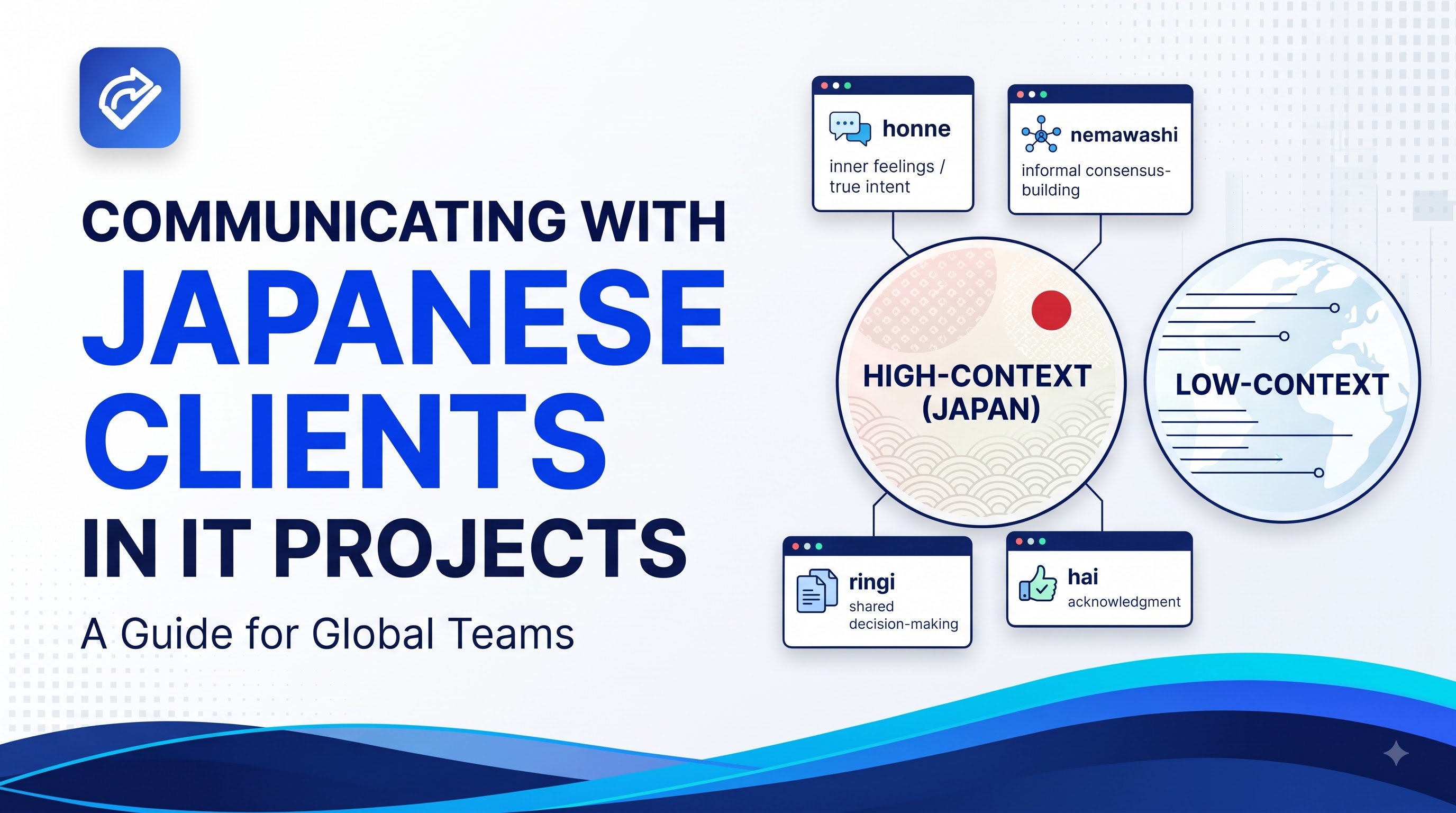
Japan sits at the extreme high-context end: most meaning is carried through context, relationships, shared history, and what is not said. Practical consequences in IT projects:
Situation | What the Japanese client says/does | Actual meaning |
|---|---|---|
You present a design proposal | "We will consider this further" | May not be acceptable — needs internal discussion |
You propose a deadline | Silence, slight nod | Not agreed — uncomfortable but reluctant to say so directly |
They send a change request | "If it's not too difficult, could you please look into this?" | This is a requirement, not a suggestion |
Feedback on a deliverable | "It's good, but there are a few minor points..." | "Minor points" may be significant issues requiring resolution |
This doesn't mean Japanese communication culture is harder — the rules are simply different. In an outsourcing context, the PM's job is to learn the rules of the field, not demand that the partner change how they communicate.
5 Cultural Characteristics That Shape Japanese Client Communication
Each of these concepts surfaces in day-to-day project interactions. Learning them won't make you "act Japanese" — they'll help you read the right signals and respond appropriately.
1. Honne and Tatemae — Honne is genuine feelings and opinions; tatemae is what is expressed publicly to maintain harmony. In meetings, Japanese clients typically display tatemae. Honne surfaces through informal channels, post-meeting emails, or through intermediaries. If you receive an email after a demo from someone who wasn't even in the room with "a few questions," that's usually honne being relayed.
2. Nemawashi — Before making a formal decision, Japanese organizations typically "water the roots" — informal consultation with all relevant parties to build consensus before the official decision meeting. This is why a meeting can feel inconclusive: the actual decision was made beforehand through nemawashi, and the meeting is the formal announcement. If you need a decision quickly, have informal conversations with one or two key people from their side first — that's PM-initiated nemawashi.
3. The Ringi system — Approvals in Japanese organizations typically flow upward through multiple layers before the final decision-maker signs off. This explains why a simple change request can take 1–2 weeks to get formally approved. When submitting a proposal or change request, give them enough lead time and provide sufficient documentation for the ringi process to move smoothly from the first recipient up to the decision-maker.
4. "Hai" doesn't always mean "Yes" — In Japanese, "hai" (はい) literally means "yes, I'm listening" — not "I agree." In business contexts, it's often used to signal active attention to the conversation. PMs can distinguish intent by ending each topic with a specific question: "Do you agree with approach A or would you prefer approach B?" rather than "Is that okay?"
5. Silence = discomfort, not agreement — When Japanese clients go quiet after a proposal, the natural instinct for many Western or Vietnamese PMs is to fill the gap with more explanation. This is usually counterproductive: silence typically signals they need time to think, or they're uncomfortable but aren't sure how to push back directly. Learning to sit comfortably with silence is one of the most valuable skills in Japanese client relationships.
4 Practical Skills for Working With Japanese Clients Offshore
Understanding culture is necessary; changing daily work habits is sufficient. These four skills can be applied starting from your next sprint.
Write instead of speak. For every important exchange — design decisions, change requests, timeline shifts — the Japanese side needs documentation. Not because they don't trust you, but because their ringi process requires written materials to move through each approval layer. A post-meeting email summary isn't administrative overhead — it's a working tool. See how to write effective confirmation emails in our requirements confirmation guide.
Leave space — don't fill silence. After presenting a point, stop and wait. If they go quiet for 5–10 seconds, resist the urge to add more. Instead, ask an open question: "What do you think about this approach?" then wait. The silence you allow usually produces more honest feedback than any amount of additional selling.
Avoid direct "No" — propose alternatives. When a Japanese client requests something unfeasible, instead of "We can't do that," try: "That approach would require three additional weeks, but we could achieve the same goal with approach Y — which would you prefer?" This isn't avoiding the truth — it's framing the problem in a way that lets both sides reach a practical outcome while preserving face.
Pre-meeting nemawashi: send materials 2–3 days in advance. Send the agenda, proposal, or key content at least 2–3 days before the meeting. This isn't just politeness — it's what enables their internal nemawashi before the official session. If you present a proposal cold in a meeting, they won't be able to decide on the spot even if they want to — their process doesn't allow it. But if they've had time to circulate the materials and build internal consensus, the formal meeting can produce a decision immediately.
How to write reports and emails for Japanese clients
Japanese clients prefer concise, well-structured reports with zero ambiguity. An effective status report for Japanese stakeholders typically follows a three-part structure:
Results: What was completed since the last report? Specific numbers.
Issues / Risks: What problems exist? What's the impact? What actions are underway?
Next steps: Specific plans for the upcoming period, with clear owners and deadlines.
Avoid vague phrases like "we're working on it," "it's almost done," or "should be fine." Japanese clients read these as signals of poor control. Replace with: "We will complete X by [date]. Current completion: 70%."
On email, two things matter most:
Clear, action-oriented subject lines. Instead of "Update on project" → "Sprint 8 Status Report — Action Required by Nov 20." Recipients in the ringi system use the subject to decide who to escalate to and with what urgency.
CC the right people. In Japanese organizations, who is CC'd carries meaning. Don't CC your counterpart's manager on routine messages; do CC them when escalation is needed or a higher-level decision is required. Ask early in the project: "Who should be on CC for status reports, and who for escalation?" — they'll appreciate this question.
Default approach | Better for Japanese clients |
|---|---|
"Hi, update on the project" | "[Project Alpha] Sprint 8 Status — 2 items for your review" |
"Question about requirements" | "[Action Required] Clarification needed on Login module spec by Nov 15" |
"We have a problem" | "[Risk Alert] Database migration delay — proposed mitigation plan attached" |
How Cultural Awareness Maps to PMI Stakeholder Management
Every practice described above sits squarely within what PMI® expects from project managers — these aren't standalone tips, they're structured into the PMBOK® Guide framework.
In your stakeholder register, go beyond names, titles, and influence levels. For cross-cultural projects, add: preferred communication format (formal report vs. informal chat), preferred frequency, decision-making process (individual vs. consensus-based), and language preferences. These fields aren't nice-to-have — they're inputs for building a communication plan that actually works.
In your communication plan, specify for Japanese clients: send agenda at least 2 days in advance, status reports in Results–Issues–Next Steps format, email summary after every decision meeting within 24 hours, and escalation path that follows their ringi structure.
In the PMP® exam, cross-cultural communication questions often appear as: "A stakeholder from a high-context culture disagrees with a decision but does not say so directly. What should the PM do first?" — PMI's preferred answer is typically to confirm understanding, use written confirmation, and create a safe environment for the stakeholder to surface concerns.
The People Domain is 42% of the PMP® 2026 exam. The ability to adapt your communication style to each stakeholder's culture and preferences is a core tested competency. Want to practice scenario questions on cross-cultural stakeholder management? Try CertFlow PRO free — no signup required.
3 Scenario Questions
Each scenario below mirrors real PMP® exam items. Read the full situation carefully before choosing an answer.
Question 1:
During a requirements review meeting with a Japanese client, all attendees nodded frequently and said "hai" throughout the session. The PM concluded the requirements were approved. Two weeks later, the client sent a formal email rejecting three key requirements. What should the PM have done differently?
A. Asked each attendee to sign an approval form at the end of the meeting
B. Sent a written summary email after the meeting, clearly listing agreed items and asking the client to confirm or correct within 48 hours
C. Requested a second meeting to verify approval before proceeding
D. Assumed verbal agreement was sufficient and documented it in the project log
Answer: B. With high-context culture clients, verbal confirmation in a meeting is insufficient — especially since "hai" typically signals listening rather than agreement. A written summary with an explicit confirmation request (and a stated response deadline) is the PMI-recommended approach to formalizing agreement. Option A creates in-the-moment pressure that conflicts with their internal consensus process. Option C adds delay without fixing the root issue. Option D is incorrect — no written confirmation means no agreement.
Question 2:
A Japanese Product Owner (PO) declines to participate in daily standups, saying they prefer to report to their manager first before sharing information with the team. The Scrum Master is concerned this violates Agile principles. What should the PM do?
A. Insist the PO attend standups as required by the Scrum framework
B. Escalate to the PO's manager to enforce participation
C. Work with the PO to find an adapted format — perhaps a brief written daily update — that respects their internal reporting structure while keeping the team informed
D. Remove the PO from the project and assign a local team member instead
Answer: C. Both PMI® and Agile frameworks emphasize that practices should be adapted to team and organizational context, not imposed rigidly. The standup's goal is transparency — if a written update achieves that goal while respecting the PO's internal reporting structure, that's pragmatic and sustainable. Options A and B create conflict and disrespect cultural norms — not PMI mindset. Option D is disproportionate escalation.
Question 3:
A Japanese client verbally declines a proposed scope change during a video call. The PM documents the rejection in meeting notes. Three months later, during a project audit, the client claims the change was "never formally rejected" and demands it be included in the final deliverable. What should the PM reference first?
A. The original project charter, which defines the initial scope
B. The meeting notes documenting the verbal rejection
C. A written confirmation email sent to the client after the call, summarizing the decision and asking for their acknowledgment
D. The change log showing the request was not approved
Answer: C. A written confirmation email with an explicit acknowledgment request is the strongest evidence because it: (1) was sent to the client, (2) requested a clear response, and (3) was not disputed at the time (silence within the stated deadline = tacit agreement). Meeting notes (B) and the change log (D) are internal documents, more easily disputed. The project charter (A) covers original scope, not post-baseline change decisions.
Summary
Working effectively with Japanese clients doesn't require changing who you are — just adding a few layers of awareness to your daily communication. Learning to read indirect signals, holding space for silence, and confirming agreements in writing are skills experienced offshore PMs develop over several projects. This guide gives you the framework to get there faster.
To go deeper on communication management per PMI, see our guides on project communication management and communication management planning in PMBOK 8. For the specific skill of confirming requirements after meetings — the single most important skill with Japanese clients — see our detailed guide here.
Ready to practice PMP® scenario questions on cross-cultural stakeholder management? Try CertFlow PRO free — no signup required.
Frequently Asked Questions
Does "hai" in Japanese always mean "yes"?
"Hai" (はい) means "yes, I hear you" — not necessarily "I agree." In business meetings, it signals active listening, not approval. To confirm actual agreement, always follow up with a written summary email and explicitly ask the client to confirm or correct within a stated timeframe. No correction received by the deadline becomes documented tacit agreement.
How long does the nemawashi process typically take?
Nemawashi duration varies by organization size and decision complexity. For routine decisions, 2–3 days is typical. For significant scope changes or budget approvals, 1–2 weeks is common. Build this buffer into your project timeline from the start, and send important proposals well in advance of when you need a decision.
How do I handle indirect negative feedback from Japanese clients?
When you receive soft signals — excessive hedging, requests to "review further," unusually long response times, or concerns raised through a third party — treat them as substantive objections. Follow up with a one-on-one email: "I want to make sure we're aligned. Are there any concerns about [specific aspect] that you'd like us to address?" This creates a safe channel for honne to surface without forcing a public disagreement.
References
Project Management Institute. (2026). PMP® Examination Content Outline – July 2026. PMI.
Project Management Institute. (2025). A Guide to the Project Management Body of Knowledge (PMBOK® Guide) – Eighth Edition. PMI.
Hall, E. T. (1976). Beyond Culture. Anchor Books. (See also: high-context and low-context cultures overview)
Meyer, E. (2014). The Culture Map: Breaking Through the Invisible Boundaries of Global Business. PublicAffairs.