PMs spend 90% of their time communicating — but without a structured plan, that time creates problems instead of progress. Here's how to fix that.
1. Why Communication Failures Kill Projects
A PM sends a weekly status report — 15 pages of technical detail, budget tables, and risk logs — to all 30 stakeholders, from the CEO to junior developers. The CEO never reads past page 1. The developers ignore it because it has nothing to do with them. Only 3 people read it all the way through. When the sponsor asks "Where does the project stand?" — nobody can answer briefly.
At the same time, a critical technical decision is made in a meeting attended by only 4 people. Three months later, a stakeholder who was left out discovers it and objects — causing a 6-week delay for rework.
Two problems, one cause: communication without a strategy. Too much information to the wrong people, too little information to those who need it.
PMBOK® 8, Section 2.5.1: "Communications management is a crucial concept for keeping stakeholders engaged. The way of communicating should be tailored based on the needs and best fit for the stakeholders, so they have all the information they need to make decisions."
2. Communication Channels Formula — The Numbers Tell a Story
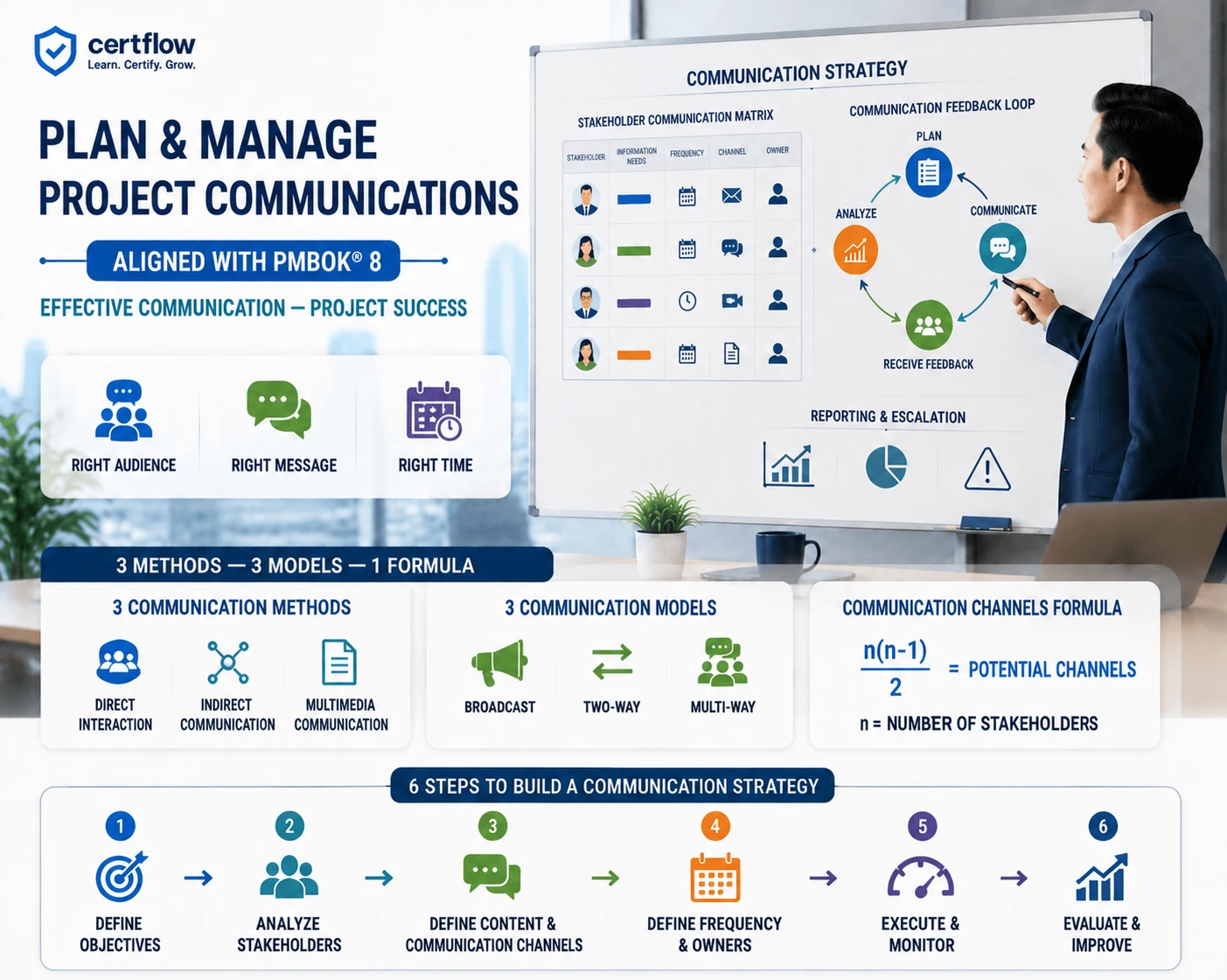
The formula for calculating potential communication channels: n(n-1)/2, where n = number of stakeholders.
Number of Stakeholders | Potential Channels | Implication |
|---|---|---|
5 | 10 | Small group — manageable informally |
10 | 45 | A communication plan is needed |
20 | 190 | A formal strategy is mandatory |
50 | 1,225 | No plan = chaos |
100 | 4,950 | Requires automated systems + governance |
These numbers explain why communication must be planned — if 20 stakeholders communicate with each other without structure, information will be distorted, duplicated, or lost across 190 uncontrolled channels.
💡 PMP Exam Tip: Exam questions often ask: "A new stakeholder joins. How many NEW channels are created?" Quick formula: adding 1 person to a group of n people creates n new channels. Example: going from 10 to 11 people adds 10 channels (from 45 to 55).
3. The 6-Enabler Communication Management Framework
Group | Enabler | Core Question |
|---|---|---|
Strategy | Define a communication strategy | Who needs what, when, and through which channel? |
Culture | Promote transparency and collaboration | Does information flow freely and transparently? |
Feedback | Establish a feedback loop | Do recipients have the opportunity to respond? |
Reporting | Understand reporting requirements | What level of detail does each stakeholder need? |
Deliverables | Create aligned reports | Do reports meet sponsor/stakeholder expectations? |
Governance | Support reporting and governance | Does communication serve decision-making? |
4. Enabler 1: Building a Communication Strategy
Communication Requirements Analysis
PMBOK 8: "An analytical technique used to determine the information needs of stakeholders through interviews, workshops, the study of lessons learned." The analysis must answer 5W1H for each communication event:
Question | Defines | Example |
|---|---|---|
Who | Who sends, who receives? | PM → Sponsor; Team → PM |
What | What information, at what level of detail? | High-level status vs. detailed tasks |
When | Frequency, deadlines? | Weekly, bi-weekly, on-demand |
Where | Which channel? | Email, meeting, portal, IM |
Why | Purpose? | Inform, decide, escalate, celebrate |
How | Which method? | Interactive, push, or pull |
Communications Management Plan
The primary output — PMBOK 8 lists its components: stakeholder communication requirements, information to be communicated (language, format, content, detail level), escalation processes, reason for distribution, time frame and frequency, person responsible, recipients, methods and technology, resources allocated, flow charts of information flow, constraints (regulatory, technology), and glossary.
PMBOK® 8, Tailoring: "Flat organizations tend to rely on open communications and informal channels, whereas hierarchical organizations use more formal approaches. The entire communication strategy should consider organizational culture."
5. Three Communication Methods and Three Communication Models
3 Communication Methods
Method | PMBOK 8 Description | Advantages | Best For |
|---|---|---|---|
Interactive | "Multidirectional exchange of information in real time: meetings, calls, IM, videoconferencing" | Ensures understanding, real-time Q&A | Complex decisions, conflict, workshops |
Push | "Sent directly to specific recipients: emails, memos, reports. Ensures distribution but not understanding." | Fast, easy to scale | Status updates, announcements, deliverables |
Pull | "Large, complex info sets requiring recipients to access at their discretion: portals, wikis, databases" | Self-service, no spam | Reference materials, large audiences |
3 Communication Models
PMBOK 8 describes 3 models from simplest to most complex:
1. Basic Sender/Receiver: Encode → Transmit → Decode. Focuses on delivery, does not guarantee understanding. Suitable for broadcast messages and notifications.
2. Interactive Model: Adds Acknowledge + Feedback/Response. The sender is responsible for: clarity, completeness, confirming interpretation. The receiver is responsible for: receiving entirely, interpreting correctly, and acknowledging/responding. PMBOK 8: "If the sender perceives that the feedback matches the original message, the communication has been successful. In communication among people, feedback can be achieved through active listening."
3. Cross-Cultural Model: PMBOK 8's most complex model — accounts for: current emotional state (both sender & receiver), culture (generational, national, professional discipline, gender), and personality biases (assumptions).
PMBOK® 8: "Cross-cultural communication presents challenges. Differences in communication styles can arise from differences in working methods, age, nationality, professional discipline, ethnicity, race, or gender. People from different cultures communicate using different languages and expect different processes and protocols."
6. Enablers 2–3: Transparency, Collaboration, and Feedback Loops
Promote Transparency and Collaboration
Transparency is the foundation of trust — and trust is the foundation of all effective communication. PMBOK 8 states that PMs should model:
- Transparency — "Being transparent in how one thinks, makes choices, and processes information helps others identify and share their own processes."
- Integrity — "Individuals demonstrate honesty by sharing risks, communicating assumptions, delivering bad news early, and ensuring status reports provide an accurate depiction."
Tools that promote transparency: Information Radiators — PMBOK 8: "A visible, physical display that provides information. Low tech and high touch." Kanban boards, burndown charts, and dashboards displayed where everyone can see them. Daily Coordination Meetings — PMBOK 8: "Brief, daily collaboration meeting. Primary goal: increase visibility, foster collaboration, ensure alignment." Maximum 15 minutes.
Establish a Feedback Loop
Feedback is what transforms communication from "inform" to "understand." Without feedback, the PM is only broadcasting — with no way to know whether the message was understood correctly.
Structured feedback mechanisms:
- Retrospectives — each sprint/phase: "what worked, what didn't, what to improve"
- Sprint Reviews — customer/stakeholder feedback on working increments
- Surveys & questionnaires — periodic stakeholder satisfaction measurement
- 1-on-1 conversations — informal but often more revealing than formal meetings
- 360-degree feedback — team ↔ PM ↔ stakeholders, multi-directional
⚠️ Important: PMBOK 8 lists "Feedback" as including "coaching, mentoring, and negotiating." Feedback has value only when it leads to ACTION. The PM must close the loop: receive feedback → analyze → act → communicate results back to the person who gave feedback. If the loop isn't closed, people will stop providing feedback.
7. Enablers 4–6: Reporting, Governance, and Stakeholder Alignment
Understand Reporting Requirements
PMBOK 8: "Project information should be adapted to provide information at an appropriate level, format, and detail for each type of stakeholder."
Audience | Needs | Format | Frequency |
|---|---|---|---|
C-suite / Sponsor | High-level: RAG status, key risks, decisions needed | 1-page dashboard, visual | Bi-weekly or monthly |
Middle management | Resource utilization, milestone progress, budget variance | 2-3 page summary | Weekly |
Project team | Task-level details, blockers, sprint goals | Backlog, boards, standups | Daily / sprint-level |
External clients | Deliverable status, timeline, quality metrics | Per SLA/contract format | Per agreement |
Regulators | Compliance evidence, audit trails | Formal documentation | Per regulation |
Create Aligned Reports
PMBOK 8 on Project Dashboards: "A set of charts and graphs showing progress or performance against important measures. Often include information displayed as RAG charts, bar charts, pie charts, and control charts." Sponsors want VISUAL — not 20 pages of text.
On Presentations: PMBOK 8: "Successful when content and delivery take into account expectations and needs of the audience." Includes: progress reports, background for decision-making, project profile raising, and specific information for support.
Support Governance Processes
Communication serves governance through: phase gate reviews (data for go/no-go decisions), change control board reports (impact analysis for change requests), steering committee updates (strategic alignment, escalations), audit & compliance reporting (evidence for internal/external audits), and portfolio/program reporting (rollup data for higher-level decisions).
PMBOK® 8, Governance Check: "Key management members are kept apprised of the project" — including operational status, resource requirements, known risks, strategic assumptions, benefits realized, decision tracking, change control, compliance, and information management.
Communication Skills — The PMBOK 8 Skill Set
Type | Skill | Details |
|---|---|---|
Oral | Active listening | "Acknowledging, clarifying, confirming understanding, addressing barriers" |
Oral | Presentations | "Progress reports, background for decision-making, project profile" |
Oral | Meeting facilitation | Guide group to decisions. Ensure participation, understanding, buy-in. |
Visual | Nonverbal communication | "Appropriate body language to transmit meaning" |
Electronic | Professional writing | New in PMBOK 8: "Crafting emails, texting, chatting, AI prompts" |
🌟 What's new in PMBOK 8 — AI in Communication: "Project managers can leverage AI-powered tools to efficiently collect, analyze, and interpret data, generating actionable insights." + AI can "determine the most effective communication channels and frequencies for each stakeholder." + AI prompting is now an official communication skill.
8. PMP Exam Tips for Communication Management
📍 Tip 1 — Channels formula: n(n-1)/2. Adding 1 person adds n channels. Exam questions often give the number of stakeholders and ask for total channels or new channels when a person is added.
📍 Tip 2 — Interactive > Push > Pull: When you need to ensure understanding (important decisions, conflict, requirements) — Interactive is the right answer. Push only ensures delivery, not understanding. Pull is for reference information.
📍 Tip 3 — Tailor, don't broadcast: When the exam describes "stakeholders at different levels receive the same report" or "sponsor says too much detail" — the answer is always "conduct communication requirements analysis and tailor." Never one-size-fits-all.
📍 Tip 4 — Feedback does not just mean receiving it: When the exam describes "client says looks good but seems disengaged" — the correct answer is to proactively seek genuine feedback, NOT accept "looks good" at face value. Absence of feedback does not equal confirmation of understanding.
9. Ten Situational Multiple-Choice Questions
Question 1
Your project has 20 stakeholders. The sponsor asks how many potential communication channels exist.
What is the correct answer, and why does it matter?
A. 20 channels — one per stakeholder.
B. 190 channels [20(20-1)/2]. This demonstrates why a structured communications management plan is essential.
C. 40 channels — each stakeholder sends and receives.
D. The exact number doesn't matter — focus on communicating effectively.
Question 2
Your team is distributed across New York, London, and Singapore. A critical design decision needs all three teams' input within 48 hours.
What communication method should you use?
A. Send a detailed email with options and ask teams to vote by reply.
B. Schedule a videoconference during the only overlapping time window for real-time interactive discussion.
C. Post options on the project wiki for teams to comment at their convenience.
D. Have each team lead decide for their team and consolidate responses.
Question 3
Your dashboard shows green RAG status. After the meeting, a committee member privately says: "Your dashboard is green, but I've heard from team members about serious quality issues. Are you hiding something?"
What does this reveal about your communication?
A. Team members shouldn't communicate directly with the committee — establish protocols.
B. Your reporting lacks transparency about known concerns. Revise to include a balanced view of achievements AND concerns.
C. The committee member is being political — defend your data.
D. Add a quality section to the dashboard.
Question 4
The sponsor complains: "I get too many Jira notifications, Slack messages, and emails. I just need to know if we're on track and if you need my help."
What should you do?
A. Remove the sponsor from all automated notifications.
B. Analyze the sponsor's needs, create a tailored approach — perhaps a concise weekly summary with key metrics and decisions needed, plus clear escalation criteria.
C. Schedule a weekly meeting for verbal updates.
D. Create a real-time dashboard for the sponsor.
Question 5
During a requirements review, the client's representative (English as second language) nodded and said "yes" to everything. Later, you discovered several key specifications were misunderstood, causing incorrect work.
What communication model explains this failure?
A. Basic Sender/Receiver failure — you transmitted but didn't confirm understanding. Switch to the Interactive model with active listening and feedback loops.
B. Cultural issue — hire an interpreter.
C. Documentation issue — provide specs in the client's native language.
D. The client's responsibility — they should have asked for clarification.
Question 6
You surveyed recipients of your monthly status report (15 stakeholders): 3 read thoroughly, 5 skim the executive summary, 4 never open it, 3 didn't know it existed.
What should you change?
A. Make the report shorter and more visual.
B. Stop sending to those who don't read it.
C. Segment your audience: detailed report for deep readers, visual summary for skimmers, and re-evaluate whether the other 7 need this information or a different format/channel entirely.
D. Switch to a real-time dashboard.
Question 7
A team member messages you at 11 PM: "Critical bug in production. Should we roll back?" Your escalation process requires sponsor notification within 1 hour for production issues. The bug affects 5% of users.
What is the BEST communication approach?
A. Notify the sponsor immediately via phone since it's a production issue.
B. Assess severity and impact first, then follow the established escalation process — notifying appropriate people at appropriate urgency through appropriate channels.
C. Roll back first, then notify the sponsor in the morning.
D. Send an email with details and await response.
Question 8
Your organization adopts an AI-powered reporting tool that auto-generates status reports from project data. The sponsor loves it. Team members worry about accuracy and lost context.
How should you handle this?
A. Adopt the tool since the sponsor wants it.
B. Reject the tool since team concerns about accuracy are valid.
C. Implement AI as a first draft for data aggregation, but establish a human review process where the PM adds context, validates accuracy, and tailors the narrative before distribution.
D. Run both manual and AI reports in parallel for 3 months.
Question 9
You inherited a project where the previous PM sent the same 3-page weekly email to ALL 30 stakeholders — detailed technical metrics, budget tables, risk logs, and schedule variance analysis.
What is the FIRST thing you should change?
A. Shorten to 1 page with key highlights.
B. Conduct a communication requirements analysis to understand what each stakeholder group needs, then redesign with tailored artifacts for different audiences.
C. Replace with a project portal for self-service access.
D. Keep the email but add an executive summary at the top.
Question 10
During a sprint review, the client says "looks good" and the meeting ends. You notice they were checking their phone frequently during the demo. No questions were asked.
What should you do about the feedback loop?
A. Accept "looks good" as positive feedback and move forward.
B. Nothing — if the client had concerns, they would have raised them.
C. Follow up privately with the client to ask specific questions about whether the increment meets expectations and whether the review format is working — because "looks good" without engagement is not meaningful feedback.
D. Make the next demo more detailed and engaging.
Answer Key
Question 1: Answer: B
— 20(19)/2 = 190 potential channels. Without a structured plan, information flow becomes chaotic. The formula justifies the investment in communication planning.
Question 2: Answer: B
— PMBOK 8: Interactive communication is most effective for complex, multidirectional exchanges. Critical decisions require real-time discussion, clarification, and consensus. Email (A) lacks context. Wiki (C) is passive. Fragmented decisions (D) miss cross-team alignment.
Question 3: Answer: B
— PMBOK 8 Be an Accountable Leader: "Integrity — willingness to share bad news early." A green dashboard hiding quality concerns is technically accurate but strategically dishonest. Controlling information flow (A) suppresses critical data. The PM must build trust through balanced, honest reporting.
Question 4: Answer: B
— PMBOK 8: communication "should be tailored based on needs and best fit." The sponsor stated their needs: "on track?" + "need my help?" Tailor accordingly. Removing all notifications (A) risks gaps. A dashboard (D) is pull — the sponsor wants pre-filtered push. A meeting (C) may work but adds calendar overhead.
Question 5: Answer: A
— PMBOK 8: Basic model "is concerned with ensuring the message is delivered rather than understood." The Interactive model adds Acknowledge + Feedback. The Cross-Cultural model adds emotional state and culture factors. Active listening = ask the client to paraphrase requirements back. While B and C may help, the model failure is the root cause.
Question 6: Answer: C
— PMBOK 8: "Information should be adapted to provide information at an appropriate level, format, and detail for each type of stakeholder." Different stakeholders need different things. A shorter report (A) helps some but not all. Stopping (B) may miss critical stakeholders. Dashboard (D) won't help passive information seekers.
Question 7: Answer: B
— PMBOK 8: communication planning includes "escalation processes" and "urgency of the need for information." The PM should assess FIRST (is 5% critical? what's the impact?), then follow the ESTABLISHED process. Knee-jerk notification (A) without assessment may cause panic. Morning (C) violates the SLA. Email (D) is push — inappropriate for urgent issues needing acknowledgment.
Question 8: Answer: C
— PMBOK 8 Tailoring: "The use of AI should be assessed. Proactive security and ethics measures should be considered." AI generates data efficiently but lacks context, nuance, and stakeholder awareness. Hybrid approach: AI for efficiency + human for quality. Both sides are right — the PM bridges them.
Question 9: Answer: B
— The fundamental problem isn't length or format — it's that one communication serves 30 different needs. PMBOK 8: "Communication requirements analysis determines the information needs of project stakeholders." The CEO doesn't need schedule variance; the developer doesn't need budget tables. Analyze needs FIRST, then design.
Question 10: Answer: C
— PMBOK 8: "If the sender perceives that the feedback matches the original message, communication has been successful." "Looks good" from a distracted stakeholder is NOT confirmation of understanding — it's absence of feedback. The PM must actively seek genuine feedback. Passive acceptance (A, B) risks building the wrong thing. More detail (D) may not address the real issue.
10. Conclusion
Communication is the circulatory system of a project — when it stops flowing, the project dies. Three key takeaways:
1. Tailor, don't broadcast — The CEO wants a 1-page dashboard. The developer wants task details. The regulator wants compliance evidence. A 15-page email sent to 30 people = 27 people who don't read it + 3 who are annoyed. PMBOK 8: each stakeholder needs "appropriate level, format, and detail." Communication Requirements Analysis is the mandatory first step.
2. The feedback loop must be closed — Communication is not broadcast → receive. It is broadcast → receive → understand → feedback → action → communicate results. When a PM receives feedback but doesn't act, trust erodes. When a client says "looks good" but isn't engaged, that's a red flag — not a green flag.
3. Transparency builds trust, trust enables communication — PM models the behaviors: share bad news early, be honest about risks, keep dashboards accurate. PMBOK 8: "Integrity — ensuring status reports provide an accurate depiction of progress." When stakeholders trust the PM, communication becomes much easier.
PMBOK® 8, Section 5: "Project management is more than just working with numbers, templates, charts, graphs, and computing systems. A common denominator in all projects is people. People can be counted, but they are not numbers." — Communication is how the PM connects with those people.
Frequently Asked Questions (FAQ)
What should a Communications Management Plan include?
The Communications Management Plan documents: stakeholder communication requirements (who needs what information), information to be communicated (type, format, detail level), frequency and timing, communication methods (meetings, reports, email, dashboard), sender and receiver responsibilities, escalation paths, and a glossary to prevent misunderstandings about terminology.
What is the formula for calculating communication channels, and why does it matter?
Formula: n(n-1)/2, where n = number of stakeholders. 5 people = 10 channels; 10 people = 45 channels; 20 people = 190 channels. This number explains why communication complexity grows exponentially on large projects, and why PMs need a formal communication plan rather than informal, ad hoc communication.
When do you use Push, Pull, and Interactive communication?
Push: send information to receivers without confirming receipt — email, newsletters, reports. Suitable for one-way updates. Pull: receivers proactively retrieve information — intranet, SharePoint, project dashboard. Suitable for non-urgent reference information. Interactive: two-way real-time communication — meetings, calls, video conferences. Suitable when immediate feedback or complex discussion is needed.
Now that you understand project communication planning, it's time to put it into practice with real exam questions.
Try Free PMP Practice Questions →
Official References: